
Ray of Hope #271: God of the Anawim
“Doing things in life not to please people; rather to please Christ, our Master!”
(Based on Amos 8:4-7, 1 Tim 2:1-8 and Lk 16:1-13 – 25th Sunday in Ordinary Time, Cycle C)
A new ticket collector had been appointed at a suburban railway station and commenced his duties during a severe spell of wintry weather.
As a Christian – being very conscientious and meticulous in the discharge of his duties – he insisted all the passengers to produce (display) their season tickets as they passed through the gate of the station.
His predecessor had got to know most of the regular passengers…
… and “allowed” them to pass without asking them to show their season tickets.
After a few days, as the new ticket collector continued to insist on all season tickets being shown…
… one of the travellers said to him one evening, ‘You’re not at all popular with the travelling public, Sir.’
Pointing to an image of the Sacred Heart of Jesus in his wallet, the ticket collector, with deep conviction, replied: “I don’t mind that!
It’s my God with whom I want to be popular…
… it’s only His approval that I desire in everything I do!”
Do I desire to seek the approval of God in everything that I do?
Do I do things in life to please Christ, my Master…
… or to please people and win their applause?
The Gospel of the Day is a sharp reminder on the need for us to take our spiritual life more seriously…
… have a greater zeal for spiritual matters than even those with worldly desires
…. Make a radical choice for the Lord and Him alone, as the treasure of our life!
Jesus speaks of the parable of the dishonest steward.
The steward, who was working under a rich man, has been reported for deceitful service (Lk 16:1)
He realized that his job would be terminated very shortly!
He needed to produce his accounts.
… it was a situation of tension for him!
But this steward was a wise and shrewd person!
He did not allow the tense situation to overpower him!
Instead, he became the master of the situation and became a controller of the entire crisis-situation…
His brain worked super-fast…
… his shrewdness gained momentum!
He called his master’s debtors, and his pen was set to work…
The debt of one hundred jars of olive oil, was manipulated to fifty…
The debt of hundred measures of wheat was reduced to eighty…
Well… all this sounds interesting…
… with this shrewd steward and his crafty style of management.
But what is the message in for us?
One important message that we can take home is that…
… the steward was ever alert and prepared to take any risks and chances, to ensure a good future!
He never went into a lethargic or casual mode!
The shrewd steward was ever-prepared to face the future!
What about us?
Are we prepared…
… in our spiritual life?
… to meet our God?
The shrewd steward never allowed the “attitude of lethargy” to conquer him.
He was pro-active.
He was courageous.
He was bold.
Here then, is the challenge for us…
If this is what the steward could do, to earn those things that are temporary…
… how much more should we be doing for those things that count for eternity?
If this is what the steward could do, to please his boss & for a secure future life…
… should we not be doing much more, to please God?
Prophet Amos reminds us that “true integrity means dealing honestly, not bending justice to gain favor with people…
… but standing firm before the God who sees all. (Cf. Amos 8:4-7)
Sometimes, it’s incredible to see the great efforts undertaken by people to gain expertise and mastery in the skills of the world…
Sportspersons practise for many hours to sharpen their skills
Singers and musicians put in many hours of practise to gain proficiency
Students preparing for competitive exams spend nights and days to crack the tests
Do we put that same kind of love, energy and creativity…
… into building up the Church
… into contributing to the Kingdom of God
… and into the things that are to serve God?
We can’t afford to get lethargic in matters related to God, to eternal life, to spirituality etc.
However, many of the times, we take things for granted…
Skipping prayer time or spiritual exercises… (We are tired!)
Failing to read sometime of Word of God… (We have so many other works!)
Missing the Sunday Holy Eucharist… (We get that as the only day to relax more!)
Failing to go for regular confessions… (We say that anyway God will understand me!)
Not caring much about our spiritual life… (We remark that God is after all, lenient and nice!)
St Paul tells us: There is one mediator between God and humankind, Christ Jesus, Himself human!” (1 Tim 2:5)
Our prayerful lives and pure hearts please Christ more…
… than human approval
… for He alone is our one Mediator and Master.
The Parable of the shrewd steward might have some negative shades
But it has a very relevant and challenging tone to shake us off from our “attitude of lethargy” to Life.
Let us do things in life not to please people and win their applause…
… rather to please Christ, our Master!
God Bless! Live Jesus!
📖 Discovering the beauty of the Catholic Church through the Catechism
MAN’S VOCATION LIFE IN THE SPIRIT – GOD’S SALVATION: LAW AND GRACE – The Fifth Commandment – Respect for human life
Organ Donation is not morally acceptable if the donor or his proxy has not given explicit consent.
Moreover, it is not morally admissible to bring about the disabling mutilation or death of a human being…… even in order to delay the death of other persons. (CCC # 2296)
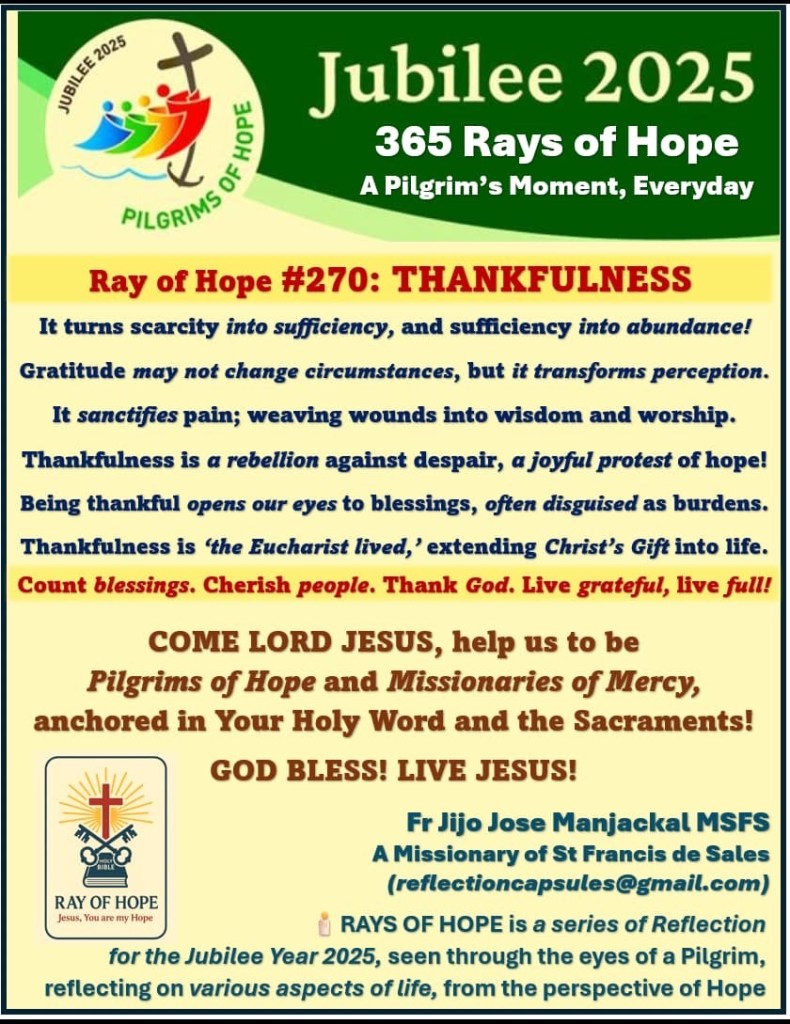
“Submitting ourselves to this mysterious Power and Strength of God’s Power, and be willing to ‘sow them’ generously”
(Based on 1 Tim 6:13-16 and Lk 8:4-15 Saturday of the 24th Week in Ordinary Time, Year 1)
A devout woman, once bought a Bible in her native language.
She was very much afraid of her husband who was deadly against God and sent forth atheistic vibrations.
In fear, she would read the Bible in his absence, and would stealthily hide it away from his presence and sight.
One day, however, by mistake, she failed to hide the Holy Book, and her husband saw it on the table.
Without saying anything, the husband opened the pages of the Bible, scanned through some and read a few lines.
As the wife stood, a little away – stunned and trembling- not knowing what he would tell her, the husband said, “Hmmm… This seems to be a good book!”
And it so happened, that every night, the man demanded for That Book when he returned back from office.
A few weeks later, the man suggested his wife that he wished to meet her parents, as for nearly 3 years, he had stayed away from them.
A tremendous and miraculous wonder had taken place.
A woman’s persistent faith had been rewarded!
A man’s heart had been finely melted!
A relationship had been restored!
That’s the power of the Word!
The Word can work in unexpected ways…
The Word can transform in unknown places…
The Word can bear fruits in unexplored areas…
Are we ready to sow the Word, everywhere, any time?
Are we open to allow the Word to work, anywhere, any time?
The Gospel of the Day is the classic presentation of the power of the Word through the Parable of the Sower and its explanation.
This is a parable that, probably we have read, reflected and meditated several times.
One of the striking messages of this Popular Parable is the “unknown, unexpected and unexplored” manner in which the Word is sown.
Going through the various places in which the Seed was sown would probably make one to say..
… “why was it that so much Seed was simply wasted – on the wayside, on the rock, among the thorns – places where there was hardly any possibility of growth?”
… “Why was it that the Sower was so unscientific, so lacking in common sense and so careless in simply broadcasting the precious seeds haphazardly?”
Probably, a logical answer and a reasonable explanation to these questions is to be found in the fact that the Seed has a tremendous power and potential.
And therefore, the Sower ‘takes the risk’ of broadcasting the Seed everywhere.
This then is the challenge that is thrown open to us also…
Can I be a person who is willing to “broadcast” the seed of God’s Word even in the most unfavourable or the most unexpected areas – to people who are hostile, arrogant or even closed?
Can I be a person who does not count the fruits in advance or get discouraged and disappointed at the possible failures in the future; instead boldly sow the Seeds of goodness, kindness and service?
The Book of Isaiah 55: 11 says, “… My Word that goes out from My Mouth: It will not return to Me empty, but will accomplish what I desire and achieve the purpose for which I sent it.”
We need to submit ourselves to this mysterious power and strength of God’s Power…
… and be willing to “sow them” generously…
… to all
… at all times!
Today is the Feast of Sts. Andrew Kim Taegon, Paul Chong Hasang and their companions…
… who gave their lives for Christ in Korea.
They show us that real strength lies in submitting to the mysterious power of God
… allowing ourselves to be sown like seeds
… so that the Gospel may bear fruit far beyond our own time.
Like these brave martyrs, let us be seeds in God’s hands…
… small, hidden, but destined to bear an eternal harvest.
When we submit to God’s power, our weakness becomes the soil of His victory!
God Bless! Live Jesus!
📖 Discovering the beauty of the Catholic Church through the Catechism
MAN’S VOCATION LIFE IN THE SPIRIT – GOD’S SALVATION: LAW AND GRACE – The Fifth Commandment – Respect for human life
Organ transplants are in conformity with the moral law…
… if the physical and psychological dangers and risks to the donor are proportionate to the good sought for the recipient.Organ donation after death is a noble and meritorious act and is to be encouraged as a expression of generous solidarity. (CCC # 2296)
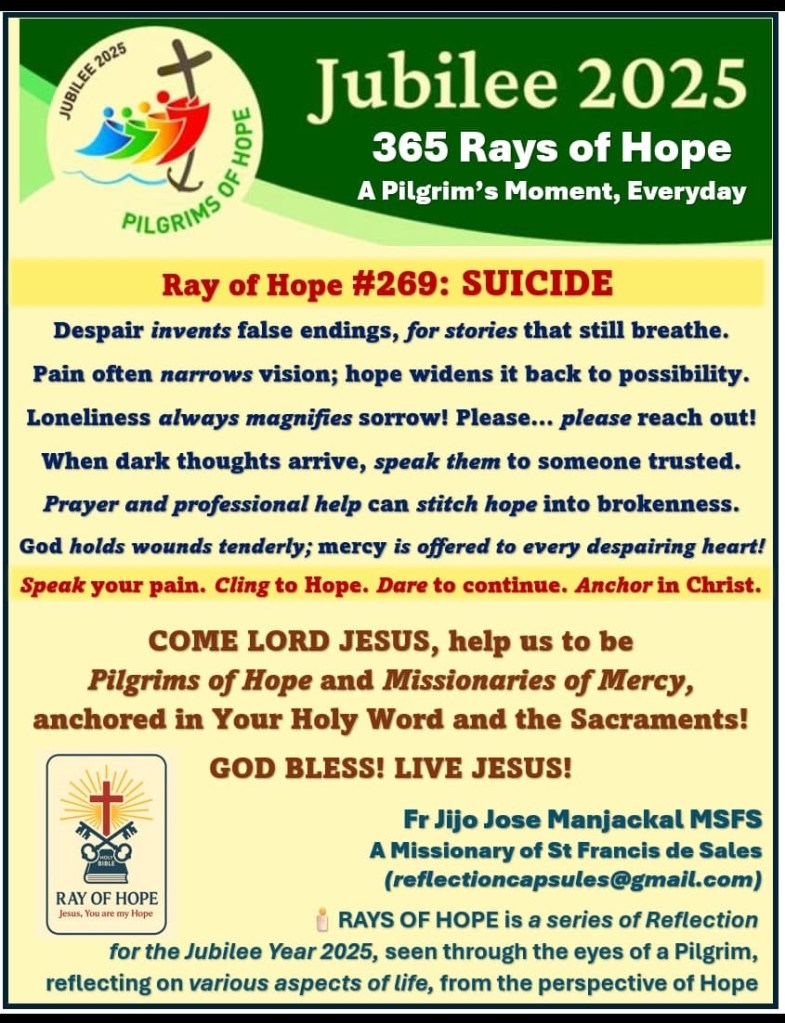
“‘Disentangling” ourselves from the habit of ‘blindly’ following others; instead, following Christ with deeper conviction!”
(Based on 1 Tim 6:2c-12 and Lk 8:1-3- Friday of the 24th Week in Ordinary Time, Year 1)
There is a particular type of a caterpillar called as “Pine Processional Caterpillars”.
These “Processional Caterpillars” walk in long lines – each one following closely the next in front.
A noted French naturalist named Jean Henri Fabre, once conducted an experiment on them.
He took a flowerpot and placed of a number of these “Processional Caterpillars” in a single-file around the circumference of the rim of a flower-pot.
Each caterpillar’s head touched the one in front of it.
He then placed the caterpillar’s favourite food in the middle of the pot.
He was surprised to observe that each of the caterpillar followed the one ahead, thinking it was heading for the food.
Round and round went these insects – for several days!
Finally, after many days of this absurd activity, the caterpillars started to drop dead – because of exhaustion and starvation!
All that they had to avoid the snare of death was to stop the senseless rounding around the pot…
…. and head, instead, directly to the food, that was placed less than six-inches away from them!
However, these “Processional Caterpillars” were trapped in a lifestyle which made them to only follow the one ahead..
… and were unable to “disentangle” themselves from the habit of ‘blindly’ following others!
Am I turning out to be a “Processional Christian?”
… claiming to follow Christ, just because others are doing the same or I have got into the “rut” of a system?
… aimlessly following Christ, without any conviction or sometimes even of an awareness of ‘why I am doing so?’
The Gospel of the Day presents to us a beautiful set of “Followers of Christ” who pursued Him in faith, in conviction and with a sense of clear purpose.
The Gospel of St Luke gives an interesting list of people (there would also have been probably others), who followed Jesus closely and were part of His Kingdom Ministry (Lk 8: 1-3).
Its edifying to learn some aspects from each of these sets of people…
They were people of opposing temperaments, differing characters, conflicting backgrounds and divergent personalities.
Yet, the “glue” of ‘belonging to Christ’ kept them together
Can I learn the aspect of..
… going beyond my personal differences and accidental characteristics, to forge together beautiful and faithful relationships, in my family, my workplaces, my communities etc, in order to follow Christ closer?
She had personally experienced the power of Christ’s healing.
This made her to keep her focus on the Lord, her God and to be intimately following Him for the rest of her life.
Can I learn the aspect of…
… recognising, cherishing and sustaining the many ‘miraculous and wonderful’ encounters of the Lord’s healing and care, that I experience on a daily basis, and thus to passionately follow the Lord?
She was the wife of Chuza, who was the steward of King Herod Antipas.
To follow Jesus involved a high level of risk for her, as there was a danger from King Herod, who was wicked and had expressed his displeasure by the murder of John the Baptist.
Can I learn the aspect of…
…. being daring and courageous in following the Lord, even at the risk of my life, the risk of being exposed to humiliation and the risk of bearing discouragements, persecutions and indifference from others?
There is not much information on their identity but they were part of a section of the society i.e. women… who were terribly maltreated and were given an unfair, unequal and unrecognizable positions in the Jewish religious hierarchy.
Can I learn the aspect of…
… being ready to break the mental barriers and the paralysing thought-patterns in the society which cripple one’s freedom, in order to become an authentic follower of the Lord?
These followers of Christ teach us vital lessons…
… of making radical transformations
… of valuing God’s wonderful workings in life
… of being courageously bold
… of overcoming challenges and barriers
… in order to Follow Christ – with conviction, with commitment and with certainty!
We cannot simply remain as “Processional Christians” – being trapped in a lifestyle which makes us to “claim to follow Christ”…
… and being unable to “disentangle” ourselves from the habit of ‘blindly’ following others!.
We instead need to become…
“Practical Christians” – who put into practice the preachings of Christ!
“Praiseworthy Christians” – who live our lives seeking to please the Lord in every act and deed!
“Precious Christians” – who live with a deep conviction of belonging to the Lord and making efforts to share His love to all!
God Bless! Live Jesus!
📖 Discovering the beauty of the Catholic Church through the Catechism
MAN’S VOCATION LIFE IN THE SPIRIT – GOD’S SALVATION: LAW AND GRACE – The Fifth Commandment – Respect for human life
Experimentation on human beings is not morally legitimate
… if it exposes the subject’s life or physical and psychological integrity to disproportionate or avoidable risks.
Experimentation on human beings does not conform to the dignity of the person
… if it takes place without the informed consent of the subject… or those who legitimately speak for him. (CCC # 2295)
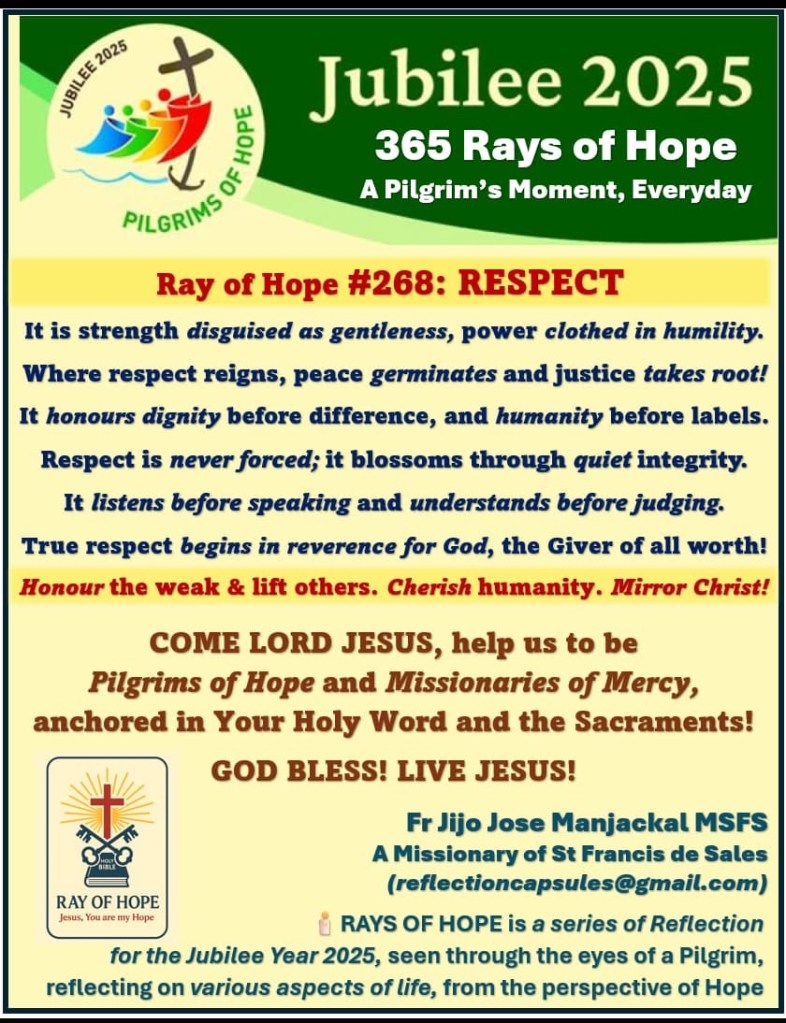
“Falling in love with the Lord and remaining faithful to the love-life in the Lord!”
(Based on 1 Tim 4:12-16 and Lk 7:36-50 – Thursday of the 24th Week in Ordinary Time, Year 1)
A catechism teacher, while distributing answer scripts of the Catechism Exam to her 3rd Standard (3rd Grade) students told them:
“I am so happy that most of you have done so well for these exams.
But remember, all these classes and exams are in preparation for the Bigger Examination.”
And she went on to explain:
“This Bigger Examination – the General Examination – is the Last Judgement Day!
And as St Robert Bellarmine tells us, ‘the School of Christ is the School of Love.
In the last day, when the general examination takes place…
… Love will be the whole syllabus!'”
Yes…
… All of us are called to grow in this understanding and practice of the “syllabus of Love!”
Have I “fallen in love” with the Lord and remain faithful to the love-life in the Lord?
The Gospel of the Day presents a wonderful expression of love towards Jesus and the subsequent acknowledgement of this gesture of love, by the Lord of Love!
The incident of sinner woman, washing the feet of Jesus in the house of Simon the Pharisee, ends with a statement, “Who is this, who even forgives sins?” (Lk 7: 49)
The answer of this statement is probably what is expressed by the woman in her gesture of love.
Jesus was a guest in the house of Simon, the Pharisee.
It was probably one of those meals whereby a respected and wise host would invite several of the socially elite to dine with an important guest.
At this meal, they would recline along the table, laying down on their sides, to eat.
The meal would also involve a series of debates and discussions, over many crucial issues, centred around the special guest.
However, suddenly, out of nowhere, a lady enters in the scene.
It was one of those highly embarrassing and highly disgusting moments for the Host!
The lady was a known sinner…
… In the society, she had earned a notorious reputation
Her very presence was causing terrible insult.
Her ensuing action…
… wiping the feet with the ointment from the alabaster jar
… wiping them with her hairs
… kissing them with tenderness
… caused still further damage to the reputation and honour of the host and his Guest!
However, what followed later, was like adding salt to the wounds of the host…
Jesus publicly recognizes, acknowledges and appreciates the action of the sinful woman.
He says, in solemn tones of approval of the action of the woman, “… She has shown great love! The one to whom little is forgiven, loves little” (Lk 7: 48)
Jesus had openly and publicly acknowledged the tremendous and daring love of the woman for Him!
And in doing so, He had given an answer to the question that would be put forth later, “Who is this, who even forgives sins?”
Her actions of love gave an answer…
… that He was the One worthy of receiving the highest and deepest love – one that counts no humiliation or hardships!
… that He was the One deserving the sweetest and the most priceless affections of our hearts – one that is limitless!
… that He was the One meritorious of every expression of endearment and fondness – one that is passionate and pure!
What is my level of love for the Lord?
Am I courageous to express my love for Him in actions that trespass humiliations or shame or guilt?
Am I bold to show that I truly love Him by living a life in accordance with the virtues of the Gospel?
Am I credible enough to say that I really love Him by extending His care to all those who are in need?
As we go about doing all our works, let us not fail to prepare ourselves well for the bigger examination – the general examination – The Last Judgement Day!
And let’s remember that when this general examination takes place…
… Love will be the whole syllabus!
St Joseph Cupertino – the Saint of the Day (The patron saint of air travelers, pilots, astronauts…
… and those with learning disabilities and often called as the ‘flying saint’ due to his miraculous gift of levitation and visions), inspires us with his words:
“Clearly, what God wants above all is our will which we received as a free gift from God in creation and possess as though our own…
When a man trains himself to acts of virtue, it is with the help of grace from God from whom all good things come that he does this!”
God Bless! Live Jesus!
📖 Discovering the beauty of the Catholic Church through the Catechism
MAN’S VOCATION LIFE IN THE SPIRIT – GOD’S SALVATION: LAW AND GRACE – The Fifth Commandment – Respect for human life
Research or experimentation on the human being cannot legitimate acts that are in themselves contrary to the dignity of persons and to the moral law.
The subjects’ potential consent does not justify such acts. (CCC # 2295)
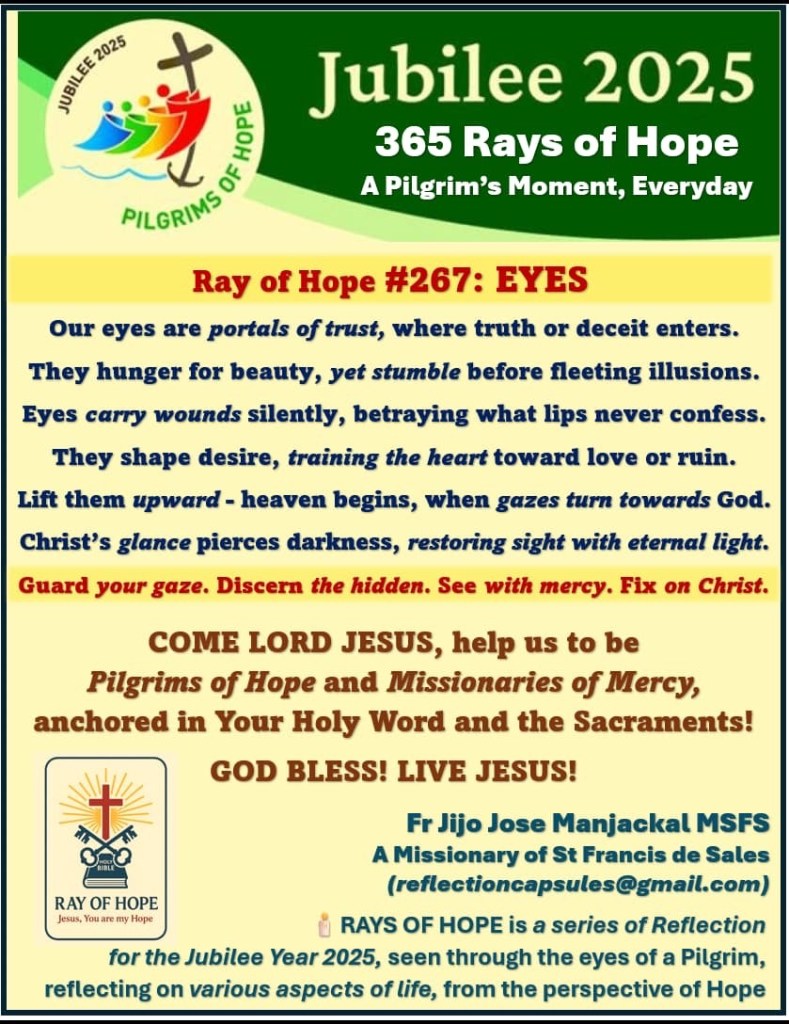
“Giving heed to the call of the Lord, and doing away with all hypocritical aspects of our life; instead, having expressions of faith, that are real and genuine!
(Based on 1 Tim 3:14-16 and Lk 7:31-35 – Wednesday of the 24th Week in Ordinary Time, Year 1)
After his victory over Mark Antony at the Battle of Actium, Augustus Caesar came back to Rome in triumph.
Among the huge crowd who greeted him, was a man (a bird seller) who had a bird that was taught to say, “Hail, Caesar, victorious!”
Augustus Caesar, the victorious king was greatly impressed that the bird was able to utter praises in honour of his victory…
… and bought the bird for a large sum.
Then someone got Caesar aside and whispered to him, that the man had another bird that was just as talented.
The man was summoned and Caesar asked for a demonstration of what the other bird could do.
The man selling the birds, however, objected and expressed reluctance…
… but Caesar insisted.
Finally the bird uttered: “Hail, Antony, victorious!”
(The second bird ended up uttering praises to the enemy who had been defeated by Augustus Caesar!)
The birds had been only trained to speak by rote!
Their expression was not something “that was really meant”…
Their expression was laden with tones of duplicity and lack of genuineness
The Gospel of the Day is a presentation on how people are also very often similar…
… failing to have expressions that are real and genuine!
… falling into the trap of duplicity and double-standardness!
The Gospel is an exposition on the attitudes of duplicity and being double-standard that can cram our Christian lives.
Jesus gives an illustration of how the attitudes of duplicity…
… and being double-standard can cram our Christian lives.
He speaks of “children sitting in the market place and calling to one another, ‘We piped to you and you did not dance; we wailed and you did not weep'” (Lk 7: 32)
Two persons who had committed themselves totally to the cause of the Kingdom are under the scanner today – John the Baptist and Jesus.
He did not drink wine, and he and his followers fasted regularly.
He baptized people in the Jordan River.
But John also preached repentance and gave a clarion call to turn away from one sins!
And this irked the people…
The elders of the Jewish community dreaded him because he recognized the corruption of the priests, and publicly called them to repent and be baptized.
They refused, because they wanted to keep their power, their wealth, their full stomachs and their fine clothing!
He shared in the table-fellowship of many people regularly.
He preached the Kingdom of God.
But Jesus also challenged people to let go off their sinful and corrupt lives and turn to God in penitence!
And this annoyed the leaders…
The Pharisees hated him because he preached with much authority and his new understanding of the law was highly challenging!
They rejected Him, because they wanted to stick to their traditions, empty hearts and their inhuman practices!
Jesus and John both would have hit high on the popularity charts if they had “played nice” or “would have allowed things to be little more easy!”
But both of Them did not budge…
This is what Jesus says, “We played the flute for you, you did not dance; We mourned to you, you did not weep.” (Lk 7:32)
Both of them refused to compromise on their convictions and principles of life
It was a tragedy of that generation…
… that two of the great leaders – John and Jesus – though came with apparent contrast – found themselves rejected!
… that these two great messengers of the Kingdom, met with a tragic end – one beheaded, the other crucified!
This shows an important philosophy that underlies many lives: an attitude of indifference to the truth and an attitude of rejection of those who challenge our lives!
This tragedy affects our generation too…
We often wrap ourselves often in the garment of hard-heartedness and arrogance…
… and fail to allow the message of the Truth to bring a transformation in our lives
We neatly hide ourselves in the dark shadows of indifference and apathy…
… and remain unconcerned with the workings of God’s Power and Grace in our hearts
But the Lord today renders a wake-up call to shake off the dusts of…
… apathy, hypocrisy and indifference from our lives!
Very often our faith is only a training to speak prayers and express articles of faith merely “by rote”
Very often, our religious expressions are laden with tones of duplicity and lack of genuineness
Let us give heed to the call of the Lord and do away with all hypocritical aspects of our life, and instead…
… have expressions that are real and genuine!
… and thus become an authentic follower of God and an ardent missionary of the Kingdom!
The words of St Robert Bellarmine, the Saint of the Day and Doctor of the Church, is an inspiration to all of us:
“Love is a marvellous and heavenly thing.
It never tires and it never thinks it has done enough!”
“The School of Christ is the School of Love.
In the last day, when the general examination takes place…
… Love will be the whole syllabus!'”
God Bless! Live Jesus!
📖 Discovering the beauty of the Catholic Church through the Catechism
MAN’S VOCATION LIFE IN THE SPIRIT – GOD’S SALVATION: LAW AND GRACE – The Fifth Commandment – Respect for human life
Science and technology by their very nature require unconditional respect for fundamental moral criteria.
They must be at the service of the human person, of his inalienable rights, of his true and integral good…… in conformity with the Plan and the Will of God. (CCC # 2294)

