Author: Fr Jijo Manjackal MSFS
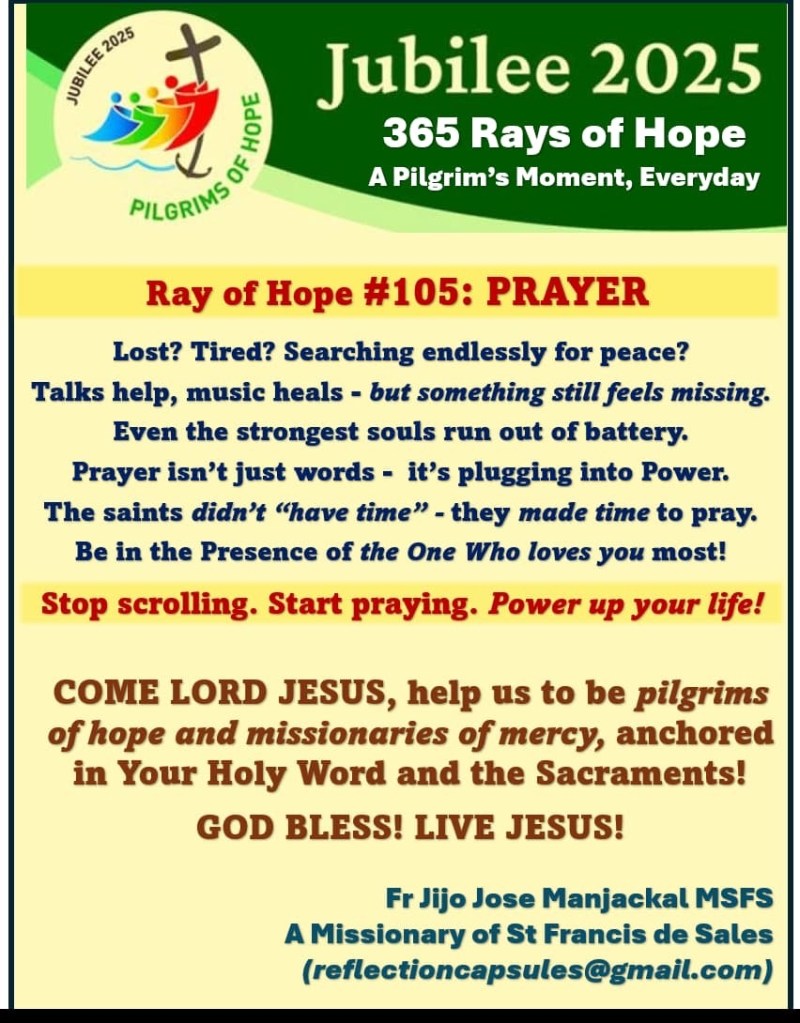
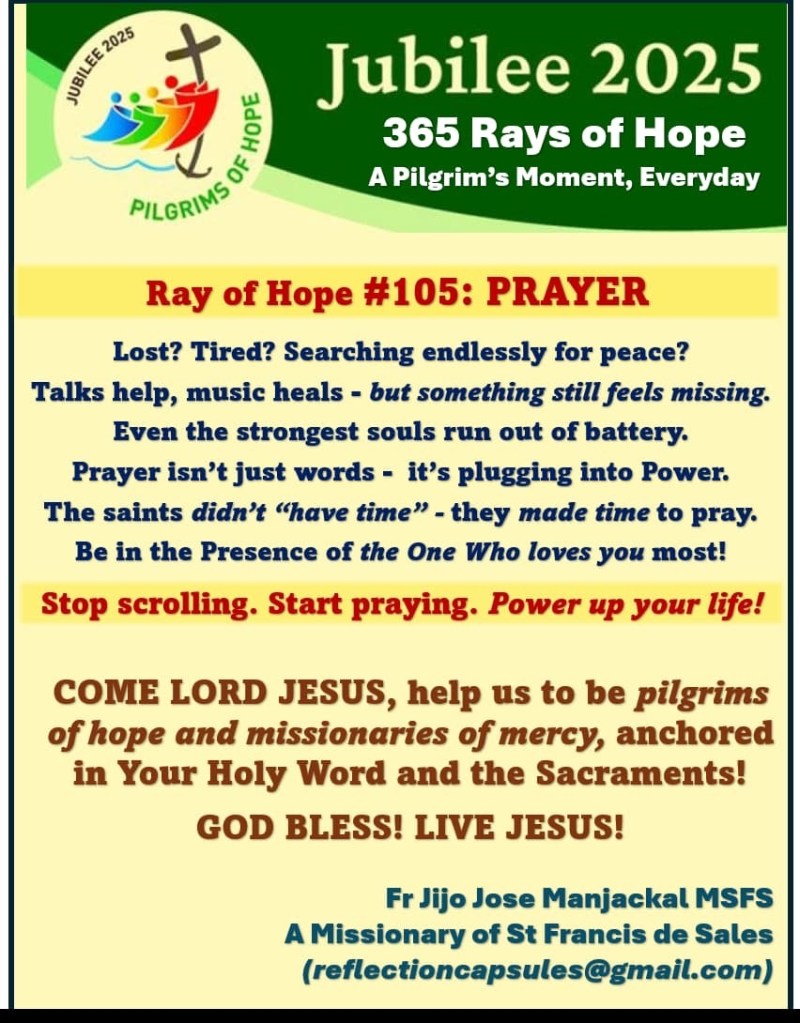
Rays of Hope #105 Prayer
✝️ REFLECTION CAPSULE – April 09, 2025: Wednesday
“Being faithful to the Lord, even when we know it is God’s Will that we should experience momentary suffering and struggle!”
(Based on Dan 3:14-20, 91-92, 95 and Jn 8:31-42 – Wednesday of the 5th Week of Lent)
Valiant stories of courage and faith are always an inspiration!
One such beautiful incident is narrated in the 3rd Chapter of the Book of Daniel
This chapter describes how the Jews were forced to bow down before a golden image of King Nebuchadnezzar.
Three young men – Shadrach, Meshach, and Abednego – refused to do so, and held on to their faithfulness to God Yahweh.
This act of defiance infuriated the king and he warned them of severe consequences if they failed to do what he commanded.
At this, the three young, displaying immense courage and faith in the Lord responded:
“O Nebuchadnezzar, we have no need to answer you in this matter.
If it be so, our God whom we serve is able to deliver us from the burning fiery furnace; and He will deliver us out of your hand, O king.
But if not, be it known to you, O king…
… that we will not serve your gods or worship the golden image which you have set up!” (Dan 3:16-17)
The three young men were convinced of the mighty delivering Hand of the Lord…
But not only that; they also boldly offered themselves to the Will of God and declared…
… “even if it is the Will of God, that we should momentarily suffer in this fire, we will still be faithful to God!”
That’s Faith!
That’s Trust!
Holding on to the Lord, not only because you wish that God will answer your prayer, in the way you want, and in the time you want…
… but being faithful to the Lord, even when you know it is God’s Will that is permitting you, to experience momentary suffering and struggle!
Being convinced of the Truth and Beauty of God’s Will…
… they were willing to make every sacrifice – and go against every stubborn temptation!
Are we ready to open our eyes to this Truth of knowing and accepting God’s Will in our life?
Or do we remain stubborn and defiant in the ‘temptation to think and do as per our own wishes…
… and fail to experience the Divine Power of the Lord?
The Gospel of the Day is a continuation of the Jews getting into arguments with Jesus on the question of His Divinity.
The Lord invites the people to open their eyes to see and experience the Truth…
… but they closed their minds, and chose to remain stubborn, in their own understanding
The Lord exposed the futility of being ignorant and explained the advantage of knowing the Truth…
… but they wilfully chose to remain stuck in their past knowledge and be unwilling to open their hearts to possibilities of change.
Jesus, the Truth-Incarnate, declares: “You will know the Truth and the Truth will set you free” (Jn 8: 31)
But the people retorted and answered: “… we have never been enslaved…” (Jn 8: 33)
They considered slavery from only a physical perspective!
They were, in fact, extremely offended when Jesus considered them to be slaves!
But Jesus brings the focus into right perspective (as he does always!), and speaks of a deadlier form of slavery and a higher form of freedom…
Slavery to Sin…
… that causes one to be away from God and His people
Slavery to ignorance and error…
… that causes one to be closed to God’s Word and prevent His transformation to take place within
He invites to receive Freedom in Him…
… that enjoins with knowing and doing the Father’s Will
… that liberates one from the bondages of death, and leads into peace and joy!
The danger to remain stagnant in sinful or ignorant ways constantly lurks in our life:
The Truth of the Bible is often presented to us in appealing and interesting formats…
… but we often seek to remain ignorant or don’t show any interest to read and understand God’s Word
The beauty of the Sacramental Life and the Teachings of the Church is laid before our eyes…
… but we time and again, tend to be lethargic, casual and sometimes even, hostile to them
Our eyes often come into contact with the suffering lot of people, in and around us…
… but many times, we turn a blind eye to them and remain indifferent in our cosy lifestyle
Each of us needs purification…
… a purification from our stubborn ways to a life of obedience and docility to God’s Word
Yes, Jesus is constantly extending His Nail-Scarred Hands, inviting us to a life of holiness and sanctity.
Let us make a self-examination of our state of life…
… realize the need to have a purification and a movement…
… and embrace and live with Jesus, the Truth, “Who sets us free!”
Today, let us make a firm commitment – like Shadrach, Meshach, and Abednego, the three young men in the Book of Daniel – whose life was a valiant story of courage and faith
And hold on to the Lord, not only because we wish that God will answer our prayer, in the way we want and in the time we want…
… but being faithful to the Lord, even when we know it is God’s Will that is permitting us to experience momentary suffering and struggle!
God Bless! Live Jesus!
📖 Discovering the beauty of the Catholic through the Catechism
MAN’S VOCATION LIFE IN THE SPIRIT – GOD’S SALVATION: LAW AND GRACE – The Ten Commandments – The Fourth Commandment – The Family in God’s Plan
The relationships within the family bring an affinity of feelings, affections and interests, arising above all from the members’ respect for one another.
The family is a privileged community called to achieve a “sharing of thought and common deliberation by the spouses…… as well as their eager cooperation as parents in the children’s upbringing. (CCC # 2206)
✝️ REFLECTION CAPSULE – April 08, 2025: Tuesday
“Being wary of the menaces to be adamantly self-righteous and being proud with our own knowledge!”
(Based on Num 21:4-9 and Jn 8:21-30 – Tuesday of the 5th Week of Lent)
Suicide is the act of intentionally causing one’s own death.
Though it has many and wide range of reasons and factors, the cause is frequently attributed to mental disorders…
… such as depression, bipolar disorder, schizophrenia, borderline personality disorder, alcoholism, or drug abuse.
Stress factors such as financial difficulties or troubles with interpersonal relationships also often play a key role.
In this fast-paced world, where indifference has grown in a humongous manner, suicide is certainly one great tendency and trend.
This suicide is, mainly, of the physical order.
How many of us have, however, thought of the threat of suicide occurring, even with respect to our spiritual life?
How many of us, have considered, that there is a danger of suicide happening, even with respect to our life of faith?
The Gospel of the Day is a warning to be aware of the danger of “suicide” from a spiritual angle that can occur in the soul of each person.
Jesus continues His revelation to the people, of He, being the ambassador of God, His Father.
He tells the people that “I am going away and you will look for me, but you will die in your sin” (Jn 8: 21)
The Lord refers to “dying in one’s sin”
This aspect of “dying in one’s sin”, which would be equivalent to a person committing suicide in the spiritual sense, could consist of various ways:
- A person dangers oneself to “suicide” in the spiritual sense, when one is too self-righteous – an attitude of “I know everything – even more than God!”
When Jesus told that He is going away, the Jews said, “He is not going to kill Himself, is He, because He said, “Where I am going, you cannot come?” (Jn 8:22)
The Jews failed to understand the words of the Lord, because they were filled with pride of their knowledge, and considered themselves to know everything.
They were filled with a certain obstinacy in being open to the words of the Lord…
… and failed to see that there could be also other possibilities of looking at the words of Jesus.
- A person risks the danger of “suicide” with respect to one’s faith, when one fails to set one’s eyes heavenward, and instead gets fixated with earthly things.
Jesus said to the Jews, ”You belong to what is below. I belong to what is above. You belong to this world, but I do not belong to this world” (Jn 8: 23)
The Jews had their thoughts and deeds centred only on the things of this world and failed to transcend their minds heavenward.
They were filled with a certain worldliness that made their concerns to be limited.
They were unable to understand the heavenly realities that the Lord presented before them, and even shut their eyes to make an attempt to understand them
- A person exposes oneself to the perils of “suicide” from the spiritual point of view, when one is wilfully ignorant of the Truth.
Though Jesus had spoken much, performed much, the Jews still ask Him,” Who are you?” Jesus then said to them, “What I told you from the beginning” (Jn 8: 25)
The Jews had great many opportunities to discover faith in the Lord, as He had exposed them to many great wonders, taught several teachings and performed many deeds to show His divinity.
Though, they were learned in their scripture and laws, they failed to recognise the Source of the Scripture and the Giver of the Law.
Their minds were adamantly closed to the Reality.
Their hearts were purposely shut to the Truth.
The Lord moaned that these Jews were risking the danger of “committing suicide” spiritually…
… of “dying in one’s sins”.
This warning is addressed to us also….
Am I exposing myself to the risk of “losing my life, in sin?”
Am I endangering myself to the peril of “forfeiting my soul, in sin?”
Let us be wary of these menaces…
… to be adamantly self-righteous and being proud with our own knowledge and failing to trust in the mighty wisdom and power of the Lord.
… to be engrossed only in the affairs of this world and failing to raise our hearts to “seek first the Kingdom of God and His righteousness”.
God Bless! Live Jesus!
📖 Discovering the beauty of the Catholic through the Catechism
MAN’S VOCATION LIFE IN THE SPIRIT – GOD’S SALVATION: LAW AND GRACE – The Ten Commandments – The Fourth Commandment – The Family in God’s Plan
Daily prayer and the reading of the Word of God strengthen it in charity.
The Christian family has an evangelizing and missionary task. (CCC # 2205)
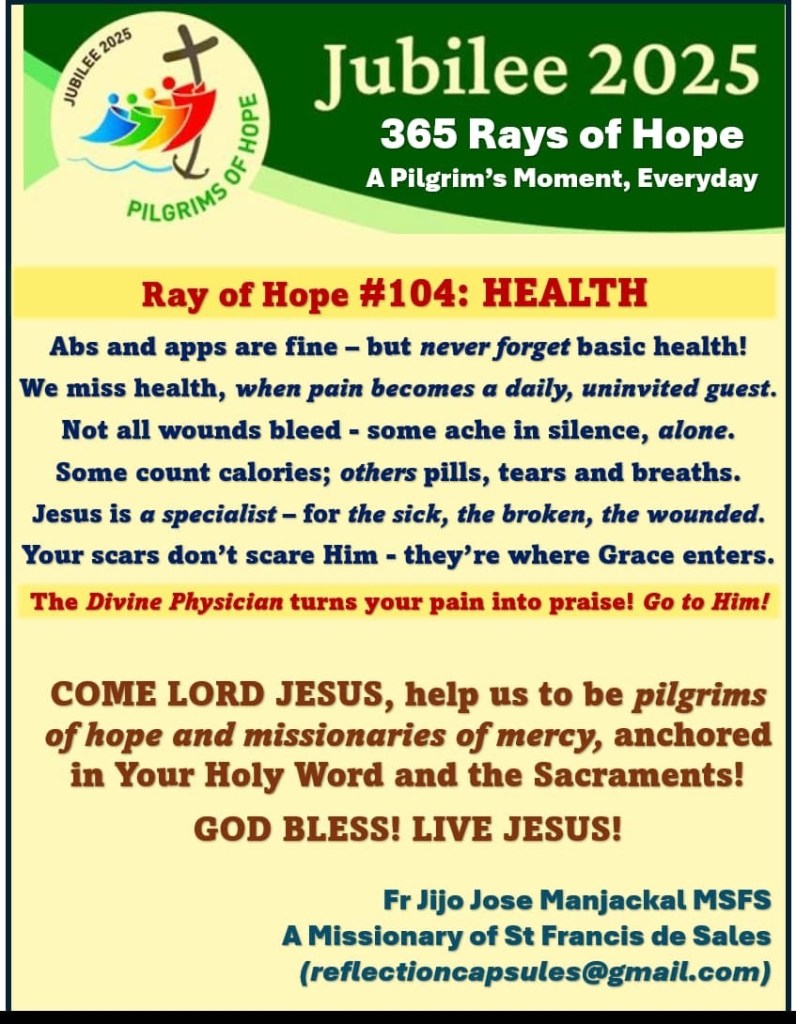
Rays of Hope #104 Health

Rays of Hope #103 Felix Culpa

✝️ REFLECTION CAPSULE – April 07, 2025: Monday
“’Making a choice’ to allow the Lord to reveal ‘the light of His love and grace’ in our hearts!”
(Based on Dan 13:1-9, 15-17, 19-30, 33-62 and Jn 8:12-20 – Monday of the 5th Week of Lent)
During the height of apartheid in South Africa…
… Archbishop Desmond Tutu emerged as a voice of reason and justice in a time of intense division.
In the midst of a society where hatred and fear divided people by race, Archbishop Tutu – making a conscious choice for goodness – became a beacon of reconciliation.
His unwavering commitment to nonviolent resistance and truth-seeking helped bring the nation toward healing and reconciliation.
In one of his famous quotes, the courageous Archbishop said:
“If you are neutral in situations of injustice, you have chosen the side of the oppressor.
Do your little bit of good where you are
… it’s those little bits of good put together that overwhelm the world.”
To behold the Divine and be an ambassador of goodness…
… one must first choose to open the eyes of the heart
… for only then can we truly see the light that guides us.”
However, if one decides to remain closed to the light of Divinity…
… then one continues to remain in the darkness of life!
The Gospel of the Day is the account of Jesus presenting Himself as the Light of the World…
… and his debate with the Pharisees, who chose to remain in the darkness of error and ignorance.
Jesus is at the Feast of the Tabernacles (Jn 7: 10)
It’s a festival of going up to Jerusalem and join in the festivities with many of the other farmers and vineyard-keepers…
… being grateful and expressing one’s thankfulness to God Yahweh, Who has blessed with a good harvest.
In the evening of the Feast day, everyone gets together in the Court of the Women at the Temple to dance and praise God for His goodness.
There is an elaborate ceremony involving the pouring out of the water from great pitchers, and then the lamps are lit.
Four huge oil lamps are positioned around the courtyard, and the priests’ assistants pour enormous quantities of oil into the bases of them.
Massive wicks are created from the worn-out clothing of the priests and stuffed into the necks.
Darkness falls quickly with very little twilight between the intense sunlight and the rising of the moon, which follows very rapidly at this time of year.
Suddenly the lamps are lit, and the whole courtyard is bathed in their light.
A cheer goes up from the revellers and from around the city, as the light can be seen from every part of Jerusalem.
Using the contrast between…
… the glowing exuberance of the brightly lit courtyard
… and the growing darkness in the atmosphere
Jesus makes a loud and bold proclamation: “I am the light of the world. He who follows me will not walk in darkness, but will have the light of life.” (Jn 8:12)
But the Pharisees objected and spoke in retort: “You are bearing witness to yourself; your testimony is not true.” (Jn 8:13)
There was a contrast-play, on here
The Temple was lit brightly… Jesus declared Himself as the Light of the World
The evening had set, and the surroundings were growing darker
… The Pharisees, by rejecting the person of Jesus, chose to remain in darkness!
Jesus was continually giving witness to the fact that He was the “light of the world.”
He brought the light…
… of healing – to those sick and in distress
… of salvation – to those in sin and guilt
… of power and grace – by His words and teachings
But the Pharisees and many of the “creamy class” of the Jewish society, chose to dwell in “darkness.”
They remained in the darkness…
… of ignorance – by not being open to the teachings and works of Jesus
… of death – by continuing a life of sin and error and refusing the offer of grace from Jesus.
Susanna in the Old Testament allowed the “light of God’s Grace and Mercy” to shine forth in her life, through Daniel. (Dan 13:41-62)
When we remain open, truthful and faithful, God shines in our life!
Jesus wishes to be the “light of our life!”
Do we open our hearts to allow His light to shine through us?
… or do we get stagnant in darkness, and choose to reject His teaching in our life…?
Do we seek the Lord in honesty, to cause His light to shine in our minds?
… or do we remain indifferent in darkness and get stuck to our proud mentality and
lifestyle…?
One of the most tragic statements in the Bible reads thus:
“He came to His own, and His own people received Him not” (Jn 1:11)
The Lord comes to us today…
… proclaiming Himself as the “light of the world.”
Let us open our hearts, in repentance and contrition…
… and ‘make a choice’ to allow Him to reveal “the light” of His love and grace in our hearts!
God Bless! Live Jesus!
📖 Discovering the beauty of the Catholic through the Catechism
MAN’S VOCATION LIFE IN THE SPIRIT – GOD’S SALVATION: LAW AND GRACE – The Ten Commandments – The Fourth Commandment – The Family in God’s Plan
In the procreation and education of children it reflects the Father’s work of creation.
It is called to partake of the prayer and sacrifice of Christ. (CCC # 2205)
✝️ REFLECTION CAPSULE – April 06, 2025: Sunday
“Picking up the broken pieces of our life, filling the spaces in our emptiness and starting, all over again!”
(Based on Isa 43:16-21, Phil 3:8-14 and Jn 8:1-11 – 5th Sunday of Lent)
It was a quiet Sunday afternoon when a young boy – seven years of age – was playing in the backyard, pretending to be a knight.
In his hand, he held his mother’s old hand mirror…
… imagining it to be a shining sword.
But as he dashed across the garden path, his foot caught on a root.
He tripped.
The mirror slipped.
And shattered – face-first into the mud.
The boy stared at the broken pieces, horrified.
This wasn’t just any mirror – it was a cherished heirloom, passed down through generations.
One of the favourites of his mother.
Now it was cracked… dirt-stained… ruined!
Tears began to fall.
Slowly, he picked up the fragments and walked into the house, bracing for punishment.
His mother looked up… saw the mud, the cracked mirror, the guilt in his eyes.
She didn’t shout.
She didn’t scold.
Instead, she knelt beside him, gently took the pieces from his hands, wiped away the dirt…
… and with a soft smile said: “It’s still a mirror. Cracked, yes – but it still reflects light.”
“And so do you!”
Then she added, as she held him close,
“Sometimes, the best things in life are born through what’s been broken.”
Isn’t that what our faith is all about?
Our God, Who doesn’t discard the broken…
… but redeems it.
Yes… Grace doesn’t fear the cracks – it fills them!
Even when life shatters us into pieces, God doesn’t throw us away.
He stoops down…
… lifts us up
… and says: ‘Let’s begin again!’
The Gospel of the Day is a beautiful testimony of a person who…
… found herself at the lowest ebbs of her life
… when everything seemed all over
… in total tatters and brokenness
Yet…
… was able to pick up the broken pieces of her life
… fill the spaces in her emptiness
… and start it all over again
All by the Mercy of the Lord, Who intervened, and instilled a new hope in her.
The incident in focus is the ‘infamous’ occurrence of the woman who was “caught” in adultery.
There are many things to be pondered and reflected on, through this incident…
Think of the “mean” and “disgraceful” attitude of the people who “caught” this woman “in the act” (Jn 8:3)
… Were they fitted with “special probing and lusty” eyes, that devilishly gazed into “intimate exchanges,” that too on an early morning?
Think of the “self-appointed” role of these “moralists” who sought to restore the innocence of the land, without realising that, perhaps, their own eyes were filled with lust, their hearts drenched in obscenity and their lives soaked in vulgarity.
… How was it that their “clean” consciences and “true” intentions caught hold of only the woman, “caught in the act”, whereas, the man involved, was left, scot-free?
Think of the “deadly” trap that they were laying before the Lord, in seeking to find his opinion on the accused woman
… How neatly they had trapped the Lord in a “most vicious” dilemma:
If the Lord permitted death, it would be going against the Law of the land – of the Romans – since only the Romans were permitted to take the life of a person
If the Lord did not allow to stone, He would be going against the Law of the Lord, which had ordered the stoning of the convicted adulterer to death.
If the Lord permitted killing, He would be going against His own teaching of mercy, and His fundamental mission of “coming to seek and save the lost”
If the Lord forgave her, He would be going against the principle of Justice, and that would be infringing the rights and duties of a Just God.
It was a near-perfect scene, for the religious leaders to dreadfully trap the Lord.
The woman had been caught “in the act” of adultery…
Jesus was now to be trapped “in the act” of breaking the Law…
The woman had been shamefully paraded and stripped of all her dignity…
Jesus was now to be gloriously humiliated and disrobed of His glory and majesty…
But all these were “mere” human thinking and wile wishes…
The wisdom of God is much greater than all human craftiness and cunningness
In their wickedness, they failed to see, that they were testing the law with the Law-Giver Himself!
And so, the Benevolent Law-giver, bent down, and wrote with His finger… (Jn 8:6)
… just as He had, centuries back, written the Law on the tablet and given to Moses: “… tablets that were made by God, having inscriptions on them that were engraved by God Himself” (Ex 32:16)
He wrote, not a new law, but He wrote to make the law perfectly understood..
“Let the one who is without sin, be the first to throw a stone at her” (Jn 8:7)
This statement shattered all those accusers who heard it!
The accusers came armed with stones of certainty, hiding behind a cloak of righteousness.
But now, one by one, the stones fell…
… not in violence, but in shame!
In fact, those who came to cast the stone had themselves been stoned brutally…
… by the guilt of their sin!
Justice had triumphed!
Mercy had excelled!
Love had won!
All had left, save the one accused and the One who was Love and Compassion!
In fact, the Only One Who could actually throw a stone…
… as the Sinless and Guiltness One!
The one accused, stood in fear and trembling before the One Who recreates and renews!
And so she was given another chance…
…. to pick up the broken pieces of her life
… and to start anew!
In the book of Daniel, an innocent lady, Susanna would undergo a similar experience…
… of being condemned and doomed to death!
But the Wisdom of the Lord would shine through the young boy Daniel…
… and innocent life was saved!
Susanna trusted in the mighty Providence of God…
… and her hopes would not be disappointed; she would not be left in desolation.
Yes, in life, we may find ourselves crushed… broken… accused… abandoned… shamed!
But the Lord, still gives us a chance!
He is closest when we are most vulnerable.
Let’s always remember… God doesn’t discard the broken mirror of our lives
He restores it – because He knows it can still reflect His light!
In the stillness of life – beside the rivers of Mercy – God whispers to us:
“You are not your past.
You are not your shame.
You are mine.
Let’s begin again!”
Shall we….?
God Bless! Live Jesus!
📖 Discovering the beauty of the Catholic through the Catechism
MAN’S VOCATION LIFE IN THE SPIRIT – GOD’S SALVATION: LAW AND GRACE – The Ten Commandments – The Fourth Commandment – The Family in God’s Plan
The Christian family is a communion of persons…
… a sign and image of the communion of the Father and the Son in the Holy Spirit. (CCC # 2205)


 Reflection Capsules