✝️ REFLECTION CAPSULES – June 23, 2025: Monday

“Purifying our lives, rather than indulging in mud-slinging on others!”

(Based on Gen 12:1-9 and Mt 7:1-5 – Monday of the Twelfth Week in Ordinary Time, Year 1)

Blessed Mother Mary.
Zechariah and Elizabeth.
Bartimaeus.
Martha.
Mary Magdalene.
Levi.
Peter.
Thomas.
Zachaeus.
Man crippled for 38 years.
The Samaritan Woman.
The woman caught in adultery.
The widow who offered the two mites.
Malchus.
The thief alongside Jesus on the cross…

Relax…

This is not a reference list of all the main persons of the New Testament for some research purpose or study.

But for a moment, let’s look at the lives of these persons….

All of them had to face some sort of trouble in their lives…
… some hitches and dilemmas, were a part of all their lives.

Now, if each of them, were to be placed on trial, as in a court, and judged according to our standards and our human yardsticks….
… Perhaps, most of them would be been condemned and convicted.

Some of them would have been humiliated in public…
… some abused with insults and foul language
… some perhaps would be stoned or even put to death!

This is human judgment.

But in the Light of God’s mercy and by God’s way of judging…
… we know the story of all their lives!

Human beings are least equipped to judge, but their judgments are miserable & condemnable

God is fully equipped to judge, but His judgment is praiseworthy & encouraging!

That’s the difference in judgment between human beings and God!

In the Gospel of the Day, Jesus says, “Do not judge!” (Mt 7:1)

We need to clarify what does the word JUDGE mean…

Jury makes judgments.
Schools make judgments on students.
Companies make judgments on candidates in an interview or in cases of promotion/demotion.

All these may not constitute the judgment that Jesus means.

Judging, in the sense of Jesus, is condemning!

It is to have a negative and pessimistic attitude to human beings and condemning and rejecting them outright and absolutely!!

We could consider “Judge not” from three aspects:

  1. We are unworthy to pass a final judgment on any person or situation:

We need to let God be God and as human beings, we need to know our limitations.

  1. We are not to judge the motives of other people:

Human beings see only the external…
… God sees the heart of the person!

  1. We are not to be petty faultfinders:

We need to cease having a “microscopic vision,” in order to scan and scrutinize the faults and weaknesses of others.

In the light of today’s Gospel, we need to examine certain aspects of our life…

Do I…
… maximize the sins and faults of others and minimize mine?
… come to quick, hasty and negative conclusions?
… pass critical stories to other?
… have a strong bias to find others guilty?
… try to be harsh even when speaking the truth?
… dilute an unkind remark by saying, “I was only joking.”
… say something critical and then trying to cover it up?

Even after this examination, if there is a tendency to judge, then there is one person we can be critical of…
… Yes, Our Own Selves!

Yes, let us be judging our actions, our behaviours, our thoughts…
… and seek to purify our lives, rather than indulging in mud-slinging on others!

It’s high time we give up the “vulture-culture!”

Vultures, as we know, are birds, which fly across landscapes and terrains, and with their sharp eyes, swoop down on rotting, dead flesh…
… any flesh that is decayed, becomes a great feast for them!

The “vulture-culture” is very much in our society too…

We tend to relish on the decay, the weaknesses, the faults, the miseries and dark areas of others lives!

Am I, in anyway, contributing to this foul-practice?

Let’s examine!
Let’s improve!

God Bless! Live Jesus!


📖 Discovering the beauty of the Catholic Church through the Catechism
MAN’S VOCATION LIFE IN THE SPIRIT – GOD’S SALVATION: LAW AND GRACE – The Fourth Commandment – The Family and the society

Political authorities are obliged to respect the fundamental rights of the human person. >> They will dispense justice humanely by respecting the rights of everyone, especially of families and the disadvantaged. (CCC # 2237)
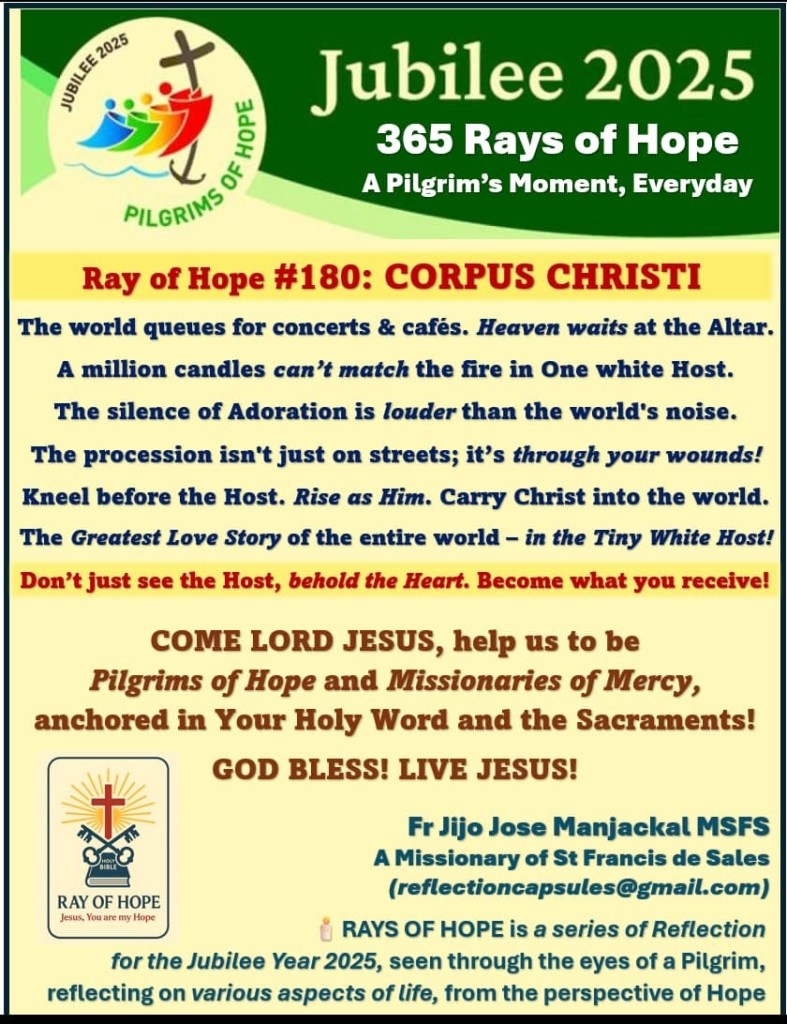
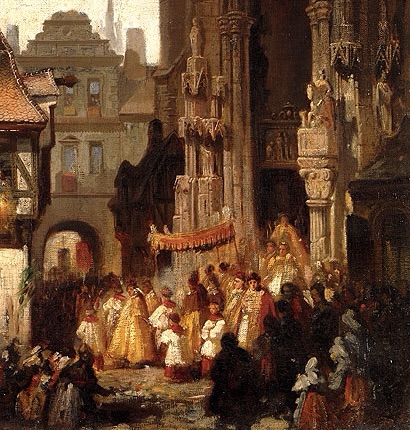
✝️ REFLECTION CAPSULES – June 22, 2025: Sunday

“Cultivating a passionate love for the Eucharistic Lord and choosing to live for Christ!”

(Based on the Solemnity of the Most Holy Body and Blood of Christ – Corpus Christi)

“I would like to say the Mass!”

These were the passionate words of Archbishop Dominic Tang, the archbishop of Canton who was imprisoned in China for 22 years…
… for his faith and loyalty to the Church and papacy.

Of these 22 years, seven years were in solitary confinement

This solitary confinement cell was not large enough to stand up nor to lie down and stretch your legs fully.

One day, Archbishop Tang was surprised with the news that he could leave his solitary confinement cell for a few hours to do whatever he wanted.

His persecutors wondered what he would ask for…
… but without any hesitation, Archbishop Tang, expressed his deep longing that had been suppressed for 22 years: “I would like
to say Mass!”

On this Solemnity of the Body and Blood of Jesus, we are exhorted to cultivate a passionate love for the Eucharistic Lord…
… just like Archbishop Tang, and to choose to live for Christ!

Our Christian Life celebrates God, who is Emmanuel – With us, God!

And our Emmanuel God, fulfils His promise, by dwelling in the Most Holy Sacrament of the Eucharist.

On this Feast of the Corpus Christi, it is apt and meaningful to realize the worth and greatness of this Most Beautiful Treasure that God is gifting to Humanity.

As human beings, we all engage ourselves in many social gatherings, events, occasions etc.

And for all of that, we do make a lot of planning, preparations and arrangements.

The Holy Mass is the re-enactment of the Sacrifice of Jesus on Calvary, in memory of the Holy Institution at the Last Supper.

It is a momentous and splendid Divine Occasion and Event!

But often, this great event is accorded very little preparation.

No wonder, for some people, the Mass often seems boring and sadly, considered a useless ritual!

Very often, just before Holy Mass or just before entering the Church…
… we engage ourselves in very casual talks, in making fun
… and in being filled with worldly attractions and other external distractions.

The Holy Eucharist is basically oriented toward four aspects
(a) Adoration and Worship of God
(b) To give thanks for His gifts and graces
(c) To ask remission of our sins
(d) To offer our petitions to the Lord.

At every Holy Eucharist, we need to become aware of these aspects.

We need to think:

Is my heart and mind really ready to embrace the Awesome Moments of the Lord’s Life – His Passion, His Death and His Resurrection, which is celebrated at Mass?

The Lord of the Universe descends on the Altar and is ready to dwell in our little hearts!

I need to realize the gravity of this Moment and prepare my heart to receive this Divine Saviour!

Do I take time to read and reflect on the Readings of the Mass beforehand?
Do I make a genuine examination of Conscience and truly repent, to receive God’s Mercy?
Do I become aware that, at Holy Mass, I am at Mount Calvary, along with our Blessed Mother…
… and ready to offer my life, along with Jesus, for the Salvation of the world?

St. Francis de Sales says:
“When you have received Him, stir up your heart to do Him homage; speak to Him about your spiritual life, gazing upon Him in your soul where He is present for your happiness!
… welcome Him as warmly as possible, and behave outwardly in such a way that your actions may give proof to all of His Presence.”

This Feast is a Feast for all the days of the year.

The Lord is present in the Blessed Sacraments in our Chapels and our Churches…
… all the days – inviting us to experience His Love!

Let’s delight in this love story, Venerable Fulton Sheen says, “The greatest love story of all time is contained in a tiny white Host!”

Let this Feast help us to make practical resolutions…
… so that we can love the Lord in the Eucharist
… and thus, in turn, become a Eucharist in this our broken and fragmented world.

We need to reflect and examine:

Can I make extra efforts to prepare for the Holy Mass and also be aware of the Presence of the Lord, after Holy Mass?

Is it possible for me to spend daily some time, >> with the Lord, in the Blessed Sacrament? For those of us, where physically, it is
not possible to be with the Lord in the Blessed Sacrament, can I spare some time to be with the Lord, in prayer and devotion, in
whichever place possible…?

Can I show an extra devotion to the Lord, especially when we pass before some Chapels or Churches, and become a living witness to God’s infinite love in the Eucharist?

Can I see the Broken Body and the Blood of the Lord, in the broken lives of the people in my life – my family, my workplace, my community, my church, my society, my nation, my world?

Can I spread the Devotion of the Blessed Eucharist to other peoples, especially to lukewarm and tepid Catholics, that all may know and realize, the Presence of the mighty Treasure of Grace, Power and Love, in this Beloved Sacrament?

St Francis de Sales says, “We must visit Jesus in the Blessed Sacrament a hundred thousand times a day!”

Let us pray: “Make me Your bread to nourish the hungry; make me your wine to quench your thirst; and make me Your comfort
to all those who cry, Amen!”

May Blessed Mamma, the Mother of the Holy Eucharist, helpus to radiate, the Love of Christ to all people!

Happy Feast of the Most Holy Eucharist!

God Bless! Live Jesus!


📖 Discovering the beauty of the Catholic Church through the Catechism
MAN’S VOCATION LIFE IN THE SPIRIT – GOD’S SALVATION: LAW AND GRACE – The Fourth Commandment – The Family and the society

Those in authority should practice distributive justice wisely…
… taking account of the needs and contribution of each, with a view to harmony and peace.

They should take care that the regulations and measures they adopt are not a source of temptation by setting personal interest against that of the community. (CCC # 2236)

✝️ REFLECTION CAPSULES – June 21, 2025: Saturday

“Firmly pledging loyalty and allegiance to our Loving God and trusting Him at all times!”

(Based on 2 Cor 12:1-10 and Mt 6:24-34 – Saturday of the Eleventh Week in Ordinary Time, Year 1)

A top ranked official, was extremely efficient and skilled in all his works.

However, he suffered from constant bouts of ulcer in the mouth, stomach upset and headaches.
Several medications couldn’t solve this problem.

Finally, a close friend of his, who had been away abroad for some years, met him…
… and knowing of his problems, suggested:
“I have the solution for all your physical troubles.

With all your works and responsibilities, you daily take up a lot of tension and worry.

So all that you need to do is…

Choose any one particular day of the week.
Whenever you get a problem that causes you anxiety…
Write it on a piece of paper….
Drop it inside a ‘Worry Box’…
… and then completely forget about it.

This ‘worry box’ is to be opened on that particular day of the week.”

The official tried this method of “writing the anxieties and problems on a paper, dropping it into a ‘worry box’ and opening it only on a Sunday.”

To his surprise, he found that most of the things that had disturbed him over the past six days were already settled.

It would have been useless to have worried about them.

That’s when he realised, his foolishness in being anxious and worried about a lot of things in life…
… things that deserved no attention for worry or anxiety!

And behold, in doing so, he also found his health to be regaining to full force.

Is that not pretty similar in our lives as well?

We often fret and worry about a lot of things in life…
… only to realise, that most of them, do not actually deserve the “anxiety attention and the worry weightage.”

The Gospel of the Day is a beautiful reflection given by Jesus on this nagging factor in our life – anxiety and worry.

The Lord firstly invites us to have a clear conviction regarding our loyalty: to God or to mammon.

He says, “No one can serve two masters… You cannot serve God and mammon” (Mt 6: 24)

We can be faithful and committed to only one of them.

To whom have we pledged our loyalty and allegiance…?

To the True and Living God who alone is worthy of every honour and who alone is able to bless our lives with true joy and happiness….?
… or to false and make-believe effigies of money, wealth and possessions which may give momentary satisfactions but fail miserably in rendering true peace of mind…?

When we have made this pledge and commitment to the Lord, He invites us to “live” this commitment.

One of the strongest signs of “living” this commitment is to “trust” in Him!

And the external sign of “trusting” in Him is to not get into the vice of “anxiety”

Jesus asks this very practical and logical question:
“Can any of you, by worrying, add a single moment to your life-span?” (Mt 6: 27)

All of us…
… surely, as we live our lives have our quota of tensions and troubles.
… without doubt, as we discharge our duties, will have our share of pressures.

But do we let these tensions and troubles and pressures to get converted to needless “worries” and undue “anxieties?”

It is said that “worry is wasting today’s time, to clutter up tomorrow’s opportunities with yesterday’s troubles.”

Worries and anxieties cause us…
… to miss the beautiful gift of the present – Today
… causing blockage in the golden chances awaiting ahead – Tomorrow
… as a result of the cloud of undue pressures and fears of the past – Yesterday

Humans, as we are, stresses and strains are sure to come our way…
… but, does my Christian Faith help me to convert such circumstances to occasions to trust in God deeper and build our faith stronger?

For a person on deep faith, situations of tension are made into moments of seeking God deeper and experiencing His providence.

For a person of higher trust, circumstances of worries are transformed to occasions of cherishing God’s presence and developing an approach of stronger reliance and dependence.

There is no doubt that life will constantly hurl ‘bricks of worry and anxiety’ on us

Discouragements are an easy trap for us to stumble in our life of faith

Anxieties are easy snares to corner us with fretfulness and fear.

But as Christians, we need to be courageous to use these ‘bricks of worry and anxiety’ into castles of “confidence and success!”

The evil one…
… seeks to hamper our desire to seek the Lord and work for His Kingdom
… attempts to tarnish our good intentions to be a messenger of His Kingdom

Do we succumb to those attacks of “anxiety” and “worry?”
… or do we stand firm, in faith and trust, placing our faith in the Lord, entirely?

Worries and anxieties often eat up our life…
… and many of us even suffer physically, spiritually and socially.

The Lord, our best friend, advises us today:
“Write down your worries and anxieties on a piece of paper… (i.e. Speak to Me in Prayer!)
… put them into the “worry box”… (i.e. Offer them to My Heart!)
… and open it once a week… (i.e. On a Sunday – the Sabbath Day, set apart for the Lord!)

And you will realise, most of the things that had disturbed over the past six days, were already settled.”

Yes, let us firmly pledge loyalty and allegiance to our Loving God…
… and trusting Him at all times, boldly declare, with hope:
“I seek first the Kingdom of God and His righteousness!”

We seek today the intercession of Saint Aloysius Gonzaga.

He is the Patron Saint of students, Christian youth, Jesuit novices, AIDS patients and caregivers…
… and invoked against eye troubles and epidemics.

God Bless! Live Jesus!

— Fr Jijo Jose Manjackal MSFS
Rome, Italy
Email: reflectioncapsules@gmail.com


📖 Discovering the beauty of the Catholic Church through the Catechism
MAN’S VOCATION LIFE IN THE SPIRIT – GOD’S SALVATION: LAW AND GRACE – The Fourth Commandment – The Family and the society

Political authorities are obliged to respect the fundamental rights of the human person. >> They will dispense justice humanely by respecting the rights of everyone…

… especially of families and the disadvantaged. (CCC # 2236)

✝️ REFLECTION CAPSULES – June 20, 2025: Friday

“Seeking ‘the reward of Eternity’ by God’s Mercy and Grace, and our spiritual longings and faithfulness!”

(Based on 2 Cor 11:18, 21-30 and Mt 6:19-23. – Friday of the Eleventh Week in Ordinary Time, Year 1)

Elizabeth I was Queen of England and Ireland from 1558-1603.

She was probably England’s greatest and most controversial Queen.

As she lay on her death bed, the nation’s best doctors battled to save her life…
… but in vain!

When she was told that she was going to die, the unfortunate Queen began to weep.

She sobbed and said: “I will give millions for an inch of time!”

She had lived 70 years of pursuing wealth, fame and pleasure

It is said she had 10,000 dresses in her wardrobe with atleast 2000 pairs of gloves alone!
She was the queen of the kingdom which was considered to be “one on which the Sun would never set”

Yet, this apparently powerful and rich Queen of England, died – pleading for “an inch of time”

This is the reality of our earthly lives….

No matter how materially rich we are…
… none of these would count as being important, when death arrives!

No matter how popular and fame we acquire while on earth…
… all of it would be reduced to nothingness, when the end comes!

The only thing that would matter, would be…
… Have we made God as the ultimate treasure and meaning of our life and live by His Will?
… Are we humble enough to acknowledge and depend on the Providence of God?

The sooner we realise this, the more meaningful would our lives be…

The further we delay, the deeper would be the moments of anxieties in life!

The Gospel of the Day is a beautiful reminder by Jesus to have an examination of the “longings of our hearts” and to set right “first things first!”

Jesus says: “Do not store up treasures for yourself on earth….” (Mt 6: 19)

Every human being has an innate longing and a craving to go beyond transitory, transient and peripheral aspects of life.

It is this dimension that is described in terms of…
… longing for eternal happiness
… desire for peace and serenity
… yearning for the Absolute
… deep thirst for God etc.

There is a search for the Eternal…
… a pursuit for the Everlasting
… a wish to pursue good thoughts
… in every human being!

However, very often in this quest, human beings go astray and go off track, by falsely seeking for the Eternal, in mere peripheral objects.

These objects vary for different people…
… It could be wealth, power, prestige, sex, drugs, other addictions, worldly attachments etc.

We often build up for ourselves castles and mansions in this physical world…
… and remain under the false pretence, that my life is comfortable and everything is very good.

But today, the Lord warns us: “Have we stored up treasures on the earth, where moth and rust destroy and where thieves can steal?!” (Mt 6:19)

Jesus points to the fact that one must not have treasures “that would not last.”

In this reference, he points to three entities: moth, rust and thieves.

Why moth?
Rich and extravagant dresses and garments were often expressions of wealth.

And moths loved to treat on such “ornate” dresses and garments

Garments, in the Bible, also refer to the dignity of a person, a symbol of righteousness and the sign of salvation

Moths eating such garments, point to the loss in spiritual agility and vigour!

Why rust?
Grains were considered as a sign of prosperity and thus they would be stored in storehouses (as the parable of the rich fool suggests – Lk 12: 18b)

The Greek word used for ‘rust’ is “brosis” which literally means “an eating”

This could refer to how rats, mice, worms, and insects could eat away at these storehouses of grain!

If wealth consisted of jewellery, then this ‘eating away’ could refer to “rust” (= the product of a chemical reaction in which oxygen combines with water vapour to form the oxide of the metal).

Why thieves?
Gold, precious metals and other costly goods would be another sign of richness.

They would be hidden by keeping them safe in the houses etc.

The most common method that was done was to find a secret place in the field and in the dark of night, a hole would be dug and the treasure would be buried.

But thieves would lurk around at night and watch where people would bury their treasure…
… and then go and dig it up.

The phrase “where thieves break in” could be literally translated “where thieves dig in.”

The houses of those times were constructed of mud; so thieves would often dig through the walls and steal the treasures!

Thus, our Blessed Lord warns against having our riches that ‘would not last’…
… those which could be consumed by moths
… those which could easily be eaten up or be rusted
… those which could be stolen and plundered by thieves

Instead the Lord says: “Store up treasures for yourself in heaven” (Mt 6:20)

We need to ask ourselves: Are we rich in what matters to God?

St Paul says, “Do not conform yourselves to the standards of this world, but be transformed by a renewal of your minds..!” (Rom 12:2)

Time and again, we like to stroll along in life, thinking, that…
… spiritual life, relation with God, Divine thoughts, holy practices, devout rituals are just not “happening” things!

But, for a moment, we need to pause and think:

We may not be thinking too seriously about our spiritual lives…
… But Jesus was really quite serious….

That’s why He DIED on the Cross…!

His bleeding death was real…
… His agony and pain and sufferings, for the sake of our sins, was real!

JESUS IS REALLY SERIOUS ABOUT OUR SALVATION…!
… But, AM I SERIOUS ABOUT THIS LIFE, THAT HE WON FOR ME?

How long are we going to fool ourselves…?

Falsely inflating our egos and satisfying our craving desires…
Being satisfied with worldly pleasures…
Seeking momentary happiness…

Where our heart is…
… there will be our treasure! (Mt 6:21)

Let’s dwell deeper on the words of St Augustine: “God, you have made us for yourself…
… and our hearts are restless till they find their rest in you.”

All our earthly and material wealth will never give us “an extra inch of time”…
… but our spiritual longings and faithfulness, by God’s Mercy and Grace, will win for us “the reward of Eternity!”

God Bless! Live Jesus!


📖 Discovering the beauty of the Catholic Church through the Catechism
MAN’S VOCATION LIFE IN THE SPIRIT – GOD’S SALVATION: LAW AND GRACE – The Fourth Commandment – The Family and the society

Those in authority should practice distributive justice wisely…
… taking account of the needs and contribution of each, with a view to harmony and peace.

They should take care that the regulations and measures they adopt are not a source of temptation by setting personal interest against that of the community. (CCC # 2236)

✝️ REFLECTION CAPSULES – June 19, 2025: Thursday

“By the Grace of God, making every moment of our life an act of prayer, in order to grow in greater closeness and union with the One who loves us the most!”

(Based on 2 Cor 11:1-11 and Mt 6:7-15 – Thursday of the Eleventh Week in Ordinary Time, Year 1)

Old Betty worked for several years as a maid, in different houses.

She was once asked the meaning of the Biblical verse “Pray without ceasing” and what it meant for her life.

“Well, it just means what it says,” said Betty.

“When I wash my face in the morning, I pray to God…
… that many sinners may be washed in the blood of Christ during the day.

When I put on my clothes, I pray to God…
… to clothe me with Christ and with His humility.

When I take up the broom to sweep, I think of the woman who swept the house for the lost piece of silver, and I pray God…
… to sweep the world and to save lost sinners.

When I clean the vessels and they begin to shine, I pray to the Lord…
… to brighten my soul.

When I wash clothes, I pray that God…
… may wash away the filth from human hearts and all may remain fresh in His grace

When I wipe the windows and scrape the rust from the front-gates, I pray that God…
… may cleanse the society of the dirt of inhumanness and take off the rust of indifference”

And thus Betty went on mentioning the things that gave her an opportunity of approaching God in prayer.

How beautiful and a practical life of prayer, isn’t it?

The Gospel of the Day is a beautiful exposition by Jesus on Prayer.

The Lord highlights the essential dimensions that constitute real prayer and goes on to give the blueprint of an Ideal Prayer by teaching the “Our Father”.

Jesus says, “And in praying, do not heap up empty phrases as the Gentiles do; for they think that they will be heard for their many words” (Mt 6:7)

In the context, when we look closely into this verse, we see that Jesus is pointing to the important principle in the pagan religions: the spoken word is most important for effectiveness of any prayer or sacrifice.

Prayer had assumed the nature of being a formula or a procedure that had to be strictly followed for its efficacy.

The pagan understanding was all about “pleasing the god” and “tapping the Divine power” by one’s words and verbal formulae.

Historically it is reported of an occasion when the presiding magistrate at a Roman pagan festival forgot to include the “Roman people” among the list of beneficiaries in his prayer…
… the festival had to be started all over again!

It is therefore the attitude towards prayer and perception of God that Jesus condemns.

And this is a strong and relevant message that the Lord seeks to drill in our minds:

Prayer is not to be reduced to being a formulaic key to unlock the power of the Divine!

It’s not our many words that makes God to grant His grace
… Rather, it is by His Will and His graciousness that we receive His blessings.

Then what is meant by prayer?
The blueprint of prayer – The Our Father – that Jesus teaches gives us the answer.

Prayer is…

Acknowledging His greatness
(Our Father, who art in heaven)

Ascribing glory and honour to Him
(Hallowed be Thy Name)

Seeking His Kingdom to come
(Thy Kingdom come)

Longing for His Will to be done in our lives
(Thy Will be done, on earth as it is in heaven)

Putting forward our needs and offering our aspirations to His Providence
(Give us today our daily bread)

Choosing to actively being reconciled to all people to receive His forgiveness
(and forgive us our sins, as we forgive those who sin against us)

Imploring to keep away from sin and all evil inclinations and desires
(and lead us not into temptation, but deliver us from evil)

Our whole life ought to be translated to acts and deeds of prayer.

In this context, it also good to provide the Catholic understanding and logic of some of the prayers, which are perhaps considered as repetitive (eg: The Rosary, Novenas, Litanies.. etc)

Are all these standard prayers mere “heaping up of empty phrases…?”

No!

The Bible teaches us many examples of repetitive prayers…

The angels continually – day and night – sing “Holy, holy, holy, is the Lord God Almighty, who was and is and is to come!” (Rev 4:8)
Psalm 136 repeats the words “for his steadfast love endures forever” nearly 26 times in 26 verses!
Jesus in the Garden of Gethsemane prayed in the “same words” three times (Mk 14: 32-39)

Jesus, in fact, also commends the fact of continually praying, through the example of the widow and the unjust judge (Lk 18: 1-14)

Thus, it is seen that the Bible has many examples of repetitive prayer.

Therefore, the repetitive Catholic Prayers like the Rosary, the Divine Mercy Chaplet, Novenas, Litanies etc… are scripturally well-supported

When prayed with honesty and devotion, they become means to allow the heart…
… to praise God and understand His mighty works
… to grow in His love and come to a deeper awareness of His Providence
… and pray with Mother Mary and the Saints and intercede to them for our intentions

When we understand prayer as being a “relationship” and being in “His loving presence”, prayer becomes a joyful, a continual and a meaningful devotion.

May His grace help us to make every moment of our life an act of prayer, in order to grow in greater closeness and union with the One who loves us the most!

Let prayer become a joyful action
Let prayer become a continual devotion
Let prayer become a powerful commitment

Yes, in our day-to-day life, let us “pray without ceasing!”

God Bless! Live Jesus!


📖 Discovering the beauty of the Catholic Church through the Catechism
MAN’S VOCATION LIFE IN THE SPIRIT – GOD’S SALVATION: LAW AND GRACE – The Fourth Commandment – The Family and the society

The exercise of authority is meant to give outward expression to a just hierarchy of values…

… in order to facilitate the exercise of freedom and responsibility by all. (CCC # 2236)