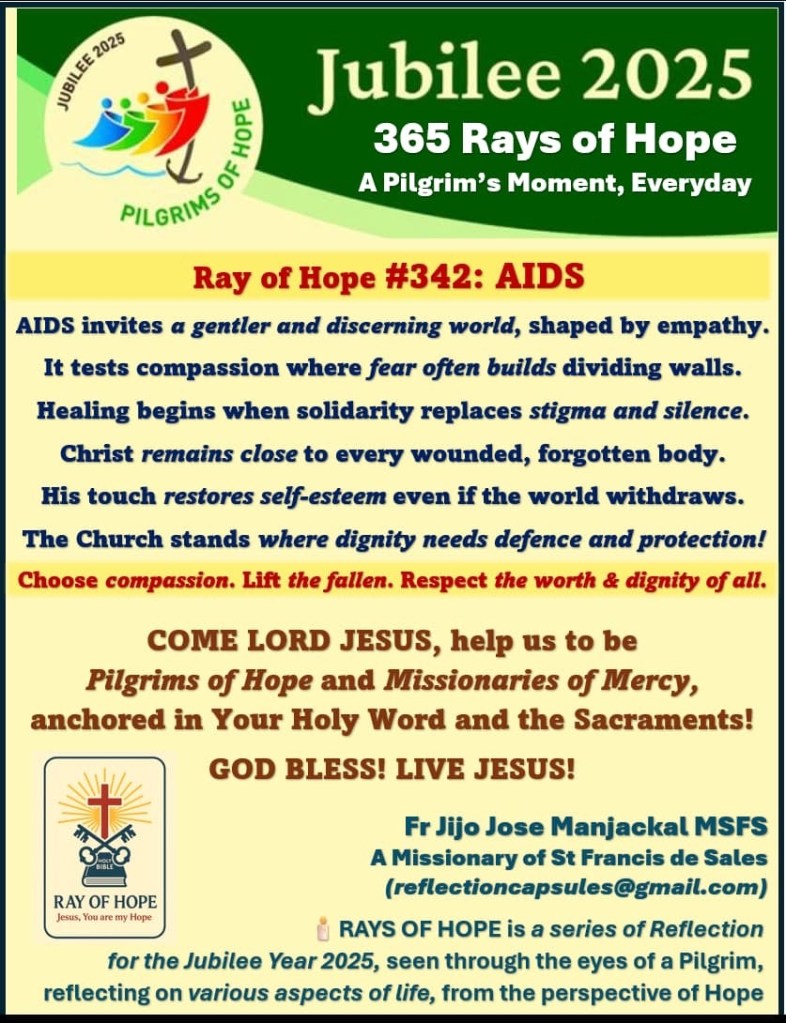
Ray of Hope #342: AIDS
“Combining strong belief in the Lord with good behaviour, to experience God’s mighty interventions in life!”
(Based on Isa 4:2-6 and Mt 8:5-11 – Monday of the 1st Week in Advent)
A preacher of the Word of God once said:
“There are two parts of the Gospel…
… the first part is called as ‘believing’
… the second part is called as ‘behaving’
When the first part joins hands with the second part, great miracles take place in life!”
How true!
When ‘strong belief’ in the Lord combines with ‘good behaviour,’ we experience God’s mighty interventions in life!
The Gospel of the Day is a wonderful incident of a man who combined “his deep faith with amazing actions of faith”…
… and thus experienced the mighty intervention of the Lord in his life.
As we enter into the Season of Advent, we are presented with the incident of the healing of the Centurion’s servant.
Jesus lavishes His appreciation for the wonderful display of faith.
This is a wonderful story of an amazing man with an amazing belief, who displays his faith in an amazing way!
They were well-respected for their leadership, discipline, and authority within the Roman military hierarchy.
They worked for the Roman Empire and were Gentiles.
This Centurion in the Gospel, however, was amazing, because of the fact, that he was very much concerned about his slave.
This was rare indeed.
In the Roman Empire, slaves had no rights.
They could be mistreated and even put to death.
It was said that “when your animals are old, you throw them out to die. You do the same with your slaves.”
So this is the amazing aspect about this amazing Centurion – He cared very much about his slave!
But when Jesus said that He would come to his house and heal him, the centurion was quick to answer him, “I am not worthy to have you under my roof” (Mt 8:8)
The centurion exhibits the spirit of a military man.
A soldier’s way of thinking is extremely logical and to the point:
When an order is given, instant obedience is expected.
His thought pattern was clear: “My commanding power goes beyond the realms of space. My presence or absence is no excuse for my soldiers to disobey!”
The Centurion fully believed that Jesus was a mighty commander with all powers subjected to Him.
And so a word was enough for the healing to take place!
The amazing expression of faith was enough for Jesus to admire and appreciate Him.
Jesus was astonished by this wonderful demonstration of confidence: “Amen, I say to you, in no one in Israel, have I found such faith” (Mt 8: 10)
We have seen many instances of people praising and appreciating the works and wonders of Jesus.
But, it’s one of those rare occasions, when Jesus publicly acknowledges and asserts the glorious faith of the one seeking for help.
The Lord, indeed, celebrates and commends this remarkable display of faith…
… and in turn, presents us with a compelling challenge to reflect on our faith journey!
In times…
… when we find ourselves amid a sea of negativity and discouragement
… when we face potentially devastating failures and despair
… when the daily struggles of life weigh heavily on us, leading to feelings of dejections
Can we also boldly say, “Only say a word, Lord… and I will be healed!”
As a famous saying goes, “It is easy to praise the Lord…
… But it is truly a challenge to receive praises from the Lord!”
When we have confidence in our love for God, we receive admiration from Him!
Through Prophet Isaiah, we are called to ascend the mountain of faith and to allow the Lord’s mountain to be established as the highest in the our life…
… to make sure that we give the highest priority to the Lord in everything we do
“Come, let us go up to the mountain of the Lord… come, let us walk
in the light of the Lord!” (Cf. Isa 2:3,5)
Yes, we are made to realise that it’s not just enough to have a “belief at the lip-level”…
… but we need to translate them into good behaviour!
Indeed, when our strong belief in the Lord combines with our good behaviour…
… we experience God’s mighty interventions in life!
God Bless! Live Jesus!
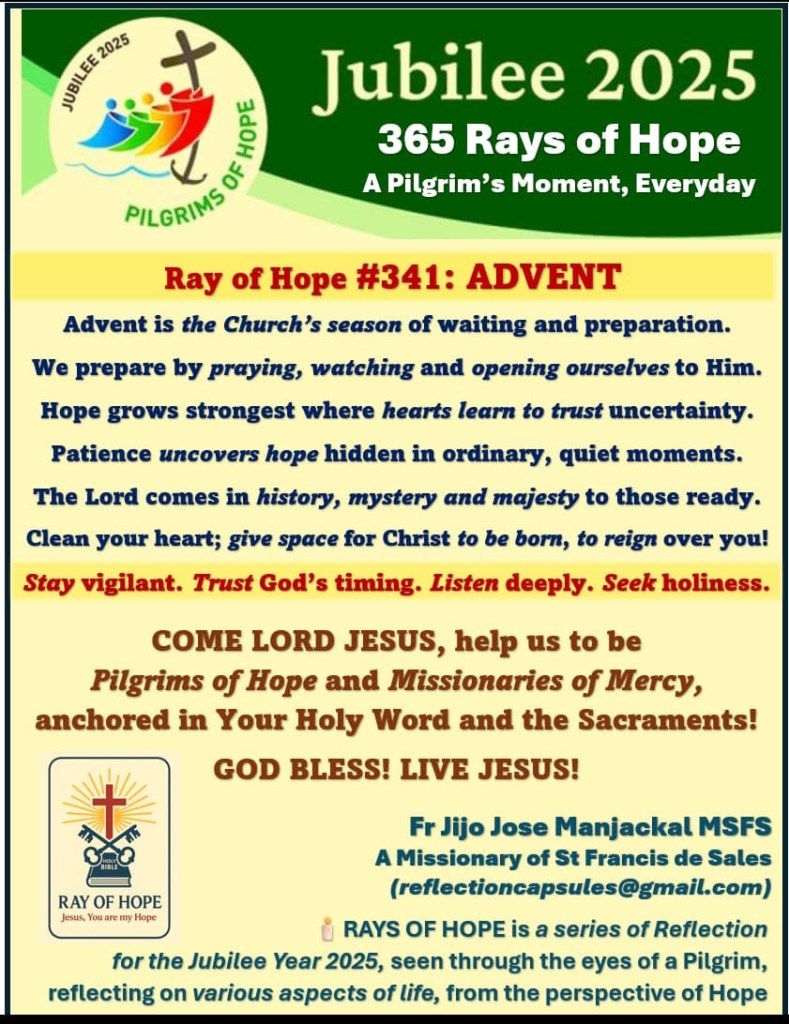
“Making this Advent a time of true preparation with repentance, and with growth in holiness!”
(Based on Isa 2:1-5, Rom 13:11-14 and Mt 24:37-44 – First Sunday of Advent, Cycle A)
A story is narrated of a group of students who were taken around
different places in a village.
They came upon an orange orchard,
where an irrigation pump had broken down.
The climate was unusually dry and many of the trees were beginning to dry and die, for lack of water.
The man who was guiding the tour – himself a farmer – then took the students to his own orchard.
The students were surprised to see the green trees in this particular fruit garden.
To know the reason, one of the students enquired the guide: “How is it that trees in your orchard are so fresh and green; you are not even using irrigation!
Whereas, most of the trees in this vicinity are dying!”
“These trees could go without rain, even for another two weeks!” answered the guide…
… “You see, when these trees were young, I frequently and systematically, kept them away from water for some time.
This hardship, caused them to send their roots, deeper into the soil, in search of moisture.
Now my trees are the deepest-rooted trees in this area!
While others are being scorched by the sun…
… mine are finding moisture at great depth
And thus, they remain fresh and green!”
The early schooling in hardship…
… helped the trees to find strength in difficult times
And thus remained fresh and green!
Christian Life calls for a life of endurance in faith
It is this endurance that will help one to remain ever faithful, ever alert and ever ready in the service of the Lord.
The Gospel is a call to avoid all complacency and lethargy…
… and to be ever fresh and green in our faith, so as to be always ready for the Advent of the Lord!
We begin today – on this First Sunday of Advent – with a new Liturgical Year.
A Liturgical Year begins on the First Sunday of Advent and ends on the Solemnity of Christ the King.
For this Liturgical Year, the Lectionary Readings will be from Cycle A (Sundays) and Year II (Weekdays)
Each year is made up of six seasons: Advent, Christmas, Lent, the Sacred Paschal Triduum, Easter and Ordinary Time.
St Augustine teaches us that “the perfection of religion is to imitate the One Whom we adore!”
The Liturgical Year is a beautiful journey into the mysteries of Christ with emphasis on the fundamental truth that Jesus has redeemed us by His Passion, Death and Resurrection
… it is from this truth, that love flows – and in turn, we are empowered and encouraged to imitate Christ!
The Season of Advent is presented to the faithful as a time of waiting, conversion and of hope!
As the Catechism of the Catholic Church guides us, “When the Church celebrates the liturgy of Advent each year, she makes present this ancient expectancy of the Messiah…
… the faithful renew their ardent desire for His second coming. (Cf. CCC, #524)
We are reminded that Christ comes to us…
… in History – as we celebrate His Birth at Bethlehem
… in Mystery – as we celebrate His Presence in the Sacraments, prayer and our daily life
… in Majesty – as we prepare ourselves – in hope – for His Glorious Second Coming!
At the start of this new Liturgical Year and as we commence our preparation for Christmas, we are presented with (interestingly) a Gospel passage that speaks about the end of the world!
We are very strongly exhorted about the need to be ever ready and prepared for the coming of the Lord…
… and to avoid every tendency to be complacent and lethargic!
An impactful reminder given by Jesus is about the days of Noah:
“As were the days of Noah, so will be the coming of the Son of man… they did not know until the flood came and swept them all away, so will be the coming of the Son of man.” (Cf. Mt 24:37, 39)
While Noah was patiently building the ark and warning people of the impending judgment, they laughed, “It will never happen.”
Very similarly, we too live in an age where there is much casualness, lethargy and indifference concerning matters of spiritual life!
There is often a lot of disdain towards a life of holiness!
As Christians – as followers of Christ – we need to be alert, enthusiastic and enduring in our faith and pursuit of holiness.
Faithfulness, ought to become the hallmark of our lives!
Endurance in works of love, ought to become our lifestyle!
As we enter into this hallowed time of preparation for the Coming of Christ, let us be alert to live a life of endurance in faith…
… knowing that it is this endurance that will help us to remain ever faithful, ever alert and ever ready in the service of the Lord!
Let us take some practical decisions, that we can specially practise, in the coming four weeks of Advent…
… to revive our spiritual life
… to restore our relationships
… to revitalize our Catholic Faith
And thus prepare our hearts for a meaningful Christmas and to allow “the Word to take flesh in us!” (Cf. Jn 1:14)
Let these days of Advent truly become days of preparation – not just externally with decorations, sweets and festivities…
… but much more with repentance, and with growth in holiness!
God Bless! Live Jesus!
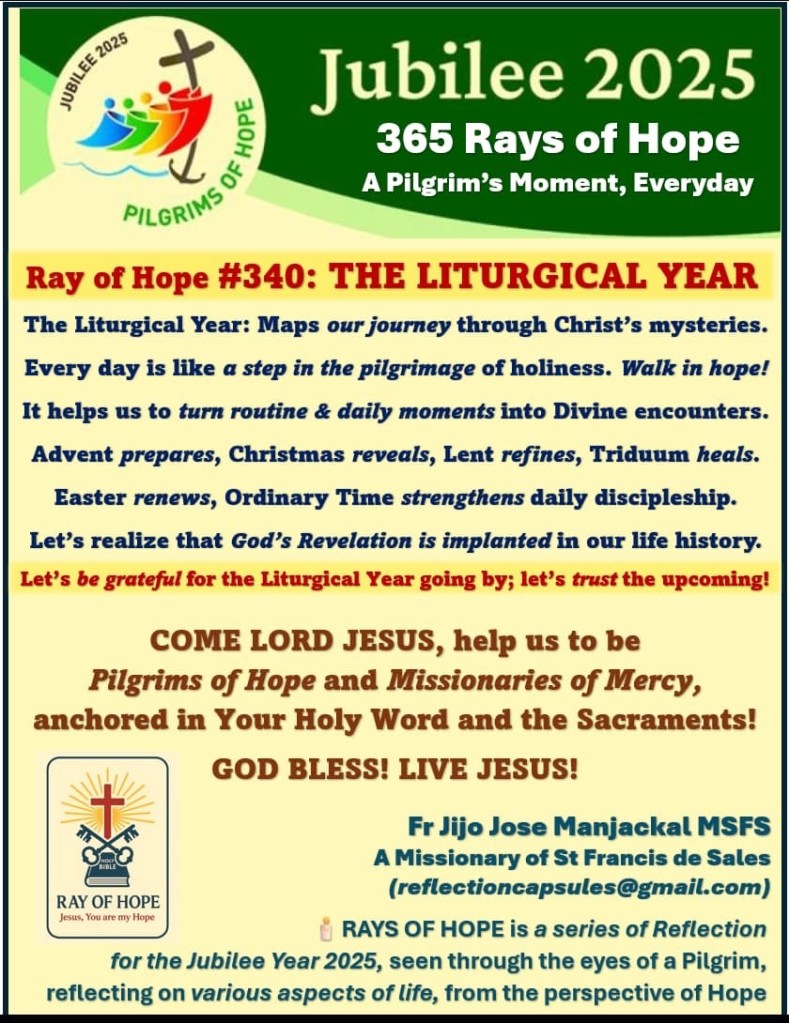
“Realise the areas of dissipation in our lives; seek for restoration, by rooting ourselves in the Lord!”
(Based on Dan 7:15-27 and Lk 21:34-36 – Saturday of the 34th Week in Ordinary Time, Year 1)
Have you ever noticed how a brand-new phone behaves in the first few weeks?
Swift. Sharp. Smooth.
You touch it, and it responds instantly.
But after a few months, this experience changes.
Suddenly, the same phone looks tired.
Apps take longer to open…
The screen freezes at the worst moments…
The battery drains faster than your morning energy.
And we ask: “Why? I didn’t drop it. I didn’t damage it. What went wrong?”
Then the technician smiles and says,
“It’s not usually one big problem.
It’s the small, silent things that weakened it over time.”
And then he lists them…
Too many apps running quietly in the background…
…filling up memory, stealing processing power.”Overcharging the phone…
… slowly heating the battery, reducing its long-term health.Running the brightness at maximum all the time…
… faulty chargers…
… letting storage remain full, leaving no room for the system to breathe
… the bluetooth, the location services, both the mobile and WiFi networks being on at all times, increasing the load on the system.
And the technician ends by saying:
“None of these causes are dramatic.
None of them crash the phone in a day.
But together, slowly… silently… they dissipate the phone’s strength!”
Well…
… If a phone can lose power through tiny, unnoticed leaks,
Imagine what can happen to our spiritual lives…
When distractions run in the background of our prayer life
When hidden fears drain away energy from our hearts,
When unrepented sins quietly heat and damage our conscience
When small compromises in our daily choices increase the load on our wills
Suddenly we realise:
“I’m not as prayerful… not as focused… not as passionate as before.”
Not because we fell dramatically
But because we dissipated gradually.
“And that’s why Jesus cautions us today:
“But take heed to yourselves lest your hearts be weighed down with dissipation…” (Lk 21:34)
We are called to make amends, to revive and revitalise.
Dissipation is strong word which could have several parallel understandings…
With respect to morality:
Dissipation refers to an overindulgence in sensual pleasures.
With respect to behaviour:
Dissipation refers to a conduct that shows one is interested only in pleasure, money, etc.
With respect to economics:
Dissipation refers to an act of using all or a lot of money, time, etc., in a foolish way.
With respect to physics:
Dissipation refers to a physical process by which energy becomes not only unavailable but irrecoverable in any form.
Dissipation is a tendency…
… to squander away enthusiasm because of allowing monotony to creep into life.
… to lose vitality as a result of being indulged in continuous immoral behaviours
… to leak-out the energy and vigour in oneself, in small amounts and thus become lifeless
… to become disinterested and dispirited due to constant exposure to luxury and comforts
Dissipation is a terrible malady that has badly affected many people in the Bible…
The people during Noah’s time were dissipated with eating and drinking, marrying and giving in marriage…
… although God had sent out a warning of their destruction through Noah.
The citizens of Sodom and Gomorrah were dissipated with extremely immoral and corrupt practices…
… even though the people were given a forewarning of their possible.
The people of Israel were dissipated with frustration and dissatisfaction while travelling in the desert…
… and failed to understand the providential hand of God.
The disciples of Jesus were dissipated with sadness, shattering of hopes and brokenness after the death of Jesus…
… and failed to believe and trust in His great promises.
Let us examine our lives and check whether we too have fallen into a state of “dissipation”…
Maybe my prayer life is “dissipated” due to various distractions, excuses of lack of time, complaints of being tired or just simply a lack of interest…
Maybe my personal intimacy with God is “dissipated” since I don’t experience any joyful or experiential feelings or because some of my expectations of God are not met…
Maybe my relationships with people is “dissipated” due to some friction or misunderstanding or an indifference that has sneaked in without any particular reason.
Maybe my family/community life is “dissipated” because I feel disinterested or not so enthusiastic in going beyond some of my personal comforts or I feel lonely in not feeling accepted or loved.
In the book of Revelations, the Lord has this complaint, ” … I have this against you: you have lost the love you had at first.
Realize how far you have fallen. Repent and do the works you did at first” (Rev 2:4-5)
Dissipation begins when we live drifted…
Restoration begins when we live rooted!
In our daily busy lives, let us…
… pause for prayer and reset our priorities
… cut down the noise, and return to the Sacraments (esp Confession)
… allow the Lord to close the unnecessary ‘background apps’ draining your souls.
Let us seek to renew our initial fervour and zeal.
The Lord deserves not “dissipated” people, but “spirited” and “passionate” people!
Today we are concluding this Liturgical Year…
… and stepping into the New Liturgical Year – with ‘Year A’ Readings on Sundays and ‘Cycle 1’ for the Weekdays
This Liturgical Year has taken us through various phases in our life of faith…
… with the Readings constantly reminding us that, that “God’s Mercy is for all. You too, be so!”
Let us thank the Lord for this Liturgical Year – for all His Blessings, Graces, Protection…
… and as we start a New Year in our Liturgical Life – with the Season of Advent – let us surrender ourselves totally to the Providence of our Loving Lord, through the intercession of our Blessed Mother and St Joseph
… as we continually give heed to the words of our Lord, “And behold, I am coming soon!” (Rev 22:7)
God Bless! Live Jesus!
📖 Discovering the beauty of the Catholic Church through the Catechism
MAN’S VOCATION LIFE IN THE SPIRIT – GOD’S SALVATION: LAW AND GRACE – The Sixth Commandment – You shall not commit adultery – Male and Female He created them
The number of men and women who have deep-seated homosexual tendencies is not negligible.
This inclination, which is objectively disordered, constitutes for most of them a trial.
They must be accepted with respect, compassion, and sensitivity.
Every sign of unjust discrimination in their regard should be avoided.These persons are called to fulfill God’s will in their lives and, if they are Christians, to unite to the sacrifice of the Lord’s Cross the difficulties they may encounter from their condition. (CCC # 2358)
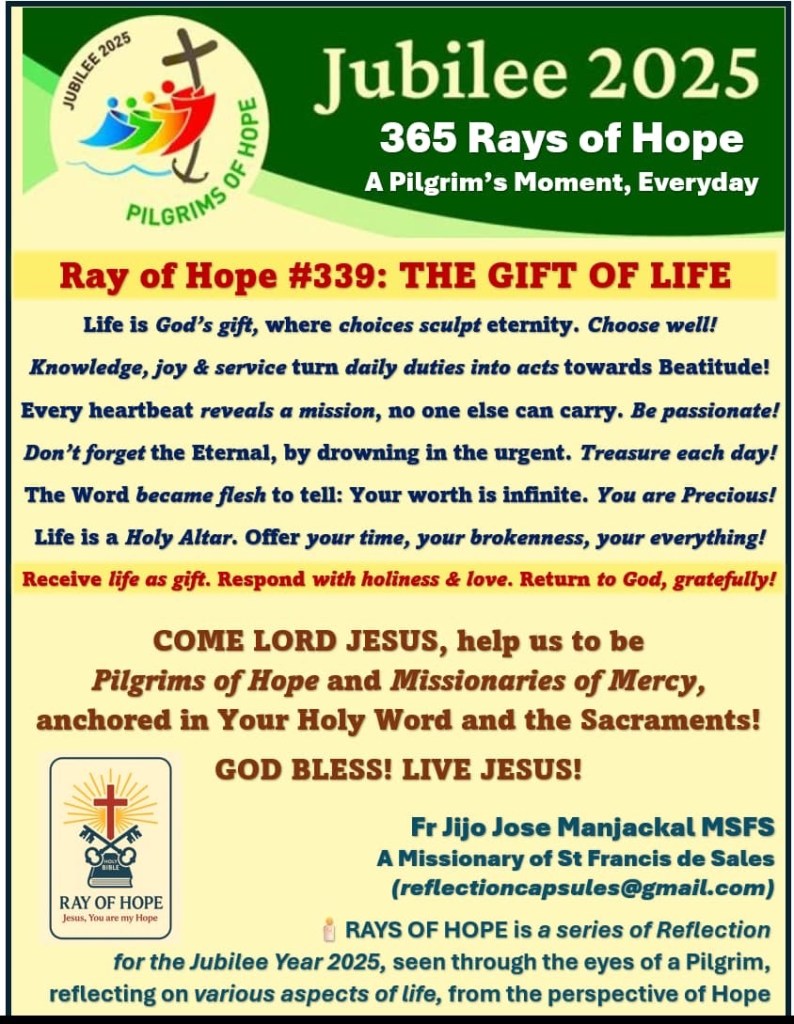
“Remain Faithful, Trusting and Patient!”
(Based on Dan 7:2-14 and Lk 21:29-33 – Friday of the 34th Week in Ordinary Time, Year 1)
The story is told of a lone lighthouse keeper battered by one of the worst winter storms on the eastern coast of America.
Hour after hour, the winds slammed the tower… waves rose like angry mountains… and the cold cut like knives.
He was exhausted. Hungry. Half-frozen.
Every step up the lighthouse stairs felt like he was climbing a mountain with no summit.
But he had one rule written in his heart:
“Never let the light go out.”
So he dragged himself up those steps…
Refilled the oil…
Cleared the glass…
And kept the flame alive, even when the storm tried to swallow it whole.
When the storm finally broke, he discovered that two ships survived only because they saw his faint, flickering light through the blizzard.
When they asked how he managed to keep going, he said:
“The storm was stronger than me…
… but my duty was stronger than the storm.”
That’s the power of endurance!
The Gospel of the Day is an exhortation to being committed to the Christian Life of Endurance by trusting always in the Enduring Word of God!
“Heaven and earth may pass away, but my words will endure forever” (Lk 21: 33)
Are we ready to rise to the challenge of this Christian Life of Endurance?
Words have immense power and potential.
They can cut
They can hurt
They can heal
They can build
They can make
They can break
They can crush
They can console
And God’s Word has ultimate control and infinite power.
God’s Promises through His words are forever.
This is clearly manifested when we travel through the pages of the Bible…
Abraham was called to a distant and unknown land.
He was promised descendants as many as the stars of the sky and the sand on the shore.
But nothing worthwhile seemed to be happening…
… God’s word seemed barren and infertile.
Yet, the enduring faith and the enduring trust of Abraham prevailed at the opportune time…
God’s Word came to fulfilment and great completion
Yes, “Heaven and earth may pass away, but His words will endure forever”
Moses was called to become the liberator of a nation.
He was promised complete guidance and absolute direction from God.
But often during the journey of liberation, Moses had to face the ire of the people.
… God’s word seemed empty and betraying.
Yet, the enduring conviction and the enduring confidence of Moses got him through…
God’s Word displayed great glory and a mighty witness.
Yes, “Heaven and earth may pass away, but His words will endure forever”
Job was blessed with immense comforts and vast riches.
He was however permitted to be tested by Satan and lost much of his security and wellbeing.
Hopelessness and wrenching despair seemed to be his best companion…
… God’s Word seemed to be abandoning and deserting him.
Yet, the enduring tenacity and the enduring perseverance of Job prevailed to the end…
God’s Word showered him with great and marvellous riches.
Yes, “Heaven and earth may pass away, but His words will endure forever”
What is my faith, trust and hope in God’s Word?
In moments of life-crushing events and soul-hurting situations…
Do I endure and trust in the enduring and eternal power of God’s Word?
In times when the asteroids of bad luck crash against the surface of my life…
Do I endure and remain firm in the enduring and everlasting strength of God’s Word?
In times when my family, community and my world gets reduced to total splinters…
Do I endure and be positive in the enduring and emphatic might of God’s Word?
The Lord has promised each one of us, immense blessings and graces through His Word.
At times…
… there are delays in the fulfilment of God’s Word, as in the case of Abraham
… there are frustrations in the following of God’s Word, as in the case of Moses
… there are misunderstandings in the listening of God’s Word, as in the case of Job
But the Lord invites us to remain Faithful, Trusting and Patient!
When life tries to shake the tower of your life…
… cling to the Light of His Word!
You are safe!
You will be an instrument of refuge to many!
Yes, “Heaven and earth may pass away, but His words will endure forever”
God Bless! Live Jesus!
📖 Discovering the beauty of the Catholic Church through the Catechism
MAN’S VOCATION LIFE IN THE SPIRIT – GOD’S SALVATION: LAW AND GRACE – The Sixth Commandment – You shall not commit adultery – Male and Female He created them
The sychological genesis of homosexuality remains largely unexplained.
Basing itself on Sacred Scripture, which presents homosexual acts as acts of grave depravity, tradition has always declared that “homosexual acts are intrinsically disordered.”
They are contrary to the natural law.
They close the sexual act to the gift of life. >> They do not proceed from a genuine affective and sexual complementarity.Under no circumstances can they be approved. (CCC # 2357)

“’Standing erect and raising up our head’ in trust, optimism and hope in the Lord!”
(Based on Dan 6:12-28 and Lk 21:20-28 – Thursday of the 34th Week in Ordinary Time, Year 1)
An anecdote is told of a pig, in a farmhouse, which fed on the leftovers of food that was supplied to it.
The pig remained content to feed on that which was smelly, dirty and stinking.
The day came when it had to be slaughtered.
As the people tied its legs to a pole to be taken to the slaughter-house…
… and the pig was carried horizontally upside down, for the first time in its life, it gazed on the skies above.
All through its life, the pig always looked downward, satisfied on its feed and food.
But now, for the first time, the pig looked upward, and saw the beauty of nature.
It wondered:
“All through, I thought, life was always stinky and nasty.
But it’s only now, when I look above, that I see that life is much beautiful and brilliant!
Too late am I!
I have missed the real beauty of life, looking always only downward!”
The whole life of the pig, was spent downcast, with images of filth and dirt and foul matter.
Only the last moments were spent looking upward, enjoying the wonderful & pleasant nature.
… Consciously or unconsciously, being content, looking downward & descending into the realms of gloom & pessimism!
Is my life cast downward? Filled with images of gloom, darkness and dirt?
The Lord, through the Gospel of the Day invites us, with strong vibes of positive feelings:
“… Stand erect and raise your heads, because your redemption is at hand” (Lk 21: 28)
The Gospel of the day is a continuation of the talks on the coming of the Son of Man.
Jesus reminds his disciples of the many signs and terrors that will be manifest in the world and persecutions that will befall on His followers.
He invites His disciples to remain firm in perseverance and faithful commitment.
The Gospel brings out a clear contradiction in the stance and approach of the “people of the world” and “people who trust in Him”…
Lk 21: 26, “…people will die of fright…”
(“people of the world”)
Lk 21: 28,”…stand erect and raise your heads…”
(“people who trust in Him”)
Dying of fright and collapsing is a sign of absolute despair and hopelessness.
When someone is in great tension, his/her physical structure reflects it…
One tends to stoop low…
One tends to put down one’s head…
The worry in the mind makes the face a sorry affair!
The tension in one’s life robs the spirit of joy in living!
Faces turn pale… smiles go wry… body starts sagging!
But the Lord of the Universe today strongly exhorts us to not remain stooped-down
He challenges us to “stand erect and raise our heads…”
The Lord made people to stand on their feet as a sign of feeling protected and strong…
The boy possessed by a demon was “held by the hand, raised up and made to stand” by Jesus (Mk 9:27)
Jesus held the hand of the daughter of Jairus and “helped her to stand” (Mk 5:41)
Peter and John took up the crippled beggar at the Temple gate “by the hand and raised him up… and he leaped up, stood and walk around… walking and jumping” and praising God (Acts 3: 7-8)
The Lord loves to help people to stand erect and hold heads high in firm faith and trust in Him.
Is my life today shattered and collapsed?
Am I unable to stand firmly in faith and in trust?
When difficulties and problems arise in life…
Do I stoop down and get fixated on the worries…
… or do I “stand erect and raise up my head” in confidence of the Providence of God?
When calamities and unsolvable crises hits my family or community life…
Do I stoop down and get lost in despair…
… or do I “stand erect and raise up our heads” in hope of the Power the Lord?
When hopes get shattered and the future appears very blurred…
Do I stoop down and get stuck in hopelessness and desolation…
… or do I “stand erect and raise up my head” in deep faith in the Guiding Hand of the Lord?
Some of us live our lives with much negativity and pessimism…
Life most of the time appears to be dark and depressing and dismal!
But the Lord today asks us to live our lives with more positivity and optimism
Life is in fact much more bright and beautiful and brilliant!
Are we going to continue to have a mentality of “looking downward” and losing the precious moments of life?
Or shall we, “Stand erect and Raise up our head” in trust, optimism and hope in the Lord?
God Bless! Live Jesus!
📖 Discovering the beauty of the Catholic Church through the Catechism
MAN’S VOCATION LIFE IN THE SPIRIT – GOD’S SALVATION: LAW AND GRACE – The Sixth Commandment – You shall not commit adultery – Male and Female He created them
Homosexuality refers to relations between men or between women…
… who experience an exclusive or predominant sexual attraction toward persons of the same sex.It has taken a great variety of forms through the centuries and in different cultures. (CCC # 2357)

