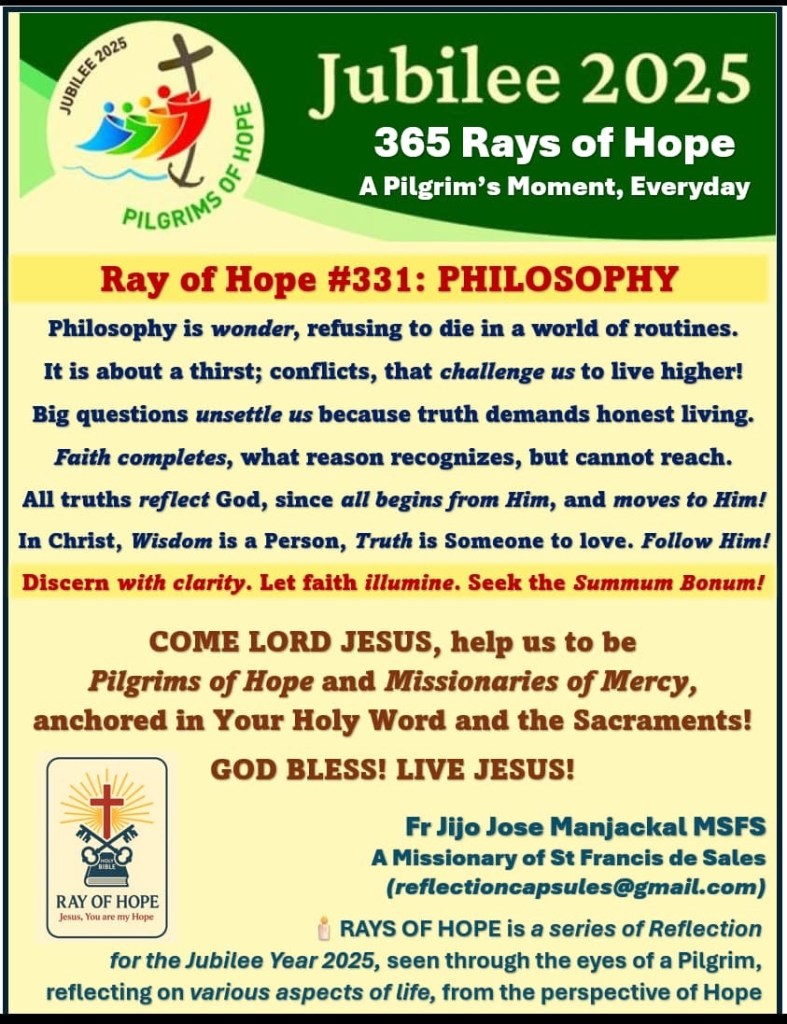
Ray of Hope #331: Philosophy
“Presenting our life to the Lord and remaining close to the Lord, the Fire of our life!”
(Based on 1 Macc 2:15-29 and Lk 19:41-44 – Thurssday of the 33rd Week in Ordinary Time, Year 1)
A priest was once persuading a church member to be more active and enthusiastic in his Christian life…
… and to give a little more priority to his spiritual life.
They were sitting inside the man’s parlour
It was winter time, and the coal was burning in the fireplace.
The man objected saying, “I can be a good person, even without doing all the spiritual activities and the requirements of the Church.”
The priest kept silent.
But stepped to the fireplace
Took the tongs, and picked a blazing coal from the fire…
… and kept it away from the fire.
In silence, both of them watched the blazing coal – which was far from the fire – lose its heat…
… and going off.
“I see…” said the man!
Living a life away from the Lord – the Fire of Life…
… will always cause tepidity and apathy to sneak in
Leading to a slow, but sure loss of life.
The Gospel of the Day is the dramatic incident of Jesus crying over the City of Jerusalem…
… who had failed to understand the coming of the Messiah
And thus lost opportunity to truly be the “Jerusalem – the City of Peace!”
The heart of a parent is broken, when the child strays away from the ways of truth and honesty.
If this is the experience of our earthly parents, how much more will be the pain and suffering of our God…
… if we stray away from Him, who loves each one of us deeply with a tender affection?
It is this sorrow and grief that is strongly expressed by Jesus in the Gospel of the day.
Jesus laments over the City of Jerusalem.
St Luke records this lamentation of the Lord with a powerfully sentimental verse:
“As Jesus drew near, he saw the city and wept over it” (Lk 19: 41)
Jesus is usually an epitome of great joy and rejoicing.
But Jesus being made to shed tears shows the gravity of situation.
What made Jesus to shed tears?
The pain and the hurt He experienced because of the ill-response and harsh reaction of His chosen people, Israel…
… represented by the city of Jerusalem.
God had chosen Israel as His people.
Out of all the civilizations on the earth, He chose them as His beloved.
Through them He promised that the Saviour of the human race would come.
This promise ignited the hearts of the patriarchs Abraham, Isaac, and Jacob.
God wiped out their enemies even in the most extreme of circumstances!
Time and again, God blessed them with judges, kings and prophets. He even provided them a place to worship.
But as the quote goes, “Familiarity breeds contempt!”
Israel, God’s own people no longer delighted in being His distinctive people.
For them, He became routine.
They began to consider Him of little value.
They allowed their hearts to grow hard, over and over, again and again.
Finally, Jesus, the long-promised Messiah came, the One whom God the Father had sent.
But most of the Jews by then, had grown stubborn and complacent in their ways.
They had no room for One who came to fulfil their Law and the Prophets.
They maltreated the Saviour of the World.
They rejected the Anointed One of the Lord.
And this led, Jesus to shed tears.
This story of Jerusalem could well be our own life-story.
We have been specially chosen and loved by the Lord.
He has taken us through many dangers, sicknesses and accidents.
In times when everything seem lost…
… He has been our refuge.
In moments when all seemed totally blank and dark…
… He has been the glowing light.
On occasions we felt like quitting life and escaping from realities…
… He held us in good stead.
But we tend to easily forget all these good deeds and wonders of the Lord.
Yes, it’s a sad thing, but a sure reality: “For many of us, God is often, just a routine!”
We fail to be grateful and thankful to the Lord….
… by living a holy and virtuous life.
… by deepening our bond of love and affection with Him
… by translating His graces into deeds of charity and concern for our people.
We instead persecute and torture Him…
… by living a lethargic or unholy or even scandalous life
… by abandoning many of His commandments and the teachings of the Church
… by harming our brothers and sisters and being highly indifferent in situations.
God’s Heart – like that of a broken parent weeping for the child – is crying out for us…
Perhaps, He is telling us, “I am wounded!”
We have strayed much…
… it’s time to come back to Him
He calls us.
He longs to have us with Him always.
He wants us back in His loving embrace.
As little children, let us run, in sincere repentance and honest contrition, to the welcoming Heart of our Beloved God.
Let us not boast or brag saying that, “I can be a good person, even without doing all the spiritual activities and the requirements of the Church.”
Rather, let’s realize that “away from the fire”…
… even a blazing coal will slowly but surely lose its heat and go off!
May we be reminded that living a life away from God – the Fire of Life…
… will always cause tepidity and apathy to sneak in
Leading to a slow but sure loss of life.
God Bless! Live Jesus!
📖 Discovering the beauty of the Catholic Church through the Catechism
MAN’S VOCATION LIFE IN THE SPIRIT – GOD’S SALVATION: LAW AND GRACE – The Sixth Commandment – You shall not commit adultery – Male and Female He created them
Fornication is carnal union between an unmarried man and an unmarried woman.
It is gravely contrary to the dignity of persons and of human sexuality…
… which is naturally ordered to the good of spouses and the generation and education of children.Moreover, it is a grave scandal when there is corruption of the young. (CCC # 2353)

“Being prepared to take risks in order to make progress in life!”
(Based on 2 Macc 7:1, 20-31 and Lk 19:11-28 – Wednesday of the 33rd Week in Ordinary Time, Year 1)
A little tortoise was constantly facing a complex of feeling too low in life.
Seeing the various other animals, moving swiftly and speedily…
… the tortoise would very often hide itself in its shell.
It felt that it could never progress in life!
One day, it came across a wise person and sought an advice of how to get the best from life.
The sage – a wise person – replied:
“My little tortoise, always remember that you have been created specifically.
So never feel low or bad about yourself.
And as far as progressing is concerned…
… Always remember: ‘Unless you stick your neck out, you can never progress!”
That was a simple, yet effective piece of advice, isn’t it
Unless the tortoise “stuck its neck out, it could never progress!”
Sticking the neck out of course, meant “taking a risk”…
… but unless that was done, progress was not going to happen.
The same is true for us in our life as well:
Unless we take risks… Unless we “stick out our necks”
… we can never progress!
The Gospel of the Day is a parable of a person who refused “to stick out his neck”…
… and thus not only failed to progress, but ended up on the losing side!
Jesus presents the very-practical “Parable of the Productive Servants”
A nobleman who, before going to a faraway country, entrusts money to his servants with an instruction, “Engage in trade with these, until I return” (Lk 19: 13)
The money given was a “mina”
A mina was a Greek coin.
The lowest level of the Greek Coinage System was the drachma…
…. equal to one day’s wages. (1 Drachma = 1 day’s wages)
One hundred drachmas equalled one Mina (100 Drachmas = 1 Mina).
Therefore, One Mina equalled nearly 100 days of wages (1 Mina = 100 days wages; i.e. nearly 3 months)
With this (fairly huge) amount of money, the Master instructs the servants to “invest”
Investment always means a “sense of risk!”
The parable goes on to say that…
… one of them made another ten (Lk 19: 16)
… the other made another five (Lk 19:18)
These two are greatly rewarded.
The one “who is willing to take risks” always finds life more rewarding and satisfying!
But, its over here, the parable presents the third servant, who decided to be “Mr. Keep it Safe!”
He came back to his master, with an excuse: “Sir, here is your coin” (Lk 19: 20)
He failed to make any investment
He failed to take “any risk”
He refused to “stick out his neck!”
Sticking the neck out of course, meant “taking a risk”…
… but unless that was done, progress was not going to happen.
And that would make him to end up on the losing side!
The Bible is replete with personalities, who would take “risks”…
… and thus emerge successful!
Noah would “take the risk” of listening to God and build the Ark for rescue from the deluge
Abraham would “take the risk” by obeying God and leaving His country and people
Moses would “take the risk” and trust in God to lead the people out of slavery
Jeremiah would “take the risk” of being a prophet despite of several oppositions to his life
Peter would “take the risk” of leaving his fishing profession to be ‘fishers of men’
… and many many more!
We also have the remarkable and heart -gripping incident of the mother and her seven sons, in the Book of Maccabees…
… “who took the risk” and offered their lives in faithfulness to God (Cf. 2 Macc 7)
They “risked their life” for God – His Will and His Kingdom!
They would “stick out their neck” in progressing in the ways of God!
How about us?
Do we “take risks?”
… the “risk” to trust in God, in spite of the uncertainties of life
… the “risk” to know God has the best plan for us, despite the many hardships we face in life
… the “risk” to believe that God always walks with us, even though we go through the ‘deserts of life’
Let us always realize: Unless we take risks…
Unless we “stick out our necks”
… we can never progress!
God Bless! Live Jesus!
📖 Discovering the beauty of the Catholic Church through the Catechism
MAN’S VOCATION LIFE IN THE SPIRIT – GOD’S SALVATION: LAW AND GRACE – The Sixth Commandment – You shall not commit adultery – Male and Female He created them
To form an equitable judgment about the subjects’ moral responsibility and to guide pastoral action
… one must take into account the affective immaturity, force of acquired habit, conditions of anxiety or other psychological or social factors that lessen… if not even reduce to a minimum, moral culpability. (CCC # 2352)

“Making significant changes in our life, to experience the magnanimous wonders and graces from our ‘Big God!’”
(Based on 2 Macc 6:18-31 and Lk 19:1-10 – Tuesday of the 33rd Week in Ordinary Time, Year 1)
A tourist, in a large city, – elderly, and not very familiar with modern technology – was determined to walk from his place of stay, and visit a famous church.
He had a map with him.
He walked fast, head high, map in hand….
… confident, certain.
But after an hour of walking, nothing looked familiar.
Streets felt strange. Landmarks were missing. His heart began to sink.
Finally, he stopped, enquired regarding the map to a passerby, and realised the truth:
The map was outdated.
The roads had changed.
And he was walking – boldly, proudly – towards the wrong destination.
For a moment, pride whispered: “Don’t turn back… just keep going.”
But truth spoke louder in his heart:
“Better to feel foolish for a minute…
… than being lost for a lifetime.”
He laughed at himself, turned around, changed direction…
… and within minutes, he was standing exactly where he needed to be.
Sometimes the biggest miracle begins with the smallest U-turn.
The Gospel of the Day takes us through a life-changing incident of a Little Man – Zacchaeus.
He was walking in life with ‘a wrong map’…
… but the moment he changed direction, Jesus changed his destiny!
The story begins with Jesus coming to Jericho and intending to pass through the town (Lk 19:1)
Jericho has a long history, especially seen in the Old Testament.
Jericho was the first city to be conquered by the Israelites under Joshua. (Josh 6:1-27)
It was surrounded by a huge wall.
However, with directives from God and under the leadership of Joshua, the city was laid siege.
On the appointed day, Joshua ordered the people to shout & the walls of the city collapsed and the Israelites destroyed it.
Joshua laid a curse on the one who would rebuild this city.
Thus, Jericho bore the brunt of a curse.
It is to this ‘place of curse’ that Jesus makes his entry.
As Jesus makes his entry to this cursed place, a little man named Zacchaeus climbs & hides himself behind the leaves of a sycamore tree.
Zacchaeus was a rejected man.
This rejection was on two levels:
A personal level
A societal level
The Gospel mentions that Zacchaeus was “short in stature” (Lk 19:3)
It is interesting to note that “Zacchaeus” in Greek means…
… the pure – a just one
However when St Luke speaks of him as being “short in stature,” it was a pointer…
… that he was perhaps living a life contradictory to what his own name suggested.
His being short was probably referring to the fact…
… that as a tax collector, he was living a life of corruption
… that as a rich man, he was still quite unsatisfied in life
Being short, he faced a sense of rejection…
… in his own self!
At the same time, Zacchaeus was also rejected by the society.
The Gospel describes him as being a tax collector.
Under the Roman system, tax collecting jobs were outsourced to people…
… who bought the right to collect taxes.
Tax collectors paid a fixed amount of tax to Rome
After that, they enriched themselves by forcing the public to pay far more than what Rome required.
Zacchaeus thus became a tax collector for the hated Roman government
He was probably treated as a heathen…
… isolated from all social life
… equated with the Gentiles at a distance when he went to the temple!
Thus, being a tax-collector, he faced a sense of rejection…
… in his own society and among his own people!
Besides, Zacchaeus was a “chief” tax collector…
… so his rejection was still more “chief” – greater and graver.
Do we also find ourselves to be rejected – just as Zacchaeus was?
Despising ourselves because of our own weaknesses and shortcomings?
… Being despised by the society, when we take a conviction that is opposed to the worldly and materialistic ways?
Despising ourselves, because of the weight of habitual sins and prolonged bad habits?
… Being despised by the society, when we fail to abide by the unholy trends of the modern world?
Zacchaeus, however, stands as an example and challenge to us…
… to not get dejected by such rejections!
Instead to “deeply desire” for the Lord and be ready to climb the sycamore tree of “sadness, rejection, disappointment and dejection” in our lives!
When we climb above our pride, Jesus calls us by name!
The Lord is gazing, addressing and seeking for us.
Am I ready to encounter, to listen and to be found by Him?
A ‘Yes’ to the question, will also mean taking some radical decisions in our life, just like Zacchaeus did…
Giving up of possessions…
Letting go of my undue desire for money, cheap popularity, the riches in my life etc.
Repaying those whom I have cheated…
Forgiving and accepting those whom I hurt, whom I don’t like, whom I am not in good terms etc.
Zacchaeus’ encounter with Jesus made him a transformed person
This same transformation is at hand for us!
Let’s realise that “even the most confident walk becomes a lost walk, if the map is wrong!”
It’s not shameful to turn around…
… it’s dangerous, not to!
Let, us, learn from the ‘little man’ and make significant changes in our life…
… to experience the magnanimous wonders and graces from our ‘Big God!’
God Bless! Live Jesus!
📖 Discovering the beauty of the Catholic Church through the Catechism
MAN’S VOCATION LIFE IN THE SPIRIT – GOD’S SALVATION: LAW AND GRACE – The Sixth Commandment – You shall not commit adultery- Male and Female He created them
The deliberate use of the sexual faculty, for whatever reason, outside of marriage is essentially contrary to its purpose.”
For here sexual pleasure is sought outside of “the sexual relationship which is demanded by the moral order…… and in which the total meaning of mutual self-giving and human procreation in the context of true love is achieve. (CCC # 2352)

“Being ready to change the ‘Disappointments’ in our life to Appointments with the Lord!”
(Based on 1 Macc 1:10-15, 41-43, 54-57, 62-63 and Lk 18:35-43 – Monday of the 33rd Week in Ordinary Time, Year 1)
An elderly person, who was known to be very joyful and optimistic in life, was once asked by his little nephew: “Uncle, what is the secret of your happiness?
Don’t you ever have disappointments?”
The uncle looked at the little lad and responded:
“Child… life has taught me to trust in God above all, and know that His Hand is there with me, at all times.
When Disappointment comes to me, all that I do is: Change a letter!
The ‘D’ in Disappointment has to be made ‘H’
Thus, every Disappointment, becomes HIS-Appointment!
And I experience His Providence with me, always!”
That’s truly beautiful, isn’t it?
Are we ready to change the ‘Disappointments’ in our life to ‘Hisappointments’…
… Appointments with the Lord?”
Every person in the world faces moments of disappointments and darkness.
Some of us get encompassed by it.
Some of us get dejected by it.
The Gospel of Day presents a blind man, who faced immense darkness, but did not allow to get encompassed or dejected by it…
.. rather changed, the Disappointment into His-appointment!
The story of the Blind Beggar, healed by Jesus is an incident recorded in all the three Synoptic Gospels (Matthew, Mark and Luke).
If we look at this incident in each of their accounts, we find that it is as if, this story has been filmed from three different cameras.
It could be like the same news story, but carried out on channel A, channel B and channel C.
The camera of each channel has picked up the story at a different angle.
The meaning and message of the life of Jesus is inexhaustible and the Holy Spirit allows the Gospel writers to present it from different perspectives and angles.
St Luke’s camera shows us that Jesus is entering Jericho when the blind beggar begins to call out.
But St Mark’s camera shows us that the healing took place, not as Jesus was entering Jericho, but as Jesus was leaving the place (Mk 10:46)
Mark names him as Bartimaeus.
Luke doesn’t name him.
How could we reconcile this geographical fact of “apparent” difference?
Was Jesus coming out of or going into Jericho?
There could be one way of understanding this…
Jericho was one of the oldest cities in the world and it has been continuously occupied for thousands of years.
During the time of Christ, however, King Herod ordered a new business and administration centre to be set up, a few miles away from the original city.
This would be called as the New Jericho.
Eventually, the old and the new Jericho would merge.
An ideal spot for begging was to be on the road between the old and new city, where there would be a frequent passage of travelers especially the business people.
So, in that sense, Jesus was both leaving Jericho and going to Jericho:
He was leaving the old site and going to the new one.
Then comes along St Matthew’s camera which shows us that there were two blind beggars that were healed (Mt 20:30), whereas the camera of St Mark and St Luke had only done a close shot of the one.
How could we reconcile this numerical fact of “apparent” difference?
There could be one way of understanding this…
For Mark and Luke, Bartimaeus was the main character in the story and was therefore the sole focus.
Perhaps Bartimaeus was known to them but the other man was a stranger to them.
The fact that only one man is recorded as speaking doesn’t mean there was only one man.
It simply means Mark & Luke identified only one man, Bartimaeus speaking. Matthew refers to both of them calling out to Jesus, clearly indicating there were two men.
In any case, to focus on these minor details to the exclusion of all else, would be to miss the point of the story.
The star recipient in the story – the Blind Beggar – is the one who overcomes many hurdles and obstacles in his life to obtain the glorious healing from the Lord.
What were some of these hurdles?
1) He had to overcome the hurdle of “being blamed”
This blind man lived at a time when sicknesses were often traced to a life of sinfulness.
The man probably lived constantly under the shadow of this hurdle of “being blamed”.
He was probably blamed that he was blind because he or his ancestors had sinned greatly and was being “punished”.
But the man overcomes this “hurdle of being blamed” and finds the light of Jesus.
Am I in need of overcoming this guilt and shame of “being blamed”?
2) He had to overcome the hurdle of ” being depressed and hopeless“
It is a pitiful fact to being a beggar, lying pathetically, sitting in his filthy, dirty rags on the side of the road.
The fact of his being blind made things even more worse.
Life was highly cruel on him and the darkness of hopelessness clouded him.
But he overcomes this “hurdle of being depressed and hopeless” and encounters the glow of Jesus.
Am I in need of overcoming this pain and sadness of being depressed and hopeless”?
The blind man shows us the way today, to overcoming hurdles…
…with an eager longing, a resolute determination and commendable humility.
Is my life blind, surrounded by the darkness of many hurdles?
The Lord of Light is passing by…
Let’s raise our voices.
Let’s lift up our hearts.
Let’s jump over the hurdles!
“Jesus, Son of David…have mercy on me!”
Yes… life surely brings very often disappointments!
But with trust in the Lord and confidence in His Providence, let us…
‘Change a letter!…
… thus making ‘every Disappointment, as HIS-Appointment!’
God Bless! Live Jesus!
📖 Discovering the beauty of the Catholic Church through the Catechism
MAN’S VOCATION LIFE IN THE SPIRIT – GOD’S SALVATION: LAW AND GRACE – The Sixth Commandment – You shall not commit adultery – Male and Female He created them
By masturbation is to be understood the deliberate stimulation of the genital organs in order to derive sexual pleasure.
“Both the Magisterium of the Church, in the course of a constant tradition, and the moral sense of the faithful have been in no doubt…… and have firmly maintained that masturbation is an intrinsically and gravely disordered action. (CCC # 2352)
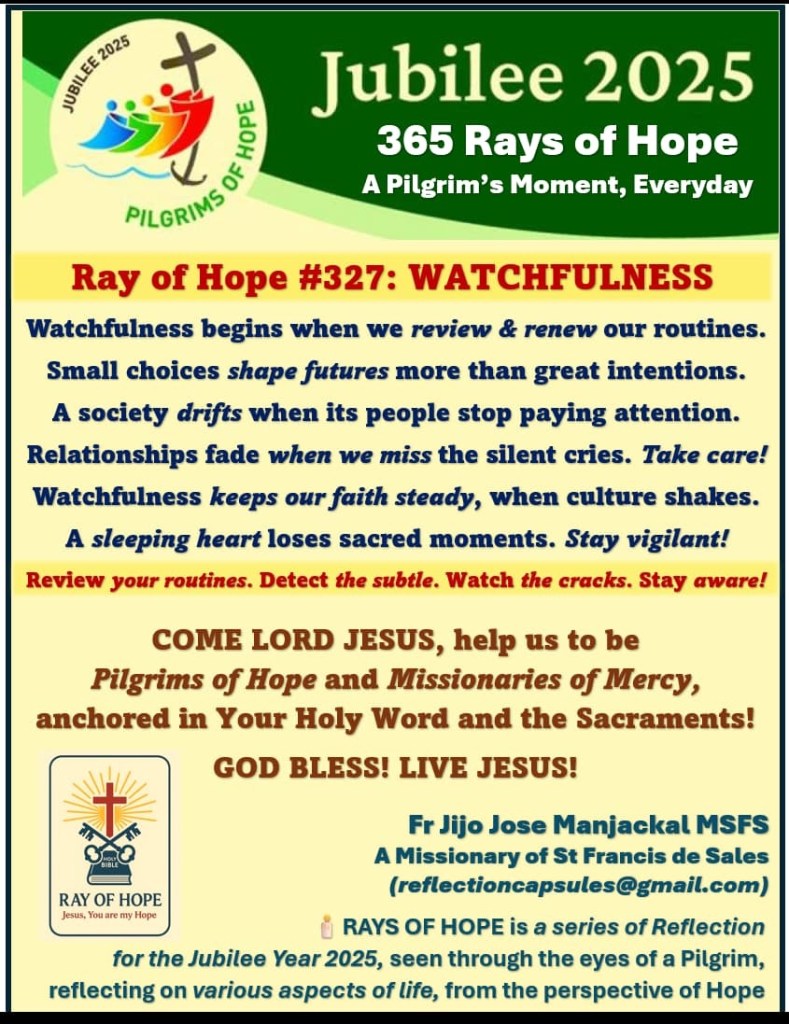
“Allowing Jesus, the King of kings and the Lord of lords, to adorn the temple of our lives!”
(Based on Mal 3:19-20a, 2 Thess 3:7-12 and Lk 21:5-19 – 33rd Sunday in Ordinary Time, Cycle C)
“God himself cannot sink this ship!”
“The captain can, by simply moving an electric switch, instantly close all the doors, practically making the vessel unsinkable”
“We believe that the ship is unsinkable.”
These were some of the comments and claims that were made about Titanic – the largest ship in the first half of the 1900’s
But all these proud & arrogant assertions found a watery grave…
… with the sinking of the Titanic on the morning of 15th April, 1912 killing over one thousand five hundred people.
It was a massive tragedy of the loss of many lives.
But it was also a horrific lesson to humankind on the need to be aware of her limitations.
It was also a torrid warning to generations on the need to be on the guard, always.
“Being on the watch” is a necessity and a basic requirement in every sphere of human life!
The Gospel of the Day presents this message of being vigilant and alert in our lives.
Jesus is on the courtyard of the Jerusalem Temple and He hears “some people speaking about how the temple was adorned with costly stones and votive offerings” (Lk 21:5)
The Jerusalem Temple was a magnificent building and one of the wonders of those days.
The Temple had just been marvellously rebuilt by Herod the Great.
In all its beauty, the Jerusalem Temple was a vast glittering mass of white marble, touched here & there with gold & colour and precious stones.
“Whosoever had not gazed on it”, said the old rabbis, “had not seen the perfection of beauty.”
The historian Tacitus, called this spectacular edifice as “a temple of vast wealth”
Precious gifts such as crowns, shields, vessels of gold and silver were presented by princes and others who visited the holy house.
The Jerusalem Temple was indeed rich in these votive offerings.
With such a grand spectacle and gorgeous building in the background, Jesus makes a prophetic saying:
“All that you see here – the days will come when there will not be left a stone upon another stone that will not be thrown down” (Lk 21:6)
These words would have come as a big shocker and a tantalizing scandal to His listeners.
Who would have thought that the Titanic would ever sink?
Who would have thought that the great Twin Towers in America would be in rubble?
Who would have thought the British Empire where “the sun never sets” would wane down?
To think of the Jerusalem Temple being totally destroyed was a case next to impossible.
The Jerusalem Temple was the holiest shrine of the Jews.
The Jerusalem Temple was the pulse and the heartbeat of the Jewish Faith.
The Jerusalem Temple was the greatest source of joy and pride for the Jews.
Any attack or any destruction of this great edifice of Faith was unimaginable and intolerable.
Yet, Jesus makes this powerful and daring prophecy.
What is the structure and edifice of joy and pride in our lives?
Is it a structure…
… of fat bank-balances and transient fame and popularity
… of remarkable public positions and offices of high ranking
… of enjoying life with temporary pleasures and passing addictions?
All too often we have heard people saying:
“I have enough money & I am happy with my life!
Just enjoy today to the max. Who knows what happens tomorrow?”
“The status that I am in today, is a result of my hard-work and labour.
Why should anyone interfere in my private life to prevent me from enjoying it in my own style?”
History teaches us that structures built without the power and grace of God is bound to fall.
The Tower of Babel is a classic example from the Bible. (Gen 11: 4-9)
Built on human pride and aspiration, it had a catastrophic collapse
The lives of many people are also a lesson for us!
Samson… King Saul… King Solomon… Judas.
They had their moments of great glory and splendour.
But when pride and self-interest crept into their lives, they lost the touch of God’s hand!
We may glory and shine in beauty for some time, by just banking on our capabilities.
But unless, we remain in firm obedience and faithful commitment to the Lord, we are bound to fail!
None of us are, and can be unsinkable!
An obstinate stand that I can manage my life by myself is hazardous.
A proud feeling that no power in the world can shake me is dangerous.
Yes, let God be God in our lives!
Let Him enthrone the highest place and the privileged position in our lives.
May Jesus, the King of kings and the Lord of lords adorn the Temple of our lives.
With Him we can shine forever.
With Him we can stand forever.
With Him we can glory forever.
God Bless! Live Jesus!
📖 Discovering the beauty of the Catholic Church through the Catechism
MAN’S VOCATION LIFE IN THE SPIRIT – GOD’S SALVATION: LAW AND GRACE – The Sixth Commandment – You shall not commit adultery – Male and Female He created them
Lust is disordered desire for or inordinate enjoyment of sexual pleasure.
Sexual pleasure is morally disordered when sought for itself, isolated from its procreative and unitive purposes. (CCC # 2351)

