Apr 26 (Jn 15:1-8)

The Time Magazine in its issue dated 19th November, 1965, reported of a major electricity breakdown along the US-Canada border.
>> This was called as the Northeast Blackout of 1965.

The impact of the breakdown was so great that it affected people in nearly 80, 000 sq.miles along the border!

The whole area was submerged in deep darkness.

The cause of the failure was the tripping of a protective relay, or a fuse, which was just the size of a bread box!
>> The safety relay, which was to trip if the current exceeded the capacity of the transmission line, was set too low.

A failure in the single fuse, of such a tiny size was able to cause the breakdown of an entire power grid of such a huge magnitude!

>> A tiny failure in the connections caused a mighty collapse!
>> A minor malfunction in the grid caused a major disintegration!

It is therefore highly essential that the most basics aspects of life,however small or tiny they may appear, be given the proper and appropriate attention.

Such is the case too, in our spiritual lives…

>> If the connection with the Lord, the Fuse of our life trips, our whole life will be in darkness!
>> If the link with the Lord, the Safety Relay of our life overloads, our whole life will collapse into obscurity!

The Gospel of the Day invites us to continually nurture and nourish our relationship with the Lord and to reflect the fruits of this affiliation in our daily lives.

Jesus says that, “I am the vine, and you are the branches. Whoever remains in Me, and I in him, will bear much fruit, because without me, you can do nothing” (Jn 15: 5)

These are highly powerful words of the Divine Lord…”WITHOUT ME, YOU CAN DO NOTHING!”

There are a few implications of these powerful words….

1. Its a great message of hope
The statement of the Lord is a deep assurance that in every moment of our lives, we can bank on Him.

St Paul realised the deep understanding of this message of hope and could cry out, “I can do all things through Christ who strengthens me” (Phil 4:13)

We can place our hope in the Lord…
… even when all seems lost and crashed in life
… even when things hit rock bottom in our life

2. It’s a great message of warning
The statement of the Lord is also a grave warning that in every moment of our lie, we can crack without Him.

The Prodigal Son realised the depth of such a break of relationship, when he had gone away from his father, and found himself in dire needs.

He would therefore say, “I shall get up and go to my Father and I shall say to him, ‘Father, I have sinned against heaven and against you…’  (Lk 15: 18)

We are warned by the Lord…
… in every moment, we need to be dependent on the Lord
… in every situation of life, we cannot achieve true success by our own merits and talents

Sometimes in life, when things go on well and when everything seems fine, we tend to forget that it is the Lord, who is ultimately leading and guiding us.

We get into a feeling that it is my achievements and hard work alone, that is the cause of every success and smile that I enjoy.

But once in a way, when darkness engulfs our lives… maybe by way of..
… a sickness or a death…
… a financial difficulty or uncertainty of the future…
… crisis in relationships or breakage of human bonding
… or any other problem or difficulty…

We realise that there is a tripping in our relationship with the Lord, the Fuse of our life!

Unless we stay connected to this Mighty Fuse, our lives will stay in gloom and shadow

>> When we are connected with the Lord, even in the midst of any crisis, the supply of inner joy and peace will always remain constant!

>> When we are in link with the Lord, even with problems encompassing us, the streaming of Divine calm and happiness, will always remain uninterrupted!

 God Bless! Live Jesus!
Apr 26 (Jn 14:27-31)

Sphygmometer is the device that is used to measure blood pressure.

Blood pressure is the strength of the blood pushing against the sides of the blood vessels.
>> A increase in BP puts extra strain on the arteries and this may lead to heart attacks or strokes.

The use of Sphygmometers, are on the rise these days…
… with an increased number of people affected with high blood pressure.

One big reason of an increased blood pressure is the rising tension levels and anxiety factors.
>> We engage in works which trigger greater emotions.
>> We let ourselves get affected with situations that cause great panic
>> We react quicker to situations and bring upon unnecessary worries and fears

Such uncontrolled and unrestrained increase in anxieties and troubles can cause a great deal of harm to our health.

The Gospel of the Day presents Jesus, the heart-expert, warning us of this danger of increased anxiety levels and troubled moments and instead invites to lead a life of peace.
>> Jesus says in Jn 14: 27, “Do not let your hearts be troubled or afraid”

The context of this statement of Jesus is the discourse at the Last Supper.

Jesus informs of his imminent going away from the disciples, which made them sad and anxious.
>> They had placed their hopes in Him.
>> They had offered their lives to Him.
But His announcement of departure caused worry and anxiety to the disciples.

But Jesus, who knows their hearts and gauges their emotions assures them, ” Peace I leave with you; My peace I give to you. Not as the world gives, do I give it to you” (Jn 14:27)

The disciples entered into an anxiety-mode as their hearts got wearied with what was to come immediately.
>> But Jesus invites them to go beyond such peripheral worries, and be assured of a peace that comes as a result of trusting in Him, the Lord of all future!

>> When one is imprisoned in the immediate worries of life…
… one fails to enjoy the true freedom of peace and joy

>> When one is landlocked amidst the borders of impending fears and troubles of life…
… one is unable to move out to experience real inner tranquillity and serenity

Are we finding ourselves often in situations, when our “hearts are troubled” (Jn 14:27b) and as a result, our spiritual BP levels go high?

Then Jesus, the Master Doctor of hearts, needs to be immediately consulted…
>> He would give us the tablet of His peace which would subside our fears
>> He would give us the tonic of His soothing Word which would calm our troubles

Troubles will, without any doubt, always haunt us…
Problems will, for sure, often beset us…
>> But we need to grow in our understanding that in all this, Jesus, is in perfect control of our lives.
                        
The Sphygmometer levels may show a higher level of BP…
>> But can we allow our Trust levels in the Lord to have a greater increase?

The reading on the Sphygmometer may show a greater count of BP…
>> But can we let the reading on our Faith Meter to show a greater count?

To control our physical Blood Pressure, we usually recommend the following solutions…
… regular exercises
… intake of medicines
… nourishing and wholesome diet

We could take a cue from this, for regulating our Spiritual Life too…
… having regular and faithful exercises of prayer and pious devotions
… in-taking of the means of healing, offered in the Sacrament of Reconciliation
… nourishing ourselves in the Heavenly Food provided in His Holy Word and The Holy Eucharist

Let Jesus, the Doctor of hearts, take complete charge of our lives
>> In Him, we shall experience fervent joy.
>> In Him, we shall live with true peace.

God Bless! Live Jesus!

Apr 25 (Feast of St Mark, the Evangelist)

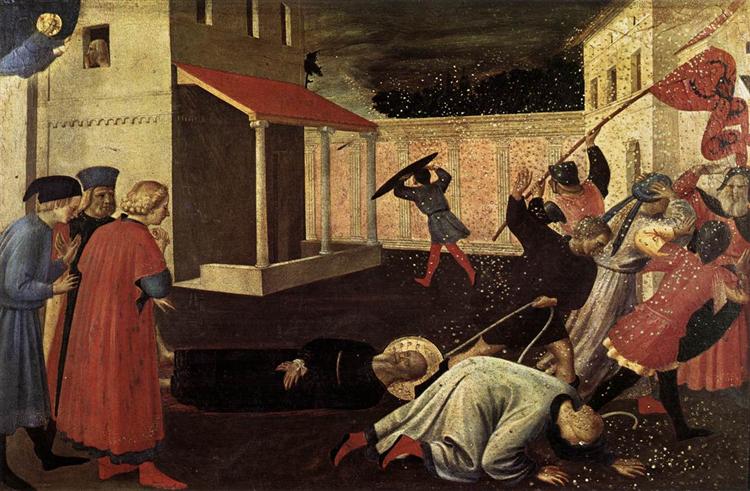
It was a place named Bokalia, which means the place of cows, on the east of Alexandria in Egypt.

The Great Feast of Resurrection, that year, 68 A.D., coincided with the great pagan celebration of god Syrabis.

A huge multitude of the pagans, assembled and attacked the Church at Bokalia and forced their way in…

These targeted their chief enemy in that church…
       seized him…
              bound him with a thick rope…
                     dragged him in the roads and streets..
And they cried out, “Drag the dragon to the place of cows!”

They continued dragging him with severe cruelty.
His flesh was torn and scattered everywhere…
… the ground of the city was covered with his blood.

They cast him that night into a dark prison.

The next morning, the pagans were back to take him from the prison.

They tied his neck with a thick rope and did the same as the day before – dragging him over the rocks and stones.

Finally, this great warrior of God delivered up his pure soul in the hand of God…
… and received the crown of martyrdom…
… the apostolic crown, the crown of evangelism, and the crown of virginity.

Nevertheless, his death did not satisfy the rage of the pagans and their hatred.

They gathered much firewood and prepared an inferno to burn him.
However, a severe storm blew and heavy rains fell.
>> This frightened the pagans, and they fled away in fear.

The believers came and took the body, carried it to the church that they had built at Bokalia, wrapped it up, prayed over it, and placed in a coffin.
>> They laid the coffin in a secret place in this Church.

This is the heroic account of the martyrdom of St Mark, the Evangelist, whose feast we celebrate today.

image
Martyrdom of St Mark, Fra Angelico, 1433, Museo de San Marco, Florence

It is to St Mark, the evangelist, that we owe, historically speaking, the first of the four Gospels.

Some of the distinct features and highlighting aspects of the Gospel of St Mark calls for our attention and reflection…

1. The Gospel of St Mark is the shortest among all the four Gospel accounts.
It probably also has the highest tempo, in terms of the language used and the pace at which the whole Gospel account moves.

>> This invites us to reflect on the urgency of the Kingdom in our lives. The time and place of the coming of the Lord is unknown. (Mk 13: 35-37) Therefore, it places on us, the need to be ever watchful, on the guard and ready for action against the evil, with lives sanctified and purified.
>> This also invites to reflect on the shortness of our lives, and how each day and each moment of our life (like each chapter and verse of the Gospel), is to be lived solely for the sake of the Lord, and making our lives a “true Gospel”, giving witness to Jesus Christ, the Crucified Risen Lord, the Son of God (Mk 15:39)

2. The Gospel of St Mark was possibly addressed originally to the persecuted and suffering Christians, of the early Church.
This meant to present Jesus, in the light of how He was able to withstand all pains, pressures and persecutions, in order to remain faithful to the Will of His Father and to the Kingdom Mission.

>> This invites us to fully embrace Jesus as the True Model for our lives. He is the Lord, who suffered immensely, took up every pain and bore every temptation, in order to remain faithful to His Father (Mk 14:36).
>> This also invites us to not be afraid of pains and sufferings in life and not to be bogged down by the illogicality of why things go absolutely haywire in our personal and societal lives. Instead, we need to look up to Jesus, who was crucified, and even from the Cross, the final act of His obedience, cried out, “Eli, Eli, Lama Sabachthani – My God, My God, why have you forsaken me?” (Mk 15:34)

3. The Gospel of St Mark is, traditionally, greatly associated with the life of St Peter.
Therefore, this Gospel makes a clear attempt at revealing some of the crucial events, feelings and character of Peter. It is an attempt, not to merely glorify Peter’s role; rather, it is also an account of how Peter, with all his failures and ‘foolishness’ was still accepted and moulded by Jesus, His patient Master

>> This invites us to face our own weaknesses and limitations of life boldly. Like St Peter, we too very often fall away, oppose the plans of God, be overly-zealous yet lazily lethargic and even betray the Lord. Yet, the Good Shepherd does not abandon us; instead goes ahead of us (Mk 16:7), to invite us “to make our life a beautiful one for Him”

>> This also invites us to not give up in life because of constant failures or be ashamed of our brokenness in life (Mk 14:72b). The Gospel of Mark is a parallel drama of the Glorifying Act of Jesus Christ and the Constantly Wavering Life of St Peter. The Gospel testifies that we are to glory not in our merits or prowess, rather to seek refuge in the wounds of Christ and to be totally dependent on the One who alone is to be our strength and guide.

Just like a lion, the Gospel of Mark brings out powerfully the life and teachings of Jesus, the Mighty Lion of Judah…
… mighty and bold
… fast and powerful,
… demanding and challenging.

The author, St Mark, himself was able to live up to be the witness and shed his blood for sake of the Great Lion of Judah!

Let us read this Gospel of St Mark…
… meditate on it..
… be challenged by it..
And strive to live the Will of the Father faithfully …
making our lives a “… Gospel of Jesus Christ, the Son of God”(Mk 1:1)

Happy Feast of St Mark, the Evangelist

God Bless! Live Jesus!

Apr 24 (Jn 13:31-35)

Mr George Crane was a popular newspaper columnist, psychologist and physician in the United States.

He speaks of an experience of a wife who came into his office, full of hatred toward her husband.

Seeking a divorce, the woman blurted out to Dr Crane, “I do not only want to get rid of him, I want to get even. Before I divorce him, I want to hurt him as much as he has caused pain to me.”

Dr. Crane suggested an clever plan “Go home and do this…
Act as if you really love your husband.
Pretend and tell him how much he means to you.

Go out of your way to be as kind, considerate, and generous as possible.
Spare no efforts to please him, to enjoy him. Make him believe you love him!

And, after you’ve convinced him of your undying love and that you cannot live without him, then drop the bombshell!

Tell him that you are getting a divorce.
That will really hurt him!
Hurt him to the core!”

With revenge in her eyes, she smiled and exclaimed, “Wonderful indeed! That is a superb way of  settling scores with the one who hurt me the most!”

So off she went, doing what was told, with enthusiasm, acting “as if”
>> She showed love, kindness, listening, giving, reinforcing, sharing…

After two months, when she didn’t return, Dr Crane called. “So, are you ready now to go through with the divorce?”
“Divorce?” she exclaimed. “Never! I discovered I really do love him.”

>> Her actions had changed her feelings.
>> Her “affectionate” motions done with revenge,  resulted in “loving” emotions with sincerity!
>> Her “acting” in actuality helped her to rediscover her lost love.

That’s the power of love!

Love is the best medicine for any sickness which cripples human life!

And the reason for this amazing power of love is simple:
True Love flows from the heart of the One who is Love… God!
Genuine Love gushes forth from the fount of the One who is Love Incarnate… Jesus!

The Gospel of the Day is the wonderful exhortation of Jesus to His followers with the “Great Commandment of Love”

Jesus says:
“A new commandment I give you, that You love one another, even as I have loved you” (Jn 13:34)

It is interesting to note that what Jesus gives is a COMMANDMENT…
… it was not a suggestion
… it was not a piece of advice
… it was not an ordinary recommendation

It was a Commandment!
>> TO LOVE, is a COMMAND!

Every follower of Christ…
…is expected …
… is bound …
… and is under obligation …
.. TO LOVE… as JESUS LOVED!

We could take a clue on understanding some dimensions of “how to love, the way Jesus loved” , by taking recourse to the 15th Chapter of St John

Jesus speaks of three dimensions of love in this Gospel passage (Jn 15)

1. A Love that is obedient
Jesus says, “If you keep my commandments, you will abide in my love” (Jn 15: 10)

Jesus remained in the love of the Father, by doing His commandments.
And he enjoins the same principle  of Obedient Love to His disciples too.

>> The one who loves, also obeys…
>> The one who loves, also follows the commands…

Do I have a love that is obedient…?
… happy to undertake the various duties and responsibilities entrusted to me and fulfilling them to the best of my capabilities.

2. A Love that is sacrificial
Jesus says, “No one has greater love than this, to lay down one’s life for one’s friends” (Jn 15: 13)

Jesus showed the depth of His love by undertaking the highest sacrifice of His own life.
And he enjoins the same principle of Sacrificial Love to His disciples too.

>> The one who loves, also offers and foregoes some luxuries and securities…
>> The one who loves, also gives up many of the comforts and personal desires…

Do I have a love that is sacrificial?
… willing to lay down one’s bias and prejudices, dying to one’s evil inclinations, putting to sword one’s bad habits that takes away from God and making adjustments of one’s self-desires to make way for God’s plans in life.

3. A Love that is fruitful

Jesus says, “.. I chose and appointed you to go and bear fruit that will remain… ” (Jn 15: 16)

Jesus showed the quality of His love by displaying the fruits of compassion, tender mercy, an accommodating heart, gentleness and generosity.
> And he enjoins the same principle  of Fruitful Love to His disciples too.

>> The one who loves, also bears fruits of patience, kindness, self-control and faithfulness…
>> The one who loves, also lives a life that radiates the fruits of joy, generosity and peace…

Do I have a love that is fruitful?
… bearing fruits that witness God’s love by promoting unity and harmony and attracting many to the tender mercy of the Lord by a live of passion and zeal.

The Lord has loved us tremendously… with a love that is obedient, sacrificial and fruitful.
> Each of us is to possess this same treasure of love.

Love binds every brokenness..
>> Love joins every divorced situation…
>> Love unites every ruptured circumstance…

May the Lord enable us to be filled from His fountain of love and share His joy and peace to a world that is broken and seeks for consolation, comfort and calm…
… and thus help us to share in His Dwelling place “where every tear will be wiped away and there will be no more death or mourning, wailing or pain…” (Rev 21: 4)

God Bless! Live Jesus!

Apr 23 (Jn 14: 7-14)

Illiteracy is a deep crisis that is affecting our global society.
Illiteracy has many undesirable consequences and results.
While the call and efforts to eradicate illiteracy, has gained momentum over the past few years, from the spiritual realm, we are faced with a similar crisis: Spiritual Illiteracy
Spiritual Illiteracy could be described as…
… the inability to know or understand the promptings and inspirations of the Holy Spirit
… the lack of keenness to know about the Lord, His Teachings and His Mission
… the failure to have any interest to know God and His infinite love and mercy
This spiritual illiteracy is on the increase, and as Christians, we need to trigger a revolution to eradicate this hollowness in experience and knowledge of the Lord.
The Gospel of the Day presents Jesus revealing the spiritual illiteracy of His apostles, “Have I been with you so long and yet you do not know me…?” (Jn 14:9)
 
The context of this statement is the Last Supper Discourse that Jesus gives to His chosen disciples.
The disciples had been, probably with Jesus for nearly three years…
>> They had seen Him performing a number of miracles
>> They had heard Him speak of the glorious Kingdom of God.
>> They had experienced Him endowed with the special favour of God
>> They had touched Him and received powers and graces for the mission.
Yet, when Jesus speaks to them about the Father, the disciples express their ignorance.
Jesus, therefore, puts forward the question: “Have I been with you so long and yet you do not know me…?” (Jn 14:9)
 
Our lives can also resemble that of these disciples in being ignorant and unaware about the Lord.
We may remain “illiterate” spiritually, even though we have been admitted for a long time in the school of Jesus.
We may be “illiterate” in knowing…
… the vision of Jesus in building His Kingdom on the earth
… the feelings of the Lord in being passionately zealous to save all people
… the value of the sacrifice that Jesus has offered for us by His passion and death
… the depth of glory that is promised to us as a fruit of the Resurrection, if we follow Him
This spiritual “illiteracy” causes us…
.. to remain unaware of the power and workings of the Holy Spirit in our lives
… to become lethargic and uninterested to know more about the Lord and His Word
… to be lukewarm and indifferent to explore the Lord deeper, especially in His Sacraments.
The call of the Gospel is to rekindle the fire to know the Lord more intimately and closely.
The book of Hosea (Hos 4:6) places a warning if we are to continue in this “illiteracy”:
“My people perish for want of knowledge!
Since you have rejected knowledge, I will reject you from my priesthood!
Since you have ignored the law of your God, I will also ignore your sons”
A revolution is to be triggered so that “spiritual illiteracy” can be wiped away!
This is also a wonderful opportunity for us to examine the possible means of “knowing” the Lord and the many opportunities that we squander away in “knowing” Him deeper…
…Do I set apart, sometime atleast, daily, reading the Bible – His Holy Word?
… Do I spend time, without any fail, in quiet prayerful moments with the Lord?
… Do I maximize my possibilities of meeting the Lord in the Blessed Sacrament?
… Do I pick up opportunities to listen to His Spirit in the various situations of my life?
… Do I ignite the sparks of desire to participate in the Sacraments, especially the Holy Eucharist and Confession?
Jesus desires that we know Him more…
… not just ‘about’ Him
… not just intellectual knowledge
… not just His teachings or wisdom
But Him!
He wants all to have an “experiential” and a “living” experience of Him!
Let us “learn Jesus” more and more, faithfully attending His School of Love and doing away with the “spiritual illiteracy” in our lives!
LEARN JESUS to LIVE JESUS to GIVE JESUS!
God Bless! Live Jesus!

Apr 22 (Jn 14:1-6)

Most of us would have experienced the “falling asleep” or “numbness” of arms, legs and feet, especially while sitting cross-legged (usually while sitting on the floor).

Right?

Technically known as “peripheral neuropathy” or “paresthesia”, this syndrome is caused by the compression of specific nerves.

When one sits cross-legged, sleep with arm above the head, or position any limb in such a way to put excess pressure on a nerve, that nerve will stop sending impulses normally.

If the pressure is great, or the duration long, the nerve will eventually stop sending impulses altogether.
>> That particular area will  essentially then “fall asleep” or feel “numb”.

Once the pressure is relieved, the nerve starts functioning normally again and one is able to  move the limb.
>> It may, however, take some time to work properly and one may feel some tingling, “pins and needles”, during the process.

Spiritually speaking, it is very much possible that one experiences such “falling asleep” or a “numbness” in one’s conscience.
>> This is Spiritual Paresthesia!

This “lack of sensation” can cause one to be “life-less” and “feeling-less” to…
… constant occurrences of sin and evil doings
… frequent aberrations in moral and ethical life
… even constant spiritual reminders that the Lord gives us

The Gospel of the Day presents a case of “Spiritual Parasthesia”, which could perhaps, be a reality in our lives as well…

Jesus, in the Gospel of the day, declares Himself as “The Way, The Truth and The Life” (Jn 14:6)
>> This reply of the Lord came in response to the query of Thomas, the Apostle who asked Jesus, “Lord, we do not know, where you are going; how can we know the way?” (Jn 14:5)

Thomas, along with the other disciples, had by now, spent quite a lot of time with Jesus, their Master….

>> They had encountered Jesus as The Way….
… the Way Forward: when sicknesses and problems of life had crippled the lives of many

>> They had encountered Jesus as The Truth….
… the Truth Uncompromised:  when lies and malicious forces sought to thwart the plans of the Kingdom of God

>> They had encountered Jesus as the Life….
… the Life in Abundance: when hopelessness and sin would cause people to give up any aspirations for life

Yet, the disciples failed to recognise these Aspects in Jesus.

They were perhaps, in a state of “spiritual parasthesia”…
… being numb to understanding Jesus
… unable to sense the words and depths of the Words of Jesus.

And so when Thomas put forward the doubt: “Lord, we do not know, where you are going; how can we know the way?” (Jn 14:5)…
… Jesus emphatically declared, ” I am THE WAY, THE TRUTH and THE LIFE!” (Jn 14: 6)

The Lord wanted the disciples to overcome their “spiritual parasthesia”…
…and come to be aware of the Reality and Greatness of His Presence in their life!

Perhaps, we too often find ourselves in a state of “spiritual parasthesia” or “spiritual numbness”!

One of the main factors, which can cause this state of “spiritual numbness”, is the reality of sin in our lives…
… which many times, we either deny or fail to acknowledge.

In the teachings of Jesus, one of the stand-out factor was His uncompromising attitude with respect to sin.

And perhaps, this is where Jesus as a Holy Person stands out incomparable with all other great spiritual or philosophical leaders of the world.
>> This is also where Christianity as a religion stands out unmatched with any other belief system or practice of spirituality.

For Jesus and in Christianity…
… there is an uncompromising teaching on the need to root out sin and evil offences
… there is an absolutely unparalleled insistence on removal of sin for spiritual progress
… there is an unsurpassed assertion on being holy and pure to be in communion with Him

We need to make an honest examination of our conscience…

Is our life suffering from a “spiritual Parasthesia” or “numbness to what is holy” or a “lack of sensation to sin”…
… Do I continue to pursue, persevere or promote deeds of sin, even though I am aware of it, or has been brought to my notice?
… Do I fail to be sensitive to issues of immense sin and evil happening in and around me, in people and situations, and instead become indifferent and uninterested?

A persistence in this spiritual “Parasthesia” or numbness can very dangerously sever our relation with the Lord.

The Lord proclaims that “In My Father’s house, there are many rooms…” (Jn 14: 2)

He wishes and desires, that all of us….
… should dwell with Him!
… should enjoy eternal life in Him!
.. should reach the heights of holiness!

But this also requires our genuine co-operation to the Grace of the Lord…
… by seeking to get over our spiritual Parasthesia or numbness…

This process of getting out of this spiritual “Parasthesia” will involve feeling some “tingling pins and needles” of reparation, penance and atonement.

Let us be willing to…
… let go a life of sin
… embrace the words of the Lord
… and live it joyfully and fervently in our life!

God Bless! Live Jesus!

Apr 21 (Jn 13:16-20)

An ambassador is an official envoy, especially a high ranking diplomat who represents a state.
>> He/she is usually accredited to another sovereign state, or to an international organization as the resident representative of their own government or sovereign.

The ambassadors have some general functions…
>> Diplomatic :
Conducting negotiations with the host government, representing their state in meetings and delivering messages on behalf of their own government, receiving messages the host government for relay back to their own; being the spokesperson for their government etc.

>> Ceremonial:
Representing their government at public events in that host country and being the most visible symbol of their own country

>> Administrative:
Overseeing the operations at the embassy and of other diplomats and staff.

This word “ambassador” is also often used more liberally for persons who are known, without national appointment, to represent certain professions, activities and fields of endeavour.

The Gospel of the Day presents Jesus, the “Ambassador” of His Heavenly Father, and who in turn, invites each of us to be His Ambassador and of His Kingdom in our world.

Jesus says: “Amen, amen, I say to you, whoever receives the one I send, receives Me, and whoever receives Me, receives the One who sent Me” (Jn 13:20)

Jesus came into this world to reveal the love and mercy of God.
>> He is the Love made flesh and the Mercy incarnate.

While on earth, Jesus sought to be the perfect Representative of God, His Almighty and Beloved Father.

Finding deep communion in long hours of prayer, Jesus would emphatically give witness to His Father, by His mighty deeds of power, spectacular wonders of healing and His heart-touching words of eternal life.

This mission of being the Ambassador of the Father, was however, not without its shares of pain for Jesus…
… He had the face the pain of being rejected by His own people
… He had to bear the agony of being betrayed by His own chosen one
… He had to face the humiliation of the worst form of execution known those days

Yet, none of this could deter the Lord from choosing to be the “Ambassador” for the Kingdom of Heaven.

He today invites each one of us to be an “Ambassador” for Him and His Kingdom.

Like an ambassador of the state or a country, perhaps we too have certain functions and roles as being the privileged “Ambassador for Christ”…

>> Diplomatic:
In the sense of not being compromising, but a function that makes us to be convinced and passionate in preaching the message of the Lord and His Kingdom to others.

Nothing should bring us low or falter us from standing firm in proclaiming His Word and standing for His Gospel virtues.

>> Ceremonial:
In the sense of not being show-off or parading mere externally, rather a duty that requires of us to make our very lives and every action a witness of the Love and Mercy of God.

~~ Our very words should reflect the goodness of the Lord
~~ Our very actions should radiate the gentleness and holiness of the Lord
~~ Our very life should mirror the self-sacrificing and altruistic nature of the Lord.

Administrative
In the sense of not being power-hungry or position-seekers, rather,with a servant-like attitude, seeking the good and upliftment of others.

As a representative of Christ, we must also feel the obligation within us to bring others to the faith in Jesus and make His message of love and holiness to spread to all.

The spiritual growth of the other ought to become a genuine concern for me!

St Paul in his Second Letter to the Corinthians echoes this call and invite of the Lord, to be His Ambassadors…
“We are therefore Christ’s ambassadors, as though God were making His appeal through us” (2 Cor 5:18-20).
 
May we be firm and joyful in being an “Ambassador for Christ and His Kingdom”!

God bless! Live Jesus!

Apr 20 (Jn 12:44-50)

“I keep six honest serving-men…
They taught me all I knew;
Their names are What and Why and When, and How and Where andWho”

–  Words of the author, Rudyard Kipling who is famous for his book, “The Jungle Book”

This concept of 5W’s and 1H – What, Why, When, Where, Who and How – is extensively used in journalism, especially while writing a factual news story.

It is said that one of the classical methods in writing the opening paragraph of a news story should contain answers to, as far as possible, all these 5W’s and 1H.

The Gospel of the Day presents St John presenting a ‘Recapitulation Passage’ on Jesus.

This passage gives a neat answer in tune with the concept of 5W’s and 1H…
>> WHO Jesus is?
>> WHAT did Jesus do?
>> WHY did Jesus come?
>> WHERE did Jesus come?
>> WHEN did Jesus come to be?
>> HOW did Jesus come?

image
Jesus Mosaic, Hagia Sophia, Instanbul, 1261

1. Who Jesus is:
St John presents Jesus as ‘the Saviour of the World’: “… for I do not come to condemn the world, but to save the world” (Jn 12: 47b)

Jesus is not the one who condemns or  denounces or reviles a person…
… Instead He is the One who saves, the One who redeems and the One who atones.

>> Have I accepted Jesus as the Saviour of my life…
… or is He just some great teacher or just a wonderful philosopher or even just a great Man?

>> Do I grow in my conviction that the “WHO” of Jesus primarily consists in Him wanting to save me from my sin, and wanting me to lead a holy and sanctified life, so that I can belong to Him completely?

2. What did Jesus do?
St John presents Jesus as ‘speaking the Word of Life’: ” Whoever rejects me and does not accept my words has something to judge Him; the word that I spoke, will condemn him… ” (Jn 12: 48)

Jesus, the Eternal Word, spoke His words which guarantees life, and life in abundance (Jn 10:10b)
That is why St Peter confessed to Jesus, “Master, to whom shall we go? You have the words of eternal life” (Jn 6: 68)

>> Am I keen in listening to the words of Jesus, that He speaks to me,especially through His Holy Word in the Bible?
>> Do I seek to live and base my life on these Words and teachings that the Lord speaks to me?

3. Why did Jesus come?
St John presents Jesus coming ‘to lead from the darkness of death to the light of eternal life’: “I came… so that everyone who believes in me, might not remain in darkness; … His commandment is eternal life” (Jn 12: 46, 50)

The Lord, who is the light of the World, came to the world so that all may share in His Life, His Eternal Life.

>> Am I fixated in the mundane pleasures and transitory luxuries of the world, and giving no heed to the spiritual side of my life?
>> Do I orient my life towards to the higher aspects of life, gazing heavenward, and preparing my spiritual life to be worthy of eternal life?

4. Where did Jesus come?
St John presents Jesus as ‘coming to this world’: “.. I come into the world…” (Jn 12: 46)

This is a significant lesson that we are taught: that Jesus came into this world.

He came to sanctify and redeem our world.

In Incarnation, Jesus descends to our world… sinful, corrupt and prone to evil tendencies.
He does not abandon this world…
> He does not give up on any of us…
>> He does not forsake us in our misery…

>> Do I make space for Jesus to enter into my world, even if I am aware that I am sinful or prone to bad habits or constantly falling into failures?
>> Am I willing to accept the transformations that will be demanded of me, when Jesus descends into the realms of my life, and exhorts me to be walking with Him on His way of the Cross?

5. When did Jesus come to be?
St John presents Jesus as ‘existing with the Father, from eternity’: “… and whoever sees Me, sees the One who sent ME; .. I say as the Father told Me” (Jn 12: 45, 50b)

Jesus, the Son, is the visible image of God, the Father.

With the Father, He has existed from all ages, in the unity of the Holy Spirit.
He is the Lord who is unchanging.
> He is the Lord who is all-knowing and all-loving.
>> He is the Lord who has the complete control over my life.

>> Do I possess the faith to be firm in my trust in the Holy Providence,knowing the Jesus knows everything, especially in my moments of hardships and trials?
>> Am I reflecting the image of God in my life, just as Jesus reflected the image of His Heavenly Father, knowing that this is possibly only by being in close union with the Lord, in devotion and discipleship?

6. How did Jesus come?
St John presents Jesus as ‘coming as the light to the world’: ” I come into the world as light… ” (Jn 12: 46)

Jesus came to the darkness of our world, by being the Light.
All His teachings radiate with truth
> All His deeds shine with holiness

>> Do I be firm in my principles and values to hold on to the teachings and commandments that the Lord, lovingly invites me to live?
>> Am I courageous to be the shining light even when many forces of darkness around me, try to put off this holy radiance of the Lord?

God Bless! Live Jesus!

19 April (Jn 10: 22-30)

In many parts of the world, it is now summer!


The effects of global warming are being clearly experienced in many of the countries..

…with increased temperatures

… unusual climatic changes


But it’s pretty interesting to note, that even though externally, the climate is warm…

.. there could be many areas in our life… which remain cold!


Isn’t it?


Perhaps….

… we are experiencing a “coldness” in many of our relationships

… there is a sense of a “cold wave” in our work-places, studies or in our undertakings and activities


We need the “tender touch” of our Blessed Lord to “warm” our “cold hearts” and in order to come to experience “abundance of life” in Him!


The Gospel of the Day presents the dimension of “coldness” that was experienced by the people, who encountered Jesus, in accepting Him as the Lord of Life.


The Gospel passage the Day begins with St John giving a dual-context in the encounter between Jesus and the people…

  1. The religious atmosphere of the time: “The Feast of the Dedication was then taking place in Jerusalem” (Jn 10: 22a)
  2. The physical atmosphere of the time: “It was winter” (Jn 10:22b)


The Feast of Dedication was also called as Hanukkah.


This feast celebrated the liberation of the city of Jerusalem from Antiochus, the Syrian King.

>> This King had desecrated the Jerusalem Temple by building an altar to Zeus and sacrificing pigs on the Temple Altar.


The Feast of Dedication celebrates the day that Israel regained control of the temple and re-consecrated it to the one true God!


However, it is to be noted that though year after year, they gathered to celebrate the re-dedication of the Temple…

… their hearts were, perhaps, still far from God Yahweh!

.. their lives were, perhaps, still, yet to be in accordance with the Will of God!


This is what St John, the Evangelist, points to, when he speaks of the physical atmosphere of the time: “It was winter” (Jn 10:22b)


This statement was not just about the weather or the season of the year

>> He was describing “a season of life… a season of faith”!


It was his style of diagnosing the interior condition of the “Faith of the People” who had come for the Feast of the Dedication!


Many of the people of Israel, were in a season of “winter”…

…”cold” in their hearts: to accept the person of Jesus – the One Who had inaugurated the Kingdom of God, going about doing a lot of works of salvation and healing!

… “cold” in their minds: to accept the teachings of Jesus – the One Who was exhorting them to live God’s commandments not just externally, but with the sincerity of the heart!

… “cold” in their lives: to accept the challenge of Jesus – the One Who was convicting them of their sinfulness and inviting them to a life of repentance and holiness!


It was this  being in a “season of winter” that prompted them to ask Jesus with a sense of apathy and irritation:

“How long are you going to keep us in suspense?

If you are the Messiah, tell us plainly” (Jn 10: 24)


“Tell us plainly” was the utterance of a frozen people…

…who had “winter” in their hearts and their minds

… who were “cold” and had begun to take their faith for granted

… who were “frozen” and were merely satisfied with external dedication of the Temple, without an inner renewal of the heart!


We need to examine our lives and check….

…. Am I also a “frozen person?”


>> Am I also, in a “season of Winter”?

… Is my relationship with the Lord, a mere utterance of the lips and fails to affect my daily living?

… Is my practice of devotion and my participation in the liturgy and sacraments, a plain ritualistic and a routine custom, without making me to truly enter into intimacy with the Lord?

… Is my life of faith, just an ordinary and lethargic one, taking the grace and blessing of the Lord for granted, and not wanting to make efforts to grow in love of the Lord and neighbour?


The Lord gives us the one straight answer: “My sheep hear my voice; I know them and they follow Me” (Jn 10: 27)


>> Let us seek to dedicate not just our externalities to the Lord; but much more our internalities – our hearts, minds and lives to His Providence


>> Let us seek to come of the “Season of Winter”….

… be warm in the love of the Lord

… be enthusiastic, receiving the touch of the Divine

… be ardent, to seek, hear and follow the voice of the Good Shepherd!


God Bless! Live Jesus! 

19 April (Jn 10: 1-10)

Heard of the “bystander” effect?

Well… the ‘bystander effect’ is a social psychological phenomenon that refers to cases, in which individuals do not offer any means of help to a victim, when other people are present.

This phenomenon is also called as ‘bystander apathy’.

According to the “bystander effect”, the probability of ‘help’ is inversely related to the number of bystanders (onlookers).

i.e. the greater the number of bystanders, the lesser will be the possibility of help that is offered.
The lesser the number of bystanders, the greater will be the possibility of help that is offered.
Such examples are commonly seen in our society…
>> If someone has an accident on the road and many people gather around, chances are that hardly anyone would take a step in assisting the injured person..
>> A cruel trend increasing these days is that when another is undergoing some mishap or disaster, there are many more people taking “selfies” or clicking pictures or busy uploading such “breaking” news on social networking sites, but totally unmoved to help the person in need…

Unfortunately, this “bystander effect” or “bystander apathy” has also dangerously encroached our spiritual lives…
>> An attitude of being “uncaring” and being concerned only of one’s selfish needs
>> An attitude of being “lethargic” and wanting to be free from taking up responsibilities

This has led to…
… “careless” tendencies in caring for our spiritual lives
… “irresponsible” avoiding of duties in taking care of others.

The Gospel of the Day presents Jesus, the Good Shepherd, who confronts this “bystander effect” in our lives.

He exhorts…
… to get involved in the lives of peoples and make a difference to them
… to be conscious of our own spiritual life and be zealous about it
Jesus speaks of Himself , as the Good Shepherd, who is close and intimate to the sheep.

It is this intimacy and closeness, that makes Him personally and affectionately concerned of His sheep.

The Lord also speaks of others, who are least interested in the welfare and safety of the sheep.
“Truly, truly, I say to you, he who does not enter the sheepfold by the door, but climbs in by another way, that man is a thief and robber” (Jn 10: 1)

The difference in the attitude of the Good Shepherd and the thieves and robbers is this:
>> The Good Shepherd has a deep intimacy with the sheep…
… the others have no relationship!

>> The Good Shepherd is fully interested in the welfare of the sheep…
.. the others only care for their personal agenda and benefits!

>> The Good Shepherd will undertake any sacrifice, even of His life for the sheep…
… the others will escape and run away from assuming any difficulties or hardships!
All of us in our lives are entrusted with “sheep” and we are to be shepherds to them…
>> This “sheep” could be anybody, based on our status and position in life.

They could be…
… parishioners, lay faithful
… students, work-colleagues, friends
… family members, spouses, children
… the needy, the wanting, those in distress
… our own selves

The question is:
In all such situations, of we being a “Shepherd”, am I afflicted with a “bystander effect” or a “bystander apathy” and fail to reach out to “our sheep”?

It is the Lord who has entrusted us with the “sheep” and He expects us to be good and faithful shepherds.

The responsibility is great… the duty is immense on us.
>> But do we get lethargic and indifferent, and fail in our duty to be a true shepherd?
May we shed off any traces of laziness and lethargy in order to be a zealous shepherd to all those entrusted to our care.

Jesus, the Great Good Shepherd, is our model and example…
… Let us grow in intimacy of our “sheep”
… Let us become more concerned of the welfare of our “sheep”
… Let us be willing to take up any sacrifice for the good of our “sheep”

God Bless! Live Jesus!