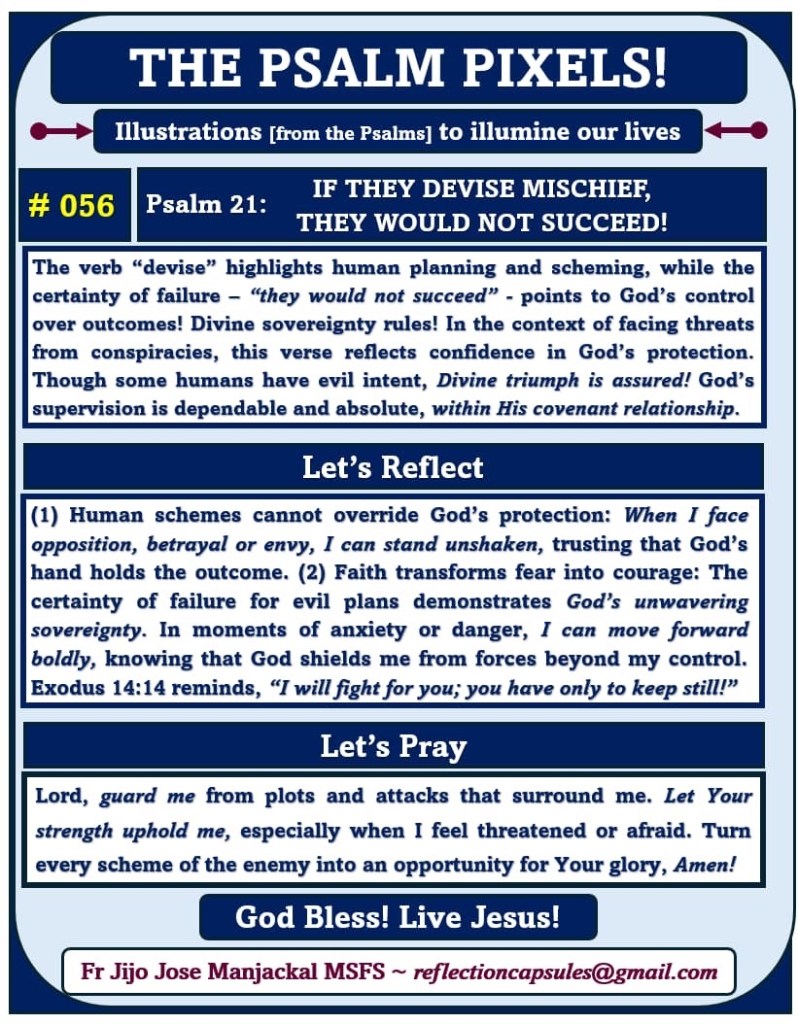
The Psalm Pixels #056
“Doing away with ‘calculative and hypocritical’ tendencies and adopting the ‘way of humility and truth!””
(Based on Isa 1:10, 16-20 and Mt 23:1-12 – Tuesday of 2nd Week of Lent)
Here is an interesting letter from a boy to a girl:
“Dearest Marie,
No words could ever express the great unhappiness I’ve felt…
… since breaking our engagement.
Please say you’ll take me back.
No one could ever take your place in my heart, so please forgive me.
I love you, I love you, I love you!
Yours forever, Jimmy
P.S., And yeah… congratulations on winning the state bumper lottery!”
That’s how very often, our attitudes and approaches in life are!
We tend to get very manipulative
And thus, often, we end up being…
… calculative and hypocritical in our relations
The call of the Gospel is to do away with this “hypocritical and tactical” tendency…
… and to adopt the “way of humility and truth!”
Am I a person who is willing to lower myself in humility?
Jesus says in today’s Gospel, “Whoever exalts himself will be humbled; but whoever humbles himself will be exalted” (Mt 23: 12)
The 23rd Chapter of the Gospel of St Matthew begins with Jesus turning the attention of His disciples and of the crowds…
… towards the Scribes and the Pharisees.
Focusing on the religious leaders and on their practices, Jesus launches a volley of critically true statements about their wicked misdeeds!
The chapter ends with the “Painful Lament” by Jesus over Jerusalem – the city of the Lord!
One of the highlights in this highly volatile and strongly-worded chapter is the number of times Jesus mentions the two groups of people – “Scribes and Pharisees”
There is, in total, 7 occurrences of the phrase, “Scribes and Pharisees” – a biblical number for totality!
This chapter is a therefore, a full-blown critique and condemnation of the ways of the Scribes and Pharisees.
Why is Jesus so outright in His condemnation, so merciless in His usage of words and so blatant in His attacks on the Scribes and Pharisees?
[Meanwhile, when we go through these critical attacks of our Blessed Lord on this group, one must always remember the words of Jesus Himself: “I have come not to call the righteous, but sinners to repentance” (Lk 5:32)
There was deep pain in the heart of the Lord, in seeing the way religion was being manhandled, misused and misinterpreted by the religious leaders of His time
As the Son of His Beloved Father, it was hurting for the Son to see a section of people, trampling upon God’s precious and venerable truths…
… and twisting them for their own self-interests and self-agenda
A strong form of condemnation was reserved only to those who were hardened in heart – as a means for them to repent and turn back their ways to the Lord.
The method of ‘sharp condemnation’ was reserved only to the proud and the arrogant; never to the poor sinners!]
The reason for Jesus making a scathing attack on the religious authorities of His times…
… could be summarized into one crucial point: Glorification of one’s own self at the expense of the Glory of God and the Mercy deserving for His people!
Therefore, Jesus goes on to point out the many occasions and circumstances when the Self-Interest of the Pharisees and Scribes took extreme priority over God Himself!
It is this self-centred and self-glorifying act that makes Jesus to tell, “For they preach, but they do not practise!” (Mt 23: 3b)
How easily can this be our own state of affairs, in our life…!
We may be people…
… who “appear” to be very fine and kind – but perhaps, we are persons who find it too hard to let go of our pride, in reaching out to the needy, in humble service!
… who speak a lot on helping others and being generous – but perhaps, we go through grilling moments in lowering ourselves and adopting a lowly status to extend a helping hand!
… who desire happiness in communities and peace at homes – but perhaps, we discover ourselves to be persons who are unwilling to let go of our ego, and allow a listening ear to the opinions of others!
Prophet Isaiah strongly appeals to each one of us, in this time of Lent:
“Wash yourselves; make yourselves clean; remove the evil of your doings from before my eyes; cease to do evil, learn to do good…” (ISA 1:16-17)
The call, today, therefore is…
… to “work for a cause – not applause!”
… to “live life to express – and not simply to impress!”
We are called to avoid being calculative and manipulative!
Yes, let’s adopt the way of humility and truth, remembering that…
… Faith is ‘not about looking holy, but living holy!’
God Bless! Live Jesus!
“Cultivating a harvest of goodness and generosity!”
(Based on Dan 9:4b-10 and Lk 6:36-38 – Monday of 2nd Week of Lent)
This story is told that one day a beggar by the roadside asked for alms…
… from Alexander the Great, as he passed by.
The man was poor and wretched and had no claim upon the ruler…
… no right even to lift a solicitous hand.
Yet the Emperor threw him several gold coins.
A courtier was astonished at his generosity and commented:
“Sir, copper coins would adequately meet a beggar’s need.
Why give him gold?”
Alexander responded in royal fashion:
“Copper coins would suit the beggar’s need…
… but gold coins suit Alexander’s giving.”
Generosity is not just about fulfilling needs…
… it’s a reflection of our character and our inner goodness!
Our behaviours towards others should not be a mere reaction to their actions…
… instead, they should mirror the essence of our own character.
The Gospel of the Day calls for ‘cultivating a harvest of goodness and generosity.’
The Lord, continuing His teachings on a practical Christian life, exhorts, “…give and it will be given to you; good measure, pressed down, shaken together, running over, will be put into your lap. For the measure you give, is the measure you get back” (Lk 6:38)
In illustrating the importance of generosity, Jesus draws upon a vivid scene from the bustling markets of Israel…
… reflecting the common marketplace dynamics prevalent in the Middle East.
Picture the vibrant open-air markets…
… where farmers display their grains—wheat, corn, barley
… on mats laid out on the ground.
In a familiar ritual, potential buyers engage in negotiations…
… bargaining over prices, quality, and quantity of the goods.
Amid this lively exchange, a customer would eventually settle on a price.
The buyer then presents their container…
… whether a sizable bowl, pot, or an open vessel.
The seller, with a measuring scoop, proceeds to fill the container, completing the exchange.
There would be some interesting steps in this process of measuring the grain for a customer and which Jesus quotes in His approach to giving:
First, the seller would fill the container to the top.
Secondly, he would press the grain down and fill some more.Thirdly, he would shake the container so the grain would settle and then fill in some more.
Finally, he would fill the container until it overflowed!
The contents of this overflowing container would then be transferred to a pouch or a bag so that the buyer could bring home the contents from the market.
Well, this process could sound a bit strange and weird to us in the modern world.
We live in times…
… when contents are sold by the weight, and not the volume
… when manipulations are done to give as less as possible
But this is where, Jesus, bringing in the example of the market, invites generosity in giving
… He encourages us to embrace a spirit of open-handed generosity!
Our giving ought to be measured not by weight, but by volume…
… and that refers to a far-greater amount of giving – generous and lavish!
Our giving ought not to be a calculated effort…
… rather should be a overflow from the heart!
St Paul in 2 Cor 9:6 says, “Whoever sows sparingly, will also reap sparingly; whoever reaps bountifully will also reap bountifully”
When we engage is such a lavish and generous giving, we have a greater experience of God showering His abundance – in fact, in a much better fashion!
“For the measure you give, will be the measure you get back” (Lk 6:38)
Of course, that is not to say that we are limiting God’s power of giving or determining His giving to our actions
But the Lord invites us to be involved in a Divine Barter System…
Give to God, Who deserves all, so that we may be blessed to receive His blessings.
In the Divine barter system, the advantage is that, we get much more than what we give…
… we obtain far greater than what we offer!
God’s giving is not to be seen just from material or physical aspects…
In fact, that would just be a very limited and low level of understanding.
God’s gifts are to be understood more from a spiritual perspective:
… Gift of His mercy to live a life in union with Him.
… Gift of His grace to be faithful and more committed.
… Gift of His love to be better human beings and be more charitable.
… Gift of His salvation to enjoy eternal bliss and happiness with Him .
All these gifts will be surely lavished and given… “good measure, pressed down, shaken together, running over, will be poured out into our laps!”
The greatest exchange – the Divine barter system – is seen and experienced in the Holy Eucharist…
… at every Holy Mass.
Let us give ourselves entirely to the Lord – especially at Holy Mass…
And through the Mass
… at all times of the day
… to all people in our life
Then, in the words of Fulton Sheen, we will be graced to hear the words of the Divine Lord telling us…
You give me your humanity, and I will give you My Divinity!
You give me your time, and I will give you My eternity!
You give me your broken heart, and I will give you My Love!
You give me your nothingness, and I will give you My all!
Let’s realize that “generosity is not just about fulfilling needs…
… it’s a reflection of our character and our inner goodness!”
Offer to others “not just the copper coins of unwilling obligations…”
… rather, generously give “the gold coins of joyful service and care!”
God Bless! Live Jesus!
“Throwing ourselves into the Hands of God, and receive what He gives us, and thus to experience the Transfiguration!”
(Based on Gen 12:1-4a, 2 Tim 1:8b-10 and Mt 17:1-9 – 2nd Sunday in Lent, Cycle A)
A five year old boy was playing in the front yard of his house, by throwing a ball up in the air.
An elderly priest, who was passing that way, asked the boy what he was doing.
The little boy, with innocence answered:
“I am playing a game of ‘catching the ball’ with God!
I throw the ball up in the air…
… and He throws it back to me!”
The senior priest was pretty amused at the simple answer.
And as he moved ahead, he thought in his mind…
“Although, the boy in his innocence just said his experience of a law of nature…
… in that simple statement, he also expressed a religious reality:
Divine experience is this: Throwing of ourselves into the Hands of God…
… and receiving what He gives to us”
That’s very true isn’t it?
Divine experience is ” throwing of ourselves into the Hands of God…
… and receiving what He gives to us”
When we throw ourselves into the Hands of God, and receive what He gives us…
… that is the experience of Transfiguration!
The Gospel of the Day presents before us the Lord undergoing the Transfiguration.
The Disciples shared in this joy.
You and me are invited today!
The Scene of the Transfiguration is one of the most captivating and thrilling scenes of the Gospels.
We shall look into this account of the Transfiguration through the eyes of St Matthew’s Gospel.
It’s interesting to see that this scene takes place on a high mountain.
Mountains play a key role in the Gospel of St Matthew.
Mountains of course, dot the landscape of the Biblical regions.
They are a great part of the physical reality of the Biblical world.
They are a symbolic of “being closer to God”.
St Matthew’s Gospel has a particular love for this “lofty symbol of God’s presence”
Jesus underwent a temptation by Satan on the Mount…
… the Mount of Temptations (Mt 4:8)
Jesus delivers His Sermon and Teachings on a Mount…
… the Mount of the Sermon (Mt 5:1)
Jesus performs many deeds of healings on a Mount…
… the Mount by the Sea of Galilee (Mt 15:29)
Jesus is transfigured on a Mount…
… the Mount of Transfiguration (Mt 17:1)
Jesus gives His final teaching and discourse on a Mount…
… the Mount of Olives (Mt 24:3)
Jesus gives up His life on a Mount…
… the Mount of Calvary (Mt 27:33)
Jesus delivers His Final Mission mandate on a Mount …
… the Mount of Galilee (Mt 28:16)
So in this Lofty and High Place of the Presence of God – a Mountain – Jesus undergoes His Transfiguration…
… and is joined by the presence of two other “Mountain” Figures – Moses and Elijah!
Moses is the Man of the Mount of Sinai and Mount Nebo – representing the Law of God!
Elijah is the Man of the Mount of Carmel – representing the Prophets of God!
Jesus is the God and Man of all the Mountains – the Fulfillment of all the Laws and the Prophets!
What is the purpose of the “many mountain settings” of the Transfiguration Scene?
To look further…
… to imagine deeper
… to hear beyond.
To see the way God sees us.
To imagine the way God perceives us.
To hear the way God wants of us.
We all need Transfiguration Moments in our lives…
… a Transfiguration Experience in our lives!
Vision that needs to be transfigured…
… into God’s representation!
Imagination that needs to be transfigured…
… into God’s resemblance!
Hearing that needs to be transfigured…
… into God’s resonance!
Let us take courage…
… and accompany the Lord!
Beyond the peripheral problems of life
… away from the hardships and difficulties of our physical, mental, spiritual, emotional worries…
…to climb the Mountain of spiritual closeness and presence of the Lord, and share in the joy of the Transfiguration!
In Book of Genesis, God tells Abram to leave…
… land, security, familiarity. (Cf. Gen 12:1-3)
God does not give Abram a map – only a promise.
Transfiguration comprises of detachment.
It happens when obedience takes priority over explanation.
In Second Epistle to Timothy, Paul reminds us that discipleship includes suffering. (Cf. 2 Tim 1:8-10)
Our worth comes from God’s call and grace “before time began”…
… so that His Transfiguring Light may shine through us, even in moments of struggle and strife!
Life has much more to offer.
Life has much more to be expected.
Life has much more to hope for….
Let us “throw” our lives into the Hands of God…
… and receive what He gives to us
And thus…
Be transfigured!
Be transformed!
Be transcending!
God Bless! Live Jesus!
“Responding to the invitation to ‘live in love’ by having a proper understanding of the word ‘love!'”
(Based on Deut 26:16-19 and Mt 5:43-48 – Saturday of the 1st Week of Lent)
A catechism teacher – an English trainer by profession – was explaining the importance of the word ‘love’ to her Class 7 students.
She said: “What is love?
Love is silence – when your words would hurt.
Love is patience – when people are rude
Love is deafness – when a scandalous rumour makes rounds
Love is thoughtfulness – when you see others in pain
Love is promptness – when you see someone in need
Love is courage – when unexpected crisis hits the boat of your lives”
And she added, “And finally…
… Love is The Man – Whom you see hanging on the Cross, shedding the last drop of His blood for us!”
Love, which takes many forms, finds its ultimate expression in “The Man” – Jesus – the Saviour of the world…
… Who invites each one of us to “live in love” by having a proper understanding of the word “love!”
Jesus, in the Sermon on the Mount, continues to pull down barriers of “comfort and coziness” by challenging His disciples to rise above the normal standards of the world.
Today He speaks on the aspect of “Love”.
Love is the fundamental and innate vocation of every human person.
Dictionaries describe love as being ‘a profoundly tender, passionate affection for another person’….
… or a ‘feeling of warm personal attachment or deep affection’.
Generally speaking, love is considered only to be a human ’emotion or feeling’.
It is something that is usually understood as being “felt” or “sensed” or “experienced”.
Jesus surely did consider “love” as an emotion and a feeling.
Therefore…
… He loved the company of people
… He cherished affection of those who followed Him
… He treasured relationships and fostered friendships with all
But beyond these “external” dimensions of Love, our Blessed Lord taught and showed a higher aspect of love
Love, not just being a “feeling” but ” love as a “decision”.
Love, not just being a “sensation” but love as a “commitment”
Therefore Jesus says:
“You shall love your neighbor and hate your enemy!” (Mt 5:43)
“For if you love only those who love you, what recompense will you have?” (Mt 5: 46)
These ‘statements on love’ must have stunned the original audience.
In the 1st-century Jewish Palestine, “enemies” and “persecutors” primarily referred to the oppressive Romans.
Jesus challenges His followers, to love and pray for those who were oppressing them…
… those occupying their land
… those imposing heavy taxes
… and those treating them unjustly.
This radical love – mirroring the Heavenly Father’s inclusive care…
… would become an identity for them to be called as ‘true children of the Heavenly Father!’
Love, when understood only as a “feeling” or an “emotion” can get reduced to being just an “object” or a “thing”
Just as one exchanges goods with each other…
… love is also exchanged with one another
Just as one shares one’s belongings and possessions with one another…
… love is also shared with one another
Just as one gives and takes things from each other…
… love is also given and taken from each other
But the Lord presents a higher understanding of love and demands a much supreme expression of love from His followers: “Be perfect as your heavenly Father is perfect” (Mt 5: 48)
Love to be a “virtue” has to surpass the ordinary realms of being “an emotion” and “feeling”…
… and transcend to being a “radical decision” and a “faithful commitment!”
When someone hurts us, we don’t “feel” like loving…
But Jesus says, “Love that person”, because love is a “daring decision”
When someone continues to be lukewarm, we don’t have any “emotions” of love…
But Jesus says, “Love that person,” because love is an “absolute allegiance”
When someone continues to cause pain, we don’t “experience” any love…
But Jesus says, “Love that person” because love is a “challenging commitment”
Now this teaching certainly irks our “normal” understanding.
How can I possibly love someone, who has hurt and killed me, mentally?
How can I be expected to show love to someone who still hurts me, even intentionally?
How can I be told to love people, who have no regard for me at all and treat me as an object?
It seems to be an impossibility.
It seems to be absurd.
But we are called to look to the Crucified Lord…
… in Whom we have the perfect example of ‘Love being lived in actuality!’
Jesus on the Cross shows that love is to be
… a “daring decision”
… an “absolute allegiance”
… and a “challenging commitment!”
One may not be able to “show” love…
… but can we at least pray, and seek for God’s blessings on the person?
One may not be able to “talk” freely to the one who has hurt…
… but can we try to wish good, and speak good about the person?
One may not be able to “resist” from having bad feelings when encountering one’s enemy…
… but can we at least offer the person to the mercy of God?
This teaching certainly seems to be a big “burden” and a significant “stress”
But this is where, we need to make a journey…
… of considering people not as a “burden” but as a brother!
… of considering people not as a “stress” but as a sister!
We are assured by the Lord that when we “observe [His commandments] diligently” with all our heart and with all our soul….
… we will be “set high above all nations that He has made, in praise and in fame and in honor; and… to be a people holy to the Lord!” (Cf. Deut 26:16,19)
Let us realize that the Lord has walked through this journey.
He is with us – to accompany us.
This journey may be hard
This journey may be hurting
This journey may be painful
But lets follow the Loving Law of the Lord…
…being impelled by the encouraging words of the Psalmist: “Blessed are they who follow the law of the Lord!” (Ps 119:1b)
We are given the powerful reminder that “Love is The Man – Whom you see hanging on the Cross, shedding the last drop of His blood for us!”…
… as we are invited to “live in love” by having a proper understanding of the word “love!”
God Bless! Live Jesus!
“Realising that it is not just what we preach, but what we practice, that makes us witness as Christians!”
(Based on Ezek 18:21-28 and Mt 5:20-26 – Friday of the 1st Week of Lent)
An eloquent priest was explaining to a group of youngsters, on who is a Christian.
He said:
“It is not what people eat, but what they digest…
… that makes them strong
It is not what we earn, but what we save…
… that makes us rich
It is not what we read, but what we remember…
… that makes us learned
And finally, it is not just what we preach, but what we practise…
… that makes us Christians!”
So true, isn’t it?
Very often, we associate our Christian way of life, only with external practices of prayer and devotion
But we need to realise…
…. every prayer needs to be accompanied with works of charity!
… every act of devotion needs to be complemented with deeds of mercy!
Jesus always keeps challenging us!
He loathes laziness and lukewarmness!
He loves to keep raising the standard of our holiness and faith!
This challenge is reflected in today’s Gospel reading.
Jesus says, “Unless your righteousness exceeds that of Scribes & Pharisees, you can’t enter the Kingdom of heaven” (Mt 5: 20)
The righteousness of the Scribes and Pharisees consisted…
… in a lifestyle which insisted only on the exact following of the ‘letter’ of the Law neglecting its spirit
… in a tendency to neglect the fundamental aspects of the Law and focus only on the peripheries
What could be some of the negative aspects of the righteousness of Scribes and Pharisees, which Jesus condemns…
… and which, perhaps, we need to overcome?
1) Sin had only to do with “external actions” and not concerned with “internal intention!”
Sin was considered as ‘the external violation of the Mosaic Law and oral traditions…
… while completely neglecting the inner disposition of the heart.’
Ritual purity, Sabbath observances, and legalistic practices were glorified….
… but greater sins like pride, greed, and hypocrisy were conveniently sidelined!
A sinner was someone who openly broke the Law, such as tax collectors and prostitutes…
…. anyone breaking ‘the law of love in their hearts’ was never considered as doing wrong!
The Scribes and Pharisees seemed to be in this category of people…
… and Jesus condemned this “superficial righteousness!”
2) They liked to preach, but not practise
We live in a world where there are many people who are good in preaching, writing reflections and advising on spiritual matters.
But very often, a massive chasm appears between their preaching and their way of life.
The Scribes and Pharisees seemed to be in this category of people…
… and Jesus condemned this “‘only-talk, no-walk’ righteousness!”
3) They liked to do things to “show-off”
A tragedy of religious practices can be, when things are done not to please God, but to win the approval and endorsement of people.
Religious piety and devotions very often become means to have self-gratification of one’s senses…
… and sadly, even platforms to boast and brag about one’s capacities and capabilities.
The Scribes and Pharisees seemed to be in this category of people…
… and Jesus condemned this “showy and puffed-up righteousness!”
4) They liked to make the Word of God, user-friendly, at the cost of God’s Will
One of the trends in the modern world, is to have all products and gadgets “user-friendly”.
Sadly, this trend is also often applied to the Word of God.
The Word of God, its commandments and laws are twisted and condensed and expanded and interpreted and quoted and explained and elucidated – all to suit one’s own comfortable and pleasurable way of life!
The Scribes and Pharisees seemed to be in this category of people…
… and Jesus condemned this “‘trending & tempting’ righteousness!”
Am I in any of these category of peoples?
The Lord challenges us today…
… to exceed this sort of a righteousness of the Scribes and Pharisees.
We need to be people…
… “who walk the talk!”
… “who practice our Faith to please God and Him alone
… “who live a Gospel-oriented life”
The Gospel ought to mould and shape us – and not we changing the Word of God to suit and justify our secured and comfortable lives!
Gal 1:10, says,” If I were still trying to please people, I would not be a slave of Christ.”
As followers of Christ, it is our duty and task to go beyond a “Pharisaic and Scribal Lifestyle”…
… and live as Jesus would want us to!
We are reminded today that “God looks at our heart today, not just our history!”
Prophet Ezekiel tells us that ‘man is not righteous because of his past, nor condemned forever by his failures.’
‘If the wicked turns from his sins… he shall surely live’ (Ezek 18:21)
True righteousness is in a heart that turns back to the Lord…
… seeking refuge at all times in His Holy Will and His Holy Mercy.
Let’s realise that it is not just what we preach, but what we practice…
… that makes us witness as Christians!
Let our every prayer, be accompanied with works of charity…
… and our every act of devotion, be complemented with deeds of mercy!
As St Francis of Assisi says, “Preach the Gospel always… use words, if necessary!“
God Bless! Live Jesus!
 Reflection Capsules