11 Aug (Based on Mt 18:1-5,10,12-14)

A little boy once came to his Daddy, one night.
He confessed a mistake that he had done during the course of the day.

Then kneeling at Daddy’s feet, the child, with hands folded, prayed with tears:
“Dear God, make me a man – like Daddy – wise and strong.
I know You can!”

This innocent gesture touched the father very much.
 He had a profound realisation of his deep limitations and the child’s high expectations

Then when the child had slept, the father knelt beside his bed.

Confessing his sins, and praying with a low-bowed head, made this prayer:
“O God, make me a child – like my sweet child here – pure, guileless, trusting in You with a faith sincere.
I know You can!”

We all grow up in life – physically, socially, psychologically etc
But sometimes this “growing up” fails to preserve the “growth” that is already witnessed in little children – openness, sincerity, trust and spontaneity.

Can we dare, as adults, to “grow” into being a Child?

The Gospel of the Day is an elegant presentation by Jesus on the “necessary attitude” that is required for a valid entry into the Kingdom of Heaven: a child-like nature.

Jesus says, “Truly I say to you, unless you turn and become like little children, you will not enter the Kingdom of Heaven” (Mt 18: 3)

One of the grave dangers in the process of “growing- up” is the tendency to lose our “natural child-like” traits.

A child is someone who is born with many inherent qualities.
But in the process of “becoming an adult”, we abandon many of those.

This ‘abandonment’ could be because…
… of the upbringing in the society or the culture we live
… or the various experiences that we go through as we grow up

As a child, we would be free to express our emotions
… but as we grow up, we tend to hold them up all within (only to burst out one day!)

As a child, we would trust and depend easily on those who care for us
.. but as we grow up, we become fearful or disbelieving towards those same persons

As a child, we would be eased to live in the present moment, enjoying and relaxing
… but as we grow up, we fall into the trap of the past and cringed with the fear of the future.

This “growth” process also affects our child-like faith and trust in God our Father.

Jesus presents the beautiful imagery of a Shepherd who goes behind the lost sheep.
 The cry of that sheep which has been strayed pierces the heart of the shepherd
 The dangers that the sheep which was lost is exposed to frightens the shepherd

Such is the deep longing and craving of our Heavenly Father towards us – we, who sometimes turn out to be the lost sheep by losing our child-like faith and confidence.

A popular song from the Hindi movie “Three Idiots” has the following line:
“… Give me another chance, I wanna grow up once again…”

The Lord invites us to have a “renewal of our minds” and to retrieve back the ‘lost’ child-like faith and trust.

It takes courage and dare to make efforts to let go of our “matured egoistic” tendencies in order to depend more on our Heavenly Father.

The process usually is encountered by resistance…
• Why should I depend on someone… I am mature enough to think for myself
• Why should I become humble… I have my own desires to be satisfied to

These could be some of the thought-patterns that one stumbles into, in giving heed to the call of the Lord to ” be like a child”.

Our Lord Himself is the greatest model and example in learning to have a “child-like” faith…
St Paul tells in his letter to the Philippians, ” ..though He was in the form of God, did not regard equality with God, a thing to be grasped. Rather, He emptied Himself, taking the form of a slave…. becoming obedient to death, even death on a cross” (Phil 2: 6-8)

May St Clare of Assisi, whose feast we celebrate today, become an inspiration for us to firmly trust in God.

In her words:
“Place your mind before the mirror of eternity!
Place your soul in the brilliance of glory!
And transform your entire being into the image of the Godhead Itself through contemplation!

Gaze upon Him, consider Him, contemplate Him, as you desire to imitate Him.”

May we be privileged to be graced with the gift of being “like children” and thus be able to firmly trust and relax in the arms of our Caring and Loving Heavenly Father!

God Bless! Live Jesus!
9th Aug (Based on Jn 6:41-51)

Here is an interesting conversation …
… between two friends – Isa and John

Isa, an intelligent and faithful Muslim expressed an interest in understanding the faith of his Catholic friend John and asked him to take him for the Holy Mass.

After the Mass, John asked Isa what he thought of it.

Very slowly and thoughtfully, Isa said, “Do you Catholics really believe that thing, that small piece of bread , is not bread but Jesus Christ?”

“Yes, we do” said John

“Your Church teaches that God is really present there?”

“Yes”

“The priest at the Altar said, body and blood, soul and divinity. You really believe all that?” came the next curious query from Isa.

“Yes, we do” replied John, growing defensive.

Isa then made as if to say something, but refrained from saying it.
John assured him that he would not be offended.

Finally, hesitatingly, Isa said, “I don’t really understand your faith!”

With a relief, John calmly said, “I can understand how you feel. It sounds very shocking, I know”

“No, you don’t understand. That’s not what I mean. You will take it as an insult, but I don’t mean it to be”, explained Isa.

“I promise that I will not take it as an insult. But I really want to know what is on your mind.”, clarified John

“Well then. . . . I don’t think you really do believe that. I don’t mean to say you’re dishonest, but . . . .”

“Hmmm… I think I know what you mean. You can’t really understand anyone who believes something so shocking.
You don’t see how one could ever get down on one’s knees before that altar, right?”

“No” enlightened Isa, “I don’t see how I could ever get up.

If I believed that little thing that looks like an ordinary round of bread was really Allah Himself, I think I would just faint.
I would fall at His feet like a dead man!”

Those words hit John like a lightening.

Here was a man, not of his faith, but who seemed to truly understand the mighty power of the Little White Host – the Holy Eucharist!

• He had been a Catholic all his life.
• He had been receiving the Holy Communion for many years.
But never before had he ever thought that the Eucharist could actually be so powerful!

Is my Catholic Faith, in the Holy Eucharist, in the lines of John…
… believing yet not really passionate
… professing faith, but not fully convinced
… theoretically doubting and practically not living

The Gospel of the Day is a continued discourse by Jesus, on the Bread of Life and is a strong reminder to revive, refresh and renew our Faith in the Lord – especially in the Most Holy Eucharist.

The Gospel passage begins with the verse, “The Jews then murmured at Him, because He said, ‘I am the bread which came down from heaven'” (Jn 6:41)

We notice here a sharp change in attitude and approach of the people..
• At the start of the Chapter, when Jesus had multiplied the bread and the people had their satisfied fill, they were extremely excited, enthusiastic and energized with respect to Jesus. (Jn 6: 1-15)

 They were overawed by His spectacular miracle
 They were keen to crown this “Bread-Giver” as their King

• But as we progress through the Chapter, we observe that the people are antagonized and annoyed by the words of Jesus that ‘He is the Bread from Heaven

 They were scandalized by His comparison to being greater than even Moses, whom alone they had considered to be the bread-giver in the wilderness
 They were lethargic and disinterested in accepting the teaching of Jesus because they knew of his earthly origins and his family background

The result: Jesus, the Bread of Life failed to be understood and be accepted!
• Their hardheartedness and their supposition that “they knew Jesus” prevented them from accepting the Bread of Life!
• Their unwillingness to be open to the truth and their pride in failing to realise that Jesus was someone who transcended earthly ties, caused them to be blinded in receiving the power of the Bread of Life!

Do these factors prevent us also from understanding and accepting Jesus, the Bread of Life in the Most Holy Eucharist?

 Am I being ignorant of the teachings of the Church and thus fail to realise the depth and the worth of the Holy Eucharist?
 Do I feel that “I know a lot of things” and that the teachings concerning the Holy Eucharist are just “not reasonable” or “do not sound logical” or are “too childish”?

Jesus in the Holy Eucharist is the greatest treasure, the mightiest force and the most supreme source of love on the earth.

But how many of us really make efforts…
… to strengthen this faith?
… to grow in this awareness?
… to nurture this conviction?

St John Maria Vianney said, “If we really understood the Mass, we would die of joy”

Every participation in the Holy Eucharist ought to make us die…
Perhaps, physically we are yet to attain that height of sanctity

But we ought to die…
… to our sinful ways of life
… to our pride and other vices that can cripple us
… to our selfish desires that denies giving the Lord the prime place in life

As Catholics, we profess and take pride that we have a Living God, “truly, really and substantially” present in the Holy Eucharist.

But…
 Can we live a life worthy of this Blessed Presence?
 Can we be truly zealous and passionate in our love for Jesus in the Holy Eucharist?

St Francis de Sales says:
“When the bee has gathered the dew of heaven and the earth’s sweetest nectar from the flowers, it turns it into honey, then hastens to its hive.

In the same way, the priest, having taken from the altar, the Son of God (who is as the dew from heaven, and true son of Mary, flower of our humanity), gives him to you as delicious food.”

May Jesus, the Bread of Life, present in the Holy Eucharist inflame the sparks of our faith and may it blaze briskly,  in devotion and service!

God Bless! Live Jesus!

8th Aug (Based on Mt 17:14-20)

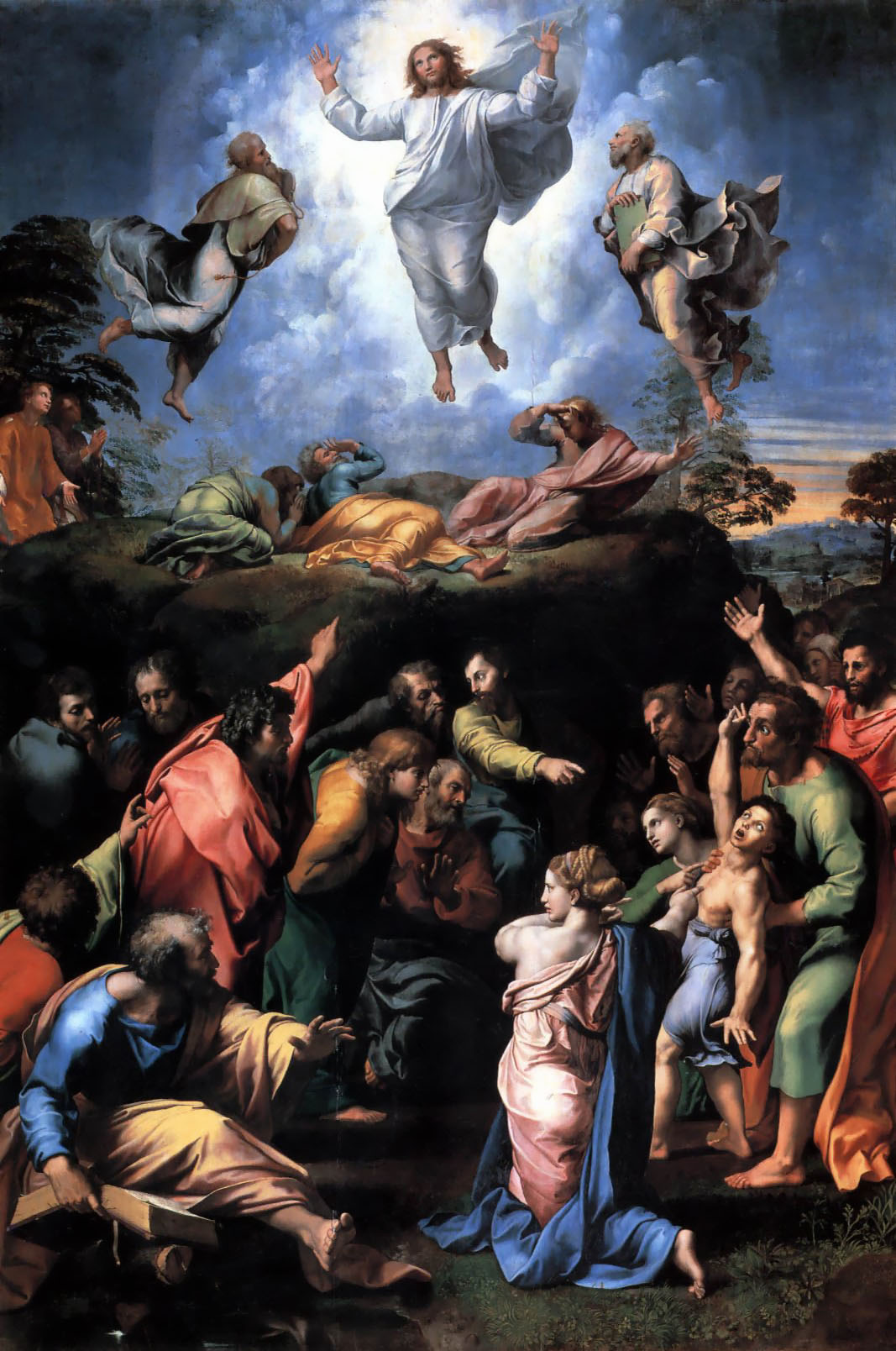
Raphael is the famous Italian painter – the architect of the High Renaissance.

Together with Leonardo da Vinci and Michelangelo, he forms the traditional trinity of great masters of that period.

There is a famous painting of the Transfiguration of our Blessed Lord by Raphael.
This painting was done in Rome in 1520.

Raphael had his health deteriorating at this time, as soon he was to die at the age of 37.
With the life-energy draining out of him, he chose to apply his mastery strokes on the painting of the Transfiguration.

image

In the upper centre part of the painting is seen a flat, rock mountain top.
 The three disciples – Peter, James and John – are shielding their eyes from the glory.
 Just above them, in the air, are Elijah and Moses and Jesus.
 Jesus is glisteningly white, as scripture says, “no fuller on earth could bleach”

At the bottom of the mountain, is the crowd of the other disciples.
 They are being unable to heal a boy, who is possessed by a demon.
 The boy, an epileptic is seen in a fit of seizure, and flanked by his helpless father

These two contrasting images in the same picture are drawn from the 17th Chapter of the Gospel of St Matthew.
• The Transfiguration of the Lord (Mt 17: 1- 13)
• The inability of the disciples to heal the epileptic boy (Mt 17: 14ff)

The Gospel of the day is the second incident: of how the disciples fail to heal the boy and how Jesus intervenes to cure and teaches the importance of possessing strong faith.

These two incidents that are depicted in the Painting of the Transfiguration by Raphael, shows contrasting dimensions…
 On one side, immense glory being revealed and the Divine splendour being manifested
 On the other, lack of faith being exposed and the failure in the Kingdom ministry

 On one side, the three disciples basking in the light of heightened faith and devotion
 On the other, the other disciples being lost in the darkness of inability to put the faith to effectiveness
.

And how often is this the painting of our own lives too…

• There are some moments when we experience the loftiness of God’s glory and power
• There are other moments when we fail  miserably to evoke His presence and are unable to feel His

• There are some times when faith makes us to feel that everything is so glorious and wonderful
• There are other times when our faith hits rock-bottom and our spiritual life loses its sheen and all seems so miserable

This is the reality of our lives – contrasting experiences of glorious faith at some instants and miserable lack of trust at other

But the Gospel of the day ends with an encouraging exhortation by Jesus to have a strong and sturdy faith – the faith the size of a mustard seed

“If you have faith the size of a mustard seed, you will say to this mountain, ‘Move from here to there’ and it will move. Nothing will be impossible for you” (Mt 17:20)

When the disciples were unable to bring about a healing to the epileptic boy, the Lord sure did rebuke them for their “lack of faith”.

But after having healed the child, He does not linger with the reproaching or admonishing attitude… instead as a loving friend and a caring master, gently but firmly encourages them to be stronger in their faith.

This is the approach that He has towards us too…
 He knows that we have our weak moments and situations of disbelief and doubts
 He knows that there are periods when our faith is merely on the lips and not really from the depths of our hearts
 He knows that there are times when annoying circumstances encroach our faith-life and all our efforts in devotion meet with bitter conclusions

Yet, with firmness and fondness, Jesus invites us to keep seeking to grow in our trust in Him and have faith of the size of the mustard seed.

Today we celebrate the Feast of St Dominic, the valiant preacher of the Word of God and the passionate promoter of the Devotion to our Blessed Mother in the Holy Rosary.

Fulton Sheen speaking on the Rosary says:
“The rosary is the book of the blind, where souls see and there enact the greatest drama of love the world has ever known.
It is the book of the simple, which initiates them into mysteries and knowledge more satisfying than the education of other men.
It is the book of the aged, whose eyes close upon the shadow of this world, and open on the substance of the next.
The power of the rosary is beyond description.”

May the words of St Dominic, “A man who governs his passions is master of the world.
We must either command them, or be enslaved by them.
It is better to be a hammer than an anvil”

… and our love for our Blessed Mother through the Holy Rosary help us to deepen our faith and trust in the Lord!

God Bless! Live Jesus!

7th Aug (Based on Mt 16:24-28)

Dayton Ohio in America has an elevated railway.

One of the stations of this railway was near a great Roman Catholic burial ground named Calvary Cemetery.
 The name of this station was Calvary Station.

The unique aspect of this station was that the trains did not stop at this station, except on request.

The reason?
For several years, in that part of the town, there were many more dead than living people.

Therefore, just after leaving the nearest station, the train guard would open the door and shout:
“Next station is Calvary! Train stops on request only…
Anybody for Calvary?”

Perhaps this a parable of life’s train!

At all other stations, life’s train stops – market-street station, school-street station, church-street station, home-avenue station etc…

But only at one station, there is a stop only when someone chooses to: the Station of Calvary!

The Gospel of the Day has Jesus, the Guard of our Life’s Train echoing the invitatory words, “Anybody for Calvary?”

Jesus tells His disciples, “Whoever wishes to come after Me, must deny Himself, take up His cross and follow Me” (Mt 16:24)

One of the finest aspects about Jesus, as a Person and as a Teacher, is the clarity and precision that He maintained in all His words and deeds.
 He was clear and precise of what was His Mission on the earth
 He is clear and precise also, of what is expected of His followers.

• There is no pretence or deception in His talks.
• There are no loopholes or strings attached in His demands

He makes it precisely clear that the one who follows Him must fulfil the three basic conditions:
1. Denying Oneself
2. Taking up the Cross
3. Following Him

• Denying Oneself – demands that one is willing to entrust the reins of one’s life totally to the Master.

 It means a priority of the highest order that is reserved for the Lord and His Kingdom
 It means a constant rejection of desires that cause the self to be greater than the Lord

• Taking Up the Cross – demands that one is wholeheartedly and readily willing to do one’s duty as a Christian, joyfully and steadily

 It means an availability to be at the service of the Lord and His Kingdom at all times
 It means a seeking and an acceptance of the Will of God at every moment of life

• Following Him – demands that one keeps a steadfast focus on the Lord alone and keeping away anything that would cause a distraction

 It means a faithful and an unflinched commitment to walk only on the path that the Lord demands
 It means a radical letting go of anything that can be contrary to the Gospel ways and the Kingdom values.

But very often we find that these things are easier said, than done…

• We wish to deny ourselves.
But too often….
 Our selfish desires dominate over us and we get disillusioned
 We give in to making excuses or dilute the seriousness of our call

• We wish to take up our cross
But too often…
 We feel ourselves overburdened with responsibilities
 We fear the hardships of disciplining ourselves and shy away from it

• We wish to follow Him
But too often…
 Worldly distractions and human affairs preoccupy us and our hearts get divided in our loyalty to the Lord
 Our enthusiastic hearts get weighed down by scandals or lack of motivations or even opposing forces

But the Lord, through today’s Gospel gives a call once again – to embrace a life of the Cross!

The way of the Cross is the only true path for a Christian.
• That was the way of the Lord.
• That is to be the way of each follower too.

As Dietrich Bonhoeffer, a German theologian says, “To endure the cross is not tragedy; it is the suffering which is the fruit of an exclusive allegiance to Jesus Christ”.

A life embracing the cross is the hallmark of a Christian – in self-denial, in total commitment and with complete sincerity.

As our life-train chugs on, Jesus, the Guard echoes the call, “Anybody for Calvary?”

Calvary is “the offence of the cross”
 None stops there except the one who chooses to
 It’s a stumbling block for the Jews and foolishness to the Greeks ( 1 Cor 1:23)
 But to those who believe, it is the power and wisdom of God ( 1 Cor 1: 24)

Are we willing to request for a stop at Calvary – to embrace the Cross of Christ?

God Bless! Live Jesus!

5 Aug (Based on Mt 15:21-28)

Years back, in the late 1900’s, engineers were asked to give their opinions on a possible railroad through the Andes Mountains

(Andes is the longest continental mountain range in the world; it passes through seven South American countries: Venezuela, Colombia, Ecuador, Peru, Bolivia, Chile, and Argentina)

They concluded that the job would be an impossible one.

However, as a last resort, an engineer from Poland named Ernest Malinowski was called in.

Malinowski’s reputation as an engineer was famous, but he was in the aging sixtieth year of his life at that time.
The authorities feared to impose such a rigorous task on the old man.

Malinowski, however, assured the representatives that the job could be done.

The railway began to worm its way across the Andes from Peru with sixty-two tunnels and thirty bridges along its way.
• One tunnel ran up to 4,000 feet in length, 15,000 feet above the level of the sea.
• On two occasions, revolutions in some of the countries through which the railroad passed, held up construction.
• Once Malinowski had to even flee to Peru and remain in exile for a time

But nothing could prevent the old man in completing the engineering feat.

By 1880, work was completed on what, till recent times (2006), was the highest railroad in the world.

Malinowski had many barriers towards the achievement of this grand feat…
… The problems arising out of old age
… The challenging mountainous terrains
… The impossibility expressed by many other engineers

However, nothing of it could deter his determination in achieving what he wanted!

Life rewards abundantly, those who are willing to challenge the barriers and be persistent in overcoming them!

The Gospel of the Day presents the beautiful story of a mother who dared to “break through” the mountainous terrains of religious prejudices, social ignominy and personal misery to  bridge blessings from God for her precious daughter.

Jesus had withdrawn to the district of Tyre and Sidon (Mt 15:21)

In the Old Testament times, this region was better known as the area of the tribes of the Canaanites.
• Over the years, the land had grown in paganism as well as corruption.

Their presence was a strong threat to the purity of Israel’s religion and morality.

Therefore, there was a long history of spiritual and military clashes between the Israelites and Canaanites.

It was in this place that Jesus meets one of them – a woman, whose daughter had been “severely possessed by a demon” (Mt 15:22b)

The presence of “that” woman, however, made the disciples of Jesus, to complain to their Master, “Send her away, for she keeps calling out after us” (Mt 15: 23b)

At this juncture, we hear two cries…
 One – the cry of the woman
 The other – the cry of the disciples

 The woman cried out of helplessness and out of deep misery – for the “unclean” demon to be cast away from her daughter
 The disciples cried out in wretchedness and disgust – for the “unclean” woman to be cast away from their presence

It’s interesting to note the wordplay in Greek,  in the words of the disciples and those of the woman…

 The disciples uttered, “APOLYSON – send her away”
 The woman cried, “KYRIE ELEISON – have mercy, Lord”

These two similar-sounding yet contradicting choruses were ringing in the air – “Apolyson – Kyrie Eleison… Apolyson – Kyrie Eleison”

The Master then stepped in to say, “I was sent only to the lost sheep of the house of Israel… It is not right to take the food of the children and throw it to the dogs” (Mt 15: 24, 26)

Perhaps the addressing of Jesus as a “dog” would have come as no surprise to the Canaanite woman.

It was a reminder of the sharp distinction that existed, historically, between the Blessed Israelites and the Cursed Canaanites.
 The Jews “were” considered as the “children” and the Canaanites (Gentiles) “were” considered as “dogs”

And in every house, the children get fed first… not the dogs!

But the figurative tone set forth by Jesus, found its amazing reply in the words of the Canaanite woman, “Yes, Lord, for even the dogs eat the scraps that fall from the table of their masters” (Mt 15: 27)

Here was a glorious acknowledgement by the woman…
“Yes, I am a Canaanite, and considered to be a dog.
I do acknowledge that Israelites have a special privilege in the order of God’s grace.

But we too, deserve the Grace of God that is due to all people, in general!”

I demand not the privileged bread that is reserved to the mighty….
But, just the crumbs of Your grace will suffice in healing my ailing daughter!”

That was an amazing reply of persistent faith!

The mountainous terrains had been broken!
No religious prejudices, no social ignominy or no personal misery could prevent the bold faith of the woman to bridge the blessings of God’s healing!

Yes, life rewards abundantly, those who are willing to challenge the barriers and be persistent in overcoming them!

With immense pride, the Lord proclaimed, “O Woman, great is your faith” (Mt 15: 28)

Do we also seek to possess such kind of a tremendous faith and unperturbed persistence?
• Sometimes we hear – like the cries of the disciples – discouraging voices and refraining chants…
• Sometimes we have to encounter the agonizingly painful and silent response of the Lord…
• Sometimes we have to bear humiliating challenges to our prayers and even disturbing answers from the Divine..

Yet, like this wonderful mother, who was determined to break down every “mountain” of barrier, for the sake of a miracle for her daughter…
… do we remain courageous, firm and bold in our faith and trust in the Lord?

St Francis de Sales says, “when you encounter difficulties and contradictions, do not try to break them; try to bend them with gentleness and time.”

May Our Blessed Lord – the God of all peoples – bless us with a firmness in our faith, perseverance in our piety and courage in our convictions!

God Bless! Live Jesus!

4th August ( Based on Mt 14:22-36)

In 1805, a young man, at the age of 19,  entered the seminary to be a priest.

After several months of study, he was still not prepared to attend lectures in Latin.
He went to live with a friend who was a priest and who personally tutored him.

Life was throwing a mighty challenge to him:
 Whether he could trust in God or not…
 Whether to continue ahead in life or not…
 Whether he could have his focus on God or not…

This priest-tutor finally persuaded the bishop to ordain him not for his learning, but for his holiness.

A few years later, this young man – now already ordained a priest – was assigned one of the most forsaken villages in the Diocese.

People in this place were highly careless about practising their faith.
• Many indulged themselves in dangerous activities and pastimes.
Life as a missionary was being too arduous and difficult.

Life was again throwing a mighty challenge to him:
 Whether he could trust in God or not…
 Whether to continue ahead in life or not…
 Whether he could have his focus on God or not…

Yet, with increased prayers, fasting and penance, the priest was able to revive and nurture the faith in the land.

The name of this priest is St John Maria Vianney.
He is feted as the Patron Saint of all Priests, and today we celebrate his feast day.

At various stages, life  had pushed him to the corners and there would be questions hurled at him: questions on whether he could trust in God, on whether he could continue ahead and on whether he could have his focus on God.

Our own personal lives at crucial and constant junctures of life faces such dilemmas, isn’t it?
How do we handle and go about facing such torrid queries of life?

The Gospel of the Day seeks to instil hope and courage in such “trying” moments of life.

After the multiplication of the loaves, Jesus dismissed the crowds.
He made the disciples to get into the boat, while He went up to the mountains to pray (Mt 14: 22-23)

Here is a great lesson that Jesus teaches us…

There will be many success stories that would be woven in life.
• Yet, all those occasions ought to lead us closer to God  – the source of every success.

Every success in life ought to, not make us proud – instead, in humility, lead us to grow closer to God – in gratitude and for greater strength.

There will also be times when the sun shines bright and there are many admirers thronging our life.
• Yet, all those occasions ought to make us realise that in God alone ought to be my true joy and satisfaction.

Every joy of life ought to, not make us lose ourselves in the thickets of achievements – instead, in meekness, help us to depend more on God – in trust and for greater faith.

As the disciples were lost on the sea, with the winds and waves turning against them, they saw Jesus walking on the sea (Mt 14: 25)

However, Jesus sought to drive away every ‘ghostly fears’ and assured them of His presence.

Peter, however, the leader of the gang took the initiative of going towards Jesus and walking on the water.
He even made his first steps on the waters.

However, when he saw the mighty winds, he got frightened and cried out, “Lord, save me” (Mt 14: 30)

Immediately, the Gospel says, “Jesus stretched out His Hand and caught him and said to him ‘O you of little faith, why did you doubt?'” (Mt 14: 31)

Here was life throwing a mighty challenge to Peter:
 Whether he could trust in God or not…
 Whether to continue ahead in life or not…
 Whether he could have his focus on God or not…

As long as he had his focus on the Lord, things were fine

But the moment, he wavered in this “focus”, Peter began to sink

The boats of our Christian lives often pass through the stormy waters of problems and difficulties.
There will be many moments when our faith makes attempts “to walk on the waters” with the Lord.

• As long as we keep our focus on Him, things would be fine.
• As long as we don’t look at the waters and instead look on to Jesus, things would be good.

But the moment there is a “deviation” in this focus – there will be the “sinking” experience!

Can we grow in our trust… in being always focussed on the Lord?

St John Mary Vianney, whose feast we celebrate today, is an inspiration for us towards building a life of dependence and focus on the Lord alone.
 He had many moments to let go of life, in despair and discouragement.
 He had many stages when it was hard to continue on in life
Yet, he was constantly able to keep his focus on the Lord and live a life of “immense trust and obedience”.

May the intercession  and inspiration of this great Saint – St John Mary Vianney – help us to lead a life ‘focussed’ on the Lord!

God Bless! Live Jesus!

3rd August ( Based on Mt 14: 13-21)

The first half of the 17th century saw Germany finding itself in the midst of wars, famines and pestilences.

In one of the cities named Eilenburg, lived a pastor by name Martin Rinkart.

Plague had swept through the town and the Thirty Years’ War had caused major wreckage among the people.

On one particular day, Rinkart had to conduct up to 50 funerals a day – some including the members of his own family.

Yet, when darkness and destruction was raging hard, Pastor Rinkart wrote as many as 66 sacred hymns.

Among them, was the song, “Now thank we all our God!”
(This hymn is included in the Hymns for Night Prayers in the Divine Office Prayer Book)

“Now thank we all our God, With heart and hands and voices
Who wondrous things hath done, In whom His world rejoices

Who from our mothers’ arms, Hath blessed us on our way
With countless gifts of love, And still is ours today”

That was amazing, isn’t it?

• As sorrow was encompassing him all around, Rinkart could still sing of the gratitude to God
• As the sea of grief surrounded and lashed his life, he could still chant the hymns of thanksgiving

 Thankfulness does not always have to bear an appointment with prosperity and peace, isn’t it?
 Gratitude does not necessarily have a date with ‘all things being fine’, isn’t it?

Our entire life – be it entrenched with joy or ingrained with moments of grief – ought to become a ‘demonstration of thankfulness and gratitude’.

The Gospel of the Day presents the beautiful picture of Jesus “raising His heart in gratitude” even in discouraging and despairing moments.

The Gospel passage is the familiar episode of the multiplication of the loaves.

Humanly considered, the scene was pretty discouraging and daunting…
• It was a deserted area
• Vast crowds of people – many who had followed Jesus on foot – had spent a large part of the day with the Lord.
• It was already evening and the time was running out for the people to get food for themselves

When the disciples looked at the massive challenge that was put forward by Jesus  – “Give them some food yourselves” (Mt 114:16) – they would have been totally in despair and confusion.

The challenge of Jesus had given them every opportunity to complain and whine…
…. Is our Master gone crazy in telling us to provide food for such a massive crowd, without having any resources at hand?
… Has our Master forgotten the basics of economics – that demand can be met only when there is a proper supply?
… Is this our Master’s way of humiliating and insulting us before such a large multitude?

 There was hardly anything to look forward to…
 There was absolutely no trace of hope coming on the way…

• Tension and worry was in the air…
• Clouds of despair and apprehension were getting thicker…

Yet, with great confidence and trust, Jesus, the Master was an epitome of thankfulness and gratefulness!

As the saying goes:
“Worthwhile is the smile of the boy who can still grin, when his two front teeth are knocked off!”

Making the crowds sit, Jesus exhibits a wonderful act of gratitude.
“Taking the five loaves and the two fish, and looking up to heaven, Jesus said the blessing…” (Mt 14: 19)

It was as if the Lord was singing a hymn in His heart,
“O may this bounteous God, Through all our life be near us,
With ever joyful hearts, And blessed peace to cheer us,

And keep us in His grace, And guide us when perplexed,
And free us from all ills, In this world and the next”

The two fish and the five loaves – humanly speaking – were nothing before the mighty crowd.
Yet, our Blessed Lord could chant the strains of thanksgiving in His Heart!

Gratitude is a beautiful flower that blooms in a garden nurtured by the waters of trust and hope in God!

And so the Lord invites that our entire life – be it entrenched with joy or ingrained with moments of grief – ought to become a ‘demonstration of thankfulness and gratitude’.

 Today our life maybe at the crossroads
 Today our hearts may be touching rock bottom due to many problems and worries.

Yet, can we take heart, and like Jesus, dare to sing a hymn of thanks and gratitude?

Can we lift up the five loaves and two fish…
…. of our broken dreams and our shattered hopes
… of our blurred vision and our lost enthusiasm
… of our confused present and our uncertain future…
… and OFFER it up to God – “looking to heaven and saying the blessing”?

• A miracle might not seem anywhere in sight…
• A wonder may be improbable as per our calculations…

But when one lifts up one’s heart in gratitude – despite the hopelessness and the despondency around – the God of all wonders will surely multiply blessings in our lives and “we shall be filled and satisfied with His glory!”

Thanksgiving grows out of a heart of immense certainty and confidence in God.

 The evening clouds of despair might be descending fast in our lives…
 Our lives maybe estranged in the wilderness of loneliness and dejection..

Yet, may our Blessed Lord inspire and give us the grace to make our lives a constant ‘demonstration of thankfulness and gratitude’.

May we always sing:
” All praise and thanks to God, the Father, now be given,
The Son and Him Who reigns, With Them in highest Heaven;

The one eternal God, Whom earth and Heaven adore;
For thus it was, is now, and shall be evermore!

God Bless! Live Jesus!

2 Aug (Based on Jn 6:24-35)

A man once had a fine-bred dog – an American Foxhound – named Jasper.

Jasper was trained well and the owner expected much of him.

Finally, after his ‘training’, Jasper was let go on a ‘hunt’ in the nearby forest.

As he was let free, Jasper got sight of an antelope and gave a spirited chase.

Soon, however, a startled rabbit came across the track of the antelope, diverting Jasper’s attention!
Forgetting the antelope, Jasper dashed after the rabbit.

Just as he was gaining momentum, a rat darted across the path!

Again, Jasper diverted and rushed after the rat, only to see it run into a hole in the ground.

Highly excited, scratching and barking, Jasper presented a picture of frustration –  distracted from the ‘big thing’ to end up by barking into a hole in the ground!

Jasper had been trained and was expected to chase “bigger” preys; but ended up, grunting, lunging and scratching at something worthless!

The reason was simple:
• Losing sight of the bigger goal and instead, being distracted by something very petty and useless
• Unable to keep focus on the ‘more’ valuable aim and instead, being diverted by something very trivial.

Is my life also “losing sight” of the precious aspects of life?

Am I seeking “the right things” and the “proper entities” of life?

The Gospel of the Day is a call by our Blessed Lord to ‘refine’ our priorities in life and to ‘re-sort’ our concerns towards Him and His Kingdom.

Today’s Gospel passage forms part of the “Bread of Life” Discourse of the 6th chapter of St John.

Jesus, after having performed the ‘magnanimous’ miracle of the multiplication of the loaves, had His popularity ratings on a high.

There were many factors that propelled towards this…

 Huge problems suddenly seemed to ‘shrink in size’ before Jesus, the Great God!
A huge crowd, who were ‘hungry’ had just been ‘satisfied’ to the full

 Impossible situations suddenly seemed to be non-existent before Jesus, the God of all possibilities!
Just two little fish and five barley loaves became a medium of nourishment to thousands

There was naturally, immense excitement among the crowds with respect to Jesus.
• Before their own eyes, a ‘massive’ miracle had been wrought
• For their own stomachs, a ‘miraculous’ wonder had been performed

They would have felt themselves in similar situations as the people of Israel in the wilderness, when their leader Moses had fed them with food (Ex 16: 12-15)

Some among them would have also recounted the words of Jesus, elsewhere during His ministry: “Behold, something greater is here…” (Mt 12:41)

And so, the people, who had become ‘fans’ of our Blessed Lord, began to ‘seek’ – frantically and with great craze.

A personal experience of the Divine is to become a launching-pad in forging a personal relationship with the Lord!
• But a personal experience of the Divine, when not properly channelled, can also get deviated and remain fixated to mere devotion and emotional piety.

Jesus was very well aware of the danger that lay in ‘fickle’ crowds who followed Him – merely for ‘bread’ and not for a ‘life-transformation’.

And so He puts forward a probing challenge to the crowds who were desperately following Him:
“Amen, Amen, I say to you, you are looking for me, not because you saw signs, but because you ate the loaves and were filled.
Do not work for food that perishes but for the food that endures for eternal life, which the Son of Man will give you” (Jn 6: 26-27)

The crowds were asked by Jesus to ‘refine’ their priorities in life and to ‘re-sort’ their concerns towards Him and His Kingdom!

The same exhortation is being rendered to us today: to ‘refine’ our priorities in life and to ‘re-sort’ our concerns towards Him and His Kingdom…

 Do I follow the Lord only to be satisfied by the ‘bread’ of having our prayers always heard in the way I want and of ‘always’ enjoying prosperity in life…
… or do I also follow the Lord for His own sake – as the One who truly becomes the ‘Bread’ of life- my strength, my hope and my greatest asset in life?

 Do I seek the Lord only when I am ‘given’ something by God; following merely a ‘receiving’ spirituality – that has hands always stretched out in anticipation to ‘get’ something from God…
… or can I grow in my hunger for Jesus, the Bread of Life, and also be willing to respond to His demand to “give” my life in service of Him, of His Kingdom and of His people?

As Christians, we ought to be persons who have our aims set on the “high” things of life – seeking Jesus and His Kingdom.
• Jesus ought to be the greatest treasure of our life
• Jesus ought to be the deepest satisfaction in our life

We are expected to chase up “bigger” preys.
 But do we sometimes, end up, grunting, lunging and scratching at something worthless?

We need to make an examination of our lives.
Perhaps, we are…
• Losing sight of the bigger goal and instead, being distracted by something very petty and useless
• Unable to keep focus on the ‘more’ valuable aim and instead, being diverted by something very trivial.

Jesus, the Bread of Life – especially by His Holy Word and in His Holy Eucharist – invites us to wholly dedicate our lives in seeking Him alone.

Let us realise, that as true Christians, real fulfilment comes from more than “just making a living”; it comes, instead, from “making a life, in Jesus”

May we not be merely ‘bread-seekers’; instead be the sincere seekers of the One who is the True Bread of Life!

God Bless! Live Jesus!

1 Aug (Based on Mt 14:1-12)

The Mammoth Cave National Park, in central Kentucky, is a U.S. National Park.
It encompasses portions of the Mammoth Cave, the longest cave system known in the world.

In these caves, one can see enormous pillars which have been formed by the steady dropping of water from the roof of the cavern.

This masonry – formed of solid rock – made by the slow and silent process of nature, is a true marvel…
• A single drop of water, finds its way from the surface down through the roof of the cave, and deposits its sediment
• Another follows it and still another… each adding its imperceptible contribution, until the icicle of stone begins to grow, ultimately reaching the pillar which likewise has been forming on the bottom of the cave.

These become a massive pillar  – brilliant and classic.

This process is so similar that which occurs in our hearts…

Each thought, that awakens for a moment, sinks into the soul – just as each little drop of water, with its limestone deposit, makes its contribution to the pillar in the cave.

Other thoughts follow and yet others…erecting within our hearts, pillars of purpose that form our character.

 Think nobler, and our character will mould into being noble…
 Think wicked, and our character will decay into being evil…
What is the thought-pattern that we nurture in our lives?

The Gospel of the Day makes a dramatic presentation of two opposing characters – one of them holy and the other evil – John the Baptist and Herod the Tetrarch –  which were formed as a result of the accumulation of contrasting deposits of thoughts and feelings.

The Gospel passage is a sort of a “flashback” passage which recounts the visually-disturbing incident of the ‘beheading of John the Baptist’.

The increasing popularity of Jesus caused Herod the Tetrarch, the ruler of the land, to come face-to-face with his guilty conscience.

Truth is always very powerful!

It can, silently, yet very authoritatively …
… challenge faulty lives
… prick guilty consciences
… confront culpable actions

Herod bore the guilt of having killed John the Baptist, who was the voice of the Truth.
 He knew that he had done something extremely wicked and merciless
 He knew that he had acted in opposition to truth, to honesty and to sincerity.

Therefore, the rising fame of the Lord – whom he misunderstood as John – drove him to despair over that brutal act of the killing of the Baptist.

• The constant exposition to wicked thoughts and evil inclinations had caused his life to become a pillar of guilt-filled feelings!

 Think wicked, and our character will decay into being evil…

On the other hand, was the righteous life of John the Baptist.

He was born with a sense of purpose – of being a voice to the Truth.

He maintained this goal by always living in sincerity – fearless and courageous.
To this end, he even valiantly shed his blood!

• The constant nurturing of holy purposes and sacred acts had caused his life to become a pillar of a purpose-filled existence!

 Think nobler, and our character will mould into being noble…

What is the thought-pattern that we nurture in our lives?

• Is my life a Pillar…
… of guilt-filled feelings – formed by deposits of wickedness, evil and sin?

OR

• Is my life a Pillar…
… of a purpose-filled existence – formed by deposits of holy determination and sanctified lives?

Today we celebrate the Feast of a Great Saintly Doctor of the Church – St Alphonsus Liguori, the Patron Saint of Theologians.
 His life was lived in-purpose
 His being was filled with determination.

May His words…

“The more a person loves God, the more reason he has to hope in Him.
This hope produces in the Saints an unutterable peace, which they preserve even in adversity, because as they love God, and know how beautiful He is to those who love Him, they place all their confidence and find all their repose in Him alone”

… inspire and impel us to also live holy lives – and thus our lives may become a “marvellous edifice” and an “enormous pillar” of God’s graces.

God Bless! Live Jesus!

24 Jul (Based on Mt 13:18-23)

One of the most famous persons who had been greatly impressed and influenced by the Holy Bible was Mahatma Gandhi.

He once made a statement, which would make all of us…
… to examine deeply our level of love for the scriptures
… to make relevant changes in order to match our lives with the teachings of the Bible

This statement goes thus:
“You Christians look after a document containing enough dynamite to blow all civilisation to pieces, turn the world upside down and bring peace to a battle-torn planet.
But you treat it as though it is nothing more than a piece of literature!”

Now, that indeed is a mightily powerful statement isn’t it?

That’s an intense statement..
.. of, on one side, our Sacred Scripture being acknowledged…
 as having tremendous power to transform
 as having remarkable force to bring about changes

… and yet, on the other side, We, the caretakers and promoters of the Bible – the Christians – being people…
 who give very minimal respect and reverence
 who fail to find the worth of the treasure that is in possession!

Well, it is left to each one of us.. to examine, in the light of this statement, whether…
… the Holy Bible has become a constant and regular companion of my life
… the Sacred Scriptures have become a catalyst for effecting personal transformation

The Gospel of the Day is the beautiful explanation, by Jesus, of the Parable of the Sower and through it, a reminder for us to revive our delight in and our dedication to, in living the Word of God.

The famous author Mark Twain once said:
“Most people are bothered by those passages of Scripture which they cannot understand;
But as for me, I have always noticed that the passages in Scripture which trouble me most, are those which I do understand.”

The passage in consideration – the explanation of the Parable of the Sower ( Mt 13: 18-23) – is surely one which has come very often under our scanner of reflection and meditation.

We almost know each of its elements in detail:
• The Sower sowing the seed
• Some falling on the wayside and birds devouring them
• Some falling on the rock and after a quick sprouting, withering away
• Some falling among the thorns and failing to grow, suffocated by its choke
• Some falling on the good seed and yielding – a thirty, a sixty and a hundred fold

We also have understood its applications in our life

Yet, very often, its implications fail to take root in us and we remain indifferent or casual regarding the Seed – the Precious Word of God!

Today, therefore, the Lord once again seeks to awaken our minds and shake our lethargic minds, in seeking to revive our love and enthusiasm for His Word.

Here are some of the practical pointers for self-introspection, towards this objective…

1. What is my reading habit with respect to the Bible – God’s Word…?

 Have I read the Bible fully, atleast once?

… If YES… why not make efforts to read “the beautiful expressions in God’s love-letters”, once again

… If NO… why not make a bold step to try to read the Bible fully, atleast once.

• One could perhaps, start with some of the easier books/sections of the Bible.. maybe, the New Testament, or the Psalms etc…

• Sometimes we might feel too bored or disinterested to pick up the pages of the Old Testament – some passages might seem even disturbing or distressing.

Yet, when we understand that those were some of the societal manners that existed back then, and Scriptures were written by human authors, under the inspiration of the Holy Spirit, in concrete life-situations, we would be able to appreciate them much better

 Can I set apart, daily, atleast a few minutes to read the Bible?

 Can I make genuine efforts to memorize atleast a few verses from the Bible?
• These verses can be invoked in our moments of prayer, in our moments of needing spiritual strength, in our moments of deepening the faith etc.

2. What is my effort and dedication in putting into practical effect the Bible – God’s Word…?

 Am I a person who only simply reads the Bible – without making efforts to understand it, or one who fails to try to put into practice what I learn from God’s Word?

 Is my love for the Word of God only finding expression in forwarding ‘Daily Bible Verses’ through social media sites/apps, emails or sms’s or do I also try to apply and live those verses in my day-to-day activities?

 These days, we have access to – especially through the internet and many magazines and books – an innumerable amount of Bible Study material, explanations on the Bible, sermons  and reflections etc.
• Do these become a springboard for me to personally learn more and deepen my spiritual bond with the Lord of the Word; or do I only take these, without making any personal reflection and use it for giving sermons, talks etc.

 Has the Word become a personal and intimate life-giver for me and do I have a deep thirst to know and grow more in the Word?

As Christians, we are privileged and prized  – to possess and partake in the Precious Book of God’s Salvific acts – The Holy Bible.

As it is said, “The BIBLE contains B(asic) I(nstructions) B(efore) L(eaving) E(arth)”

The Bible…
… is a treasury of immense love
… is a source of unmatched transformative power
.. is a supplier of unparalleled strength and grace towards salvation

Do I treat it just an ordinary piece of literature, a lifeless object to be just decorated (or in some cases, dusted and dirtied) and a book of sacredness but still untouched and unexplored…

…or Can I discover It to be the mighty source, containing the immensity of God’s Power and encountering the Lord Himself, “Who is the Word – that became flesh and dwells among us”?

God Bless! Live Jesus!