Mar 29 (Mk 12:28-34)

A heart-touching incident is told of a man who was travelling in a train.

Sitting opposite him was a mother and a little girl.

>> He talked to the little girl and told her stories and showed her his penknife – how it opened and closed.

>> He even sang to her, and she loved her new companion.

As the train reached the destination, the little girl looked up to the man and asked: “Do you love Jesus?”

He didn’t understand her at first…

… but she repeated the question.

The man stammered and blushed as he said good-bye to her and her mother…

>> But he couldn’t forget the question; “Do you love Jesus?”

He went to bed that night and that question didn’t go away, “Do you love Jesus?”

>> When he woke up the next morning, it was still there.

The question was planted by the Spirit in his heart and it put down its roots.

>> It demanded an answer.

Five years later he was walking through the city, when he bumped into a lady coming out of her house.

>> He recognized her as the mother of the little girl.

“Hello!” he said to her warmly, “I don’t suppose you remember me. About five years ago I travelled in the same train coach as you and your daughter.”

“I remember it well,” she said, “come in.”

So he went into her house.

“Do you remember that your daughter asked me a question as we were getting out of the train?” >> “How is she? Can I see her?” he asked.

The woman looked away.

>> Tears were in her eyes.

“I’m sorry” she said…

… “She is in heaven!”

She took him to her room and there were her Bible, and her dolls, and prize books, and some toys. “That’s all that’s left of my sweet Lettie,” her mother said.

“No,” said the man – who was shocked and dazed – quite vehemently. “That is not all that is left of her.

>> I am left. I am left. I owe her my faith in God!

I was an unbeliever when she asked me that question.

>> I loved the world and I lived badly, but she asked me that question and I never could forget it, and since that time I have changed.

I am not the man I was. I am now God’s.

>> I can answer the question now!”

What about us?

>> Can we answer that question: “Do YOU love Jesus?”

The Gospel of the Day is an exhortation by the Lord, to Love God with our “ALL”…

… All our heart

… All our soul

… All our mind

… All our strength

The Gospel begins with a member of the scribe, approaching Jesus with a question:

“Which is the greatest of all commandments?”(Mk 12: 28)

This man, who questioned Jesus was a scribe

>> Some translations would put it as “a Lawyer”

>> The Gospel of St Matthew describes him as a “Scholar of the Law” (Mt 22: 35)

He was an expert in the Mosaic Law.

…someone who studied the law, interpreted the law and taught the law!

Jesus responded him, with something immensely special:

“The Lord our God, is Lord alone. Love the Lord your God, with all your heart, with all your soul, with all your mind and with all your strength”(Mk 12:29- 30)…

>> “Love your neighbour as yourself” (Mk 12: 31)

Note the insistence on the word “all”….

… “all” your heart… feelings, emotions, desires

… “all” your soul… will, choices, decisions

… “all” your mind… reason, knowledge, memory

… “all” your strength… talents, abilities, capacities

The Lord commands and demands a “total” and “complete” loving!

>>He demands an “absolute” and “unadulterated” love!

Love, as Jesus defines, is not simply about feelings and emotions, as is the popular and the ‘commercial’ understanding.

Undoubtedly, Love has the dimensions of being a tender feeling and an expressive emotion.

>> But beyond that, Love is…

… a commitment

… a dedication

… a decision

…. that one makes to be faithful – to a person or a duty or a situation!

>> Life sometimes can be quite harsh to us – making us feel totally lost out, abandoned even by God and even causing us to question the presence and existence of a Just and Loving God…

… But, can we still dare to “love God”?

>> Life sometimes hits very hard at us – in the form of others not accepting us, others ridiculing, criticizing us and we finding ourselves as the subject of hatred and injustice.

… But, can we still dare to “love our neighbours”?

>> Life sometimes is very unfair to us, we feel – by not rewarding us with rewards, that we consider, we deserve, in answer to the hard-work we put in.. or by not allowing us to enjoy the joys of life and instead bombards us with tensions and worries

… Can we still go out of the way and live a life “In Love and For Love”?

When one’s life is truly centered on love for God, one also begins to express this love to one’s neighbours , in concrete and certain acts of love.

As Christians, we often…

… seek to find “loopholes” in laws of loving the Lord and our neighbour…

… try to spot “gaps” in commandments which ask to love the Lord and our neighbour…

But the insistence of the Lord is clear:

“Love Fully”

“Love Totally”

“Love Completely”

This is the ideal to which we, as Christians are called!

If not for this highest ideal, our life as a Christian would cease to have a uniqueness!

As we make our journey, in the “train of life”, we are constantly faced with this fundamental question of our faith: “Do YOU love Jesus?”

This question is planted by the Spirit in our hearts and it put down its roots.

>> It demands an answer.

What is our answer?

God Bless! Live Jesus!

——————————–

Quotable-quote-a-day-with-St Francis de Sales (SFS) – “ Our longing to gaining God’s Love causes us to meditate…

… Love, when gained, leads to contemplation.

>> Love renders the charm of what we love so pleasing…

… our minds never tire of reflecting on it!”

——————————–
EUREKA: Discovering Catholic Treasury – through a Lenten lens! : “Lumen Gentium”

A. What is it?

>> “Lumen Gentium” is a Second Vatican Council Dogmatic Constitution on the Church

>> “Lumen Gentium” is the Latin phrase for “Light of the Nations”

>> It was promulgated by Pope Paul VI on 21 November 1964

B. What does it speak of?

>> “Lumen Gentium” has a two-fold purpose:

(a) To explain the Church’s nature as “a sign and instrument of communion with God and of unity among all men”

(b) To clarify the Church’s universal mission as the sacrament of human salvation.

>> “Lumen Gentium” consists of 7 chapters

(i) Chapter 1: “The Mystery of the Church”

>> It provides a summary of the very nature of the Church – as both the visible and invisible reality – through which all persons are called to participate in the Trinitarian, Divine life of God through, with, and in Christ Jesus.

(ii) Chapter 2: “On the People of God”

>> It teaches that God wills to save people not just as individuals but as a people.

>> Because Christ’s love and mission are universal, so the Church’s missionary love extends to all people

>> In union with Him, the members of this people share in His anointing and thus in His mission. Baptism confers the dignity of being prophet, priest, and king in Christ.

(iii) Chapter 3: “On the Hierarchical Structure of the Church and in Particular on the Episcopate”

>> Christ entrusted the apostles with the mission of leading, assigning Peter as the head. Their successors, the bishops, are entrusted with the same mission until the end of the world.

>> The Bishop’s highest priorities are to lead the people towards order, harmony, and unity.

(iv) Chapter 4: “The Laity”

>> Christ continues His threefold messianic mission through the laity as well as the hierarchy.

>> The laity profoundly evangelize by how they live their everyday lives.

(v) Chapter 5: “The Call to Holiness”

>> The key to holiness rests in Love – Love of God.

>> This call to holiness is from Christ himself.

>> It is the Holy Spirit who moves us closer to God’s holiness.

>> All the faithful of Christ of whatever rank or status, are called to the fullness of the Christian life and to the perfection of charity

(vi) Chapter 6: “The Religious”

>> The religious state clearly manifests that the Kingdom of God and its needs, in a very special way, are raised above all earthly considerations.

>> It is considered a “deepening of the baptismal character”.

(vii) The Eschatological Nature of the Pilgrim Church and Its Union with the Church in Heaven

>> We are in a special way connected to all those who have attained Christ’s promise.

>> Our union in the Mystical Body of Christ is never more real than when we participate in the Sacred Liturgy/the Mass.

>> Celebrating the Eucharist closely unites us to the Church in heaven. We are together in communion with those in heaven and we worship God together, through Christ, in the Spirit.

(viii) “Our Lady”

>> The Church honors Mary because she is the beloved Mother of Jesus.

>> As the Mother of God and as the Mother of the Redeemer, She maintains a place of honor in both the earthly Church and in the Heavenly.

>> We honor and have piety toward Mary for no other reason than to better know Christ and to open the whole world up to receiving the graces of Christ.

>> It encouraged people to cultivate a loving devotion to Mary and strongly urged theologians and pastors to abstain from gross exaggerations and or neglectful omission in considering the dignity of Mary.

C. Pointers for Reflections

1. “Lumen Gentium” emphasizes on “the Call to Holiness and a Fully Human Life”

>> Christ instituted the Seven Sacraments and established the Apostles and their Successors to represent Him as Head of the Church. Through them Christ continues to teach, to sanctify, and to rule over the Church.

>> The Church, possesses the fullness of the means of sanctification.

2. It speaks of “a Church of the Poor and for the Poor”

>> In loving the poor, the Church practices the Lord’s admonition to love those who are unable to make kind of return (Lk 6:32-34)

>> To be poor like Christ means to rely entirely on God.

D. What virtues/points can we pick up from “Lumen Gentium” for this Season of Lent?

1. Focusing on the Primary Duty of our Christian vocation: To be Holy

2. Love the Church – Be proud to belong to the Church

E. Tips to practice these virtues

1. Everyday making an examination and ask: How much did I try to grow in holiness today?

2. Pray for the Church everyday – especially in these days of crisis and scandal…

… trusting that God will always protect the Church and keep Her safe.

May this Lent and the familiarity with the Encyclical “Lumen Gentium” help us to grow in our acclamation: “Eureka – I have found the Lord”

(The Full Text of “Lumen Gentium” can be found at:

http://www.vatican.va/archive/hist_councils/ii_vatican_council/documents/vat-ii_const_19641121

Mar 28 (Lk 11-14-23)

A group of two brothers were roaming in the forest, when they found a couple of tiny birds of the family of linnets.

When the boys got the birds home, they put the linnets in a cage, opposite the canary bird, which was tied in another cage.

(Canary birds are known to be “Singing Birds”)

They explained to their mother that they hoped the linnets – being so young – would learn to imitate the singing canary…

… Instead of cheeping as normally birds do, they expected them to sing (like the canary)

The next day the boys entered the room, and exclaimed:

“Mother, come here, look what has happened!

>> Our canary is cheeping like a linnet!”

The mother came in.. and found it so!

>> Instead of the linnets learning to sing, the Canary bird forgot its ability to sing!

Thus, the canary had to be separated from the wild birds of the wood and kept under cover for a time before regaining the singing ability.

Such is the case with Christians who allow themselves to “influenced and altered” by the ways of the world!

>> We may end up losing the “Song of our Faith!”

Yes, Christian life requires that we be constantly “on the watch and guard”, because it is…

… a constant struggle between the forces of evil and the power of goodness…

… a relentless warfare between the coercion of sin and the strength of holiness…

The Gospel of the Day presents this struggle between…

… Jesus and the Pharisees

… the Holy One and the evil forces

… the Kingdom of Heaven and the kingdom of Satan

The Lord came to the world to usher in the Kingdom of God.

>> Bringing to forefront the Kingdom of Power and Holiness, the Lord casts out a demon from a person who is dumb. (Lk 11:14)

This mighty action of healing and deliverance had a tremendous effect…

… the dumb man spoke

… and the people marvelled.

But, this wondrous act of power and authority also triggered a volley of struggles…

… a struggle of words between the Pharisees and Jesus

… a teaching on the struggle between the Kingdom of God and the forces of evil

The Lord lashes out in authority and conviction, on being accused of siding with evil powers to cast out demons: “Every kingdom divided against itself is laid waste and a divided household falls” ( Lk 11: 17)

>> Jesus makes it clear that one cannot be siding with negative forces in order to perform deeds of goodness and salvation!

>> Jesus makes it clear that one cannot be on the side of evil and sin and yet be authentic and genuine in doing works of true deliverance and righteousness!

This brings us to an important dimension that needs our honest and critical consideration..

Am I a person truly on the side of God when I engage in works and ministries of the Lord…

… but still continuing to be on the side of the Evil One by living a life of sin?

Am I a person imbued with the Spirit of the Holy Lord in professing to be a Christian…

… or am I living a dual-life by failing to give up immoral tendencies and obliging the evil spirit?

Am I a person who may be performing a lot of good works in the name of God…

… but failing to have an intimate relationship and union with the God of all power and glory?

Venerable Fr Peter Marie Mermier, the founder of the Congregation of the Missionaries of St Francis de Sales puts it beautifully:

“The ministry of a priest without prayer, is a barren ministry, without any effect, even harmful; it is a ministry of death!

>> Instead of enlightening, it blinds; instead of healing, it kills!

But the ministry of the one who prays, is a ministry of life!”

Christian life is not to be just defined by external works of piety and works…

…but is to be a reflection of the inner intimacy and relation with the Lord.

Christian Life is not to be merely characterized by many deeds of charity and devotion…

… but is to be a manifestation of one’s true faith and closeness to the Divine Master.

• A true inner disposition and authority is a must to be effective and credible in our life.

• A proper grounding is an absolute requirement to be engaged in the works of the Lord.

I may find myself often in the “cage” of faith and unbelief…

>> But am I clear in taking the side of the Lord and Him alone?

I may find myself often in the “cage” of actions of goodness and temptations of the evil…

>> But am I convinced of taking the side of the Kingdom of God alone?

Christian Life is a constant struggle

… between the evil and good

… between the Devil and Jesus

… between the Kingdom of God and the powers of wickedness

Which side are we on?

Let us be careful not to allow ourselves to “influenced and altered” by the ways of the world…

… so that we may not end up losing the “Song of our Faith!”

God Bless! Live Jesus!

——————————–

Quotable-quote-a-day-with-St Francis de Sales (SFS) – “We are crucified to the world and the world must be crucified to us

>> It esteems us as fools…

… let us esteem it as mad!”

——————————–

Mar 27 (Mt 5:17-19)

The Hebrew alphabet contains twenty-two letters

>> Every letter in the Hebrew alphabet caries many special meanings.

The Tenth Letter of the Hebrew Alphabet is called as “Yod”.

>> It is represented as ‘

>> It has the sound of “Y” as in “Yes”.

There is an interesting Jewish legend about this letter “yod”.

In the book of Genesis 17:15, we read that God changed the name of Sarai to Sarah.

>> In Hebrew language, this was done by removing the ‘ (yod) from the end of her name.

However, the letter “Yod”, created a stir in heaven for having been dropped from Sarai’s name

>> It was continually fluttering around the throne of God, in restlessness!

So God decided to calm the letter “yod” by putting it at the beginning of Hoshea’s name.

>> This changed Hoshea to Joshua as we read in the book of Numbers 13:16.

(Interestingly, Joshua is the also the root word of Jehoshoa, from where the name “Jesus” comes)

But why are we discussing so much about this letter “Yod” in today’s reflection?

Jesus mentions about it, in today’s Gospel…

>> Jesus says, ” Amen, I say to you, until heaven and earth pass away, not the SMALLEST LETTER or the SMALLEST PART OF THE LETTER will pass from the Law, until all things have taken place. ” (Mt 5: 18)

The SMALLEST LETTER refers to Hebrew letter “Yod”

>> It is the smallest letter of the Hebrew Alphabet.

The SMALLEST PART OF THE LETTER refers to the “thorn of the Yod”

>> It is just a small curve at the top of the letter, a light decoration on the letter “Yod”

Why was Jesus being so specific and particular in speaking about the Law?

>> What was Jesus meaning, by referring to the “tiniest” elements of the alphabet?

Jesus refers to the prime sanctity of God’s Word to His People.

>> This Word had now taken flesh (Jn 1: 14)

>> Jesus, the Word Incarnate, came to bring the Law to its fulfilment…not to undermine them.

>> Jesus, the Law personified, came to bring it to its perfection…not to do away with it.

While the Old Law could only show the mistake of the person…

…Jesus, the New Law would grant forgiveness and grace to the one who atones!

While the Old Law could only make the person to realise one’s faults…

…Jesus, the New Law would confer life and salvation to the one who repents!

When we consider the Gospel of St Matthew, we can consider the shift in emphasis:

Stage 1: In the initial part of the Gospel

>> Jesus says, “UNTIL HEAVEN AND EARTH PASS AWAY, not the smallest letter or the smallest part of the letter will pass from the LAW, until all things have taken place” (Mt 5: 18)

Stage 2: At the end of the Gospel

>> Jesus says, ” HEAVEN AND EARTH WILL PASS AWAY, but MY WORDS will not pass away” (Mt 24: 35)

There is a progressive shift in emphasis…

… from the LAW to the WORDS OF JESUS.

>> He is the perfection and the fulfilment of the Law!

This is the Divine Process of the unfolding of the plan of God’s Salvation for the world…

… finding its fulfilment and perfection in Jesus!

But this was not at the expense of the Old Law!

>> The Old Law is to be read, understood and practised, in the light of the New!

>> The New Law casts its illumining light on the Old, revealing life-giving messages!

As the classical saying goes:

” The New Testament is in the Old, concealed; the Old Testament is in the New, revealed”

What is the message for us, in this reflection?

>> The Great Power in the Promises of God in our life!

The Lord assures us, that none of His Promises will go unfulfilled in our life!

>> He guarantees that, He will bring His Word of Salvation to fulfilment in our life!

What is needed however…

… Our openness to trust and believe in His Word!

… Our willingness to make necessary changes, in the light of His Word!

… Our zeal and passion to make others to come to life, by sharing His Word!

The Lord assures us, with much emphasis:

“… GIVE HEED to the statutes and ordinances which I teach you, and do them; that YOU MAY LIVE…

KEEP THEM and DO THEM; for that will be YOUR WISDOM and YOUR UNDERSTANDING” ( Dt 4: 1, 6)

May we not be afraid to seek perfection in obeying the Law of the Lord and keeping His commandments…

>> Let us take courage to the fact that the Lord is with us, as a Loving Parent, gently encouraging us and patiently cheering us…

… to listen and obey, to even the “smallest” and the “tiniest” commands of His Holy Will!

God Bless! Live Jesus!

——————————–

Quotable-quote-a-day-with-St Francis de Sales (SFS) – “ Some are tormented searching for the way to love God!

>> These poor souls do not know that there is no other method to love Him…

… apart from doing what pleases Him!”

——————————–

EUREKA: Discovering Catholic Treasury – through a Lenten lens! : “Spe Salvi”

A. What is it?

>> “Spe Salvi” is an Encyclical by Pope Emeritus Benedict XVI promulgated on November 30, 2007, >> “Spe Salvi” is a Latin title which means “Saved in Hope” and is the second Encyclical by the Pope Emeritus.

B. What does it speak of?

>> “Spe Salvi” speaks about the Theological Virtue of Hope.

>> The central thesis of this Encyclical is that Christian hope utterly transforms human life.

>> The Pope reminds us that we can have hope because we have a great goal: our salvation.

>> We can’t take our salvation for granted because it depends on our cooperation with grace.

>> “Spe Salvi” is divided in 8 sections:

(i) Faith is Hope: The solid basis for our Hope is our “Faith in God”.

>> Because we know God, we can have hope and rest secure in the knowledge that as Christians, we “have a future.”

(ii) The concept of faith-based hope in the New Testament and the early Church: Mentions that the encounter with Christ is not something abstract, but can change our lives. That is what attracted people to it in the beginning of the Church.

(iii) Eternal life – what is it? : “Eternal life” is the ultimate goal, what gives sense to our whole life.

(iv) Is Christian hope individualistic? : The role of Hope is vital, for Faith can be interpreted (wrongly) in a merely “informative sense”, whereas genuine Hope always goes beyond the “informative to the performative”.

(v) The transformation of Christian faith-hope in the modern age: Faith…enables us to experience the reality of God’s Kingdom in this present life.

>> This experience in turn becomes the final proof to us that what we hope for is real and true.

(vi) The true shape of Christian hope: Man’s great, true hope that holds firm in spite of all disappointments can only be God—God Who has loved us and Who continues to love us ‘to the end,’ until all ‘is accomplished.’ ”

(vii) ‘Settings’ for learning and practicing hope: The pope identifies four “settings” for learning and practicing hope. (a) Prayer (b) Deeds of Service (c) Suffering (d) Judgment of God

(viii) Mary, Star of Hope: This is a long prayer to our Lady, invoking her intercession.

C. Pointers for Reflections

1. “Spe Salvi” is a reminder of the Great Virtue of Hope

>> The Three Theological virtues are Faith, Love and Hope

>> Of these, often, Hope is often given a “backseat” and sometimes, even taken for granted

>> This Encyclical calls us to consciously grow in this Theological Virtue especially in this world, which is often “tending towards hopelessness and fatalism”

2. “Spe Salvi” demonstrates a variety of examples and illustrations from other Christian authors, books and other philosophical thinkers/writers

>> Pope Emeritus Benedict XVI displays his class by referencing to a number of authors and books – including a funeral oration by St. Ambrose, theologians like Henri de Lubac, mystics as Augustine of Hippo, Bernard of Clairvaux, and Benedict of Nursia, philosophers such as Francis Bacon, Immanuel Kant, Friedrich Engels, Karl Marx, Max Horkheimer, Fyodor Dostoyevsky and Plato along with other authors and thinkers like Vladimir Lenin, Theodor W. Adorno, Cardinal Nguyen Van Thuan.

>> This reminds all Christians of that famous quote: “Every Christian must have a Bible in one hand and a newspaper in the other.”

D. What virtues/points can we pick up from “Spe Salvi” for this Season of Lent?

1. Being a person of hope

2. Having a deeper thirst for knowledge

E. Tips to practice these virtues

1. Being optimist and cheerful in all the situations of life – and especially when things go wrong, to have “hope” that God is always doing everything for our good. (Rom 8:28)

2. Keeping ourselves updated on the happenings of the world, and seeking to find “Christian solutions” to these day-to-day challenges

May this Lent and the familiarity with the Encyclical “Spe Salvi” help us to grow in our acclamation: “Eureka – I have found the Lord”

The Full Text of “Spe Salvi” can be found at:

http://w2.vatican.va/content/benedict-xvi/en/encyclicals/documents/hf_ben-xvi_enc_20071130_spe-salvi.html

God Bless! Live Jesus!

Mar 25 (Solemnity of the Annunciation)

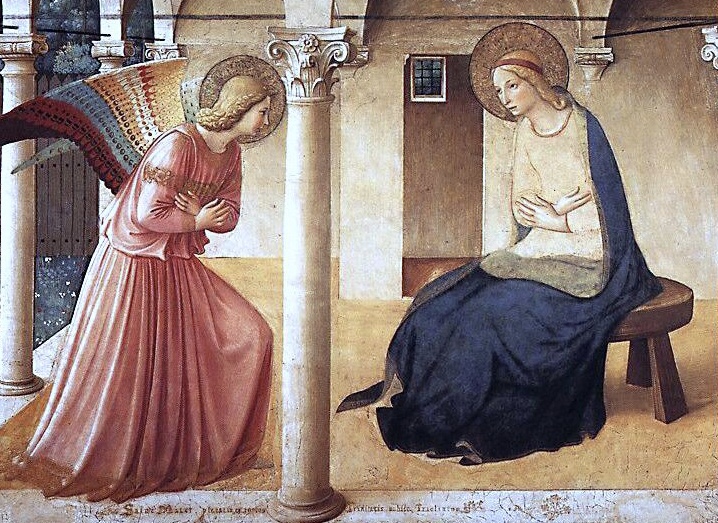
Annunciation, Fra Angelico, 1446, Convent of San Marco, Florence

All great things and great situations have humble beginnings.

The Great Mystery of Salvation that was to be culminated in the Person of Christ…

… had Its Humble Beginnings in the scene of the “Annunciation!”

A great mission had been launched by Heaven…

… and all the heavens – with the angels – had their eyes gazed on Mary and Her Response.

>> “Will she?”

>> “Won’t she?”

>> “Psst… Did God make a mistake by endowing human beings with so much freedom, that they can even reject the Word of God in their lives?”

These were probably some of the conversations that were on among the angels.

One among them.. an Archangel… had been sent by God to the earth, on a very crucial mission.

The name of the Archangel was Gabriel… whose name means God is my strength.

>> He was sent to a young girl named Mary.. whose name probably means cherished or beloved.

The heavens were waiting with eagerness as to what would be the outcome of that mission.

>> The Archangel, had approached the woman with much devotion and reverence

With deep piety, the Angel asked, “Would you be the Mother of the Child of God?”

Heaven had taken a massive decision…

>> A decision to seek the consent of a human person in the plan of salvation.

>> A decision to respect the gift of freedom and involve human beings in the design of redemption

The angels were waiting with eagerness what would be the answer…

>> Perhaps even nature was still for a moment as it awaited the reply…

With gentleness and serenity, the young girl replied, “Behold, I am the handmaid of the Lord. Be it done to me according to Your Will!”

And immediately, there were pleasant faces that lit up…

>> Nature also began to smile and brighten up further…

Mary…

… had said Yes to do the Will of God.

… had consented to be the Mother of His Beloved Son.

… had made a responsible use of her freedom and chosen for Love.

The script had begun… the journey had started…

>> The history of salvation had begun to take human shape!

This announcement of the Good News of the beginning of salvation history, with the encounter of Blessed Virgin Mary with Angel Gabriel, is the Feast of the Annunciation of the Lord.

This Feast of the Annunciation is a reminder to us on various counts…

1. Human Beings are to make a responsible use of the freedom, that is bestowed by God Almighty.

The first parents sinned in the Garden of Eden as a result of misusing the liberty.

They had a choice:

… to enjoy the holy presence of the Lord by being faithful and obedient…

… or to forfeit this glory by being disobedient.

They chose the one which made them lose their honour and splendour.

But Blessed Mary sets right this fault, by making a deliberate choice…in true freedom, for love and to express humankind’s desire to gel along with God’s Will, once again!

2. The Choice for God’s Will is an act of tremendous faith and hope.

When Mary said yes to the Will of God… though She was aware of the greatness of this call and the duty she was to undertake, all the implications of the future life, were still not clear to her.

Many things would get clear only when she begins living the Will of the Lord in Her life.

Yet, she took the bold step…towards responsibility, towards pain and suffering, towards sacrificing her comforts and personal wishes…. for the sake of the Lord. .. in faith and trust!

The Feast of the Annunciation is an invitation for us…

>> To grow deeper into embracing the Will of God in our lives.

>> To give consent to the inspirations of the Lord that comes constantly to us.

>> To be open to march forward in faith and hope, in our life of faith in the Lord.

The Lord is wishing to find a place in a willing heart, even today…

>> Just as Mary, our Loving Mother, who said Yes to the Will of the Lord, let us also, say Yes to God’s Will…

… and allow the Lord to find a place to be born, in our world today.

Happy Feast of the Annunciation.

>> Let us continue to hold on to our Blessed Mamma

>> Let us continue to seek to grow in the Love of Her Beloved Son.

God bless! Live Jesus!

——————————–

Quotable-quote-a-day-with-St Francis de Sales (SFS) – “

“At the Annunciation, Mary made the greatest act of humility that was ever made or ever will be made by a pure creature.

>> For seeing herself exalted by the angel who saluted her, saying she was full of grace and that she would conceive a Son who would be both God and Man…

… Our Lady, being reassured by the angel and having learned what God willed to do with her and in her, made this supreme act of humility, saying: ‘I am the servant of the Lord. Let it be done to me as you say!’”

——————————–

EUREKA: Discovering Catholic Treasury – through a Lenten lens! : “Ecclesia de Eucharistia”

A. What is it?

>> “Ecclesia de Eucharistia” is an Encyclical by Pope St John Paul II

>> It was published on April 17, 2003

>> “Ecclesia de Eucharistia” is a Latin phrase for “The Church from the Eucharist”

B. What does it speak of?

>> “Ecclesia de Eucharistia” offers a deeper reflection on the mystery of the Eucharist in its relationship with the Church.

>> The goal of this encyclical was to “rekindle”, at the beginning of the Third Millennium, our “amazement” at the mystery that is the Eucharist

>> “Ecclesia de Eucharistia” is divided into 5 Chapters:

(i) The Mystery of Faith: It explains the sacrificial nature of the Eucharist which, through the ministry of the priest, makes sacramentally present at each Mass the body “given up” and the blood “poured out” by Christ for the world’s salvation.

>> The celebration of the Eucharist is not a repetition of Christ’s Passover. It is the one sacrifice of the Cross, which is re-presented until the end of time.

(ii) “The Eucharist Builds the Church”: When the faithful approach the sacred banquet, not only do they receive Christ, but they in turn are received by Him.

>> The Church is united to Her Lord Who, veiled by the Eucharistic species, dwells within Her and builds Her up.

(iii) “The Apostolicity of the Eucharist and of the Church”: ust as the full reality of Church does not exist without apostolic succession, so there is no true Eucharist without the Bishop. The priest who celebrates the Eucharist acts in the person of Christ the Head.

(iv) “The Eucharist and Ecclesial Communion”: Faithful to the teaching of the Apostles, united in the discipline of the sacraments, she must also manifest in a visible manner her invisible unity.

(v) “The Dignity of the Eucharistic Celebration”: The celebration of the Holy Mass is marked by outward signs aimed at emphasizing the joy which assembles the community around the Incomparable Gift of the Eucharist.

(vi) “At the School of Mary, ‘Woman of the Eucharist’”: Reflects on the analogy between the Mother of God, who by bearing the Body of Jesus in Her Womb became the first “tabernacle”, and the Church who in Her heart, preserves and offers to the world, Christ’s Body and Blood.

>> The Eucharist is given to believers so that their life may become a continuous Magnificat in honor of the Most Holy Trinity.

C. Pointers for Reflections

1. “Ecclesia de Eucharistia” strongly promotes Eucharistic devotion outside of the Mass as a Source of Grace for deepening our own Faith as well as increasing Communion within the Universal Church

>> “The Eucharist is a priceless treasure: by not only celebrating it but also by praying before it outside of Mass, we are enabled to make contact with the very Wellspring of Grace.

>> A Christian community desirous of contemplating the Face of Christ… cannot fail also to develop this aspect of Eucharistic worship, which prolongs and increases the fruits of our Communion in the Body and Blood of the Lord

2. The Encyclical clarifies and sheds light on the allegation that the Catholic Church is attempting to “re-crucify Jesus” every time Mass is celebrated.

>> The Mass makes present the Sacrifice of the Cross; it does not add to that sacrifice nor does it multiply it.

>> What is repeated is its memorial celebration, its “commemorative representation” (memorialis demonstratio), which makes Christ’s One, Definitive Redemptive Sacrifice always present in time.

D. What virtues/points can we pick up from “Ecclesia de Eucharistia” for this Season of Lent?

1. Trying to spend more time in Eucharistic Adoration

2. Learning more about the Teaching on the Holy Eucharist, and trying to explain to those who don’t understand/misunderstand the Holy Mass

E. Tips to practice these virtues

1. Set apart a fixed day/time (depending on the situation and context of one’s life – either once a day/ once a week/once a month)…

… to spend time with Jesus in the Holy Eucharist.

>> If possible, do so, along with the entire family/community

2. Read at least the First Chapter of “Ecclesia de Eucharistia” (From articles 1-20)…

… in order, to get more clarity on the Church’s understanding of the Holy Eucharist

May this Lent and the familiarity with the Encyclical “Ecclesia de Eucharistia” help us to grow in our acclamation: “Eureka – I have found the Lord”

(The Full Text of “Ecclesia de Eucharistia” can be found at:

http://www.vatican.va/holy_father/special_features/encyclicals/documents/hf_jp-ii_enc_20030417_ecclesia_eucharistia_en.html

God Bless! Live Jesus!

EUREKA: Discovering Catholic Treasury – through a Lenten lens! : “Dignitatis Humanae”

A. What is it?

>> “Dignitatis Humanae” is the Declaration of the Second Vatican Council on the Declaration on Religious Freedom.

>> “Dignitatis Humanae” – the Latin title – means “the Dignity of the Human Person”

>> This declaration was promulgated by Pope Paul VI on December 7, 1965.

B. What does it speak of?

>> “Dignitatis Humanae” speaks of the Church’s support for the protection of religious liberty.

>> The main aspects of “Dignitatis Humanae” are:

(i) The fundamental right to religious liberty: All persons have a right to religious liberty, a right with its foundation in the essential dignity of each human being.

>> All persons must be free to seek the truth without coercion, but are also morally obligated to embrace the Truth of the Catholic faith once they recognize it.

(ii) The responsibility of the state: The government is to protect the rights and equality of all citizens as part of its essential role in promoting the public good

(iii) Religious freedom and Christianity: Christians are called to an even more conscientious respect for religious freedom. Man’s response to God in faith must be free – no person is to be forced to embrace Christianity.

>> God’s own call to serve him binds persons in conscience but is not compulsion.

C. Pointers for Reflections

1. “Dignitatis Humanae” affirms that “the one true religion subsists in the Catholic and Apostolic Church

>> This statement is also bound to the fact that “all men are bound to seek the truth, especially in what concerns God and his Church, and to embrace the truth they come to know, and to hold fast to it.”

2. Human dignity has only one source and only one guarantee – We are made in the Image and Likeness of God.

>> The Declaration states that it was Christianity that led to the developing and uniquely stressing the idea of the individual person with an eternal destiny.

D. What virtues/points can we pick up from “Dignitatis Humanae” for this Season of Lent?

1. Deepening our love for the Church and drawing more people to the True Faith

2. Growing in our understanding of our own self – that we are in the glorious Image and Likeness of God – and so, each one of us are very good

E. Tips to practice these virtues

1. Live the teachings of the Church in day-to-day life, and especially practise the basics of Catholic Living – Regular Holy Mass, Confessions, Bible Reading, Examination of Conscience, Recitation of the Holy Rosary, and Praying together in the Family

2. Identify one’s strengths and blessings that God has given, and spend every day at least 10 minutes, to thank the Lord!

May this Lent and the familiarity with the Encyclical “Dignitatis Humanae” help us to grow in our acclamation: “Eureka – I have found the Lord”

(The Full Text of “Dignitatis Humanae” can be found at:

http://www.vatican.va/archive/hist_councils/ii_vatican_council/documents/vat-ii_decl_19651207_dignitatis-humanae_en.html)

God Bless! Live Jesus!

Mar 23 (Lk 15:1-3, 11-32)

Six-year old Johny planned to secretly give a surprise to his father, on his birthday.

He decided that he would secretly bake a cake for his father and that would turn out to be a beautiful gift.

>> He was aware that that his father had told him not to put on the oven without his permission

>> He was also not really sure how a cake is to be baked

Yet, he decided to give it a try…

So on the previous night, after he made sure, his father had slept, Johny quietly crept into the kitchen.

>> He had a manual with him which would guide him to bake the cake.

He found a big bowl and spoon, pulled a chair to the counter, opened the cupboard and pulled out the heavy flour can, spilling it on the floor.

He scooped some of the flour into the bowl with his hands, mixed in most of a cup of milk and added some sugar, leaving a floury trail on the floor.

>> Meanwhile, his kitten, had joined him, and was busy enjoying the bits and pieces fallen on the ground.

Johny, was all covered with flour and he was also getting a bit frustrated as the mixing was taking much longer than expected.

But he wanted to do something for his Dad!

He didn’t know what to do next, whether to put it all into the oven or on the stove, (and he didn’t know how the oven worked)!

Suddenly he saw his kitten licking from the bowl of the cake dough.

>> He tried to push her away.

But in the frantic act, he knocked the egg-tray on to the floor.

In desperation, he tried to clean the floor..

… but unfortunately he slipped!

Just then, he raised his eyes and saw his gigantic Daddy standing before him.

He just remained on the floor….

…. All messed up and dirty…

Large tears swelled up in his little eyes!

The father kept watching him.

>> Johny was sure that he was going to receive a big spanking and a scolding was on the way.

But to his surprise, making his way through the mess, Daddy reached out to him.

>> He picked up his crying son hugged him…. And loved him!

In the process, Daddy also dirtied his clothes!

But here was a beautiful picture of a Father who displayed a tremendous love and acceptance…

.. even if it meant to dirty himself!

True love knows no bounds!

The Gospel of the Day – the Parable of the Prodigal Son – is the beautiful exposition of the Unconditionally True Love of the Heavenly Father to each of His beloved children!

The Parable of the Prodigal Son is surely one of the most popular, the most loved and the most touching parables of Jesus.

This parable has three main characters and we could view any of them as playing the main role in the story:

1. The Prodigal Son

>> He went away from the love of his father

Inheritance was given to children only after the death of the father

>> In asking the inheritance, therefore, alluded to the fact that the Prodigal son considered his father to be dead!

But having spent his life in useless living, he realised the emptiness and vacuum that filled his heart.

And so he decided to turn back.. and go to his father

2. The Elder Son

>> He remained the faithful “servant” of the house

But when he saw, that his brother – who had wasted away the inheritance, was received with so much warmth, his temper rose!

He couldn’t digest the fact that his brother who lived a “wasted life” was honoured….

… whereas he was never given the chance to “enjoy with his friends”

The context of the parable is Jesus speaking to the “Pharisees and scribes” who were “complaining that Jesus always accepted sinners” (Lk 15: 1-2)

>> In this context, the character of the Elder Son portrayed the attitude of the Pharisees and Scribes.

But beyond these two characters towers high the Image of the Father – the Father who loved and accepted his lost son!

>> He suffered a deep pain when his younger son went away

>> He underwent immense pain waiting for the son to come back

>> He went through moments of dilemma when his elder son was opposing the welcome of the younger one

Yet through all this, the Character of the Father towers high!

>> He is the Father of Mercies – Who accepts all, just as they are

>> He is the Father of Love – Who loves everyone, unconditionally

>> He is the Father of Compassion – Who receives all to His loving embrace

In our life, often as children – like the Prodigal Son – we go away.

We try to do something good…

… but our life turns into a mess!

>> Our student life gets messed up with lack of commitment and failures

>> Our marriage hits the rocks with misunderstandings and lack of acceptance

>> Our family life gets into a crisis with lack of unity and peace of mind

We feel our life is all in a mess…

>> We find ourselves lost, frustrated and upset!

But in all such situations, we need to look up…

… and see how the Loving Father is waiting to embrace us…. And love us!

Yes, the Merciful Father is waiting for each one of us…

… Whatever be the mess, that my life may be in!

Let us run into His embrace of Love… with a sincere repentance and contrition of heart…

>> And pledge to live for Him, and with Him…

…forever!

God Bless! Live Jesus!

——————————–

Quotable-quote-a-day-with-St Francis de Sales (SFS) – ““Stretch out your hand to Him like a little child to his father…

… so that He may lead you on!”

——————————–

EUREKA: Discovering Catholic Treasury – through a Lenten lens! : “Laudato Si”

A. What is it?

>> “Laudato Si” is an Encyclical by Pope Francis, released on June 18, 2015.

>> “Laudato Si” which means “Praise be to You” is the 2nd Encyclical of Pope Francis

>> The title is inspired from St Francis of Assisi’s 13th-century “Canticle of the Sun” (also called the Canticle of the Creatures), a poem and prayer.

B. What does it speak of?

>> “Laudato Si” is addressed to “every person living on this planet” with the hope of entering “into dialogue with all people about the Earth – our common home.”

>> 6 Chapters make up “Laudato Si”

(i) “What is happening to our Common Home”: Looks at the various symptoms of environmental degradation. The encyclical postulates that a truly ecological approach is also inherently social – an approach that simultaneously hears the cry of the earth and the cry of the poor.

(ii) “The Gospel of Creation”: Considers the world the way that God intended it. The chapter surveys the rich scriptural traditions to show that there is no Biblical justification for “a tyrannical anthropocentrism unconcerned for other creatures.” A person who is truly concerned about the trafficking of endangered species is automatically concerned with the trafficking of humans.

(iii) “The Human Roots of the Ecological Crisis”: Examines the twin notions of “technocratic paradigm” and a “modern anthropocentrism”.

>> These views see nature as devoid of any spiritual or transcendental value.

>> This has led to the misplaced ideas that the earth’s resources are infinite and that economic growth and technology alone can solve global hunger and poverty.

(iv) “Integral Ecology”: It charts a path to recapture awareness of the interconnectedness of creation. It is essential to appreciate the impact of environmental degradation on “cultural ecology”. The experience of indigenous peoples is specifically referred to in this regard.

(v) “Lines of Approach and Action”: This Chapter sets out various international collective actions needed.

(vi) “Ecological Education and Spirituality”: It shifts attention to the individual believer, families and communities, and invites them to make a difference in small but tangible ways.

>> Consumer choices, the cultivation of ecological virtues such as reducing wastefulness, and environmental education for the young are explained as practical steps leading to a deeper, spiritual “ecological conversion” through which the follower of Christ recognizes the true worth of all created entities.

C. Pointers for Reflections

1. “What kind of world do we want to leave to those who come after us, to children who are now growing up?”

>> This question is at the heart of “Laudato Si’

>> We have forgotten that “we ourselves are dust of the earth; our very bodies are made up of her elements, we breathe her air and we receive life and refreshment from her waters.”

>> The Encyclical encourages all to have an “ecological conversion”

2. Living our vocation to be protectors of God’s handiwork is essential to a life of virtue.

>> This “corrected lifestyle” it is not an optional or a secondary aspect of our Christian experience

D. What virtues/points can we pick up from “Laudato Si” for this Season of Lent?

1. Cultivate greater sensitivity to nature

2. Deepen and thank God as the Creator

E. Tips to practice these virtues

1. Make a list, and practise, a few but very practical steps to protect the nature

2. Raise a prayer of Thanks to the Lord, for all the things we see around

>> Let nature, become a time of meditation with the Lord

May this Lent and the familiarity with the Encyclical “Laudato Si” help us to grow in our acclamation: “Eureka – I have found the Lord”

(The Full Text of “Laudato Si” can be found at:

Click to access papa-francesco_20150524_enciclica-laudato-si_en.pdf

God Bless! Live Jesus!