REFLECTION CAPSULE – May 25, 2021: Tuesday

“Being ready to grow deeper in the awareness that God is always having a hold of me!”

(Based on Sir 35:1-12 and Mk 10:28-31 – Tuesday of the 8th Week in Ordinary Time)

One day a person who was going through much spiritual and mental perplexity called up his friend.

He knew that his friend was able to remain sturdy and confident, even in the midst of troubles of life.

And so he desired to learn from him this secret to stay calm

“Tell me,” the anxious friend asked over the phone, “how is it that you can trust God so easily? How is it that you always got hold of God?”

For some time, the person was silent.

And then, taking a deep sigh, he replied, “It surely did take me a while to know and learn this.

But let me be honest with you.

Even now I have my moments when I don’t know if I have got hold of God…
… but one thing I have learnt over the years: ‘God always has a hold of me!”

It was this assurance that God was always holding him…
… that allowed this person to remain calm and confident in his journey of life.

Are we ready to grow deeper in this fact: That God is always having a hold of me…
… and this assurance that translates to a life of trust and confidence!

Our lives in the Lord, is a spiritual journey…

The greater assurance we have in the promises of the Lord, the more pleasant will be our journey

The stronger our assurances in the Word of the Lord, the swifter will be our progress in this journey towards the Lord

The Gospel of the Day presents Jesus declaring His assured promises to those who follow Him, sincerely and wholeheartedly.

Jesus tells to Peter and the other disciples:
“Amen, I say to you, there is no one who has given up house or brothers or sisters or mother or father or children or lands for my sake and the sake of the Gospel, who will not receive a hundred times more now in this present age…
… and eternal life in the age to come” (Mk 10: 29)

This incident takes place right after the encounter of the rich young man with Jesus (Mk 10: 17-22)

This man was proposed by Jesus to sell all his possessions and then follow Him.

The man, however, found it hard, to let go off his attachments, and instead let go of the Lord.

He went away sad!

Peter, as the leader of the disciples, however, contrasts this “possessive and worldly” tendency of the rich young man by telling Jesus, “We have given up everything and followed you” (Mk 10: 28)

Perhaps, there was a growing concern among the disciples, as to whether their radical decision to commit themselves to the Master would go in vain!

Perhaps, there was an apparent fear within the disciples, as to whether their decisions to leave their professions, their families and their aspirations to follow the Lord would go fruitless!

And so the Lord, with a candid straight-forwardness replies that their sacrifices would surely assure them of rewards…
… of a much higher quality and eminence.

How often do our lives also sometimes sink in hopelessness, thinking whether our expressions of faith would end up in meaninglessness!

Sometimes even fearful thoughts and anxious emotions may cross our mind…
… will the various sacrifices and pains that I take up for the Lord, go in vain?
… will my unshed tears, my unspoken prayers and painful sighs, end up in futility?
… will the efforts I make to grow in love and nourish others in faith, lead to fruitlessness?

But the Lord assures us, that none of these efforts – small or great, noticed or unnoticed, seen or unseen – will escape the penetrating eyes of the Lord and go unrewarded.

All our actions, done in love has an assured reward!

What is however, most essential, is our total focus on the Lord and unflinched commitment to Him.

The Lord most certainly assures us of rewards and gifts.

But, in this pursuit, may we not stray or lose focus of Him!

Our lives ought to be impelled by the love for the God of rewards…
… than merely the rewards of God!
Our lives must be lived in faithfulness to the God of gifts…
… than being fascinated only to the gifts of God!

May the Lord Himself be our greatest reward…
… our finest gift!

We also seek the intercession of St Bede the Venerable, whose feast we celebrate…
… and be inspired by his words: “He alone loves the Creator perfectly who manifests a pure love for his neighbour”

When we grow in the assurance that God is always holding us…
… we can remain calm and confident in this journey of life.

Yes… GOD IS ALWAYS HAVING A HOLD OF ME!

Are we ready to grow deeper in this awareness?

God Bless! Live Jesus!


Discovering the beauty of the Catholic Church through the Catechism:
JESUS

JESUS MEANS IN HEBREW: “GOD SAVES.”
At the annunciation, the angel Gabriel gave him the name Jesus as his proper name, which expresses both his identity and his mission.
Since God alone can forgive sins, it is God who, in Jesus his eternal Son made man, “will save his people from their sins”. In Jesus, God recapitulates all of his history of salvation on behalf of men.
In the history of salvation God was not content to deliver Israel “out of the house of bondage” by bringing them out of Egypt. He also saves them from their sin.
Because sin is always an offence against God, only he can forgive it.
For this reason Israel, becoming more and more aware of the universality of sin, will no longer be able to seek salvation except by invoking the name of the Redeemer God.
The name “Jesus” signifies that the very name of God is present in the person of his Son, made man for the universal and definitive redemption from sins.
It is the divine name that alone brings salvation, and henceforth all can invoke his name, for Jesus united himself to all men through his Incarnation…
… so that “there is no other name under heaven given among men by which we must be saved. (Cf. CCC # 430-432)

REFLECTION CAPSULE – May 24, 2021: Monday

“May Mary, the Mother of the Church – our Beloved Mother and the Perfect Disciple – Who followed Her Son wholly, in obedience to the Will of the Father, intercede and inspire us, to discover and treasure the true riches of life!”

(Based on Sir 17:24-29 and Mk 10:17-27 – Monday of the 8th Week in Ordinary Time – Feast of Mary, Mother of the Church)

A story is told about Phythius, an ancient King of Lydia (Lydia – a place in the present day Turkey).

Phythius was very wealthy, but also very greedy, and he would spend as little as possible.

His wife – the Queen – was however, greatly determined to cure him of this “wealth mania!”

One day when he came home hungry from a long hunt, she told the slaves to place before him dishes that were filled with gold…
… gold that was fresh from the royal gold mines.

The King stared down at his gold-filled plates, admiring them for some time, and then he asked for some food.

“Food?” his wife asked, feigning surprise, “But surely they have brought you what you love best in the world, haven’t they?”

“What are you talking about?” the King replied, as he lost his temper, “Gold can’t satisfy my hunger.”

“No?” the Queen answered, “Is it not foolish then to have such love for something that cannot be useful so long as you hang on to it?

Believe me; gold is truly of service only to people who exchange it for the good and useful things of life.”

The rich man in the Gospel of the Day also faced a similar “wealth mania”…
… and was reminded that “riches come to have true value, only when given in service, to the needy”

Are we also facing a “wealth mania” in our lives?

We have concluded a journey of fourteen weeks (nearly hundred days) of walking intimately with the Lord in His Passion, Death, Resurrection and the outpouring of the Holy Spirit…
… starting with the Ash Wednesday in the season of Lent
… through the Maundy Thursday, Good Friday and Easter Sunday
… the Ascension and the Feast of the Holy Spirit – the Pentecost.

As we resume the Ordinary times of the Liturgical year, we are presented today…
… with a message to make an examination of the “quality of our life”, through this incident of the rich man

The rich man in the Gospel approaches Jesus to ask, “Good Teacher, what must I do to inherit eternal life?” (Mk 10: 17)

When Jesus gave him a list of commandments, that needed to be followed to help ensure a passage into eternal life, the man replied, “Teacher, all these I have observed from my youth” (Mk 10: 20)

We underline a few aspects of this young man…
… he did desire for a life of eternity and followed the commandments
… he did nurture a sense of being pious and devout, to please the Lord

However…
… he probably failed to live up to the intentions of the commandments
… he possibly got lost into only keeping the letters of the commandments; not the spirit!

He got attached to doing God’s commandment, but failed to break his attachments with the riches of the world.

He possessed the good will to follow God’s teachings, but failed to let go of the possessions of his life.

The Lord realized this “pitiable” condition of the young man.

He was wealthy in the world, but was unable to be rich before God
He was obedient to the laws, but was unable to be obedient to give up his attachments.

Therefore, the Lord, knowing this state of the young man – devout yet not properly focused…
… “looked at him, loved him, and said: ‘You are lacking in one thing. Go, sell what you have and give to the poor and you will have treasure in heaven; then, come, follow me'” (Mk 10: 21)

This young man could represent any one of us…

We seek to be pious but find it hard to let go of our possessions
We seek for holiness in life but go through a struggle to give up our attachments
We seek to follow the Lord wholly but stumble to give ourselves entirely to the Lord

Yet, the Lord does not give up on us…

He looks on us…
He loves us…
And He invites us, to have the proper focus in life!

It is not material possessions that ought to occupy our hearts; rather, our hearts needs to be possessed with the Love for the Lord.

It is not worldly treasures that should be our prime motto in life; rather, a life, dedicated to the Kingdom of God and helping the needy with the resources we have.

Our material life is totally in the control of the Lord.

Our material possessions will be of no avail, when we leave this world.
Our hands will not be able to hold any riches when we depart from this life.

Let us instead be possessed by the Lord, gather the precious stones of His grace and love by works of charity and hold on to Him…
… so that we may have a wonderful life of eternity with the Lord of all treasures!

Let us give heed to some of the wise and noble sayings of Holy People who have described the necessity to be detached from the riches of the world…

St Bede the Venerable: “He alone loves the Creator perfectly who manifests a pure love for his neighbor.”

St Alphonsus Liguori:”Those who desire nothing from this world are masters of the whole world.”

St Gregory the Great: “Be not anxious about what you have, but about what you are… Make use of temporal things, but set your heart on eternal things.”

Today we also celebrate the Feast of Mary, the Mother of the Church.

Mother Mary is the model for all in the Church to “always say YES to God’s Will!”

This feast which has been promulgated in the Year 2018…
… is celebrated every year on the Monday after Pentecost.

One of the primary reasons for the celebration of the Feast of Mary, Mother of the Church is “to foster Marian piety and the Maternal sense of the Church.”

Pope Francis says that, “this celebration will help us to remember that growth in the Christian life must be anchored…
… to the Mystery of the Cross
… to the oblation of Christ in the Eucharistic Banquet
… and to the Mother of the Redeemer and Mother of the Redeemed!”

The Marian title of “Mother of the Church,” was given to the Blessed Mother by Pope Paul VI at the Second Vatican Council.

Let us ask our Blessed Mother Mary, the Mother of the Church to intercede and pray for all of us…
… to be faithful and witnessing members of the Church by prioritising for the “true riches of our life!”

Happy Feast Day of Mary, the Mother of the Church…
… to all Her Little Children of God!

God Bless! Live Jesus!


Discovering the beauty of the Catholic Church through the Catechism:
AT THE HEART OF CATECHESIS: CHRIST

“At the heart of catechesis we find, in essence, a Person, the Person of Jesus of Nazareth, the only Son from the Father…who suffered and died for us and who now, after rising, is living with us forever.”
To catechize is “to reveal in the Person of Christ the whole of God’s eternal design reaching fulfilment in that Person.
It is to seek to understand the meaning of Christ’s actions and words and of the signs worked by him.”
Catechesis aims at putting “people in communion with Jesus Christ: only He can lead us to the love of the Father in the Spirit and make us share in the life of the Holy Trinity.”
In catechesis “Christ, the Incarnate Word and Son of God, is taught – everything else is taught with reference to him – and it is Christ alone who teaches – anyone else teaches to the extent that he is Christ’s spokesman, enabling Christ to teach with his lips.
Every catechist should be able to apply to himself the mysterious words of Jesus: ‘My teaching is not mine, but his who sent me.’”
Whoever is called “to teach Christ” must first seek “the surpassing worth of knowing Christ Jesus”; he must suffer “the loss of all things. . .” in order to “gain Christ and be found in him”, and “to know him and the power of his resurrection, and (to) share his sufferings, becoming like him in his death, that if possible (he) may attain the resurrection from the dead”
From this loving knowledge of Christ springs the desire to proclaim him, to “evangelize”, and to lead others to the “yes” of faith in Jesus Christ.

But at the same time the need to know this faith better makes itself felt. (Cf. CCC # 426-429)

REFLECTION CAPSULE – May 23, 2021: Sunday

“Realizing that by our Christian vocation, we are constantly in touch with ‘Fresh Waters’ of Grace, and becoming aware of the worth of the ‘source of life’”

(Based on the Solemnity of the Pentecost)

An incident is told of a great ship that was stranded off the coast of South America.

Week after week, the ship lay there, in the still ocean waters with not a hint of a breeze.

The captain was desperate; the crew was dying of thirst.

The salty ocean waters stared at the members of the ship.

Finally, one day, on the far horizon, a steamship appeared.
As this tiny boat, approached them, the captain of the great ship called out:
“We need water. Give us water!”

The steamship replied: “Lower yourselves, and life will be yours!”

The captain – an experienced person, and who knew that it was impossible to get potable water from the oceans – was infuriated.

But the steamship gave the same reply, “Lower yourselves, and life will be yours!”, and sailed away.

The captain was all by himself – feeling angry and desperate!

But a little later, when no one was looking, a cleaner boy of the ship, lowered a bucket into the sea and then tasted what he brought up: It was perfectly sweet, fresh water!

How was that possible?

The ship had been stranded, just out of the oceans, into the mouth of the River Amazon (Amazon makes up for nearly 1/5th of the earth’s fresh waters!)

For weeks together, they had been sitting on top of all the fresh water that they needed.

But it remained undiscovered!

So it is, often, with our Christian Lives as well!

What we are really seeking, is already inside us: Waiting to be discovered!

The Holy Spirit, Who has been dwelling within us, from our Baptism, gently whispers to us: “Lower yourselves, and life will be yours!”

Today, on this Great Day of Pentecost, we are invited to open our hearts to recognize the Power of the Holy Spirit…
… and to become aware of the inherent greatness in our vocation as Christians.

On the day of Pentecost, in the Upper Room, as the disciples were gathered in prayer, along with Blessed Mother Mary, “the Holy Spirit filled the entire house in which they were” (Acts 2:2)

It is to be noted that the word used to describe the coming of the Holy Spirit is the Greek word “aphno” which means “suddenly”

“And suddenly there came from the sky a noise like a strong driving wind…” (Acts 2: 2)

The coming of the Holy Spirit was “sudden”.

This energetic entry of the Holy Spirit is a glimpse to one important characteristic of the person of the Holy Spirit: Vitality!

The Holy Spirit is a spirit of life… of energy… of vivacity… of animation… of dynamism!

Where the Holy Spirit is, there is the great movement of the will, the mind and the heart!

It was this “sudden” coming of the Holy Spirit that transformed the small group of Jesus’ disciples into mighty warriors of the Kingdom of God.

Fear was transformed into power…

Timidity was changed into boldness…

Uncertainty was converted into conviction…

Our own lives need an encounter of this “life-transforming” experience.

Is my Christian life, dull and slow – merely laced with routine actions of prayers and sacraments?
Is my life of faith, lethargic and tepid – simply being pulled on, without any particular awareness or lived without any enthusiasm?
… then, we need the mighty movement of the Holy Spirit to impress life and vitality to our life and our faith!

The Holy Spirit is undoubtedly one of the most shy person of the Blessed Trinity and therefore, also often, neglected in our daily prayers or devotion

The study and awareness of the Holy Spirit is certainly, in general, given lesser priority and importance in comparison to the other Persons of the Trinity
The Feast of the Pentecost is very often not accorded the “solemn” tone in comparison to other feasts like Christmas or Easter

But let us realize, that in the Holy Spirit and in the celebration of this Feast, we have a great treasure to cherish and enjoy.

Each Christian ought to build an intimate relationship with the Holy Spirit.
Each Christian must become more aware of the role of the Holy Spirit in daily living

How wonderful it would be if we could inculcate a few practical resolutions to grow in our intimacy and union with this Powerful and Dynamic Personality of the Blessed Trinity:

  1. “Morning Offering to the Holy Spirit” as we begin the day, thanking for His protection and seeking His help through the day
  2. Invoking a tiny chaplet, “Come Holy Spirit, fill our hearts and minds” as we begin a particular activity or work
  3. Making a short examination of conscience at the end of the day, introspecting our lives in overcoming sin, being grateful for His guidance and seeking to grow spiritually in holiness, with the power of the Holy Spirit
  4. Co-operating with the Holy Spirit to become effective agents of unity in our homes, our communities, our places of work and our churches.
  5. Purposely creating a few seconds of silence in the schedule of our works or our activity or through the course of the day, and talking to the Holy Spirit, as a friend, in the cave of our heart
  6. Listening to the still, gentle voice of the Holy Spirit in the depths of our being, speaking to us to be more active to read God’s Word in the Bible and to partake of the Sacraments more frequently especially Confession and Holy Eucharist.

The Lord has blessed our lives with the gift of the Holy Spirit.

He longs to be empower our lives…

He earnestly wants to be in total control of our lives…

But for this, He needs our permission…
A permission in the form of…
… longing for Him
… making sincere efforts to live a life casting away sin

Let us realize that by our Christian Vocation, we are constantly in touch with “Fresh Waters” of Grace.

May we be aware of the worth of the “source of life” that is with us, and live a life worthy of it…
… by constantly giving heed to the call: “Lower yourselves, and life will be yours!”

Wish you a very Happy Feast of the Holy Spirit – the Pentecost!

Happy Birthday to our Mother Church!

May we cherish the life offered by our Mother, in the Sacraments, and especially receive the sweetness of the Holy Eucharist more worthily and enthusiastically!

God Bless! Live Jesus!


Discovering the beauty of the Catholic Church through the Catechism:
THE TRANSMISSION OF THE CHRISTIAN FAITH
The transmission of the Christian faith consists primarily in proclaiming Jesus Christ in order to lead others to faith in him.

From the beginning, the first disciples burned with the desire to proclaim Christ: “We cannot but speak of what we have seen and heard.”
They invite people of every era to enter into the joy of their communion with Christ: That which was from the beginning, which we have heard, which we have seen with our eyes, which we have looked upon and touched with our hands, concerning the word of life – the life was made manifest, and we saw it, and testify to it…
… and proclaim to you the eternal life which was with the Father and was made manifest to us – that which we have seen and heard we proclaim also to you, so that you may have fellowship with us … and our fellowship is with the Father and with his Son Jesus Christ

… and we are writing this that our joy may be complete (Cf. CCC # 425)

REFLECTION CAPSULE – May 22, 2021: Saturday

“Being animated by the Presence and Power of the Holy Spirit, so that we too may be Christ’s faithful and dynamic witnesses… and like St Peter and St John – and St Paul – become “special students” of our Great Teacher, Jesus!”

(Based on Acts 28:16-20, 30-31 and Jn 21:20-25 – Saturday of the 7th Week in Eastertide)

The experience of teachers in a school with the students is pretty interesting.

Each student is unique in their character and nature.

The relationship with each student is also unique

Undoubtedly…
… some students tend to be more in the limelight… due to their high vibrancy and level of enthusiasm
… some students remain in the shadows… due to their soft and timid nature

But the teacher shares a unique relationship with all..
… with some more close, with some just normal, with some just casual

Sometimes the most naughty one, or the mischievous one gets special attention

Sometimes, the most silent one gets a special favour of affection and care

The Greatest Teacher, Jesus also had his class of students… his chosen twelve.. the Apostles.

He shared a unique relationship with all of them, undoubtedly.

Yet, among the twelve, there were some with whom Jesus had a special bonding

One among them was very vocal, emotional and actively in the limelight…

The other was more silent, affectionate and passively in the backgrounds…

The Gospel of the Day presents Jesus, the teacher in conversation with these two of His students, with whom He had a special bonding – Peter and John.

Peter was the one, very vocal, emotional and being active in the limelight…

John was the more silent, affectionate and remained passively in the backgrounds…

We are the end of the Gospel of St John.

Jesus had engaged Peter in a one-to-one conversation reviving His commitment to Him and the Kingdom by asking him, three times, “Simon, son of John, do you love me?”

Peter was also entrusted to be the Shepherd of His Church on the earth

However, Peter was also curious what would be the future of the other disciple.

His curiosity is a common human trait: a keen desire to know the future and the prospects of other people.

Sometimes this trait can also degenerate into jealousy…
Sometimes this trait can also be reduced to envy…

In the parable of the workers in the vineyard… those who came at the end received the same one denarii as the first.
The complaint of those who toiled the whole day was not just that they received a less pay; but more so, that why did the last ones…
… get a higher pay!

The generosity towards the others, made them to feel envious

In the parable of the Prodigal Son, the prodigal son was given a grand reception on his arrival back.
The complaint of the elder son was not just that he never had enjoyed a luxurious time with his friends; but more so, that the younger sin who had committed many sins…
… was given a special welcome.

The generosity towards the younger son, made him to feel jealous.

Realizing the possibility of this common human trait, Jesus chides Peter who was over-curious to know of the future of John; instead He re-focusses Peter’s attention on what is most important: Following Him.

Therefore Jesus tells to Peter: “What concern is it of yours? You follow me” (Jn 21: 22)
.

The same advice is rendered to us also…

We sometimes tend to be too anxious about the life of the other…
… but fail to have a proper control in our personal lives!
We sometimes tend to be over-curious about the future of others…
… but fail to live our lives worthily!

The Lord advises us the same too, “You follow me!”

The two special students of Jesus, the teacher – Peter and John – is also a reminder of two ways or levels of Christian holiness…

The Life of Peter… lived in witness to Christ by a life of martyrdom

The Life of John… lived in witness to Christ by a life of loving sacrifices in life

Each one of us are to…
… live in holiness, filled with love, like St John
… live in commitment, willing to give up even our lives, like St Peter

The first reading of the Liturgy also points us to the Life of St Paul…
… a zealous and valiant missionary, who offered his life in total commitment to the Kingdom

St Paul dwells in Rome – considered from St Luke’s perspective as the end of the earth (signifying that the Gospel has moved from Jerusalem, the centre to Rome, the end of the earth!)
“And Paul lived there two whole years at his own expense, and welcomed all who came to him, preaching the Kingdom of God and teaching about the Lord Jesus Christ quite openly and unhindered!”

On the eve of the Great Feast of the Pentecost, let us prepare our hearts to receive the fire of the Holy Spirit.

We seek the special intercession of our Blessed Mother – the Queen of the Apostles – on her Feast Day…
… that She Who interceded with the Apostles, may intercede for us also, for the Mighty Gift of the Holy Spirit!

May we be animated and constantly live in the presence and power of the Holy Spirit, so that we too may be Christ’s faithful and dynamic witnesses…
… and like St Peter and St John – and St Paul – become “special students” of our Great Teacher, Jesus!

Happy Feast of Mary, Queen of the Apostles!

God Bless! Live Jesus!


Discovering the beauty of the Catholic Church through the Catechism:
THE GOOD NEWS: GOD HAS SENT HIS SON

‘But when the time had fully come, God sent forth his Son, born of a woman, born under the law, to redeem those who were under the law, so that we might receive adoption as sons.
We believe and confess that Jesus of Nazareth, born a Jew of a daughter of Israel at Bethlehem at the time of King Herod the Great and the emperor Caesar Augustus, a carpenter by trade, who died crucified in Jerusalem under the procurator Pontius Pilate during the reign of the emperor Tiberius, is the eternal Son of God made man. He ‘came from God’, ‘descended from heaven’, and ‘came in the flesh’. For ‘the Word became flesh and dwelt among us, full of grace and truth; we have beheld his glory, glory as of the only Son from the Father. . . and from his fullness have we all received, grace upon grace.’

Moved by the grace of the Holy Spirit and drawn by the Father, we believe in Jesus and confess: ‘You are the Christ, the Son of the living God.’ On the rock of this faith confessed by St. Peter, Christ built his Church,” to preach the unsearchable riches of Christ! (Cf. CCC # 422-424)

REFLECTION CAPSULE – May 21, 2021: Friday

“Trusting in the Goodness of the Lord and being hopeful in the Mercy of the Lord, let us, tell the Lord: ‘Yes, Lord, I love you!’”

(Based on Acts 25:13-21 and Jn 21:15-19 – Friday of the 7th Week in Eastertide)

A little boy one day approached his father who he knew, was well versed with the terms used in the Bible, with a doubt.

“Daddy,” asked the boy, “what is the meaning of Cherubim and Seraphim. We hear it so often in the Bible.”

The father, appreciating the Biblical curiosity of his child, after some thoughtful moments answered:
“Cherubim is a word which means “knowledge”

The word Seraphim stands for “flame”

It is commonly understood that Cherubims are angels that excel in the knowledge of God…
… and the Seraphims are those who excel in the love for God.

“Ah,” answered the boy, “In that case, I wish and hope, that when I die, I will be a Seraphim!
I would prefer more to love God, than to know everything!”

Of course, Cherubims and the Seraphims have their own importance in the order of Angels.

But what the child innocently expressed was his desire to love the Lord more!

How about us?

Do we also desire to Love God…?
… more?

The Gospel of the Day is the encounter of Jesus with His chosen Disciple Peter…
… who “knew Jesus” a lot
… but was yet to “love Jesus completely!”

The incident presents St Peter grappling with his weaknesses in expressing his love for his Master…
… and Jesus, knowing very well the frailties of his chosen one, entrusting great responsibilities on him.

Jesus in His post-resurrection appearances to the Apostles, engages in a special one-to-one conversation with the Peter, the leader of the chosen ones…

It’s interesting to see the choice of the Lord for Peter as the leader of His chosen ones.

Peter was a fisherman by profession…

Like the waves, his faith and trust in the Lord would also often waver…
Like the winds blowing heavily, his zeal for the Lord would also often vacillate…

Yet, the Lord chooses him to be a “fisher of man” for His Kingdom…. expecting him…
… to be like the fish – finding life and vibrancy only by being in the waters of grace and mercy
… to be like the net – gathering up the children of God and keeping them together
… to be like the boat – not being stuck on the shores, but ready to launch into the deep waters of evangelization

Peter had undoubtedly a lot of interest and zeal in the Lord… and in His Mission.

Yet by nature, he tended to be more emotional… indecisive…fluttering

And this caused him to deny the Lord three times, during the passion of the Lord.

But the Lord, in His infinite mercy, restores the brokenness in the relationship, with His healing love.

Our lives too, so often, resembles that of Peter.

We fluctuate in our commitments to the Lord…
We easily break many of the resolutions made to the Lord…
We very often go astray, despite having experienced much love from the Lord…

Yet, Jesus does not abandon us.

Like the Shepherd, who comes after His lost sheep…
Like a Potter, who re-moulds His work when dis-shaped…
Like a Physician, who attends with patience for His ailing patient…

The Lord comes to us…

And with much hope puts forward the same question, that He asked Peter:
“Do You love Me?”

The Lord awaits an answer…

It will be easy to jump in and say “Yes, Lord, I do love you”.

But…
… let our answer, not just be triggered by emotional feelings
… let our answer, not be simply impelled by a ritualistic custom

Rather, from the depth of our inner-being…
… acknowledging our sinfulness and failures…
… realizing our weaknesses and shortcomings…

And yet….
… trusting in the goodness of the Lord…
… hopeful in the mercy of the Lord…

Let us, tell the Lord…
… “Yes, Lord, I love you!!”

Let the courageous example of St Paul also be an inspiration

His life of bold witness to Jesus and His Resurrection, made him to become a point of discussion even among the high Roman ruling circle (Acts 25:13-21)

God Bless! Live Jesus!


Discovering the beauty of the Catholic Church through the Catechism:
YOU DID NOT ABANDON HIM TO THE POWER OF DEATH

After his fall, man was not abandoned by God. On the contrary, God calls him and in a mysterious way heralds the coming victory over evil and his restoration from his fall.
This passage in Genesis is called the Protoevangelium (“first gospel”): the first announcement of the Messiah and Redeemer, of a battle between the serpent and the Woman, and of the final victory of a descendant of hers.
The Christian tradition sees in this passage an announcement of the “New Adam” who, because he “became obedient unto death, even death on a cross”, makes amends superabundantly for the disobedience, of Adam.
Furthermore many Fathers and Doctors of the Church have seen the woman announced in the “Proto-evangelium” as Mary, the mother of Christ, the “new Eve”.
Mary benefited first of all and uniquely from Christ’s victory over sin: she was preserved from all stain of original sin and by a special grace of God committed no sin of any kind during her whole earthly life.
But why did God not prevent the first man from sinning? St. Leo the Great responds, “Christ’s inexpressible grace gave us blessings better than those the demon’s envy had taken away.”

St. Thomas Aquinas wrote, “There is nothing to prevent human nature’s being raised up to something greater, even after sin; God permits evil in order to draw forth some greater good. Thus St. Paul says, ‘Where sin increased, Grace abounded all the more’; and the Exsultet sings, ‘O happy fault…which gained for us so great a Redeemer!’ (Cf. CCC # 410-412)

REFLECTION CAPSULE – May 20, 2021: Thursday

“Being convinced of the deep love that the Father has towards us and orienting our lives in a way that is worthy of our call as witnesses of the Kingdom!”

(Based on Acts 22:30, 23:6-11 and Jn 17:20-26 – Thursday of the 7th Week in Eastertide)

A cute story of a little boy, who loved fruits.

This little fellow was once, tempted to pluck some cherries from a tree, which his father had strictly forbidden him to touch.

“You need not be afraid,” said his notorious companion, “for if your father should find out that you have taken them, he is too kind to hurt you.”

“Ah,” said the brave little fellow, “that is the very reason why I would not touch them;
For I know that my father would not hurt me. So I should not hurt him by my disobedience!”

The little boy knew the love of his Father towards him
… and so he dared not hurt his Father.

He was not afraid of the punishment of the Father.

He was instead afraid of the hurt that would cause pain to the Father.

True love causes a holy and pious concern of not wanting to cause any offence to the one who is loved.

True Love casts away all fear!
True Love drives away every anxiety!

It is this True Love of the Father that was made known by Jesus to all of us.

The Gospel of the Day presents Jesus shedding greater light on His intimate relation with the Father and revealing deeper, the love of the Father for each one of us.

Jesus prays, “… so that they may be one, as we are one. I in them and You in Me, that they may be brought to perfection as one, that the world may know that you sent me, and that you loved them even as you loved me.” (Jn 17: 22b, 23)

The High Priestly Prayer of Jesus in the Seventeenth Chapter of St John, is another insight into the intimate relation that Jesus had with His Father.

All His Life, He sought to do only the Father’s Will

All His Life, He sought to reveal the love of the Father to the world.

This was driven by the fact that Jesus was in intimate union with the Father.

To His disciples, Jesus wishes to leave this same legacy – the legacy of loving the Father intimately.

Jesus wishes to tell us that we have a Father who is deeply interested and caring for us.

Jesus wishes to convince us that our lives are secure in the Providential care of the Father.

However, our lives sometimes fail to display this trust and confidence in the providential care of the Father

Some of us may have a wrong notion of God being interested only in finding my wrongdoings and punishing me for the same…

Some of us may have the wrong notion of God being too holy and majestic that makes Him unapproachable, unavailable and inaccessible!

But Jesus seeks to drive away all such false impressions.

He tells us that the Father…
… is surely the keeper of justice, and may take us through a time of trials and difficulties.

Those are not to be seen as cruel punishments, but loving acts for improvements towards a holier life!

He tells us that the Father…
…. is surely the Lord and Master of the Universe, and is totally aware of even the calamities or hardships that befall our lives!

In all those hard moments, the loving Father keeps us safely in the palm of His hand, not allowing us, His beloved children to get hurt or harmed!

We have the beautiful assurance of the Lord to St Paul, as we read in the Acts of the Apostles:
“The following night the Lord stood by him and said, “Take courage, for as you have testified about me at Jerusalem, so you must bear witness also at Rome!” (Acts 23:11)

The Lord “always stands by us”…
… and this should be our motivation and strength to “always stand for the Lord!”

When we are convinced of the deep love that the Father has towards us, we would be able to orient our lives in a way that is worthy of our call as witnesses of the Kingdom.

Jesus by His unity with the Father, enjoyed perfect freedom.

He invites us to also deepen our union with the Father and enjoy greater freedom of happiness and joy.

Let us seek the intercession of St Bernardine of Siena, whose feast we celebrate today.

May we be encouraged by his words to live our lofty vocation of being an Intimate Follower of Christ, “Whenever the divine favour chooses someone to receive a special grace, or to accept a lofty vocation…
… God adorns the person chosen, with all the gifts of the Spirit needed to fulfil the task at hand!”

God Bless! Live Jesus!


A hard battle. . .

The doctrine of original sin, closely connected with that of redemption by Christ, provides lucid discernment of man’s situation and activity in the world. By our first parents’ sin, the devil has acquired a certain domination over man, even though man remains free.
Original sin entails “captivity under the power of him who thenceforth had the power of death, that is, the devil”.
Ignorance of the fact that man has a wounded nature inclined to evil gives rise to serious errors in the areas of education, politics, social action and morals.
The consequences of original sin and of all men’s personal sins put the world as a whole in the sinful condition aptly described in St. John’s expression, “the sin of the world.” This expression can also refer to the negative influence exerted on people by communal situations and social structures that are the fruit of men’s sins.
This dramatic situation of “the whole world [which] is in the power of the evil one” makes man’s life a battle

The whole of man’s history has been the story of dour combat with the powers of evil, stretching, so our Lord tells us, from the very dawn of history until the last day. Finding himself in the midst of the battlefield man has to struggle to do what is right, and it is at great cost to himself, and aided by God’s grace, that he succeeds in achieving his own inner integrity (Cf. CCC # 407-409)

REFLECTION CAPSULE – May 19, 2021: Wednesday

“Being focused on the Lord and seeking to be pure and unsullied – in holiness and sanctity!”

(Based on Acts 20:28-38 and Jn 17:11-19 – Wednesday of the 7th Week in Eastertide)

The Question-Answer column of a particular youth magazine, once had a query as follows:
“I’m puzzled about life, and I wonder if you could help me?

Am I different from everyone else of my age?

Or do they wear false masks as I do?

I go to parties and dances and act as if I were enjoying myself like everyone else I know.

But I am not enjoying myself at all!

I always feel that there is something missing, and I don’t know what it is. . .

Behind the laughing and the fun, I think I look at life just a bit more seriously than most I know.

I see more in life than just having a good time.

Do you think this is wrong at the age of twenty?

In a few years will I see things differently?

Or should I take off the false face now, and act the way I feel?”

The expressions of this young man, faced with a dilemma in life, resonates with the thoughts of many people in the world…
… including perhaps, ours…

We get a feel that there is certainly “more” to life…
… than just the peripherals that I daily engross myself in…

We get an impression that there certainly is something “higher” in life…
… than just being limited to the external comforts of life…

An answer to this vital dilemma of our life is given expression by the Lord in today’s Gospel: We live in the world, but we do not belong to the world!

Jesus prays to the Father: “I do not pray that you should take them out of the world, but that You should keep them safe from the evil one.
They are not of the world, even as I am not of the world” (Jn 17: 16)

The call of a Christian is to live as a people “set apart” for Christ.

The Lord wishes, desires, wants and makes it a must that the one who follows Him, must seek to follow Him fully, wholeheartedly and unreservedly.

But the Lord was also very much aware that this His desire for a people “totally set apart” would face a lot of challenges and crisis from the Evil One.

He knew that His followers would struggle much in living a pure life in the midst of many impurity, uncleanness and contamination.
He knew that His followers would find it hard to preserve holiness in the hub of wicked temptations, ensnaring enticements and luring persuasions

St Paul warns the Church at Ephesus to be aware of the many dangers that may allure them in the world…
… and to remain focussed and alert

“Take heed to yourselves and to all the flock, in which the Holy Spirit has made you guardians, to feed the church of the Lord which He obtained with His own Blood.
I know that after my departure fierce wolves will come in among you, not sparing the flock; and from among your own selves will arise men speaking perverse things, to draw away the disciples after them. Therefore, be alert…” (Acts 20:28-31)

We often find ourselves lost in this strange maze of the world….

We immerse ourselves too much in worldly activities and works….
… But, somehow at the end of the day, when lying down on our beds, we, perhaps, feel ourselves lost and not having a true sense of satisfaction!

We plunge ourselves to enjoy a lot of worldly pleasures, comforts and luxuries…
… But, somehow, after having been sort of saturated with those externals, we, perhaps, find ourselves still unhappy or experiencing a void!

We engage ourselves in an excess use of the social media, networking sites, chatting applications and remain attached constantly to modern communication gadgets…
… But, somehow, though we are in contact with many people, we, perhaps, realize that there is a grave presence of loneliness and not having genuine relationships of love and true care!

And therefore, Jesus, the ever-practical, sensible and realistic Master…
… Firstly, prays for His followers for strength and courage: “I pray for them…. Holy Father, keep them in Your name… “(Jn 17: 9a, 11b)
… Secondly, reminds His followers on the need to set their hearts on Him because they belong not to the world: “They are not of the world, even as I am not of the world” (Jn 17: 16)

This then ought to be our strength and hope, as we seek to live a Holy Christian Life in this world, often corrupted by sin and transgressions.

Knowing that Jesus has prayed for us….

In His prayer, we can find hope and blessings
In His prayer, we can find encouragement and support

Setting our heart entirely on the Lord and not being totally attached to the aspects of the world
In His Love, we find meaning in our relationships
In His Presence, we ought to engage all our activities

Light passes through pollution, but doesn’t get contaminated!

Every Christian, a reflection of the Light of Christ, ought to be such…
… focused on the Lord, seeking to be pure and unsullied, in holiness and sanctity.

God Bless! Live Jesus!

Although it is proper to each individual, original sin does not have the character of a personal fault in any of Adam’s descendants.
It is a deprivation of original holiness and justice, but human nature has not been totally corrupted…
… it is wounded in the natural powers proper to it
… subject to ignorance
… suffering and the dominion of death
… and inclined to sin – an inclination to evil that is called concupiscence”.
Baptism, by imparting the life of Christ’s grace, erases original sin and turns a man back towards God, but the consequences for nature, weakened and inclined to evil, persist in man and summon him to spiritual battle.
The Church’s teaching on the transmission of original sin was articulated more precisely in the fifth century, especially under the impulse of St. Augustine’s reflections against Pelagianism, and in the sixteenth century, in opposition to the Protestant Reformation.
… Pelagius held that man could, by the natural power of free will and without the necessary help of God’s grace, lead a morally good life; he thus reduced the influence of Adam’s fault to bad example. … The first Protestant reformers, on the contrary, taught that original sin has radically perverted man and destroyed his freedom; they identified the sin inherited by each man with the tendency to evil (concupiscentia), which would be insurmountable.

The Church pronounced on the meaning of the data of Revelation on original sin especially at the second Council of Orange (529) and at the Council of Trent. (Cf. CCC # 405-406)

REFLECTION CAPSULE – May 18, 2021: Tuesday

“Having close intimacy with our Father by growing in our life of prayer!”

(Based on Acts 20:17-27 and Jn 17:1-11 – Tuesday of the 7th Week in Eastertide)

The earthly life and ministry of Jesus is presented in the Bible mainly through the Four Gospels – Matthew, Mark, Luke, John.

Of these, Mathew, Mark and Luke are termed as the Synoptic Gospels (synoptic meaning ‘same view’) because they have a common view.

The Gospel of John reflects a Christian tradition that is different from that of the other Gospel.
It differs significantly from the synoptic gospels in theme, content, time duration, order of events, and style.

One important distinction that is seen between the Synoptic Gospels and the Gospel of John is that, while some events are very clearly and narratively described in the Synoptics…
… the elements of the same are found in the Gospel of John, either figuratively or in more detail.

One such event is the Temptations.

The temptations of Jesus find a clear mention in the three Synoptic Gospels as a one-time event.
But the Gospel of John would present the same temptations, not as a one-time affair, but spread through the life and ministry of Jesus.

Another event we see is the Institution of the Holy Eucharist.

The narrative of the Institution of the Holy Eucharist finds a specific mention in all the three Synoptic Gospels, at the time of the Last Supper
The Gospel of John presents a very long teaching on the Holy Eucharist (Jn 6) and clearly presents the implications and consequences of being a Eucharist through the washing of the feet and His explicit commandment of love (Jn 12)

Another event or incident that finds a mention in two of the Synoptic Gospels is the Lord’s Prayer – the Our Father.

It doesn’t appear as one-block of prayer in the Gospel of John.

However, the Gospel of John also presents a very extensive teaching and displays a method of prayer.

The Gospel of the Day is this beautiful expression of Jesus praying in the Gospel of John and presents to us elements which need to become part of our own prayer life.

The Seventeenth Chapter of the Gospel of John is traditionally called as the High Priestly prayer of Jesus.

The Gospel passage of the day (Jn 17: 1-11) presents a few basics and essentials of prayer:

  1. Jesus prays for the glory of the Divine
    Every prayer ought to be an expression of praise, worship and exaltation of the Holy Name of God.

Jesus prayed, “Father, the hour has come. Give glory to Your Son, so that your Son may glorify You!” (Jn 17: 1)

The lips of the Lord moved in praise of His Father and seeking the glory that was due to Him.

Is my prayer an expression of my desire to ‘lift up the name of the Lord on high?”

Or does my prayer degenerate into merely asking for things and wanting to focus the attention on me, than the Divine?

  1. Jesus prays for the gift of eternal life for His people
    Every prayer ought to have its intention aimed towards eternity!

Jesus prayed, “… just as You gave Him authority over all people, so that He may give eternal life to all You gave Him” (Jn 17: 2)

The purpose of the Lord was clearly focussed on eternal goodness and everlasting benefits.

Is my prayer an articulation of my longing for heaven and centred towards seeking the higher-things of life?

Or do I get limited in my prayer with merely earthly and transitory things of life; not that they are unimportant, but whether they snatch away our minds from the true needs and requirements of life?

  1. Jesus prays with an expression of His intimacy with God and His People
    Every prayer ought to be a manifestation of my unity with the Lord and the people to whom I am connected.

Jesus prayed, “I revealed your name to those whom you gave me out of the world. They belonged to you and you gave them to me… ” (Jn 17: 6)

The prayer of the Lord showed that He was in intimacy with the Father and was in close union with the people in His life

Is my prayer a sign of my close friendship with the Lord as well my close binding with the many people in my life?

Or am I failing in my prayer due to a breakage of relation with the Lord due to sin, and suffering from disturbance of mind due to damaged and hateful links with the people in my life?

  1. Jesus prays for the unity of the people and safety from the evil
    Every prayer ought to make me closer to the Lord and His people and cause to me stay further away from the evil.

Jesus prayed, “Holy Father, keep them in your name that you have given me, so that they may be one just as we are one” (Jn 17: 11b)

The heart of the Lord moved to seek to protect the people He loved and also grow in greater intimacy

Is my prayer constantly drawing me to purge away sins from my life, so that I can remain in His name, and also make me assist His people in service?

Or does my prayer life make no effect on me to stay away from the evil and fail to be expressed in loving actions of charity and help?

The Lord desires that just as He prayed, in close intimacy with His Father, we too may grow in our life of prayer and union with the Heavenly Father.

It’s this intimacy that will make us to offer our lives in total service to the Lord – not counting costs, or losing one’s comforts – just like St Paul who testified at Ephesus:
“And now, behold, I am going to Jerusalem, bound in the Spirit, not knowing what shall befall me there; except that the Holy Spirit testifies to me in every city that imprisonment and afflictions await me.

But I do not account my life of any value nor as precious to myself, if only I may accomplish my course and the ministry which I received from the Lord Jesus, to testify to the gospel of the grace of God!” (Acts 20:22-24)

God Bless! Live Jesus!


Discovering the beauty of the Catholic Church through the Catechism:
THE CONSEQUENCES OF ADAM’S SIN FOR HUMANITY

All men are implicated in Adam’s sin, as St. Paul affirms: “By one man’s disobedience many (that is, all men) were made sinners”: “sin came into the world through one man and death through sin, and so death spread to all men because all men sinned.”
The Apostle contrasts the universality of sin and death with the universality of salvation in Christ. “Then as one man’s trespass led to condemnation for all men, so one man’s act of righteousness leads to acquittal and life for all men.”
Following St. Paul, the Church has always taught that the overwhelming misery which oppresses men and their inclination towards evil and death…
… cannot be understood apart from their connection with Adam’s sin
… and the fact that he has transmitted to us a sin with which we are all born afflicted, a sin which is the “death of the soul”.
Because of this certainty of faith, the Church baptizes for the remission of sins even tiny infants who have not committed personal sin.

How did the sin of Adam become the sin of all his descendants? The whole human race is in Adam “as one body of one man.”
By this “unity of the human race” all men are implicated in Adam’s sin, as all are implicated in Christ’s justice. Still, the transmission of original sin is a mystery that we cannot fully understand.
But we do know by Revelation that Adam had received original holiness and justice not for himself alone, but for all human nature. By yielding to the tempter, Adam and Eve committed a personal sin, but this sin affected the human nature that they would then transmit in a fallen state.
It is a sin which will be transmitted by propagation to all mankind, that is, by the transmission of a human nature deprived of original holiness and justice.

And that is why original sin is called “sin” only in an analogical sense: it is a sin “contracted” and not “committed” – a state and not an act. (Cf. CCC # 402-404)

REFLECTION CAPSULE – May 17, 2021: Monday

“Not being discouraged by the problems of life; instead, considering them as golden opportunities to grow much deeper and stronger in the Love of the Lord, knowing that ‘strength of any kind grows only by exertion!’”

(Based on Acts 19:1-8 and Jn 16:29-33 – Monday of the 7th Week in Eastertide)

Space scientists in the 1960’s and 70’s made several efforts to help astronauts (cosmonauts) to have a safer and healthier stay in space.

The major hurdle to this was the fact that no matter how well prepared physically the cosmonauts or astronauts for the trip…
… even a short stay in space had a massive negative influence on their health.

Weightlessness (antigravity) and lack of movement (hypokinesia) caused immediate retardation of the whole body of the space traveller…
… muscles, bones, peripheral and central nervous systems degenerated within several hours to a large extent.

Upon return to Earth, the astronauts had to readjust to Earth’s gravity and experienced problems standing up, stabilizing their gaze, walking and turning.

They needed a long-term intensive rehabilitation to get back in shape.

To counteract this, a running suit laced with elastic bands was utilized.

The function of this elastic band, was to resist every move that the cosmonaut would make.

This resistance would force them to exert extra strength.

This worked!

When they had resistance, their muscles were stronger and it prepared them for recovery back into the earth’s atmosphere.

The greater pressure they exerted, the stronger was their physique and faster did it help them to get back to normalcy faster.

How true is this of our life as well!

The easier our life, the greater is the possibility of our spiritual fibre being weak…

The comfortable our living, the higher are the chances of being lax and lethargic…

Strength of any kind grows, only by exertion!

And therefore, the Gospel of the Day will present Jesus encouraging and motivating His disciples and we, His followers to be firm and strong, even in the midst of any sort of persecution or problems.

Jesus will tell, “In the world you will have tribulations; but be of good cheer, I have overcome the world” (Jn 16: 33)

The Lord in His final discourses to the Disciples constantly gives the message of Hope and Encouragement.

Jesus is a not a leader who shies away from presenting the truth.

Jesus is not a Master who hides the real facts of following Him.

He plainly tells them that His going away from the world will result in a number of persecutions.

He predicts that His chosen ones would desert Him in His time of agony and suffering: “Behold, the hour is coming and has arrived when each of you will be scattered to His own home and you will leave me alone.” (Jn 16: 32)

Yet, He assures His followers, that He will still remain with them and strengthen them.
He is bold to tell them, “… Take courage, I have conquered the world” (Jn 16: 33b)

Our life is also beset with many problems, afflictions and difficulties.

Sometimes, we do ask ourselves, “Why do I face so many problems?”
Sometimes, we do feel, “Why such immense pains in our life?”
Sometimes, we do question, “Why is life so unfair to me?”

But the Lord tells us, that we ought not to get discouraged or disheartened.

We need to realize, that such hardships and problems, keep us oriented towards seeking the help of God.

When difficulties creep in life, our face is set more towards the Lord.
… But when life goes on too smoothly, there are chances that tend to relax our relation with Him

When problems surface and surmount, our minds are attuned more towards seeking the Lord
… But when life is too cozy and comfortable, there are possibilities of being too casual in prayer life

When hardships bite us hard, our hearts long deeper for the presence and providence of God
… But when life goes on a smooth sailing, there are prospects that we tend to forget the important role of the Lord in life

Adversities in life act as elastic bands that cosmonauts or astronauts use…
…. They function in a way, to resist our every good action and aspiration…

But resistance ought to make us exert greater effort and have a stronger dependence on the Lord!

Greater the adversities, the stronger ought to be our dependence and trust in the Lord.

Strength of any kind grows only by exertion!

St Paul is a beautiful example of a person who never got discouraged by the troubles of life.

After having prayed for the gift of the Holy Spirit on the believers at Ephesus, who had never even heard about the Holy Spirit… (Acts 19:1-7)
… St Paul went on to preach and boldly proclaim about the Kingdom, in the synagogues: “And he entered the synagogue and for three months spoke boldly, arguing and pleading about the kingdom of God” (Acts 19:8)

May we not get discouraged by the problems of life…
… instead, consider them as golden opportunities and graces to grow much deeper and stronger in the Love of the Lord!

God Bless! Live Jesus!


Discovering the beauty of the Catholic Church through the Catechism:
MAN’S FIRST SIN

Man, tempted by the devil, let his trust in his Creator die in his heart and, abusing his freedom, disobeyed God’s command. This is what man’s first sin consisted of.
All subsequent sin would be disobedience toward God and lack of trust in his goodness.
In that sin man preferred himself to God and by that very act scorned him. He chose himself over and against God, against the requirements of his creaturely status and therefore against his own good.
Created in a state of holiness, man was destined to be fully “divinized” by God in glory. Seduced by the devil, he wanted to “be like God”, but “without God, before God, and not in accordance with God.”
Scripture portrays the tragic consequences of this first disobedience. Adam and Eve immediately lose the grace of original holiness. They become afraid of the God of whom they have conceived a distorted image – that of a God jealous of his prerogatives.
The harmony in which they had found themselves, thanks to original justice, is now destroyed: the control of the soul’s spiritual faculties over the body is shattered; the union of man and woman becomes subject to tensions, their relations henceforth marked by lust and domination.
Harmony with creation is broken: visible creation has become alien and hostile to man. Because of man, creation is now subject “to its bondage to decay”.
Finally, the consequence explicitly foretold for this disobedience will come true: man will “return to the ground”, for out of it he was taken. Death makes its entrance into human history!
After that first sin, the world is virtually inundated by sin. Scripture and the Church’s Tradition continually recall the presence and universality of sin in man’s history:

What Revelation makes known to us is confirmed by our own experience. For when man looks into his own heart he finds that he is drawn towards what is wrong and sunk in many evils which cannot come from his good creator. Often refusing to acknowledge God as his source, man has also upset the relationship which should link him to his last end, and at the same time he has broken the right order that should reign within himself as well as between himself and other men and all creature (Cf. CCC # 397-401)

REFLECTION CAPSULE – May 16, 2021: Sunday

“Celebrating Jesus, the Divine Doctor of our souls – the Dr Carpenter Who is upstairs – and continues to heal people and bring salvation to all people!”

(Based on the Solemnity of the Ascension of our Lord)

A very poor family by the name of Carpenter, lived in the Blue Ridge Mountains of North Carolina.

The oldest boy was given education in the city, with the help of some family friends, who generously financed his studies when they realized he wanted to become a doctor.

The boy Carpenter, graduated with honors…
… but declined all job offers to practice medicine in the city.

He decided to go back to the mountains, where there were many sick people and few doctors.

For many years he ministered to the sick.

Some paid, most couldn’t.

He gave his very best and helped everyone he could.

In his old age he was in broken health himself and almost penniless.

Two small rooms above the town grocery store were his home and office.

At the foot of the creaky stairs leading up to his office was a sign with these words: “Dr. Carpenter is upstairs.”

One morning someone climbed those stairs to find their devoted doctor dead.

The entire community was plunged in grief.

They wanted to erect some kind of monument to him.

But they decided to simply write these words on a large tombstone: “Dr. Carpenter is upstairs.”

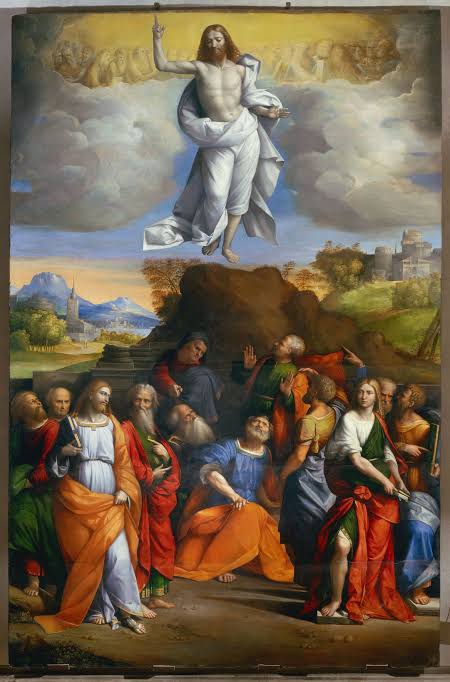
Today, on this Ascension Day, the Church proudly displays the placard of hope and salvation: “Dr Carpenter is upstairs!”

But unlike the doctor boy who died, Jesus – the Divine Doctor of our souls – is alive…
… and continues to heal people and bring salvation to all people!

Yes, “Jesus, the Dr Carpenter is upstairs!”

This is the day…
… in which Jesus ascended to the heavens, as a culmination of the glory of the Resurrection
… on which Jesus gave the mission mandate of preaching His Good News to the entire world.

In our proclamation of the Apostles’ Creed, we affirm:
“… He ascended into heaven, and is seated at the right hand of God, the Father Almighty!”

The Solemnity of the Ascension of the Lord is a declaration of various pointers for our reflection…

The Ascension is an event that reminds the glory and majesty of the Lord, who is sovereign over all
The Lord ascended.

Elsewhere in the Bible, we have incidents of persons being taken up to heaven

Enoch was taken up by God: “Then Enoch walked with God and he was no longer here, for God took him” (Gen 5:24)

Elijah went up: “As they walked on conversing, a flaming chariot and flaming horses came between Elisha and Elijah, and Elijah went up to heaven in a whirlwind” (2Kgs 2: 11)

Mother Mary was ‘assumed’ into heaven, body and soul (Dogma of the Assumption)

However, Christ ‘ascended’

It was His Power that made Him to ‘go up’ to the heavens.

This is a tremendous demonstration of His Divinity, His Glory and His Power!

The Ascension is an event which radiates hope to the suffering and optimism to the distressed

The interesting saga of Christ’s life, beginning with….
… His simple yet powerful event of His Birth…
… His ordinary yet impressive event of His ministry…
… His agonizing yet impactful event of His passion and death…
… His glorious and spectacularly amazing event of the Resurrection…
… finds its joyful and resplendent finale in His Ascension to the heavens.

This is a beautiful exhibition of how a life, lived in faith and commitment, even if it has to go through the barbed wires of pain, humiliation, suffering and uncertainty…
… has a splendid and magnificent ending!

The Ascension is an event that urges us in our commitment to be Missionaries for the Kingdom of God

The Lord’s concluding words to His apostles constituted a binding mandate…
… to go into the whole world and preach the Gospel to the whole creation
… to be an instrument of His power to cast out demons, to speak in new tongues, to endure poisons, to lay hands on sick and restore them to recovery.

This is a dutiful reminder of how the Lord trusts and has immense confidence in each one of us to be the proclaimers of His word.

The Lord wishes to reign over in our hearts.

He wishes to be the sovereign ruler of our lives.

May the Feast of the Ascension be a reminder for us to open our hearts to let the Lord to be in total command of our lives.

May…
a. The conviction in His love
b. The zeal to be His Missionaries and
c. The passion to make this world a holier place
… help and strengthen us, to be “doctors of healing and love” in our world of suffering and pain!

Yes, “Dr Carpenter is Upstairs!”

Happy Feast of the Ascension!

God Bless! Live Jesus!


Discovering the beauty of the Catholic Church through the Catechism:
FREEDOM PUT TO THE TEST

God created man in His image and established him in his friendship.
A spiritual creature, man can live this friendship only in free submission to God.
The prohibition against eating “of the tree of the knowledge of good and evil” spells this out: “for in the day that you eat of it, you shall die.”
The “tree of the knowledge of good and evil” symbolically evokes the insurmountable limits that man, being a creature, must freely recognize and respect with trust.
Man is dependent on his Creator…

… and subject to the laws of creation and to the moral norms that govern the use of freedom. (Cf. CCC # 396)