REFLECTION CAPSULE – Aug 18, 2021: Wednesday

“Being ready to let go of ourselves and get transformed to be a Volcano of Generosity!”

(Based on Judg 9:6-15 and Mt 20:1-16 – Wednesday of the 20th Week in Ordinary Time)

One of the most powerful, spectacular and amazing natural wonder of the world is a Volcano!

The image of a Volcano brings to our mind a massive mountain, erupting fumes of smoke and lava.

A volcano represents mighty force.

A volcano stands for…
… immense heat
… great strength

The Gospel of the Day lets out a life-challenging message, delivered with much power and force…
… like a volcano!

We have the familiar parable of the Landowner and the workers from Mt 20:1-16 for our Gospel Passage today.

This landowner is quite unique and amazing in his approach.

He hired labourers for his vineyard first in the early hours of the day…

Then periodically throughout the day…
Finally, he hired some at the fag end of the day – to work only one hour.

The labourers in those days, like often in our society too…
… had no secure work and no consistent income.

They were given hired on a day to day basis.

Those hired late, were not sure of what wages they would be paid…
They had to, therefore, solely depend on the kindness of the one who had hired them!

The landowner in the Gospel, pays the labourers, not as per their work…
… but as per his kindness!

He pays the labourers, not just based on their hard efforts…
… but based on His big-heartedness!

The Landowner is like a Volcano – mighty and immense and great…
… in his generosity!

He is a Volcano of Generosity!

Like a volcano, he is mighty…
… in standing up to his principles in being firm to render benevolence.

Like a volcano, he is immense…
… in lavishing unexpected favours and rendering surprising packages

Like a volcano, he is great…
… in being fair in his dealings and yet going beyond justice to the needy.

This landowner is Jesus!

He is the Volcano of generosity.

Jesus has given us life and many essentials and comforts of life…
… in His generosity.

Jesus has strengthened us with His transformative words in the Bible…
… in His generosity.

Jesus has provided us with grace and mercy when we have been lost in sin…
… in His generosity.

Jesus has blessed us with His Body and Blood in the Holy Eucharist to nourish us…
… in His generosity.

Jesus has showered us with love and affection when we have been broken and shattered…
… in His generosity.

All this He has done when we least deserved it.

Like the late-employed workers we did not deserve this great bounty.

Perhaps, some of us might identify ourselves with the workers who were employed at the start of the day…
… and we feel ourselves been cheated and treated unfairly.

We feel that since we have been more faithful and committed, we ought to deserve more!

But the words of the Lord, need to sink deep into our hearts, “My friend, I am not cheating you…
… Am I not free to do as I wish, with my own money?” (Mt 20: 13, 15)

Let’s accept it:
We have been treated justly…
… we have been given our just wages
… we have been paid rightly.

But we lose our temper, because we compare ourselves with others and feel, “I deserved more!”

We cry foul, because we judge other people and their efforts and say, “That fellow was not so much worthy!”

We shout unfair, because we look over on the other side of the fence and exclaim, “I did better than that one!”
We go blind to the fact that we have been treated justly, and instead crib that others have been prized with greater generosity.

This is the Volcano of Generosity – Jesus.

His generosity goes beyond our wildest imaginations.
His generosity crosses all human boundaries of expectations.
His generosity traverses way ahead of what we can think or conceive!

And this Volcano of Generosity invites us to be similar in our attitude and life…

Be a volcano of generosity…
… with encouragement, for those who fail in life, despite trying hard!
… with love, for those who lose heart and struggle with problems of life!
… with patience, for those who get irritated and annoyed with situations!
… with kindness, for those who constantly find faults and are pessimistic!
… with hope, for those who find no meaning in life and remain depressed!

The Volcano is one of the most powerful, spectacular and amazing wonder in the world.

If we can shape our lives, into a Volcano of Generosity…
… we too can be a powerful, spectacular and amazing witness to the Lord in this world!

Are we ready to let go of ourselves…
… and get transformed to be a Volcano of Generosity?

God Bless! Live Jesus!


Discovering the beauty of the Catholic Church through the Catechism
THE RESURRECTION AS TRANSCENDENT EVENT

“O truly blessed Night,” sings the Exsultet of the Easter Vigil, “which alone deserved to know the time and the hour when Christ rose from the realm of the dead!”
But no one was an eyewitness to Christ’s Resurrection and no evangelist describes it.
No one can say how it came about physically.
Still less was its innermost essence, His passing over to another life, perceptible to the senses.
Although the Resurrection was a historical event that could be verified by the sign of the empty tomb and by the reality of the apostles’ encounters with the Risen Christ, still it remains at the very heart of the mystery of faith as something that transcends and surpasses history.

This is why the risen Christ does not reveal himself to the world, but to his disciples, “to those who came up with him from Galilee to Jerusalem, who are now His witnesses to the people” (Cf. CCC # 647)

REFLECTION CAPSULE – Aug 17, 2021: Tuesday

“Making Christ as the greatest possession and treasure of our lives!”

(Based on Judg 6:11-24 and Mt 19:23-30 – Tuesday of the 20th Week in Ordinary Time)

A distinguished man was lying on his death-bed.

As he lay, some of his precious ornaments, priceless stones and his fine collection of exquisite watches were brought to him.

Turning a cold glance on the treasure, which he would once have clutched with an eager grasp…
… he said with a sigh:
“Alas! this is a very fine thing in this country…
… but I am going to a country where it will be of no use to me!”

The man, at his death-bed realized the worthlessness of clinging on to riches and wealth!

If only, he had realized it, when he had years to live…
… life would have been much peaceful and contented
… life would have been better utilized to prepare for eternal life

Well…
… all of us, do have time to realize – the worthlessness of clinging on to riches and wealthy..

Do we seek to make Christ as the greatest possession and treasure of our lives?

Do we mend our lives accordingly, and live in pursuit of heaven?

Jesus, in the Gospel of the Day gives a triple perspective on the aspect of riches (Mt 19:23-30)

  1. The difficulties that attachments to riches pose, in entering the Kingdom of God
  2. The power of God that alone can assist and help one to attain eternity
  3. The promise of reward to those who live a life of detachment

Jesus says, “Amen, I say to you, it will be hard for one who is rich to enter the Kingdom of heaven” (Mt 19: 23)

The reason why riches are given such a strong reprimand by the Lord is because:

Attachment to riches can easily take away one’s heart from the Lord…
… The Lord, Who stripped Himself of all glory and became poor is often given less priority!

Being obsessed with riches leaves us with little time and thought for things of eternity
… Our plannings, aspirations and projects often end up being only earthly in nature!

Having too many riches can pose a danger to feel proud and independent
… A sense of “I can manage all by myself” creeps in; in the process, keeping aside God from our lives!

Venerable Bishop Fulton Sheen says:
“It is ever true that the richer the soul is on the inside, the less need it has of luxuries on the outside;
Excessive adornments and an inordinate love of comforts are proof of our inner nakedness!”

  1. The power of God that alone can assist and help one to attain eternity

On hearing of the difficulty of the rich to enter the Kingdom of God, the disciples asked Jesus, “Who then can be saved?” (Mt 19:25)

Jesus replied, “For human beings, this is impossible; but for God all things are possible” (Mt 19: 26)

The demands of Christianity to live a life of detachment from riches, can sometimes cause undue anxieties.

And we begin to ask…
… Is it really possible for us to live as Jesus expected of us?
… Is it not beyond my capabilities to achieve what the Lord wishes of us?

Such kind of anxieties and worries, can often cause weariness our soul!

St Francis de Sales says:
“Anxiety is the greatest evil that can befall a soul, except sin!
Have patience with all things, but first of all with yourself!”

The Lord tells us that even in our efforts to be detached…
… we need to depend on Him
… we need to know that His Grace will take us through

Therefore, to have detachment…
… we ought to come to the Lord in prayer, surrendering our lives
… we need to thank the Lord continually for all His blessings, acknowledging Him as the source
… we need to reach out to the Lord in the poor, the weak and the needy (Mt 25:40)

  1. The promise of reward to those who live a life of detachment

Jesus says: “Everyone who has given up”…will receive a hundred times more and will inherit eternal life” (Mt 19:29)

A question of despair or hopelessness sometimes nags a Christian…
… What is the use of living an honest and virtuous life?
… Why is my life unrewarded, whereas many others thrive even by unjust means?

The Lord however, gives an answer…

… that none of such sacrifices will go unrewarded

He does promise His rewards – temporal as well as spiritual…
… but these are to be received in accordance to the Will of God.

Many times, the Will of God, is not taken into consideration…
… when we look for rewards in having made a sacrifice.
… when we seek for answers to our prayers
… when we expect fruits for our efforts

The Lord therefore invites and challenges us…
… to purify our motives when we make sacrifices
… to align our interests to God’s Will when we work for Him

That’s why Jesus would say: “Seek first the Kingdom of God and His righteousness…and all other things shall be added unto you” (Mt 6:33)

The words of Mother Angelica, the founder of EWTN (Eternal Word Television Network) are a reminder to us:
“Have we lost sight of this world being a pilgrimage?

It’s a journey! You’re not home yet!
A Christian must never lose sight of this passing reality of life”

Yes, let us come to this realization about attachments to riches:
“Alas! This is a very fine thing in this country…
… but I am going to a country where it will be of no use to me!”

God bless! Live Jesus!


Discovering the beauty of the Catholic Church through the Catechism
THE CONDITION OF CHRIST’S RISEN HUMANITY

By means of touch and the sharing of a meal, the Risen Jesus establishes direct contact with His disciples. He invites them in this way to recognize that He is not a ghost and above all to verify that the Risen Body in which He appears to them is the same Body that had been tortured and crucified, for it still bears the traces of His Passion.
Yet at the same time this authentic, real body possesses the new properties of a glorious body: not limited by space and time but able to be present how and when He Wills; for Christ’s humanity can no longer be confined to earth, and belongs henceforth only to the Father’s Divine Realm.
For this reason too, the Risen Jesus enjoys the sovereign freedom of appearing as He wishes: in the guise of a gardener or in other forms familiar to his disciples, precisely to awaken their faith.
Christ’s Resurrection was not a return to earthly life, as was the case with the raisings from the dead that he had performed before Easter: Jairus’ daughter, the young man of Naim, Lazarus.
These actions were miraculous events, but the persons miraculously raised returned by Jesus’ power to ordinary earthly life. At some particular moment they would die again.

Christ’s Resurrection is essentially different. In His Risen Body, He passes from the state of death to another life beyond time and space. At Jesus’ Resurrection, His Body is filled with the power of the Holy Spirit: He shares the Divine Life in His glorious state, so that St. Paul can say that Christ is “the man of heaven” (Cf. CCC # 645-646)

REFLECTION CAPSULE – Aug 16, 2021: Monday

“Focussing our attention back on the True Riches of Life!”

A man was passing out of a church when he met an old acquaintance whom he had not seen for several years. In their brief interaction, the man said to his acquaintance, “I understand you are in great danger.”

(Based on Judg 2:11-19 and Mt 19:16-22 – Monday of the 20th Week in Ordinary Time)

This statement was said seriously, and was heard with surprise.

The acquaintance who was addressed was not aware of any danger that he was facing, and so, curiously inquired what was meant.

The man, with a sense of concern, then replied: “I have been informed… that you are getting rich!”

(The acquaintance was being reminded of the danger that riches have…
… Riches can lead one’s heart away from the Lord, the greatest treasure
… Riches can blur one’s vision to help and reach out in service to the needy)

With a sense of acceptance, the acquaintance answered: “I thank the Lord for this timely intervention!

I do agree I have been losing my peace of mind over the last years…
… even though my bank balance is on the rise!

I do experience a spiritual vacuum!
And I hope that your reminder will help me focus my attention back on the True Riches of Life!”

This is the great and a naked reality of our 21st century, in particular: There is a great spiritual vacuum at the heart of our society… a tumour of the soul!

There are many who have plenty of wealth…
… but extremely poor in peace of mind

There are many who have honour and fame…
… but strangely lost in loneliness and despair

There are many who have cashed in popularity and glam and glitz…
… but end up in depression and gloom

There are many who have built bungalows and estates…
… but sadly abandoned in nursing animosity at home

Our world is habitually sick…

Our families are frequently cracked and broken!

The Gospel of the Day, brings on stage, one person…
… who claimed he had everything right
… who claimed he did everything right

And yet….yet…”he lacked something!”

A vacuum filled his soul!!

The rich young man in today’s Gospel passage apparently looks as an ideal person…
… and some of us can even identify the pattern of our lives with his.

He seeks for Eternal Life…
… We too seek the spiritual treasures and religious riches

He addresses Jesus as the Master…
… We too acknowledge the supremacy and authority of God in our lives…

He knows the laws…
… We too know the basics of our teachings and are informed of the doctrines

He practices the commandments…
… We too do our bit in keeping the rules and regulation of religion

Despite all these aspects, he still lacked something…..

DESPITE ALL THESE ASPECTS, ARE WE TOO LACKING SOMETHING?

To hear that statement was hard for that man…
… and it is hard for us too, to hear and digest that – “You are lacking something!”
It’s a statement which can belittle people!

It’s like telling a Great Artist…
… your art is superb, but you still lack the quality in painting the nuances

It’s like telling a Great Speaker…
… your talks are classic, but you still lack the trait of modulation of tones

It’s like telling a Great singer…
… your voice is amazing, but you still lack the punch in singing the high notes

After doing and achieving many things, to hear that “You are lacking something” is hurting….

But that was the fact…. that was the reality and the reason, for the vacuum and the void that was experienced!

The rich young man thought he had gained everything… He assumed he did everything right…

But he still lacked something
… What was that?

“He lacked” having heaven as his greatest treasure and fortune…

“He lacked”…
… the control to let go off money and mammon as the controlling factor of his life…
… the charity to share his resources and his possessions to the needy and the wanted…
… the generosity to set free his mind from being dominated by the cares and burdens of this world…

The man had gained much in life, but he still lacked what was most important: A great vacuum had engulfed his soul…
… a great void had overpowered his life!

Is my life in resemblance with this person, who thought he had everything right…
… yet lacking the Basics?

Is my life similar to this person, who considered he was on the right track…
… but lacked the Right Direction?

St Francis de Sales says, “It [is] overambitious to aim at being poor without suffering any inconvenience…
… in other words, to have the credit of poverty and the convenience of riches!”

The Lord invites us, as He invited the Rich Young Man:
“Go, sell what you have
…give to the poor and follow Me!”

“Give up the feeling that money and worldly riches can rule your life…
… rather acquire spiritual treasures”

“Give up the notion that worldly success can satisfy you…
… rather feed your lives with divine riches”

May this intervention of the Gospel help us to have a sense of acceptance, and reply:
“I thank You, Lord for this timely intervention!

I do agree that perhaps, I have been losing my peace of mind…for various reasons
I do experience a spiritual vacuum!
I hope that Your reminder will help me focus my attention back on the True Riches of Life!”

God Bless! Live Jesus!


Discovering the beauty of the Catholic Church through the Catechism
THE APPEARANCES OF THE RISEN ONE

Christ’s Resurrection cannot be interpreted as something outside the physical order, and it is impossible not to acknowledge it as an historical fact.
It is clear from the facts that the disciples’ faith was drastically put to the test by their master’s Passion and Death on The cross, which He had foretold.
The shock provoked by the Passion was so great that at least some of the disciples did not at once believe in the news of the Resurrection.
Far from showing us a community seized by a mystical exaltation, the Gospels present us with disciples demoralized and frightened.
Even when faced with the reality of the Risen Jesus, the disciples are still doubtful, so impossible did the thing seem: they thought they were seeing a ghost. “In their joy they were still disbelieving and still wondering.”
Therefore the hypothesis that the Resurrection was produced by the apostles’ faith (or credulity) will not hold up.

On the contrary their faith in the Resurrection was born, under the action of divine grace, from their direct experience of the reality of the risen Jesus. (Cf. CCC # 643-644)

REFLECTION CAPSULE – Aug 15, 2021: Sunday

“Like our Blessed Mother Mary, properly channelizing the God-given Freedom towards excellence of life, blossoming of virtues and the Glory of God!”

(Based on the Solemnity of the Assumption of our Blessed Mother Mary)

The Feast of the Assumption of our Blessed Mother Mary is celebrated in variety of ways, all over the world.

Assumption, by Titian, 1518, Santa Maria Gloriosa dei Frari, Venice

In some of the small towns of Rome, there is a very symbolic custom.

It is called as L’Incinata – the Bowing Procession.

The people in the village carry a statue of the Blessed Virgin Mary down the main street.

This is symbolic of Mother Mary on Her way to heaven

From the opposite direction comes another procession, carrying the statue of Jesus.

This is symbolic of Her Son Jesus coming to welcome Her

Under an arch that has been prepared with branches and thousands of flowers, the two processions meet.

The statues are then made to bow to each other, three times…
… It is symbolic of Jesus welcoming His Beloved Mother at the gates of heaven.

Then the combined procession continues, with the people carrying the statues side-by-side to the Church….
… Symbolically indicating, Jesus taking along His Mother to Her throne in heaven!

This ‘bowing procession’ so very beautifully and symbolically represents the wonderful event of the Assumption of our Blessed Mother Mary.

It celebrates the Son-King sharing His Glory with His Mother.

Human kingdoms have followed the tradition of the son who is the King of the Land, crowning his mother, as the Queen of the Kingdom.

The Old Testament bears witness to this fact:
King Solomon on assuming charge of the throne, after King David, raised his mother Bathsheba to his side, to be the royal queen (1 Kings 2: 19)

This was also a foretaste of what was to follow…
… Jesus, the King of Kings awarding the throne of glory to His Mother, Mary and raising Her to be the Queen of Heaven and Earth!

The feast of the Day – the Assumption of Mother Mary – is one of the four Marian Dogmas that the Catholic Church pronounces.

A dogma is a doctrine that is solemnly proposed by the Church as formally revealed in Scripture or Tradition.

The four Marian Dogmas are:

  1. Mary as the Mother of God
  2. The Perpetual Virginity of Mary
  3. The Immaculate Conception of Mary
  4. The Assumption of Mary into heaven

The declaration of the Dogma of the Assumption of Mary is as follows:
“By the authority of our Lord Jesus Christ, of the Blessed Apostles Peter and Paul, and by our own authority, we pronounce, declare, and define it to be a divinely revealed dogma: that the Immaculate Mother of God, the ever Virgin Mary, having completed the course of her earthly life, was assumed body and soul into heavenly glory.”

This Dogma of the Assumption was proclaimed on November 1, 1950, by Pope Pius XII in the Apostolic Constitution “Munificentissimus Deus”

This proclamation was not defining something new in the Church…
… rather it was an official recognition of the centuries-old belief on Christians about the Assumption of their Heavenly Mother.

The celebration of the Feast of the Assumption teaches us one important aspect: The Assumption of Mother Mary is the sure hope for us, for a life of eternal glory!

Our Blessed Lord came to this world to “die” and “win” salvation for human beings.

This act of salvation had its total co-operation in the Person that God had chosen as His Own in the Divine Plan – Mother Mary.

From the moment, She said “yes” to the messenger of the Lord to become the Mother of God’s Child…
… She placed Herself in a position of “constantly being under the scanner to say a Yes” to God’s Will!

Her Yes to God, meant a “No” to many things in Her personal life…
… her own individual desires
… her own undisclosed dreams

She would become the epitome of the one who lived the teaching that Jesus would later expound during His ministry, “No one who puts a hand to the plough and looks back is fit for service in the Kingdom of God” (Lk 9: 62)

Her echo of “Yes” reverberated and resonated all through Her life…
…. in times of loneliness
… in times of immense pain
… in times of utter hopelessness

It was this daring faithfulness that made God to bestow on Her the privilege to share in Her Son’s Glory!

This is wonderful story of the Assumption.

This then is one of the great promise and assurance that God gives to each one us through this Dogma of the Assumption of our Blessed Mother Mary.

Does life grind us, with its daily toils and do we undergo immense pain and suffering – sometimes even unbearable and agonizing?

Does life grill us, with many incidents of misunderstandings, exposition to calumnious talks and total absence of positive encouragements and unconditional acceptance by people?

Does life gnash us, with constant tensions and difficulties that never seem to leave us alone and paralyze us with innumerable jolts of depression and despair?

Then, the Assumption of our Blessed Mother comes to our rescue, with a hopeful answer to all such miserable questions!

We need to be reminded that Mary had exclaimed, “Behold, I am the Handmaid of the Lord” (Lk 1:38)

Mary was an ordinary human being.

She too had Her ordinary and humble beginnings.
She too went through common life’s struggles and strains.

But through these “ordinary” circumstances…

God “raised” Her to the Heights
God “assumed” Her into Glory
… simply because She “found favour with God” and lived a life worthy of that call
In total submission, humble obedience and loyal faithfulness!

This then is our call too…

As Baptized Christians, we too have “found favour” with God.

We dwell in “ordinary” circumstances of life – with hardships and pains.

But if we also…
… seek and live the Will of the Lord at all times
… constantly submit to what He wants
… and dutifully bow to His mercy and grace

Then the glory which Jesus has “won” for us at Resurrection, can be ours!

God’s plans are indeed wonderful…

In the “Story of the Fall” a mother (Eve) had been involved intimately with a man (Adam) and humanity fell into the sea of sin!
In the “Story of the Rise”, a Mother (Mary) was involved intimately with a Man (Jesus) and humanity is promised to “assume” to the skies of glory!

Are we ready to co-operate with God’s plans in our lives, just as Mother Mary did…
… and thus receive the “Privilege of Assumption into Glory” just as Mother Mary received?

Let us grow in our Love for the Lord and for the Blessed Woman who bore God in Her womb and was borne by God into heaven, and not left in the grave to turn back into dust!

Today, the Great Land of India celebrates her Independence Day.

May all Indians grow to understand the true meaning of freedom…
… and like Mother Mary, properly channelize the God-given Freedom towards excellence of life, blossoming of virtues and to the Glory of God!

Happy Feast to Jesus, Our Great King and to Mamma Mary, His Glorious Queen-Mother!

Happy Independence Day to all Indians, all over the world!

God Bless! Live Jesus!


Discovering the beauty of the Catholic Church through the Catechism
THE APPEARANCES OF THE RISEN ONE

Mary Magdalene and the holy women who came to finish anointing the body of Jesus, which had been buried in haste because the Sabbath began on the evening of Good Friday, were the first to encounter the Risen One.
Thus the women were the first messengers of Christ’s Resurrection for the apostles themselves.
They were the next to whom Jesus appears: first Peter, then the Twelve. Peter had been called to strengthen the faith of his brothers, and so sees the Risen One before them; it is on the basis of his testimony that the community exclaims: “The Lord has risen indeed, and has appeared to Simon!”
Everything that happened during those Paschal days involves each of the apostles – and Peter in particular – in the building of the new era begun on Easter morning. As witnesses of the Risen One, they remain the foundation stones of his Church.

The faith of the first community of believers is based on the witness of concrete men known to the Christians and for the most part still living among them. Peter and the Twelve are the primary “witnesses to his Resurrection”, but they are not the only ones – Paul speaks clearly of more than five hundred persons to whom Jesus appeared on a single occasion and also of James and of all the apostle. (Cf. CCC # 641-642)

REFLECTION CAPSULE – Aug 14, 2021: Saturday

“Seeing the world through the eyes of a child – in openness, sincerity, wonder and innocence – to have ‘a wonderful day,’ every day of our life!”

(Based on Josh 24:14-29 and Mt 19:13-15 – Saturday of the 19th Week in Ordinary Time)

Charles Francis Adams was a 19th century American historical editor, politician and diplomat.

His son was Brooks Adams, who became a historian.

A researcher, while making a study on the life of the Adams Family came across their personal diaries.

Both, the father and son, had entered a description of a particular day…
… It was a day when they had gone fishing.

However, interestingly, their descriptions had a world of difference…

The father, wrote in his diary:
“Went fishing with son. Day wasted.”

The son, however wrote in his diary:
“Went fishing with my father. The most wonderful day of my life!”

Why such a huge contrast in the description of the same day?

The son Brooks, was only twelve years at that time.

It was a bad day at fishing as they didn’t catch any fish…
… but they spent a lot of time talking

The boy had asked a number of questions, and the father had creatively answered…
… in the process, explained many important aspects about life.

The father, on the other hand, felt it as a waste of time…
… without even any fish being caught!

Our attitude in life makes a world of difference!

Seeing the world through the eyes of a child – in openness, sincerity, wonder and innocence – can help us to have “a wonderful day,” every day of our life!

Hence, in the context of a family life, there is a popular quote which says:
“A house is built with bricks and beams…
… A home is built with love and dreams!”

The Gospel of the Day presents to us an occasion to dwell on a reflection on our families…
… and some of the basic essentials that needs to be part of every family (religious community included as well)

Family Life is an important component of every society.

The Gospel of St. Matthew, Chapter 19, has an interesting structure or a progression with respect to the topics discussed and the persons involved.

The chapter begins with a discussion on the institution of ‘Marriage’. (Mt 19: 2-10)

Jesus explains the importance of this sacred bond and a strong exhortation is given on the need to do away with divorce.

The chapter proceeds, as we see in today’s reading, with a discussion on ‘little children’. (Mt 19: 13-15)

This discussion is followed by an incident in which a ‘young man’ encounters Jesus (Mt 19: 16-22)

The Chapter will finally end with an exhortation by Jesus to have maturity as an ‘adult’ is making choices for the Kingdom of God! (Mt 19: 23-30)

Thus, the Chapter 19 of Matthew is a travel through a FAMILY context…
… starting from MARRIAGE…and the need to avoid DIVORCE…
… to little CHILDREN
… to the problems of a YOUTH
… and finally ending with the choices as an ADULT.

In today’s Gospel, we have the discussion on Little Children (Mt 19: 13-15)

Though it’s a short passage, the Gospel gives us enough food for thought…
… especially in the context of a family or a community life.

We see four different groups or sets of people in today’s Gospel Passage, and we can learn some aspects from each of those sets…

Three of them give us a positive quality which is to be inculcated
One gives a negative quality which is to be avoided in life.

  1. Firstly, the Gospel begins with the statement, “Little children were brought to Jesus…” (Mt 19: 13a)

Probably the parents, the elder brothers/sisters or the guardians of the children would have brought them to Jesus.

So we see here, the First set of people… Parents, Guardians, Elders etc…. and they teach us the First Positive Quality – the Spirit of Responsibility!

They were Responsible in caring for the good and future of the children.

It was an ancient practice that children would be brought to Rabbis to be blessed and prayed over.

This first set of people teach us to be responsible for the growth of others in our family and in our communities.

  1. The Second set of people are obviously the Little Children.
    These little ones teach us the Second Positive Quality, needed in a family or a community – the Spirit of Receptivity!

Children display a great sense of receptivity and openness.

They are able to accept the affection, the care, the love and the blessings that are given to them.
They do not close themselves to the good things in life.

We too need to cultivate this Spirit of Receptivity, to be open to the actions, thoughts, views and feelings of others in our family and our community.

  1. The Third Set of people display a negative attitude which we need to avoid.

When the children were brought to Jesus, the Disciples refuse to accept them and want to keep them away (Mt 19: 13b)

They show a Spirit of Rejection!
They perhaps felt that these children would be a nuisance to Jesus and His ministry.

They felt it as a waste of time and energy to entertain the children.

Little things in life were considered to be a useless and futile activity.

We need to avoid this Spirit of Rejection…

In our families or communities, we can have this attitude towards those who don’t do any work or fail to contribute anything.

We often fail to understand the importance…
… of little tokens of love
… tiny expressions of care by our family and community members

And we, instead, tend to reject and avoid them.

  1. The fourth Set is represented by Jesus Himself…
    … and he presents the Spirit of Restoration and Redemption.

He does not reject…
… rather, He accepts and seeks to redeem the little children.

He seeks to restore the little ones who are rejected…
… who are avoided and who are not given the due importance.

In our lives, we too need to be having a Spirit of Redemption and Restoration…

To redeem the ones who are at the periphery and who fail to get any attention
To restore the ones who are broken and abused and are shunned!

Thus, this powerful Gospel passage teaches us…

To avoid the Negative Quality of the Spirit of Rejection…

Rather…

To adopt the positive qualities of…
… The Spirit of Responsibility,
… The Spirit of Receptivity
… The Spirit of Redemption and Restoration!

Today we celebrate the Feast of St Maximillian Kolbe, who was called by Pope St John Paul II as the “Patron Saint of our Difficult Century!”

May the words of this Heroic Saint, who volunteered to die in place of a stranger in the Nazi death camp of Auschwitz, be an inspiration for us:
“The most deadly poison of our times is indifference.

And this happens, although the praise of God should know no limits.
Let us strive, therefore, to praise Him…
… to the greatest extent of our powers!”

Let us seek the Intercession of the great Saint that we may avoid the tendency to Reject People…

And instead, we may be…
… Responsible towards others
… Receptive to others
… and Redeem and Restore the lives of others!
And thus build happy and loving homes!

May we always understand that “our attitude in life makes a world of difference!”

Seeing the world through the eyes of a child – in openness, sincerity, wonder and innocence – can help us to have “a wonderful day,” every day of our life!

God Bless! Live Jesus!


Discovering the beauty of the Catholic Church through the Catechism
RESURRECTION – THE EMPTY TOMB

“Why do you seek the Living among the dead? He is not here, but has Risen”
The first element we encounter in the framework of the Easter events is the empty tomb.
In itself it is not a direct proof of Resurrection; the absence of Christ’s Body from the tomb could be explained otherwise.
Nonetheless the empty tomb was still an essential sign for all. Its discovery by the disciples was the first step toward recognizing the very fact of the Resurrection.
This was the case, first with the holy women, and then with Peter. The disciple “whom Jesus loved” affirmed that when he entered the empty tomb and discovered “the linen cloths lying there”, “he saw and believed”.

This suggests that he realized from the empty tomb’s condition that the absence of Jesus’ Body could not have been of human doing and that Jesus had not simply returned to earthly life as had been the case with Lazarus. (Cf. CCC # 640)

REFLECTION CAPSULE – Aug 13, 2021: Friday

“Making the Lord – the Lover of our souls – as the “fireproof” strength in our relationships!”

(Based on Josh 24:1-13 and Mt 19:3-12 – Friday of the 19th Week in Ordinary Time)

“Fireproof” is a 2008 Christian drama film.

It is an incredibly gripping, compelling and a transformational story about saving a marriage – of Catherine and Caleb – that had hit rock-bottom.

Catherine was a hospital administrator, married to fire captain Caleb Holt.

Caleb recruited young men under the dictum of never leaving one’s partner, ‘especially in a fire’.

But at home, the scenario was quite opposite; he and Catherine argued over almost everything.

Catherine accused Caleb of being selfish with time and money.
Caleb complained that Catherine was ungrateful for all he did to help others.

Both felt that the other didn’t care or appreciate each other

The constant bickering reached the high point, when Catherine demanded a divorce and an irritated Caleb agreed.

The two complained to their respective friends regarding this unpleasant phase of their life.

John, Caleb’s father convinced his son to delay the divorce proceedings in order to try “Love Dare”, a 40-day challenge for improving marriages by changing the way a spouse was treated.

Caleb’s friend Michael also persuaded Caleb to hold off on divorce and challenged the fire-captain with a bold statement:

“I’ve seen you run into a burning building to save people you don’t even know, but you’re going to let your own marriage burn to the ground?”

The acceptance of Christ into his life invigorated Caleb to ask God to help in defeating his demons and overcoming his addictions.

The movie proceeds, through many twists and turns, with Catherine finally realizing and acknowledging the many selfless acts done by her husband and enters into reconciliation with him.

The film ends with Caleb and Catherine renewing their wedding vows as a covenant with God.

Marriage is a sacred institution – a precious covenant – that demands a lifelong commitment and a faithful dedication, despite the ups and downs of life.

It is this message that is driven home by Jesus in today’s Gospel when He expounds His teaching on the sacredness of the Covenant of Marriage.

The passage begins with a testing interrogation by the Pharisees, “Is it lawful to divorce one’s wife for any cause?” (Mt 19:3)

Jesus came to the world to demonstrate the magnanimity of God’s Love.

This magnanimity includes…
… His unconditional manner of loving us, irrespective of our worthiness
… His unfailing faithfulness to us, despite our many acts of betrayal and disloyalty

It is this model of God’s love that becomes the blueprint for us in loving others, and especially in a marriage relationship.

The partners, pledged in love to each other in marriage, ought to imitate the love that God has for us…

We have cheated and strayed away from what God wants of us…
… He still loves us and is faithful to us

We have, on innumerable occasions, spat at His face by our shameful deeds and defamed His name by our sinful acts…
… He still holds us close to Him and remains loyal to us

We have, despite many warnings, purposely hurt Him in thoughts, words and deeds and even rejected His graces by not co-operating with His Will for us…
… He still waits patiently for our return and constantly seeks to draw us to Him

We have failed Him many times, but He has always made efforts to try to win us

We have hurt and pained Him much, but He has still longs for us, with His soothing balm of acceptance

It is this “magnanimity of God’s Love” that becomes the basis, the inspiration and the ideal in every marriage relationship.

Therefore Jesus says, “What therefore God has joined, let not man put asunder” (Mt 19: 6b)

We live in a world where the quickest solution to many problems is found in “throwing it away!”

And the same mentality affects human relationships too… especially to those in marriage.

The challenge therefore is to dare to swim against these worldly currents and bring in the “Jesus Culture of Faithful Commitment” in human relationships, especially of marriage.

Theoretically speaking, this sounds quite good and wonderful.

But when it comes down to the actual practice… in married lives… it is undoubtedly a very hard effort.

“But what is impossible for humans is possible for God” (Lk 18: 27), is the assurance of Jesus.

When the going gets really hard and we want to call it ‘quits’ in our relationships…
… let us look to Jesus who said Yes to the Will of God in the painful agony at Gethsemane

There may seem no hope ahead…

Still, can we say Yes to God’s Will – to be faithful and committed?

When none of our efforts of restoration work out and we get ‘fed’ up and feel to have reached the ‘limit’ in relationships…
… let us look to Jesus Crucified, who was never ‘fed’ up with our misdeeds and our constant misunderstanding and misuse of His love

It may seem that all the past was mere fantasy and the future appears to be non-existent…

Still, can we hold on to Hope in God – to be true to our promise and be loyal?

The promises made…

to our Faith in Baptism
to the spouse in Marriage
to the Lord in Consecrated and Priestly Life
… all demand an undissolved commitment and an undiluted faithfulness.

As the dialogues in the movie “Fireproof” says (in the scene where the ‘salt and pepper bottles’ are glued together):

“When two people get married, it’s for better or for worse, like these joined salt and pepper.
… For richer or for poorer.
… In sickness and in health.

If you pull them apart, you’ll break either one or both of them.
God made marriage to be for life.”

Yes, fireproof doesn’t mean that a fire will never come…

But it does mean, that when it comes, one will be able to withstand it!

May the Lord, the Lover of our souls be the assurance of “fireproof” in our relationships!

God Bless! Live Jesus!


Discovering the beauty of the Catholic Church through the Catechism
RESURRECTION – THE HISTORICAL AND TRANSCENDENT EVENT

The mystery of Christ’s resurrection is a real event, with manifestations that were historically verified, as the New Testament bears witness.
In about A.D. 56 St. Paul could already write to the Corinthians: “I delivered to you as of first importance what I also received, that Christ died for our sins in accordance with the scriptures, and that he was buried, that he was raised on the third day in accordance with the scriptures, and that he appeared to Cephas, then to the Twelve…”

The Apostle speaks here of the living tradition of the Resurrection which he had learned after his conversion at the gates of Damascus. (Cf. CCC # 639)

REFLECTION CAPSULE – Aug 12, 2021: Thursday

“Entrusting ourselves to the Lord and imitating Him, knowing that God’s Plan of Salvation (GPS) for human beings, is His Mercy!”

(Based on Josh 3:7-17 and Mt 18:21-19:1 – Thursday of the 19th Week in Ordinary Time)

A tech-savvy young man was once explaining the functioning and usage of a smartphone to an elderly priest.

The use of GPS (Global Positioning System) was among the few things that he taught the senior priest.

Explaining GPS, the man told of how it can be used to quickly locate places, move from one place to another effortlessly…
… and adding, “You know Father, even if you lost your direction, the GPS will safely guide you

It will only give a message, ‘Re-routing’ and then guide you to your location, provided your destination is proper”.

Hearing this, the priest reflected a while and said, “Ah! So this is a beautiful reflection of the way God is, isn’t it?”
… and he continued: “Every time we stray, God safely guides us. Every time we miss the way, He prompts the right direction. He gives the message ‘re-routing’ and amazingly shows the way to proceed ahead.

Of course, all we need to ensure is that our destination is Holiness!”

The priest concluded by saying, “I think GPS for me stands for God’s Plan of Salvation…
… and GPS for human beings is His Mercy!”

That’s truly beautiful, isn’t it?

God’s Plan of Salvation (GPS) for human beings is His Mercy!

The Gospel of the Day is the mighty message of the Lord to share in this Divine attitude of reaching out Mercy to everyone in our life.

To be merciful involves the aspect of forgiveness.

Many of us have our moments of grappling with the aspect of ‘forgiveness’.

For some people, it’s easy…

But some others struggle hard in serving out pardon…

Jesus today teaches us this necessary virtue of “forgiveness”.

To the query of Peter, “Lord, how often shall my brother sin against me, and I forgive him” (Mt 18: 21), Jesus illustrates His reply with the Parable of the Unforgiving Servant.

One of the principles in this virtue of forgiveness is the avoiding of a “mathematical accounting policy” in granting pardon.

As human beings, there is sometimes an avoidable tendency in us to “keep counts” in our relationships…

We make a count or keep a rough numerical impression…
… of how many times a person has done good to me
… of when was the last time a person behaved badly with me
… of how many times a person has hurt or caused harm to me
… of how often has a person offended me or spoken ill about me

Relationships…
… sometimes get reduced to mere mathematical entities
… sometimes find themselves entangled in the web of calculative units

It’s in such situations that “forgiving” the one who has erred against us becomes a ‘calculative’ affair.

Thus, we find that Peter in the Gospel asks Jesus, “How often must I forgive the brother who has sinned against me?”

We maintain, sometimes, a sort of an imaginary “fault-account” book.

And our thought-process takes the following pattern:
“This person, on so and so date, committed this mistake
And on so and so date, I had forgiven him”.

“This person, on this particular day, had behaved in a very indifferent manner to me
And a particular number of days later, I had extended my pardon”.

But Jesus today warns us to stop looking at life and relationships from a “mathematical” or “calculative” perspective.

What is the basis for Jesus to say this?

It is simply the fact that all of us – without any exception – are the beneficiaries of the Mercy and Forgiveness of God.

God abandons all mathematical calculations in extending His forgiveness to us

God lets go of every measure of computation in allowing us to receive His mercy

Rom 3:23 says that “all have sinned and are deprived of the glory of God. They are justified freely by His grace through the redemption in Jesus Christ”.

Each of us find ourselves sinking in the “boats of sinfulness and guilt”.
But it is the Mercy of God that still keeps us ashore.

Each of us pass through the “deserts of shame and culpability”

But it is the Forgiveness of God that nourishes us with the oasis of blessings

This “free and underserved” reception of the Forgiveness of God places an undeniable responsibility on us to extend His pardon to all.

The prayer “Our Father” is recited so often by us, during the day or in our prayers.

But do we realize that it contains a clause, whose condition, if not fulfilled, does not help us to receive the “unconditional forgiveness of God”?

We pray, “Forgive us our sins… as we forgive those who sin against us”.

Even though the mercy of God is always made available for us, it can be genuinely received only if one is willing, generous and humble enough to “forgive” the faults of others.

Forgiveness is a powerful weapon that, of course, won’t change the past, but will surely transform the future.

So many are the moments we stray away from the path of the Lord.

But every time we stray, God safely guides us.

Every time we miss the way, He prompts the right direction.

He gives the message ‘re-routing’ and amazingly shows the way to proceed ahead.

Of course, all we need to ensure is that our destination is Holiness!

Let us entrust ourselves to the GPS of our lives and imitating the Lord… knowing that
… God’s Plan of Salvation (GPS) for human beings is His Mercy!

Today we specially seek the intercession of St Jane de Chantal, in order to have greater strength in our personal relationships.

She is the patron saint of forgotten people, in-law problems, loss of parents, parents separated from children and widows.

She is the foundress of the Congregation of the Visitation of the Virgin Mary
… along with St Francis de Sales (the Doctor of Love)

(This is the Congregation to which St Margaret Mary Alacoque who promoted the Devotion to the Sacred Heart of Jesus belonged to

May the words of St Jane de Chantal words inspire us:
“If we truly love our neighbours, we refrain from saying anything prejudicial to them.

We support everyone as we would like to be supported.
We try to give the example that we would like to receive from others.
We excuse and forgive the blunders of others as we would like ours to be forgiven and excused.
We rejoice in the happiness of others and are sorrowful in their pains, just as we would like them to respond to us in ours.
We graciously help others in their needs both by prayer and actual service.
In this way we truly show our good-will and love.”

Happy Feast of St Jane de Chantal!

God Bless! Live Jesus!


Discovering the beauty of the Catholic Church through the Catechism
ON THE THIRD DAY, HE ROSE FROM THE DEAD

“We bring you the good news that what God promised to the fathers, this day He has fulfilled to us their children by raising Jesus.”
The Resurrection of Jesus is the crowning truth of our faith in Christ, a faith believed and lived as the central truth by the first Christian community…
… handed on as fundamental by Tradition
… established by the documents of the New Testament
… and preached as an essential part of the Paschal mystery along with the cross
Christ is risen from the dead!

Dying, he conquered death; To the dead, he has given life! (Cf. CCC # 638)

REFLECTION CAPSULE – Aug 11, 2021: Wednesday

“Engaging ourselves in radical Christian charity and humility!”

(Based on Deut 34:1-12 and Mt 18:15-20 – Wednesday of the 19th Week in Ordinary Time)

Online social networking services, over the last few years, have achieved immense levels of popularity and usage.

Many use them, on account of their…
… versatility in finding and maintaining contacts
… easy to use features and the availability of readily accessible tools
… resourcefulness which helps to gain a lot of information and entertainment

One of the features that is available on most of these networking sites/apps is the option to “unfriend” someone.

To “unfriend” means to remove someone from a list of friends or contacts on a social networking website.

The technique to do that is pretty simple:

Going to the person’s profile
Hover over the ‘Friends’ button at the top of the profile
Click on “Unfriend’

It’s as easy and straightforward as that to “throw” someone out of the friend list!

Real life too, sometimes falls into this “simplistic” technique to “unfriend” people from life – especially people who are close to us and who ought to deserve “repeated” chances before the ties are severed…

… Someone offends us – either out of ignorance or perhaps due to some reason – but we easily “break ties” with that person

… Someone speaks a bad word about us and we take so much offence that we lose all our peace of mind and devise schemes to terminate or harm that person – either physically or socially or mentally

… Someone acquires a bad name – out of false rumours or maybe even out of some true incident; but we make a mountain of the mole and go on to further critically damage the image of that person

Our life sometimes makes it so easy “to unfriend” someone…
… sometimes, even our own family members, or close friends or some other person who has played a deep role in our lives.

The Gospel of the Day invites us to reflect in depth on this our trend to “unfriend” people from our lives, without even giving them further chances or opportunities to remedy themselves.

Jesus says, “If your brother sins against you, go and tell him his fault, between you and him alone” (Mt 18: 15)

Jesus was a person who had an important principle in all His teachings: the need to strive towards perfection.

In Mt 5: 48, Jesus says, “Be perfect as your Heavenly Father is perfect”

It’s this pursuit of perfection in human relationships that makes Jesus to invite us in being careful and cautious with respect to severing our relationships with one another.

“Friendship”, it is said, “is delicate as a glass – once broken it can be fixed but there will always be cracks”

Jesus, therefore warns us on the need to “handle with care” our relationships.

The “pursuit towards perfection” makes it inevitable for a Christian – a follower of Christ, to go beyond one’s own limitations and situations in maintaining relationships…
… by preserving and perfecting the fine ones
… by mending and restoring the broken ones.

It is easy to say “I don’t like you any more” because of some bad experience
… but it takes Christian Gentleness to respect and accept a person, despite his/her faults or failures

It is easy to show a person the exit-door in our relationship due to some misunderstanding or ego-clash
… but it takes Christian Humility to let go of one’s “proud and adamant mentality” and lower oneself to try to understand better the person in fault and his/her situation and background

It is easy to harbour grudge and to nurture ill-feelings and to spread the contagion of malicious talks regarding a person whom we don’t like
… but it takes Christian Charity to allow the honey of Christ’s love to permeate our hearts and to be able to find goodness even in the midst of a slush of ‘apparent dirt’ in the person

Our lives, families, communities and societies are being plagued by a number of cancers with respect to relationships:

Backbiting and spreading false rumours about people and situations
Cooking up bogus stories and building up on some true incidents to fashion an “interesting and spicy” report regarding particular persons
Actively engaging in forming groups and cliques against someone in order to satiate one’s own pleasures and get through one’s personal agenda for life

Are we ready to be bold to let go of all such tendencies to which we can be prone and instead engage ourselves in radical Christian charity and humility?

St Clare of Assisi, whose feast we celebrate today, is an inspiration for us to firmly trust in God.

Let her words inspire us:
“Place your mind before the mirror of eternity!
Place your soul in the brilliance of glory!

And transform your entire being into the image of the Godhead Itself through contemplation!
Gaze upon Him, consider Him, contemplate Him, as you desire to imitate Him.”

“We become what we love and who we love shapes what we become.
If we love things, we become a thing.

If we love nothing, we become nothing.

Imitation is not a literal mimicking of Christ, rather it means becoming the image of the beloved, an image disclosed through transformation.
This means we are to become vessels of God´s compassionate love for others.”

God Bless! Live Jesus!


Discovering the beauty of the Catholic Church through the Catechism
CHRIST DESCENDED INTO HELL
Christ went down into the depths of death so that “the dead will hear the voice of the Son of God, and those who hear will live.”

Jesus, “the Author of life”, by dying destroyed “him who has the power of death, that is, the devil, and [delivered] all those who through fear of death were subject to lifelong bondage.”
Henceforth the risen Christ holds “the keys of Death and Hades”, so that “at the name of Jesus every knee should bow, in heaven and on earth and under the earth.”
“Today a great silence reigns on earth, a great silence and a great stillness. A great silence because the King is asleep. The earth trembled and is still because God has fallen asleep in the flesh and he has raised up all who have slept ever since the world began.”
“He has gone to search for Adam, our first father, as for a lost sheep. Greatly desiring to visit those who live in darkness and in the shadow of death, he has gone to free from sorrow Adam in his bonds and Eve, captive with him – He who is both their God and the son of Eve.

“I am your God, who for your sake have become your son. I order you, O sleeper, to awake. I did not create you to be a prisoner in hell. Rise from the dead, for I am the life of the dead!” (Cf. CCC # 635)

REFLECTION CAPSULE – Aug 10, 2021: Tuesday

“Being inspired by the life and example of St Lawrence, and letting go of our earthly desires, to win the prize of heavenly salvation!”

(Based on the Feast of St Lawrence)

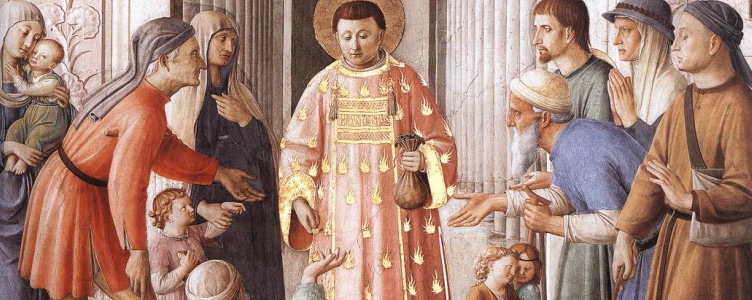
St Lawrence distributing alms to the poor, by Bl Fra Angelico, circa 1447, Pinacoteca Vaticana, Vatican City

The forests of northern Europe and Asia are home to a little animal called the Ermine.

It is characterized by its snow-white fur

Some countries have the state robes of the judges lined with this fur…
… the white fur being a symbol of honour and purity.

The Ermine would do anything to protect and safeguard its fur.

Fur hunters however, take undue advantage of this weakness of the Ermine.

They don’t keep a snare to catch the ermine

Instead the smear filth on the entrance and the interior of its house – usually in a cleft of a rock, or the hollow of a tree.

The dogs are then left behind the ermine…
… Frightened, the ermine runs towards its home, the only place of refuge.

However, it finds the entrance dirty and unclean.

It is unwilling to spoil the pure white fur coat.
And so, the ermine makes a choice…

To give in to the hungry and fierce dogs…
… than to spoil the purity of the white fur!

A choice is made – to preserve purity, even at the cost of one’s life!

Every Christian is expected to do the same…
… preserve the purity of one’s holiness, even at the cost of one’s life.

Today we celebrate the Feast of one such Daring Christian – St Lawrence…
… who yielded his life than to lose his pledge to Christ
… who let go of his earthly desires, to win the prize of heavenly salvation

St Lawrence lived the words of Christ who exhorted:
“He who loves his life loses it, and he who hates his life in this world, will keep it for eternal life!” (Jn 12: 25)

The Gospel Passage of the day is preceded by a very vital and crucial verse in the Gospel of St John…

Jesus says, “The Hour has come for the Son of Man to be glorified” (Jn 12: 25)

The life of Jesus, as seen in the Johannine Gospel is a journey towards this climax aspect – The Hour!

What is “The Hour?”

The Hour is the hour of glorification
… the hour of His task as a Messiah, which is to be completed by His “lifting up” on the Cross!

It was the Hour when the Lord will conquer death, by submitting Himself totally to the Will of the Father!

Jesus never shied away from this Hour

He came into this world for this Hour
… Death was the goal of His Life, the gold that He was seeking.

He invites His followers to also make this choice…
… to lose one’s life, in order to gain life in Him!
… to die to oneself, in order to bear much fruit!

What are the implication of losing our life, in order to gain life in Him?

Letting go a life of sinful habits and tendencies…
… and making holiness and sanctity as our lifestyle

Seeking to put an end to our tendencies to self-boast or feed our pride…
… and instead, engaging in acts of humility and giving space for God’s Mercy

Letting go of our stubborn nature in reconciling with others…
… and trying to foster relationships based on self-giving and self-sacrifice

Seeking to avoid occasions of sin…
… and instead, creating opportunities for being consciously in the presence of God

By our Baptism, we have been blessed with the white robe of holiness and purity

Our Sacramental life keeps it unstained.

The world, on the other hand, constantly seeks to malign this pure robe…
… by its lures of impurity and filth

Like the ermine, we are faced to make a choice…

To die to the hungry and fierce world…
… than to spoil the purity of holiness!

Yes, we need to make a choice – constantly, at every moment…

A choice to preserve purity, even at the cost of one’s life!

Let us be inspired by the life and example of St Lawrence.

May his courage and valour help us also…
… to yield our life than to lose our pledge to Christ
… to let go of our earthly desires, to win the prize of heavenly salvation

Happy Feast of St Lawrence!

God Bless! Live Jesus!


Discovering the beauty of the Catholic Church through the Catechism
CHRIST DESCENDED INTO HELL

The frequent New Testament affirmations that Jesus was “raised from the dead” presuppose that the Crucified One sojourned in the realm of the dead prior to His Resurrection.
This was the first meaning given in the apostolic preaching to Christ’s descent into hell: that Jesus, like all men, experienced death and in His soul joined the others in the realm of the dead.
But he descended there as Saviour, proclaiming the Good News to the spirits imprisoned there.
Scripture calls the abode of the dead, to which the dead Christ went down, “hell”- Sheol in Hebrew or Hades in Greek – because those who are there are deprived of the vision of God.
Such is the case for all the dead, whether evil or righteous, while they await the Redeemer: which does not mean that their lot is identical, as Jesus shows through the parable of the poor man Lazarus who was received into “Abraham’s bosom”
“It is precisely these holy souls, who awaited their Saviour in Abraham’s bosom, whom Christ the Lord delivered when he descended into hell.”

Jesus did not descend into hell to deliver the damned, nor to destroy the hell of damnation, but to free the just who had gone before him (Cf. CCC # 632-633)

REFLECTION CAPSULE – Aug 09, 2021: Monday

“Falling in love with the One Who gave Himself up for our atonement and salvation!”

(Based on Deut 10:12-22 and Mt 17:22-27 – Monday of the 19th Week in Ordinary Time)

An incident is told about a master painter, who had a very fervent student-disciple.

The master was suffering from a severe bout of arthritis.

It was very painful for him to paint.
He had to hold his brush between his thumb and index finger.

And as he painted, the student-disciple often heard him crying out in pain.

On one such occasion, the student asked the old master:
“Why do you go on painting, if it hurts so much?”

The master looked up to his disciple, and with an assuring smile replied:
“Remember always, son…
… Pain passes, but beauty remains!”

Every selfless act of suffering and struggle indeed leaves an imprint of lasting beauty and splendour.

In the canvas of Salvation History, the Son of Man indeed had to go through much suffering…
… but the painting finally reveals the Great Truth: “PAIN PASSES, BUT BEAUTY REMAINS!”

The painting of salvation indeed displays immense Generosity and magnanimous Mercy of the Lord, Who paid a “ransom” to save His people

He spared no efforts in getting His people released…
… by suffering on the Cross
… shedding His Blood
… giving up His life
… and rising from the dead

Have we fallen in love with this MASTER Who gave Himself up for us?

Are we willing to live our life in obedience, and in imitation of the command of Him, Who ransomed His life for us?

The Gospel of the Day presents an interesting, yet a ‘not-too-familiar’ passage of Jesus and His disciples being asked to pay the Temple tax.
“When Jesus and His disciples came to Capernaum, the collectors of the Temple tax approached Peter and said, “Doesn’t your Teacher pay the Temple tax?” (Mt 17: 24)

What was this Temple tax?

The Temple tax was …
… a symbolic gesture in gratitude for what the people of Israel owed to God, for their redemption from slavery in the land of Egypt.

It was a Jewish tax with its origins seen in Ex 30: 12-16:
“Then the LORD spoke to Moses, saying: ‘This is what everyone among those who are numbered shall give: half a shekel… The half-shekel shall be an offering to the LORD.”

This offering was to be an “atonement money”, which would be used for the service of the meeting tent (Ex 12: 16)

In later centuries, this half-shekel was adopted as the amount of the Temple Tax – the one that all Jews were supposed to pay once a year for the upkeep and maintenance of the Jerusalem Temple.

The Temple Tax was thus an “atonement” money

It was a “ransom” money!

It is fascinating to note that the incident of this “ransom/atonement” money is mentioned immediately after Jesus spoke of His Passion and Death.

Jesus told His disciples in Mt 17:22-23:
“The Son of Man is to be handed over to men, and they will kill Him, and He will be raised on the third day”

The incident of the Temple tax, which is the atonement/ransom money, is mentioned…
… immediately after Jesus speaks of His Passion, Death and Resurrection.
Is there any connection between these two incidents?

The Temple tax was in gratitude for the redemption of Israel from slavery
… Jesus would now free all people from the slavery of sin by His Death and Resurrection

The Temple Tax was paid as “ransom” money…
… The Blood of Jesus would now be the “ransom” that will be paid for redemption of humanity.

Jesus did not resist His disciples from paying the Temple Tax…
… as we would see in the incident of the miraculous catch of the fish with a coin in the mouth (Mt 17: 27)

But the perfect payment of the “tax”…
… would be done by Jesus Himself – by His Sufferings, Death and Resurrection!

Jesus would not just pay the tax…
… He would also give Himself in complete obedience to the Father

Thus, He would becoming the “tax” – the ransom and the atonement money!

1 Tim 2:6 says, “Jesus gave Himself as a ‘ransom’ for all”
Mk 10:45 says “The Son of Man did not come to be served but to serve, and to give His life as a ‘ransom’ for many”

It is interesting to also note that this incident of the Temple Tax brings reminds us of the former occupation (trade) of two of the disciples of Jesus:

  1. Matthew… who was a tax collector (Mt 9:9)
    (Probably that explains why this incident is mentioned only in the Gospel of St Matthew)
  2. Peter… who was a fisherman (Mt 4:18)
    (That’s why Jesus asks Peter to “go to the sea, take the first fish that comes up, and open the mouth to find a coin…”)

Matthew and Peter could represent any of us…

Maybe, like Mathew – the Tax Collector…

We are collecting a lot of things in life…
… but still not finding peace in life!
We are occupied with material dimensions at our “own tables”…
… or find ourselves at the receiving end of not being accepted and being looked down by others.

Maybe, like Peter – the fisherman…

We are fishing in the waters of life for contentment and satisfaction…
.. but fail to have a catch!
We are putting in a lot of effort to fish for success, yet finding none…
… or find ourselves drowning in a sea of sin, hopelessness or despair

Whoever we are…

The Lord extends His loving invitation…
… to leave our “tables of collection” and follow Him!
… to cast away our “nets of fish” and follow Him!

He has become the “Ransom”…
… in Whom we can find the ‘collection’ of all joys and contentment of life!
… in Whom we can witness the ‘great catch’ of salvation and redemption!

By this great act, He gave the “Ransom”…
… for our freedom from captivity!

By His humbling sacrifice, He paid the “Atonement money”…
… for our salvation for eternal life!

Let us fall in love with the Man Who gave Himself up for us!

Let us be willing to live our life in obedience and imitation of His commands Who ransomed His life for us!

When our Christian witnessing takes us through struggles and pains, let’s be grateful to our Crucified Lord, remembering: “PAIN PASSES, BUT BEAUTY REMAINS!”

God Bless! Live Jesus!


Discovering the beauty of the Catholic Church through the Catechism
“HE DESCENDED INTO HELL. ON THE THIRD DAY HE ROSE AGAIN”

Jesus “descended into the lower parts of the earth. He who descended is He who also ascended far above all the heavens.”

The Apostles’ Creed confesses in the same article Christ’s descent into hell and His Resurrection from the dead on the third day, because in His Passover it was precisely out of the depths of death that He made life spring forth: “Christ, that Morning Star, who came back from the dead, and shed His peaceful light on all mankind, Your Son who lives and reigns for ever and ever. Amen!” (Cf. CCC # 631)