✝️ REFLECTION CAPSULE – Aug 17, 2022: Wednesday

“Recognizing and realising the immense wonders of God’s Grace at every step of our life, and leading our life with joyful faces!”

(Based on Ezek 34:1-11 and Mt 20:1-16 – Wednesday of the 20th Week in Ordinary Time, Year 2)

Grumbling and complaining had become a habit for old Mrs. Dolly.

She would find a point to be critical for anything and everything.

Finally, it so happened one day, that the parish priest felt he had found something about which she could make no complaint: the old lady had a very excellent produce in her vegetable garden – of the finest potatoes in that area.

“Oh, finally, I hope you must be well pleased” said the parish priest, with a gleaning smile, to Old Mrs Dolly, “Every one’s excitedly talking about how wonderful are the potatoes in your garden this year!”

However, with a frown, the old lady rumbled back, “Well, they are not so bad.

But where are the bad ones for the pigs?”

Well, the one who puts on the tinted spectacles of grumbling, invariably finds a reason to complain about anything in life, isn’t it?

As it is said, “it is usually not so much the greatness of our troubles as the littleness of our spirit that makes us complain.”

The Gospel of the Day presents a group of people who find their way into grumbling even about, perhaps the most undeserved subject of complaining: the Free Gift of the Grace of the Generous God!

Jesus presents the parable of the Workers in the Vineyard liking it to the Kingdom of Heaven (Mt 20: 1)

“It’s not fair” is a common phrase that we raise in our day-to-day activities.

Children, while playing games with each other, invariably raise a “It’s not fair” slogan, especially when they feel some cheating is done by the umpires or the opposite team players
Students quote the “It’s not fair” phrase when sometimes they get lesser marks than expected, and blame the professor or the system
Employees in a company chant “It’s not fair” when they feel that somehow they have been given lesser pay or treated unfairly with respect to promotions etc.
Family members or friends shout “It’s not fair” when there are impartialities or favouritism or ignorance discovered in relationships

A sense of dissatisfaction reigns in many circumstances of our daily life.

Such was the displeasure expressed by those workers, who had toiled the whole day and received just one denarius, in the Parable of Jesus of the Workers in the Vineyard: “It’s not fair!”

These workers felt… “It was not fair”…
… that the landowner had equated the wages of those who came in last to them, who had toiled the whole day!
… that there had been no consideration to the immense toil in the blazing sun that they had put in!
… that the principle of justice and impartiality had been badly violated and trampled upon!

But the Master of the Vineyard was quick to point out to them their fallacy in such a thinking…

He reminded them first of all, that the wages that they received, was something that they had already agreed upon
He also brought to their notice that the wages given to the others were simply out of his generosity and good-will

How often do we also raise the cry of complains and ring in the growls of grumbling when we see others finding pleasure in greater favours and happiness of life…

“I toil so much in life, and I don’t seem to be really growing prosperous or at least being freed from the pangs of daily life struggles…
… But someone else, has a relaxed and cosy life and still find themselves enjoying with the comforts and luxuries of life”

“I try my level best, with much hard-work and labour in order to excel in my talents and I don’t seem to reap its fruits…
… But someone else, maybe blessed by natural talents or sheer out of luck, seems to be doing much better and enjoying greater harvests of success”

The workers who grumbled did not complain because they did not get the “just” wage…
… but their complaint was because “they were made equal to the others”

It was a complaint arising out of…
… “unfair comparison”
… “jealousy in seeing others being rewarded more”
… “we being made small before others”

Perhaps, this is where we need to make a radical shift in our perspectives.

God’s Grace comes to human persons in different levels and measures.

Grace is defined as “favour – the free and undeserved help that God gives us to respond to His call to become children of God…partakers of the divine nature and of eternal life”.

Therefore to make bargains on Grace… to make it a “countable” entity…
… would be a clear violation of its very essential nature of being a “free gift!”

Hence, what is required is to make a shift in perspectives…
… from “complaining” to being “thankful”
… from “grumbling” to being “grateful”
… from saying “It’s not fair!” to saying “It’s Your Grace”

Life constantly pushes us into corners which make us to have “grumpy” faces, “complaining” tongues and “grumbling” tones.

But, can we recognise and realise the immense wonders of God’s Grace at every step of our life…
… and lead a life with “joyful” faces, “grateful” tongues and “thankful” tones?

God Bless! Live Jesus!


📖 Discovering the beauty of the Catholic Church through the Catechism
THE EUCHARIST – What is This Sacrament Called?

The inexhaustible richness of this sacrament is expressed in the different names we give it.
Each name evokes certain aspects of it.
It is called: Eucharist, because it is an action of thanksgiving to God.

The Greek words ‘Eucharistein’ and ‘Eulogein’ recall the Jewish blessings that proclaim – especially during a meal – God’s works: creation, redemption, and sanctification. (CCC #1328)
✝️ REFLECTION CAPSULE – Aug 16, 2022: Tuesday

“Realizing the worthlessness of clinging on to riches and wealthy, and seeking to make Christ as the greatest possession and treasure of our lives!”

(Based on Ezek 28:1-10 and Mt 19:23-30 – Tuesday of the 20th Week in Ordinary Time, Year 2)

A distinguished man was lying on his death-bed.

As he lay, some of his precious ornaments, priceless stones and his fine collection of exquisite watches were brought to him.

Turning a cold glance on the treasure, which he would once have clutched with an eager grasp…
… he said with a sigh:
“Alas! this is a very fine thing in this country…
… but I am going to a country where it will be of no use to me!”

The man, at his death-bed realized the worthlessness of clinging on to riches and wealth!

If only, he had realized it, when he had years to live…
… life would have been much peaceful and contented
… life would have been better utilized to prepare for eternal life

Well…
… all of us, do have time to realize – the worthlessness of clinging on to riches and wealthy..

Do we seek to make Christ as the greatest possession and treasure of our lives?
Do we mend our lives accordingly, and live in pursuit of heaven?

Jesus, in the Gospel of the Day gives a triple perspective on the aspect of riches (Mt 19:23-30)

  1. The difficulties that attachments to riches pose, in entering the Kingdom of God
  2. The power of God that alone can assist and help one to attain eternity
  3. The promise of reward to those who live a life of detachment

Jesus says, “Amen, I say to you, it will be hard for one who is rich to enter the Kingdom of heaven” (Mt 19: 23)

The reason why riches are given such a strong reprimand by the Lord is because:

Attachment to riches can easily take away one’s heart from the Lord…
… The Lord, Who stripped Himself of all glory and became poor is often given less priority!

Being obsessed with riches leaves us with little time and thought for things of eternity
… Our plannings, aspirations and projects often end up being only earthly in nature!

Having too many riches can pose a danger to feel proud and independent
… A sense of “I can manage all by myself” creeps in; in the process, keeping aside God from our lives!

Venerable Bishop Fulton Sheen says:
“It is ever true that the richer the soul is on the inside, the less need it has of luxuries on the outside;
Excessive adornments and an inordinate love of comforts are proof of our inner nakedness!”

The power of God that alone can assist and help one to attain eternity

On hearing of the difficulty of the rich to enter the Kingdom of God, the disciples asked Jesus, “Who then can be saved?” (Mt 19:25)

Jesus replied, “For human beings, this is impossible; but for God all things are possible” (Mt 19: 26)

The demands of Christianity to live a life of detachment from riches, can sometimes cause undue anxieties.

And we begin to ask…
… Is it really possible for us to live as Jesus expected of us?
… Is it not beyond my capabilities to achieve what the Lord wishes of us?

Such kind of anxieties and worries, can often cause weariness our soul!

St Francis de Sales says:
“Anxiety is the greatest evil that can befall a soul, except sin!
Have patience with all things, but first of all with yourself!”

The Lord tells us that even in our efforts to be detached…
… we need to depend on Him
… we need to know that His Grace will take us through

Therefore, to have detachment…
… we ought to come to the Lord in prayer, surrendering our lives
… we need to thank the Lord continually for all His blessings, acknowledging Him as the source
… we need to reach out to the Lord in the poor, the weak and the needy (Mt 25:40)

The promise of reward to those who live a life of detachment

Jesus says: “Everyone who has given up”…will receive a hundred times more and will inherit eternal life” (Mt 19:29)

A question of despair or hopelessness sometimes nags a Christian…
… What is the use of living an honest and virtuous life?
… Why is my life unrewarded, whereas many others thrive even by unjust means?

The Lord however, gives an answer…
… that none of such sacrifices will go unrewarded

He does promise His rewards – temporal as well as spiritual…
… but these are to be received in accordance to the Will of God.

Many times, the Will of God, is not taken into consideration…
… when we look for rewards in having made a sacrifice.
… when we seek for answers to our prayers
… when we expect fruits for our efforts

The Lord therefore invites and challenges us…
… to purify our motives when we make sacrifices
… to align our interests to God’s Will when we work for Him

That’s why Jesus would say: “Seek first the Kingdom of God and His righteousness… and all other things shall be added unto you” (Mt 6:33)

The words of Mother Angelica, the founder of EWTN (Eternal Word Television Network) are a reminder to us:
“Have we lost sight of this world being a pilgrimage?

It’s a journey! You’re not home yet!
A Christian must never lose sight of this passing reality of life”

Yes, let us come to this realization about attachments to riches:
“Alas! This is a very fine thing in this country…
… but I am going to a country where it will be of no use to me!”

God Bless! Live Jesus!


📖 Discovering the beauty of the Catholic Church through the Catechism
THE EUCHARIST – SOURCE AND SUMMIT OF ECCLESIAL LIFE

By the Eucharistic celebration we already unite ourselves with the heavenly liturgy and anticipate eternal life, when God will be all in all.

The Eucharist is the sum and summary of our faith: “Our way of thinking is attuned to the Eucharist, and the Eucharist in turn confirms our way of thinking” (CCC #1326-1327)

✝️ REFLECTION CAPSULE – Aug 15, 2022: Monday

“Through the intercession and inspiration of Mother Mary, seeking to grow in holiness, and making the best use of our freedom as Children of God!”

(Based on the Solemnity of the Assumption of our Blessed Mother Mary – Independence Day of India)

“Saare jahaan se acha!” (“Better than the entire world!”)

These were words, exclaimed by Rakesh Sharma – with a jubilant face and an excited voice – high up in the outer space.

The first man to go up to space from India, was replying to the query by Indira Gandhi, the Prime Minister of India, as to ‘how the nation looked from the outer space’.

“Saare jahaan mein acha!” (“Better than all in the entire world!”)

These were probably the Words, exclaimed by God – with a Radiant Face and a Splendid Voice – transcending the entire universe, looking at Blessed Mother Mary.

These triumphant words are proclaimed and repeated by the entire Church in unison and acclamation!

Rakesh Sharma stated India to be the Better than the Entire world!

God declared Blessed Mother Mary to be better than all in the Entire World!

Sentiments of Patriotism and Sentiments of God’s Abundant Grace and Mercy join hands on this day

The 15th of August…
… the Independence Day of India and the Assumption of our Blessed Mother Mary!

This day has much to teach us… much to thank the Lord… and much to exhort us!

This day has much to be nostalgic… much to be joyful… and much to be hopeful of!

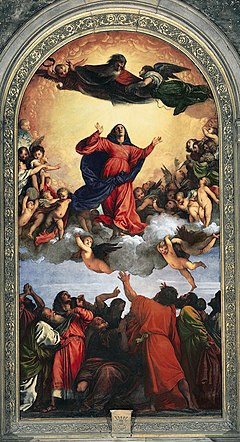
Assumption of Mary, by Titian, 1518, Basilica di Santa Maria Gloriosa del Frari, Venice

The Solemnity of the Assumption of our Blessed Mother Mary celebrates Jesus, the Son-King sharing His Glory with His Mother.

Human kingdoms have followed the tradition of the son who is the King of the Land, crowning his mother, as the Queen of the Kingdom.

The Old Testament bears witness to this fact:

King Solomon on assuming charge of the throne, after King David, raised his mother Bathsheba to his side, to be the royal queen (1 Kings 2: 19)

The Assumption of Mother Mary is one of the four Marian Dogmas that the Catholic Church pronounces.

A dogma is a doctrine that is solemnly proposed by the Church as formally revealed in Scripture or Tradition.

The four Marian Dogmas are:

  1. Mary as the Mother of God
  2. The Perpetual Virginity of Mary
  3. The Immaculate Conception of Mary
  4. The Assumption of Mary into heaven

The declaration of the Dogma of the Assumption of Mary is as follows:
“By the authority of our Lord Jesus Christ, of the Blessed Apostles Peter and Paul, and by our own authority, we pronounce, declare, and define it to be a divinely revealed dogma…
… that the Immaculate Mother of God, the ever Virgin Mary, having completed the course of her earthly life, was assumed body and soul into heavenly glory.”

This Dogma of the Assumption was proclaimed on November 1, 1950, by Pope Pius XII in the Apostolic Constitution “Munificentissimus Deus”

This proclamation was not defining something new in the Church…
… rather it was an official recognition of the centuries-old belief on Christians about the Assumption of their Heavenly Mother.

The Feast of the Assumption is one of the most important feasts of our Lady.

The Assumption was the reward God granted to our Blessed Mother for the Right use of Her Freedom!

Freedom plays a vital role in the destiny…
… of a person
… of a family
… of a society
… of a nation
… of the world!

Mamma was invited to be the Mother of God by Angel Gabriel…
… in true freedom, She said Yes!

Mamma felt the need to be a Helper of the Needy by her cousin Elizabeth…
… in true freedom, She said Yes!

Mamma was to be a model of Patience in difficulties at the birth of Jesus…
… in true freedom, She said Yes!

Mamma was requested to be a Silent Contemplative during His boyhood…
… in true freedom, She said Yes!

Mamma sensed an urgency to be an Intercessor before God at Cana…
… in true freedom, She said Yes!

Mamma was called to be a Serene Bearer during the Passion of the Lord…
… in true freedom, She said Yes!

Mamma was called to be a Model of Prayer at the Upper Room…
… in true freedom, She said Yes!

A responsible use of freedom is a sign of true and authentic spirituality and is a pathway to greater glory!

Freedom is not simply doing what we want…
… Freedom is assuming responsibility for ours and others’ lives!

Freedom is not simply getting our pleasures fulfilled…
… Freedom is fulfilling our tasks in the best way possible!

The Assumption of Blessed Mother Mary is an invitation and a challenge for each one of us….
… to focus our attention on things of heaven & transcendence and not get fixated with cares of this world!
… to live a life of holiness and purity and seeking to do God’s will at all times and in every situation!
… to share with the pain and passion of the Lord and become partakers in the salvation of the world!
… to realize that to be Holy & a Saint is a call of every Christian & we need to prioritize our life on them!

We need to be reminded that Mary had exclaimed, “Behold, I am the Handmaid of the Lord” (Lk 1:38)

Mary was an ordinary human being.

She too had Her ordinary and humble beginnings.
She too went through common life’s struggles and strains.

But through these “ordinary” circumstances…

God “raised” Her to the Heights
God “assumed” Her into Glory
… because She “found favour with God” and lived a life worthy of that call
In total submission, humble obedience and loyally faithful!

This then is our call too…

As Baptized Christians, we have “found favour” with God.

We dwell in “ordinary” circumstances of life – with hardships and pains.

But if we also…
… seek and live the Will of the Lord at all times
… constantly submit to what He wants
… and dutifully bow to His mercy and grace

The glory which Jesus has “won” for us at Resurrection, can be ours!

God’s plans are indeed wonderful…

In the “Story of the Fall” a mother (Eve) had been involved intimately with a man (Adam) and humanity fell into the sea of sin!
In the “Story of the Rise”, a Mother (Mary) was involved intimately with a Man (Jesus) and humanity is promised to “assume” to the skies of glory!

Are we ready to co-operate with God’s plans in our lives, just as Mother Mary did…
… and thus receive the “Privilege of Assumption into Glory” just as Mother Mary received?

Today is a BIG Day…
… a Day to thank the Lord for Mamma’s Holiness and Her exemplary Life of Responsible Freedom …
… a Day to thank the Lord for our nation’s freedom and her valiant freedom fighters!

Let us become mindful of our Loyalty & Obligation to our Nation…
… safeguard the Precious Gift of Freedom!

Let us become conscious of our Responsibility & Duty to the Lord…
… grow in the Prized Treasure of Holiness!

May Blessed Mamma intercede for our Beloved Nation India…

And may we hold Her loving hands…
… as we seek to grow in Holiness and making the best use of our freedom as Children of God!

A very Happy Time to Blessed Mamma reigning with Her Divine Princely Child…
… and a Happy Feast to all of us, Her little ones on the earth!

A Very Precious Future to Mother India, on her Independence Day…
… and a Precious Day to all of us, her beloved citizens!

God Bless! Live Jesus!


📖 Discovering the beauty of the Catholic Church through the Catechism
THE EUCHARIST – SOURCE AND SUMMIT OF ECCLESIAL LIFE

“The Eucharist is the efficacious sign and sublime cause of that communion in the divine life and that unity of the People of God by which the Church is kept in being.”
It is the culmination both of God’s action sanctifying the world in Christ…

… and of the worship men offer to Christ and through him to the Father in the Holy Spirit. (CCC #1325)

✝️ REFLECTION CAPSULE – Aug 14, 2022: Sunday

“Striving to be sincere followers of Christ who are ‘willing to be counted’ to stand up for the Kingdom values!”

(Based on Jer 38:4-6, 8-10, Heb 12:1-4 and Lk 12:49-53 – 20th Sunday in Ordinary Time, Cycle C)

An interesting incident is narrated of how some years ago, the prime minister of a certain country was speaking before several distinguished leaders as well statesman.

He was severely critical of his predecessor who was known to be a harsh dictator.

While he was speaking someone from the audience sent up a note:
“How about you? What were you doing when the dictator committed all these atrocities?”

At that, the Prime Minister – filled with fury and rage – shouted: “Who sent up that note?”

Not a single person stirred.

“I’ll give him one minute to stand up!”

The seconds ticked off.

Still no one moved.

“All right, I’ll tell you what I was doing.

I was doing exactly what the writer of this note was doing – exactly nothing!
I was afraid to be counted!”

As a Christian, am I afraid to be counted…
… and thus fail to stand up for Christ and His Values?

Every Christian is expected to set the world on fire…
… by being passionate in their love for the Lord
… and being compassionate to the people of God!

Our Blessed Lord was greatly filled with zeal to “set the earth on fire”…
… and desires all His followers to share in this passion for the Kingdom of God.

The Gospel of the Day begins with Jesus exclaiming:
“I have come to set the earth on fire, and how I wish it were already blazing” (Lk 12: 49)

“Fire” in the Bible is an imagery of many aspects…

God’s judgment (Jdt 16:17; Is 66:16; Am 7:4; 2 Pt 3:7)
God’s protective presence (Ex 13: 21, 2 Kgs 6:17)
Purification (Nm 31:23; Ez 22:19-22, Zec 13: 9),
The Holy Spirit (Mt 3:11, Acts 2:3).
God’s Holiness (Dt 4:24)
God’s glory (Ez 1:4, 13)

Fire also has many characteristics:

It warms… refines… transforms… burns!

The Lord who was greatly zealous to “set the earth on fire” invites us to examine:

Am I filled with zeal, to blaze the world “on fire”…
… the fire of God’s love?
… the fire of God’s purging mercy?
… the fire of God’s judgment with respect to sin and evil?

The following verse of the Gospel passage comes in as a shock…

“Do you think that I have come to establish peace on the earth? No, I tell you, division!” (Lk 12:51)

The Gospel of St. Mathew’s version of the same verse reads:
“Do not think I have come to bring peace. I have to come not to bring peace, but a sword… (Mt 10: 34)

These verses become more surprising in the context of…

The Sermon of the Mount where in Mt 5:9, it says, “Blessed are the peacemakers”
The description of the Messiah where in Isa 9: 6 it says, “He (Messiah) will be called “Prince of Peace”

Why does St Mathew use the words “peace and sword?”

Why does St Luke use the words “peace and division?”

This could be a technique called “Juxtaposing”.

Juxtaposing simply means to place two things side-by-side or next to each other…
… especially to compare or to emphasize on the contrast.

This technique is used extensively in the Bible…

“Unless a grain of wheat dies, it will not give life” (Jn 12: 24)
“A good tree cannot bear bad fruit” (Mt 7:18)
“Light shines in the darkness” ( Jn 1:5)

Thus we see…
… life and death
… good and bad
… light and darkness

This “juxtaposition” we also observe in our daily life.

Any artist or a person with some aesthetic sense will vouch for the fact that, in order a highlight some light-coloured flowers in a bouquet…
… a darker background is preferred.

Even in our style of dressing, we prefer to wear dark-coloured trousers…
… along with light-coloured shirts.

The logic is simple: Juxtaposing two contrasting stuff emphasizes the meaning.

Peace, is generally defined as a situation where there is no violence or war.

Sword, on the other hand, signifies conflict, struggle and death.

Peace, is normally understood as a situation of calm and absence of conflicts

Division, on the other hand, points to disturbances, instability and turmoil.

What is the meaning of this usage of “juxtaposition” in today’s Gospel passage?

The Kingdom of God is righteousness, peace and joy (Rom 14: 17)
To establish this peace or this Kingdom of God…
… sword is an inevitable reality!
… division is an inescapable consequence!

Disturbances, instability, turmoil, conflict, struggle and even death is a real possibility!

That’s why Jesus would go on to say:
“From now on a household of five will be divided… three against two and two against three…” (Lk 12: 52)

These verses are an import from Mic 7:6 which speaks of “division in the household”.

In the Jewish Society…
… the household was one of the strongest units of loyalty and binding.

However, Jesus shatters all these pre-conceived notions and demands:
“Loyalty of a disciple to Jesus is to be much higher than even to his own household!”

All intimate relations, even that within the family, are to be given subordinate status in our Love for Jesus.

It is also interesting to note the order of people mentioned in Lk 12: 53:
… Father vs Son, Daughter vs Mother, Daughter-in- law vs Mother in Law.

It is always the young vs the old.

What could be the meaning?

The Kingdom of God will cause a sword of division…
… It will be a division of the Young vs Old!

Young and Old are not to be considered in the physical sense…
… but in the spiritual sense!

Young as being people who are “new”… those by giving up a life of sin, choosing to be part of the Kingdom of God.

Old as being those people who are “unrepentant”… those who cling on to sinful ways and oppose the Kingdom.

The Kingdom of God is always characterized by people who are willing to be “new” in the Spirit…
… young at heart and mind, full of dynamism and full of enthusiasm.

What are the implications of all what we have said today?

  1. The establishment of peace in the Kingdom of God is always accompanied by the sword of division

Are we ready to face the struggles and difficulties that surely will come on our way, as we work for the Kingdom?

  1. In this our mission of establishing the Kingdom, we are demanded to have a loyalty to Jesus that is higher than all other relationships.

Are we ready to sacrifice… perhaps our relationships or our way of thinking or even our lifestyle – all for the sake of loyalty to Christ?

  1. The Kingdom of God demands that we always be young – dynamic, enthusiastic, cheerful and energetic.

Are we ready to always remain Young at heart and in mind, for the sake of the Kingdom of God?
Jesus, Who was greatly filled with zeal to “set the earth on fire”…
… desires all His followers to also share in this passion for the Kingdom of God.

Yes, let us become Christians “who set the world on fire!”…
… and strive to be sincere followers of Christ who are ‘willing to be counted’ to stand up for the Kingdom values!

God Bless! Live Jesus!


📖 Discovering the beauty of the Catholic Church through the Catechism
THE EUCHARIST – SOURCE AND SUMMIT OF ECCLESIAL LIFE

The Eucharist is “the source and summit of the Christian life.”
“The other sacraments, and indeed all ecclesiastical ministries and works of the apostolate, are bound up with the Eucharist and are oriented toward it.”

For in the blessed Eucharist is contained the whole spiritual good of the Church, namely Christ himself, our Pasch. (CCC #1324)

✝️ REFLECTION CAPSULE – Aug 13, 2022: Saturday

“Being responsible and receptive to others, and redeeming and restoring the lives of others!”

(Based on Ezek 18:1-10, 13b, 30-32 and Mt 19:13-15 – Saturday of the 19th Week in Ordinary Time, Year 2)

Charles Francis Adams was a 19th century American historical editor, politician and diplomat.
>> His son was Brooks Adams, who became a historian.

A researcher, while making a study on the life of the Adams Family came across their personal diaries.


Both, the father and son, had entered a description of a particular day…
… It was a day when they had gone fishing.

However, interestingly, their descriptions had a world of difference…

The father, wrote in his diary:
“Went fishing with son. Day wasted.”

The son, however wrote in his diary:
“Went fishing with my father. The most wonderful day of my life!”


Why such a huge contrast in the description of the same day?

The son Brooks, was only twelve years at that time.
>> It was a bad day at fishing as they didn’t catch any fish…
… but they spent a lot of time talking

The boy had asked a number of questions, and the father had creatively answered…
… in the process, explained many important aspects about life.
>> The father, on the other hand, felt it as a waste of time…
… without even any fish being caught!


Our attitude in life makes a world of difference!

Seeing the world through the eyes of a child – in openness, sincerity, wonder and innocence – can help us to have “a wonderful day,” every day of our life!

Hence, in the context of a family life, there is a popular quote which says:
“A house is built with bricks and beams…
… A home is built with love and dreams!”


The Gospel of the Day presents to us an occasion to dwell on a reflection on our families…
… and some of the basic essentials that needs to be part of every family (religious community included as well)


Family Life is an important component of every society.

The Gospel of St. Matthew, Chapter 19, has an interesting structure or a progression with respect to the topics discussed and the persons involved.


The chapter begins with a discussion on the institution of ‘Marriage’. (Mt 19: 2-10)

Jesus explains the importance of this sacred bond and a strong exhortation is given on the need to do away with divorce.
>> The chapter proceeds, as we see in today’s reading, with a discussion on ‘little children’. (Mt 19: 13-15)
>> This discussion is followed by an incident in which a ‘young man’ encounters Jesus (Mt 19: 16-22)
>> The Chapter will finally end with an exhortation by Jesus to have maturity as an ‘adult’ is making choices for the Kingdom of God! (Mt 19: 23-30)


Thus, the Chapter 19 of Matthew is a travel through a FAMILY context…
… starting from MARRIAGE…and the need to avoid DIVORCE…
… to little CHILDREN
… to the problems of a YOUTH
… and finally ending with the choices as an ADULT.

In today’s Gospel, we have the discussion on Little Children (Mt 19:13-15)

Though it’s a short passage, the Gospel gives us enough food for thought…
… especially in the context of a family or a community life.


We see four different groups or sets of people in today’s Gospel Passage, and we can learn some aspects from each of those sets…
>> Three of them give us a positive quality which is to be inculcated
>> One gives a negative quality which is to be avoided in life.

1. Firstly, the Gospel begins with the statement, “Little children were brought to Jesus…” (Mt 19: 13a)
Probably the parents, the elder brothers/sisters or the guardians of the children would have brought them to Jesus.

So we see here, the First set of people… Parents, Guardians, Elders etc…. and they teach us the First Positive Quality – the Spirit of Responsibility!
>> They were Responsible in caring for the good and future of the children.

It was an ancient practice that children would be brought to Rabbis to be blessed and prayed over.
>> This first set of people teach us to be responsible for the growth of others in our family and in our communities.


2. The Second set of people are obviously the Little Children.
These little ones teach us the Second Positive Quality, needed in a family or a community – the Spirit of Receptivity!

Children display a great sense of receptivity and openness.
>> They are able to accept the affection, the care, the love and the blessings that are given to them.
>> They do not close themselves to the good things in life.

We too need to cultivate this Spirit of Receptivity, to be open to the actions, thoughts, views and feelings of others in our family and our community.


3. The Third Set of people display a negative attitude which we need to avoid.
When the children were brought to Jesus, the Disciples refuse to accept them and want to keep them away (Mt 19: 13b)

They show a Spirit of Rejection!
>> They perhaps felt that these children would be a nuisance to Jesus and His ministry.

They felt it as a waste of time and energy to entertain the children.
>> Little things in life were considered to be a useless and futile activity.


We need to avoid this Spirit of Rejection…

In our families or communities, we can have this attitude towards those who don’t do any work or fail to contribute anything.

We often fail to understand the importance…
… of little tokens of love
… tiny expressions of care by our family and community members

And we, instead, tend to reject and avoid them.


4. The fourth Set is represented by Jesus Himself…
… and He presents the Spirit of Restoration and Redemption.

He does not reject…
… rather, He accepts and seeks to redeem the little children.
>> He seeks to restore the little ones who are rejected…
… who are avoided and who are not given the due importance.

In our lives, we too need to be having a Spirit of Redemption and Restoration…
>> To redeem the ones who are at the periphery and who fail to get any attention
>> To restore the ones who are broken and abused and are shunned!


Thus, this powerful Gospel passage teaches us…

To avoid the Negative Quality of the Spirit of Rejection…

Rather…
To adopt the positive qualities of…
… The Spirit of Responsibility,
… The Spirit of Receptivity
… The Spirit of Redemption and Restoration!


Let us seek the grace that we may avoid the tendency to reject people…
>> And instead, we may be…
… responsible towards others
… receptive to others
… and redeem and Restore the lives of others!
And thus build happy and loving homes!


May we always understand that “our attitude in life makes a world of difference!”

Seeing the world through the eyes of a child – in openness, sincerity, wonder and innocence – can help us to have “a wonderful day,” every day of our life!


God Bless! Live Jesus!


——————————–
📖 Discovering the beauty of the Catholic Church through the Catechism
THE SACRAMENT OF THE EUCHARIST
>> The Holy Eucharist completes Christian initiation.
>> Those who have been raised to the dignity of the royal priesthood by Baptism and configured more deeply to Christ by Confirmation…
… participate with the whole community in the Lord’s own sacrifice by means of the Eucharist. (CCC #1322-1323)
———————————

✝️ REFLECTION CAPSULE – Aug 12, 2022: Friday

“Having faithfulness and loyalty to be the hallmarks of our successful relationship with the Lord!”

(Based on Ezek 16:1-15, 60, 63 and Mt 19:3-12 – Friday of the 19th Week in Ordinary Time, Year 2)

Henry Ford is the founder of the Ford Motor Company.

He manufactured the first automobile that was affordable even to the middle class – an object of expensive curiosity turned into a practical conveyance.

Ford had a happy married life with Clara Jane Bryant.

On their golden wedding anniversary, a reporter asked them:
“To what do you attribute your fifty years of successful married life?”

“The formula,” said Mr Ford, “is the same formula I have always used in making cars – just stick to one model!”

Being faithful and loyal is undoubtedly the hallmarks of a successful relationship.

But we live in a world, where divorce is becoming an increasingly common term and phenomenon.

The Gospel of the Day presents Jesus engaged in a conversation with the Pharisees and clarifying and shedding light on the concept of faithfulness and fidelity in relationships.

When we hear the word divorce, we primarily associate it…
…. with a man and woman, in marriage, seeking divorce.

But divorce is not merely limited to spousal relations.

In fact, divorce is on the increase everywhere….
There is divorce…
… between the parents and the children
… between siblings and family relations…
… among the members of a religious community and congregation..
… among the members of the Church…
… within the society itself.

There is also a great divorce within one’s spiritual life…
… One is separated and torn apart between serving God and serving the World!

In all these cases of divorce…
… the one basic factor that is lacking is that of Commitment and Faithfulness.

When there is a decrease in commitment and faithfulness, the gravity of divorce and separation, increases!

It could be…
… in the spousal relation
… in the family relation
… in the community relations
… in the societal relations
… or even in our personal spiritual relationship with God!

When we fail in faithfulness, we succeed in separation…

When we are complacent in commitment, we are in danger of divorce…!

Today, let us look into our personal spiritual relationship with God…and examine…

Are we separating ourselves from God?
Are we being divorced from God?

Apparently, we may feel that these questions are not for us…

But let’s go a little deeper into ourselves…
… Are we really serving God as our master? … as the Only Master?
… Or are there times, when we fail in our faithfulness, and become complacent in our commitment…?

We need to give the first place to God…
… in our personal lives , our family lives/ our religious and priestly consecration.

But are there occasions, when for some time at least, we keep God away…
… to satisfy our sinful pleasures?
… to answer our egoistic tendencies?
… to fulfil our worldly sinful desires?
… to gratify our evil personal agenda?

If the answer is yes…
… then we are not on God’s side!

The Lord demands a total commitment and dedication to Him.

God hates divorce!

In Baptism, we have entered into a covenant with Him.

Am I in danger of being divorced or separated from our Beloved Covenant Partner?

It is little acts of unfaithfulness & infidelity, that slowly shreds a relationship into pieces.

Lets tighten up our spiritual lives, and re-dedicate our commitment and faithfulness and consecration to the Lord.

He is a God who cares deeply for us

He is Loving parent who sees to all our needs
He is a lover who is intensely passionate about us

Shall we not remain in His loving affection by being more faithful and committed to Him and Him alone?

Let faithfulness and loyalty be the hallmarks of our successful relationship with the Lord.

Let’s say…

‘Yeah’ to Jesus and His Kingdom…
… and ‘Nay’ to Satan and the World!

God Bless! Live Jesus!


📖 Discovering the beauty of the Catholic Church through the Catechism
THE MINISTER OF CONFIRMATION

In the Latin Rite, the ordinary minister of Confirmation is the bishop.
Although the bishop may for grave reasons concede to priests the faculty of administering Confirmation, it is appropriate from the very meaning of the sacrament that he should confer it himself, mindful that the celebration of Confirmation has been temporally separated from Baptism for this reason.
Bishops are the successors of the apostles. They have received the fullness of the sacrament of Holy Orders.
The administration of this sacrament by them demonstrates clearly that its effect is to unite those who receive it more closely to the Church, to her apostolic origins, and to her mission of bearing witness to Christ.
If a Christian is in danger of death, any priest should give him Confirmation.

Indeed the Church desires that none of her children, even the youngest, should depart this world without having been perfected by the Holy Spirit with the gift of Christ’s fullness. (CCC #1313-1314)

✝️ REFLECTION CAPSULE – Aug 12, 2022: Friday

“Having faithfulness and loyalty to be the hallmarks of our successful relationship with the Lord!”

(Based on Ezek 16:1-15, 60, 63 and Mt 19:3-12 – Friday of the 19th Week in Ordinary Time, Year 2)

Henry Ford is the founder of the Ford Motor Company.

He manufactured the first automobile that was affordable even to the middle class – an object of expensive curiosity turned into a practical conveyance.

Ford had a happy married life with Clara Jane Bryant.

On their golden wedding anniversary, a reporter asked them:
“To what do you attribute your fifty years of successful married life?”

“The formula,” said Mr Ford, “is the same formula I have always used in making cars – just stick to one model!”

Being faithful and loyal is undoubtedly the hallmarks of a successful relationship.

But we live in a world, where divorce is becoming an increasingly common term and phenomenon.

The Gospel of the Day presents Jesus engaged in a conversation with the Pharisees and clarifying and shedding light on the concept of faithfulness and fidelity in relationships.

When we hear the word divorce, we primarily associate it…
…. with a man and woman, in marriage, seeking divorce.

But divorce is not merely limited to spousal relations.

In fact, divorce is on the increase everywhere….
There is divorce…
… between the parents and the children
… between siblings and family relations…
… among the members of a religious community and congregation..
… among the members of the Church…
… within the society itself.

There is also a great divorce within one’s spiritual life…
… One is separated and torn apart between serving God and serving the World!

In all these cases of divorce…
… the one basic factor that is lacking is that of Commitment and Faithfulness.

When there is a decrease in commitment and faithfulness, the gravity of divorce and separation, increases!

It could be…
… in the spousal relation
… in the family relation
… in the community relations
… in the societal relations
… or even in our personal spiritual relationship with God!

When we fail in faithfulness, we succeed in separation…

When we are complacent in commitment, we are in danger of divorce…!

Today, let us look into our personal spiritual relationship with God…and examine…

Are we separating ourselves from God?
Are we being divorced from God?

Apparently, we may feel that these questions are not for us…

But let’s go a little deeper into ourselves…
… Are we really serving God as our master? … as the Only Master?
… Or are there times, when we fail in our faithfulness, and become complacent in our commitment…?

We need to give the first place to God…
… in our personal lives , our family lives/ our religious and priestly consecration.

But are there occasions, when for some time at least, we keep God away…
… to satisfy our sinful pleasures?
… to answer our egoistic tendencies?
… to fulfil our worldly sinful desires?
… to gratify our evil personal agenda?

If the answer is yes…
… then we are not on God’s side!

The Lord demands a total commitment and dedication to Him.

God hates divorce!

In Baptism, we have entered into a covenant with Him.

Am I in danger of being divorced or separated from our Beloved Covenant Partner?

It is little acts of unfaithfulness & infidelity, that slowly shreds a relationship into pieces.

Lets tighten up our spiritual lives, and re-dedicate our commitment and faithfulness and consecration to the Lord.

He is a God who cares deeply for us

He is Loving parent who sees to all our needs
He is a lover who is intensely passionate about us

Shall we not remain in His loving affection by being more faithful and committed to Him and Him alone?

Let faithfulness and loyalty be the hallmarks of our successful relationship with the Lord.

Let’s say…

‘Yeah’ to Jesus and His Kingdom…
… and ‘Nay’ to Satan and the World!

God Bless! Live Jesus!


📖 Discovering the beauty of the Catholic Church through the Catechism
THE MINISTER OF CONFIRMATION

In the Latin Rite, the ordinary minister of Confirmation is the bishop.
Although the bishop may for grave reasons concede to priests the faculty of administering Confirmation, it is appropriate from the very meaning of the sacrament that he should confer it himself, mindful that the celebration of Confirmation has been temporally separated from Baptism for this reason.
Bishops are the successors of the apostles. They have received the fullness of the sacrament of Holy Orders.
The administration of this sacrament by them demonstrates clearly that its effect is to unite those who receive it more closely to the Church, to her apostolic origins, and to her mission of bearing witness to Christ.
If a Christian is in danger of death, any priest should give him Confirmation.

Indeed the Church desires that none of her children, even the youngest, should depart this world without having been perfected by the Holy Spirit with the gift of Christ’s fullness. (CCC #1313-1314)

✝️ REFLECTION CAPSULE – Aug 11, 2022: Thursday

“Entrusting ourselves to the Lord knowing that God’s Plan of Salvation (GPS) for human beings is His Mercy!

(Based on Ezek 12:1-12 and Mt 18:21-19:1 – Thursday of the 19th Week in Ordinary Time, Year 2)

A tech-savvy young man was once explaining the functioning and usage of a smartphone to an elderly priest.

The use of GPS (Global Positioning System) was among the few things that he taught the senior priest.

Explaining GPS, the man told of how it can be used to quickly locate places, move from one place to another effortlessly…
… and adding, “You know Father, even if you lost your direction, the GPS will safely guide you
>> It will only give a message, ‘Re-routing’ and then guide you to your location, provided your destination is proper”.


Hearing this, the priest reflected a while and said, “Ah! So this is a beautiful reflection of the way God is, isn’t it?”
… and he continued: “Every time we stray, God safely guides us. Every time we miss the way, He prompts the right direction. He gives the message ‘re-routing’ and amazingly shows the way to proceed ahead.
>> Of course, all we need to ensure is that our destination is Holiness!”


The priest concluded by saying, “I think GPS for me stands for God’s Plan of Salvation…
… and GPS for human beings is His Mercy!”


That’s truly beautiful, isn’t it?

God’s Plan of Salvation (GPS) for human beings is His Mercy!


The Gospel of the Day is the mighty message of the Lord to share in this Divine attitude of reaching out Mercy to everyone in our life.

To be merciful involves the aspect of forgiveness.


Many of us have our moments of grappling with the aspect of ‘forgiveness’.

For some people, it’s easy…
>> But some others struggle hard in serving out pardon…


Jesus today teaches us this necessary virtue of “forgiveness”.

To the query of Peter, “Lord, how often shall my brother sin against me, and I forgive him” (Mt 18: 21), Jesus illustrates His reply with the Parable of the Unforgiving Servant.


One of the principles in this virtue of forgiveness is the avoiding of a “mathematical accounting policy” in granting pardon.


As human beings, there is sometimes an avoidable tendency in us to “keep counts” in our relationships…

We make a count or keep a rough numerical impression…
… of how many times a person has done good to me
… of when was the last time a person behaved badly with me
… of how many times a person has hurt or caused harm to me
… of how often has a person offended me or spoken ill about me

Relationships…
… sometimes get reduced to mere mathematical entities
… sometimes find themselves entangled in the web of calculative units.


It’s in such situations that “forgiving” the one who has erred against us becomes a ‘calculative’ affair.

Thus, we find that Peter in the Gospel asks Jesus, “How often must I forgive the brother who has sinned against me?”


We maintain, sometimes, a sort of an imaginary “fault-account” book.
>> And our thought-process takes the following pattern:
“This person, on so and so date, committed this mistake
And on so and so date, I had forgiven him”.

“This person, on this particular day, had behaved in a very indifferent manner to me
And a particular number of days later, I had extended my pardon”.


But Jesus today warns us to stop looking at life and relationships from a “mathematical” or “calculative” perspective.


What is the basis for Jesus to say this?

It is simply the fact that all of us – without any exception – are the beneficiaries of the Mercy and Forgiveness of God.
>> God abandons all mathematical calculations in extending His forgiveness to us
>> God lets go of every measure of computation in allowing us to receive His mercy


Rom 3:23 says that “all have sinned and are deprived of the glory of God. They are justified freely by His grace through the redemption in Jesus Christ”.

Each of us find ourselves sinking in the “boats of sinfulness and guilt”.
>> But it is the Mercy of God that still keeps us ashore.

Each of us pass through the “deserts of shame and culpability”
>> But it is the Forgiveness of God that nourishes us with the oasis of blessings


This “free and underserved” reception of the forgiveness of God places an undeniable responsibility on us to extend His pardon to all.


The prayer “Our Father” is recited so often by us, during the day or in our prayers.
>> But do we realize that it contains a clause, whose condition, if not fulfilled, does not help us to receive the “unconditional forgiveness of God?”

We pray, “Forgive us our sins… as we forgive those who sin against us”.
>> Even though the mercy of God is always made available for us, it can be genuinely received…
… only if one is willing, generous and humble enough to “forgive” the faults of others.


Forgiveness is a powerful weapon that, of course, won’t change the past, but will surely transform the future.


So many are the moments we stray away from the path of the Lord.
>> But every time we stray, God safely guides us.
>> Every time we miss the way, He prompts the right direction.

He gives the message ‘re-routing’ and amazingly shows the way to proceed ahead.
>> Of course, all we need to ensure is that our destination is Holiness!


Let us entrust ourselves to the GPS of our lives and imitating the Lord… knowing that
… God’s Plan of Salvation (GPS) for human beings is His Mercy!


St Clare of Assisi, whose feast we celebrate today, is an inspiration for us to firmly trust in God.

Let her words inspire us:
“We become what we love and who we love shapes what we become.
>> If we love things, we become a thing.
>> If we love nothing, we become nothing.
Imitation is not a literal mimicking of Christ, rather it means becoming the image of the beloved, an image disclosed through transformation.
>> This means we are to become vessels of God´s compassionate love for others.”


God Bless! Live Jesus!

——————————–
📖 Discovering the beauty of the Catholic Church through the Catechism
THE SIGNS AND THE RITE OF CONFIRMATION – THE MINISTER OF CONFIRMATION
>> The original minister of Confirmation is the bishop.
>> In the East, ordinarily the priest who baptizes also immediately confers Confirmation in one and the same celebration.
>> But he does so with sacred chrism consecrated by the patriarch or the bishop, thus expressing the apostolic unity of the Church whose bonds are strengthened by the sacrament of Confirmation.
>> In the Latin Church, the same discipline applies to the Baptism of adults or to the reception into full communion with the Church of a person baptized in another Christian community that does not have valid Confirmation. (CCC # 1312)
——————————-

✝️ REFLECTION CAPSULE – Aug 10, 2022: Wednesday

“Letting go of our earthly desires, to win the prize of heavenly salvation!”

(Based on the Feast of St Lawrence, the Martyr)

The forests of northern Europe and Asia are home to a little animal called the Ermine.

It is characterized by its snow-white fur

Some countries have the state robes of the judges lined with this fur…
… the white fur being a symbol of honour and purity.

The Ermine would do anything to protect and safeguard its fur.

Fur hunters however, take undue advantage of this weakness of the Ermine.

They don’t keep a snare to catch the ermine

Instead the smear filth on the entrance and the interior of its house – usually in a cleft of a rock, or the hollow of a tree.

Dogs are then left behind the ermine…
… Frightened, the ermine runs towards its home, the only place of refuge.

However, it finds the entrance dirty and unclean.

It is unwilling to spoil the pure white fur coat.

And so, the ermine makes a choice…

To give in to the hungry and fierce dogs…
… than to spoil the purity of the white fur!

A choice is made – to preserve purity, even at the cost of one’s life!

Every Christian is expected to do the same…
… preserve the purity of one’s holiness, even at the cost of one’s life.

Today we celebrate the Feast of one such Daring Christian – St Lawrence…
… who yielded his life than to lose his pledge to Christ
… who let go of his earthly desires, to win the prize of heavenly salvation

St Lawrence lived the words of Christ who exhorted:
“He who loves his life loses it, and he who hates his life in this world, will keep it for eternal life!” (Jn 12: 25)

The Gospel Passage of the day (Jn 12:24-26) is preceded by a very vital and crucial verse in the Gospel of St John…
Jesus says, “The Hour has come for the Son of Man to be glorified” (Jn 12: 25)

The life of Jesus, as seen in the Johannine Gospel is a journey towards this climax aspect – The Hour!

What is “The Hour?”

The Hour is the hour of glorification
… the hour of His task as a Messiah, which is to be completed by His “lifting up” on the Cross!

It was the Hour when the Lord will conquer death, by submitting Himself totally to the Will of the Father!

Jesus never shied away from this Hour

He came into this world for this Hour
… Death was the goal of His Life, the gold that He was seeking.

He invites His followers to also make this choice…
… to lose one’s life, in order to gain life in Him!
… to die to oneself, in order to bear much fruit!

What are the implication of losing our life, in order to gain life in Him?

  1. Letting go a life of sinful habits and tendencies…
    … and making holiness and sanctity as our lifestyle
  2. Seeking to put an end to our tendencies to self-boast or feed our pride…
    … and instead, engaging in acts of humility and giving space for God’s Mercy
  3. Letting go of our stubborn nature in reconciling with others…
    … and trying to foster relationships based on self-giving and self-sacrifice
  4. Seeking to avoid occasions of sin…
    … and instead, creating opportunities for being consciously in the presence of God

By our Baptism, we have been blessed with the white robe of holiness and purity

Our Sacramental life keeps it unstained.

The world, on the other hand, constantly seeks to malign this pure robe…
… by its lures of impurity and filth

Like the ermine, we are faced to make a choice…

To die to the hungry and fierce world…
… than to spoil the purity of holiness!

Yes, we need to make a choice – constantly, at every moment…
… a choice to preserve purity, even at the cost of one’s life!

Let us be inspired by the life and example of St Lawrence.

May his courage and valour help us also…
… to yield our life than to lose our pledge to Christ
… to let go of our earthly desires, to win the prize of heavenly salvation

Happy Feast of St Lawrence!

God Bless! Live Jesus!

📖 Discovering the beauty of the Catholic Church through the Catechism
THE SIGNS AND THE RITE OF CONFIRMATION – THE EFFECTS OF CONFIRMATION

Candidates for Confirmation, as for Baptism, fittingly seek the spiritual help of a sponsor.

To emphasize the unity of the two sacraments, it is appropriate that this be one of the baptismal godparents. (CCC # 1311)

✝️ REFLECTION CAPSULE – Aug 09, 2022: Tuesday

“Being willing to ‘go out of the way,’ doing things that are very beautiful and teaching others actions, that can be imitated!”

(Based on Ezek 2:8-3:4 and Mt 18:1-5, 10,12-14 – Tuesday of the 19th Week in Ordinary Time, Year 2)

A mother took her three children to a fine restaurant for a dinner.

It was a crowded Sunday and they could only get separate seats.

As food was served, the youngest daughter – 6 year old Mary – who was seated at the far corner of the restaurant…
… loudly enquired from her mother: “Mother, don’t people say grace before meals in this place?”

A wave of silence wrapped the entire restaurant!

The mother did not know how to react.

But soon enough, the manager of the hotel, who was at the counter, said in an assuring voice to the child: “Yes we do. You may start?”

All the people bowed their head in silence

Little Mary closed her eyes, joined her hands and bowing her head…
… in a loud and crystal voice prayed: “Bless us, O Lord, and these your gifts, which we are going to receive from your goodness, through Christ our Lord? Amen!”

The child found it strange to observe that none of the elders were praying…
… So she went “out of the way”

And did something that was very beautiful
And taught others an action to be imitated

The Gospel of the Day is an invitation by the Lord to re-discover this “forgotten” dimension of our lives: Having child-like qualities in our life of faith…
… especially to “go out of the way”!

The Gospel passage begins with disciples asking their Master: “Who is the greatest in the Kingdom of Heaven?” (Mt 18: 1)

Taking a child, Jesus exclaims: “Truly I say to you, unless you turn and become like little children, you will not enter the Kingdom of Heaven” (Mt 18: 3)

One notable characteristic of a child is to do things “out of the way.”

A child “goes out of the way”…
… in expressing love and affection by trying to imitate the kind acts of the elders
… in trying to help others – giving a hand at the household chores, or doing little works

Jesus, speaking of this worthwhile quality of a child…
… presents to us the image of a Shepherd who goes “out of the way”, in search of the lost sheep.

Jesus says: “If a man has a hundred sheep, and one of them goes astray…
… will he not leave the ninety-nine in the hills, and go in search of the stray?” (Mt 18: 12)

The shepherd loves all his hundred sheep…
… yet, when one gets strayed, he makes “an out-of-the-way effort” to get the lost one back.

He does not give up on the strayed.

He doesn’t desert the lost.
He doesn’t abandon the one, gone from his circle.

This attitude of going “out of the way”…

“taking an extra pain”
“dripping an extra sweat”
… would seem weird and strange to the calculative, pragmatic and business-minded head of ours, in this modern period!

We might question:

Is it not a waste of time to go after the “lost sheep”…
… of an obsessed drug-addict or a habitual drunkard or a consistent smoker?

Is it just too futile to awaken a “lost sheep”…
… of a soul in slumber, where there is no focus on spiritual life, where there is slackness of prayer and sacraments and where worldliness and materialism have crept and conquered?

Is it of any use to go after the “lost sheep”…
… of a couple who are constantly bickering and a family which is broken up with regular fights and misunderstandings?

Is there any sense in trying to restore the “lost sheep”…
… of a community whose members seem disinterested, who are lethargic, who have their own personal and hidden agenda and who always back-talk and back-bite?

Is it just not meaningless to revive the “lost sheep”…
… of a society or a nation where corruption has taken deep-roots in hearts of people and all sincere efforts of transformation often gets dumped into the bin?

The True Shepherd however, in all such situations, of the “lost sheep” …
… “goes out of the way”

The Good Shepherd makes an extra effort in getting them back!

This Good Shepherd today invites us to be partakers in restoring the lost ones…
… by having a child-like attitude.

A critical danger in the process of ‘growing- up’ is the tendency to lose our ‘natural child-like’ qualities.

As a child, we were free to express our emotions…
… but when we “grow up”, we tend to hold them up all within (only to burst out one day!)

As a child, we were easily dependent on those who cared for us…
… but when we “grow up”, we become arrogant towards them and seek ‘independence’

As a child, we were able to enjoy and relax in the present moment…
… but when we “grow up”, we get caught up in the snare of the past and shrink with fear of the future.

The Lord invites us to get back the “lost” child-like faith and trust.

We need to realize that we are always little children to our Heavenly Father!
He loves to care for us… He longs that we depend on Him entirely!

Yes, children sometimes teach elders great lessons, isn’t it?

Many times we forget the basics of life, which the children remind us

Sharing… Being fair… Enjoying the present moment
Curiosity to learn… Willingness to let go hurts… Having a sense of wonder

Let us be willing to “go out of the way”…

And do things that are very beautiful
And teach others actions, that can be imitated!

God Bless! Live Jesus!


📖 Discovering the beauty of the Catholic Church through the Catechism
THE SIGNS AND THE RITE OF CONFIRMATION – THE EFFECTS OF CONFIRMATION

To receive Confirmation one must be in a state of grace.
One should receive the sacrament of Penance in order to be cleansed for the gift of the Holy Spirit.

More intense prayer should prepare one to receive the strength and graces of the Holy Spirit with docility and readiness to act. (CCC # 1310)