✝️💫 REFLECTION CAPSULE – April 12, 2023, Wednesday

“Having our ‘eyes opened’ and ‘seeing the obvious’ in our Life of Faith!”

(Based on Acts 3:1-10 and Lk 24:13-35 – Wednesday of the Easter Octave)

A commonly known incident is told of a customs officer, who observed a truck coming up to the border.

The wary behaviour of the driver caused the customs officer to look at him with suspicion – of smuggling some goods – and he ordered a search of the vehicle.

The officer was pretty sure, that the driver was involved in smuggling something…

But even after a thorough search – of the panels, the bumpers, the wheel cases and other parts of the truck….
… he was unsuccessful!

Not convinced, but due to lack of proof, the customs officer had to wave the driver through.

This happened many times over the years – week after week….

The officer made the driver to go through rigorous searches: full body search, X Rays, Sonar…
… but nothing illicit was ever found!

Finally, the day arrived when the customs officer was to retire.

For one last time, the officer observed the same driver coming in…
… and he asked him: “I know you are a smuggler!
And I also know, very cleverly, you have been deceiving me all these years, and taking some goods beyond this check point.

Today is my last day at work.
So I pray you, to tell me what have you been smuggling all these years.
I promise that I will not tell anyone about it.”

Seeing the insistent pleading of the customs officer, the driver replied, coolly:
“Trucks!”

The customs officer had made a detailed check up of the driver, on several occasions.

But he missed the most obvious good that could have been smuggled: Trucks!

How often can this happen in our lives as well…
… We “miss the most obvious!”

The Gospel of the Day is a beautiful incident to “open our eyes” to see the obvious – the obvious reality of our Faith…
… and thus, to be convinced witnesses of this Good News of the Reality

The post-Resurrectional narratives today presents before us the incident of our Risen Lord appearing to the two disciples on the way to Emmaus (Lk 24: 13-35).

One of the striking features that this passage presents before us is the human tendency (weakness!) to “miss the obvious!”

The two disciples, who are on the way to Emmaus, had been greatly struck by the incidents that had happened over the last one week in Jerusalem.

This therefore, resulted in them failing to “read the signs of symbols”…

Their Master, Jesus, in Whom they had placed all their hopes, had undergone a cruel death on the Cross (Lk 24:21).
… The CROSS, however, seemed, to them, purely as a sign of humiliation and shame!

This was followed by the report of some women who had seen the empty Tomb of the Lord (Lk 24:22)
… The EMPTY TOMB, however, seemed, to them, purely as a sign of dashed hopes and broken dreams

This confusion was confirmed by some of the other members of the group, but Him they had not met (Lk 24: 24)
… This ABSENCE of JESUS, however, seemed, to them, purely as a sign of a lost prospect and an uncertain future.

As they walked on the way, Jesus explained the Scriptures to them, to open their hearts to what was written about Him (Lk 24: 27
… The SCRIPTURES, however, seemed, to them, purely as a sign of falling on deaf ears and God’s words being found empty.

As they reached the village, Jesus made movements as if to go on ahead (Lk 24: 28)
… The MOVEMENTS of JESUS, however, seemed, to them, purely a sign of a traveller wanting to move on with His journey

A number of symbols were presented to these disciples…
Cross, Empty Tomb, Absence of Jesus, Scriptures, Movements of Jesus
… but all of them seemed irrelevant and immaterial.

They failed to make an impact!
They MISSED THE OBVIOUS!

That’s when, our Blessed Lord would “open their eyes” by partaking in one of the most important post-resurrectional ‘Expression of His Presence’: The Breaking of Bread!
“He sat down to eat with them, took the bread, and said the blessing; then He broke the bread and gave it to them…
… then their eyes were opened and they recognized Him!” (Lk 24: 30-31)

The ‘Breaking of the Bread’ opened their eyes… and they began to “See the Obvious”

The Cross began to be seen as the Symbol of Victory!
The Empty Tomb began to be seen as the Symbol of God’s Almighty Power!
The Absence of Jesus began to be seen as the Symbol of His Presence amidst the community!
The Scriptures began to be seen as the Symbol of God’s Promises being fulfilled!
The Movements of Jesus began to be seen as the Symbol of the Lord alluring them to invite Him into their hearts and homes!

This incident invites us to also have our “eyes opened” and “see the obvious” in our Faith.

And this experience is deepened by our participation in the “Breaking of the Bread”.

The “Breaking of Bread” is the Holy Eucharist.

This incident of the “Breaking of Bread” contains the elements (Scripture, Prayer, Blessing, Breaking of bread) of the Liturgy of the Eucharist, as stated in the Catechism of the Catholic Church…
… “Eucharistic celebration always includes: the proclamation of the Word of God; thanksgiving to God the Father for all his benefits, above all the gift of his Son; the consecration of bread and wine; and participation in the liturgical banquet by receiving the Lord’s body and blood.”

There are moments in our life, when we like the disciples on the way to Emmaus, walk dejected and disillusioned.
… things seem lost for us and the future holds no good for us
… darkness seem to pervade our every thought

Like those Disciples, we too are given a lot of symbols of God’s Presence…
… but we fail to find meaning in them!

It is therefore the Breaking of the Bread – the Holy Eucharist – that can strengthen our Christian Life and “open our eyes”…
… to “see the obvious!”

May this powerful incident of the Emmaus Experience, help us to resolve and renew a few commitments with respect to the Holy Eucharist…
… to be more eager to participate for the Holy Mass as often as possible
… to never be late for Mass; instead to prepare well, and participate with more enthusiasm
… to seek to spend more time with the Eucharistic Lord and encourage others to do so as well

It is the Eucharist that can help us to know and realize that even in our “saddest walks of life,” the Lord is with us – walking with us, and giving us many signs and symbols of Faith…

And thus, to have our “eyes opened”…
… and “see the obvious” in our Life of Faith!

God Bless! Live Jesus!


📖 Discovering the beauty of the Catholic Church through the Catechism
THE SACRAMENT OF HOLY ORDERS IN THE ECONOMY OF SALVATION – THE EFFECTS OF THE SACRAMENT OF HOLY ORDERS – The indelible character

As in the case of Baptism and Confirmation this share in Christ’s office is granted once for all.

The sacrament of Holy Orders, like the other two, confers an indelible spiritual character and cannot be repeated or conferred temporarily. (CCC # 1582)
✝️ REFLECTION CAPSULE – April 11, 2023 – Tuesday

“Experiencing the caring and intimate Love of the One Who is ‘always with us!’”

(Based on Acts 2:36-41 and Jn 20:11-18 – Tuesday of the Easter Octave)

One of the very beautiful verses in the Bible – not too known though – is from the book of the Psalms.

Psalm 56: 8, “Thou hast kept count of my tossings; put thou my tears in thy bottle! Are they not in thy book?”

Another translation would read, “…. You have collected my tears in a wineskin.”

This verse speaks volumes of a God who is so intimately related to a person and expresses a very personal and close association.

God is a God Who…
… is especially close to His people in their moments of pain and suffering
… is particularly near to His people in their times of affliction and tribulations.

The Gospel of the Day is a beautiful witness to this loving concern and tender affection of God, expressed by Jesus to Mary Magdalene.

We are still near the tomb of the Lord. Mary Magdalene, the soul who loved the Lord so profoundly, is still lingering around the tomb of the Lord.

She had experienced Divine Love in a significant manner.

Her heart could not fully accept that the Lord who had transformed her life was no more
Her mind could take in the fact that the One whom she loved so deeply had gone away.

And so she kept waiting.

True love always seeks…

True love always seeks to break boundaries, do away with hurdles and cast away any barriers

Finally, when she did encounter Him, her eyes were kept away from recognizing the Lord.

But the Lord did recognize her…
… not just her physical pains, rather also her mental agony and her spiritual longing!

And so He asks her, “Woman, why are you weeping?” (Jn 20:13)

Mary had been incessantly weeping over the loss of her Beloved

However, these tears were not in vain….
… these tears were not lost in futility.

Rather, the Lord was storing them up carefully in a vial… in a bottle… in a wineskin
“[O, Lord… You have] put my tears in your bottle” (Ps 56:8)

And these tears of affection, love and fondness was rewarded by the Lord, by calling her by name, “Mary!” (Jn 20:16)

The sweetness of that voice, calling out her name, wiped away every tear!

Her tears were turned to smiles
… her mourning to comfort
… her brokenness to immense joy!

Today, we are reminded the same…

We may be shedding many tears before the Lord

It could be due to many reasons…
… maybe some personal crisis in life
… maybe some brokenness in the family
… maybe some tragedy or calamity to our closed ones

All these may cause us to have tears – either externally or within the depth of our hearts

Some tears may be seen by others – most will go unnoticed, invisible

Yet, the One who loves us the most – the Lord – is storing up all our tears in His presence

Each one of our tears is precious to the Lord.

Just like Mary Magdalene, who continued to be faithful and longing for the Lord, let us also be steadfast to our God…
… despite our tears and pains and sadness.

This faithfulness to Him will surely win the reward for us
… the reward of our names being called out by the Lord!

St Peter, while addressing the people on Pentecost Day, invited them to experience the healing and merciful love of the Lord…
“Peter said to them, ‘Repent, and be baptized every one of you in the name of Jesus Christ so that your sins may be forgiven; and you will receive the gift of the Holy Spirit.

For the promise is for you, for your children, and for all who are far away, everyone whom the Lord our God calls to Him.’” (Acts 2:38-39)

Let us draw closer to the Lord – in sincerity and repentance – and experience His Caring and Intimate Love of the Lord of Who is “always with us!”

Happy Easter to all of you!

God Bless! Live Jesus!


📖 Discovering the beauty of the Catholic Church through the Catechism
THE SACRAMENT OF HOLY ORDERS IN THE ECONOMY OF SALVATION – THE EFFECTS OF THE SACRAMENT OF HOLY ORDERS – The indelible character

This sacrament configures the recipient to Christ by a special grace of the Holy Spirit, so that he may serve as Christ’s instrument for his Church.

By ordination one is enabled to act as a representative of Christ, Head of the Church, in his triple office of priest, prophet, and king. (CCC # 1581)

✝️ REFLECTION CAPSULE – April 10, 2023 – Monday

“Entrusting all our works and deeds to the Safe Hands of Jesus, our Saviour!”

(Based on Acts 2:14, 22-33 and Mt 28:8-15 – Monday of the Easter Octave)

A commonly-known humorous narration is told about how Jesus and satan were having an argument about Who was better on the computer.

They said to each other: “Let’s set up a test that will run for three hours and then let’s see who does the better job!”

So Jesus and satan sat down at the keyboards and typed away.

They did spreadsheets.
They wrote reports.
They sent faxes.
They sent e-mails
They downloaded.
They did every known job.

But ten minutes before their time was up…
… lightning suddenly flashed across the sky
… thunder rolled
… the rain poured

And, of course, the electricity went off.

Satan stared at his blank screen and screamed every curse word known in the underworld.

Jesus just sighed and remained cool!

The electricity finally flickered back on and they restarted their computers.

Satan started searching his files frantically, screaming:
“It’s gone! It’s all gone!

I lost everything when the power went out!”

Meanwhile, Jesus quietly started printing out, all of his files that He had worked on from the past three hours.

Satan observed this and became irate.

“Wait! You cheated, how did You do it?”

Jesus just shrugged and replied, “Don’t forget, I am Jesus!

The meaning of the name Jesus is: God Saves!”

Well… the three hours of the agonizing Death of Christ on the Cross, was seen as a sign of victory by Satan

The Kingdom of darkness had been conquered… so it was felt!
The world of misery had overcome all goodness… so it was felt!

But it was God who had the last laugh!

Jesus rose from the dead, and Life and Salvation became the last words.

The Resurrection – Jesus’ rising from the dead – was the most spectacular joke that God had pulled on Satan.

It was a reminder that whatever happens in life…
… when one has entrusted everything to the Lord, then ultimately: God Saves!

Resurrection is a Feast with a call to celebrate and enjoy God’s magnificent victory over Satan and the powers of darkness.

The Gospel of the Day is the account of the encounter of Jesus with the women, who had come to the tomb of the Lord.

  • At the desert, Satan had sought to make Jesus a fool, by tempting and luring Him through many temptations. (Mt 4: 1-10)
  • During His life, the Lord encountered many occasions, when He was subject to being in humiliating, mocking and testing situations
  • In the Garden of Gethsemane, the Lord once again faced a trying time in battling to embrace God’s Will totally and completely (Lk 22: 41-44)
  • On the Cross, the soldiers and others who persecuted the Lord, mocked and challenged Him to come down from the Cross (Mk 15: 29-32)

At every stage of His Life, our Blessed Lord was put into situations of being the “butt of jokes” and the “laughingstock” and a target for many a trial, tribulations and mockeries.

The Crucifixion was meant to be the greatest of all such “agonizing” mockeries!

But…
… Divine Wisdom always finds a way out to triumph!
… Divine Providence always regains the way to victory!

This is the message of the Resurrection.

The women who saw the empty tomb and encountered the Lord, were filled with a holy fear, a tremendous joy and a deep devotion (Mt 28: 8-9)

Divine Wisdom always, has the final laugh in every trial and tribulation!

Are we ready to share in the happiness of this “joyful” act of the Lord?

Life may bite us sharply with ensnaring temptations and evil tendencies…

Life may make a fool of us with mounting tensions and troubles…
Life may put us down badly with uncertainties and doubts…

We may often, find ourselves mocked.

We may often, find ourselves ridiculed.

But in all such situations, let us dare to look to our Crucified Lord…
… who Himself underwent painful mocking and unfair scorning…

Yet, had the final laugh, through the Resurrection from the dead!

The Resurrection gives us…
… every reason to rejoice, even in the midst of deadly trials…
… every cause to be joyful, even in the midst of heavy tribulations…

May the Risen Lord be the reason for us to rejoice and be joyful, thanking Him for the greatest joke ever – the crushing of Satan by the power of the Holy Cross!

Yes, in all moments of our struggles…
… even when the lightening of problems hit our lives
… even when the electricity of encouragement goes off

Let us entrust all our works and deeds to the Safe Hands of Jesus…
… because “God always saves!”

Happy Easter to all of you!

“Let Hallelujah be the joyful song that we radiate in all our thoughts, words and deeds!”

God Bless! Live Jesus!


📖 Discovering the beauty of the Catholic Church through the Catechism
THE SACRAMENT OF HOLY ORDERS IN THE ECONOMY OF SALVATION – WHO CAN RECEIVE THIS SACRAMENT?

In the Eastern Churches a different discipline has been in force for many centuries: while bishops are chosen solely from among celibates, married men can be ordained as deacons and priests.
This practice has long been considered legitimate; these priests exercise a fruitful ministry within their communities.
Moreover, priestly celibacy is held in great honour in the Eastern Churches and many priests have freely chosen it for the sake of the Kingdom of God.

In the East as in the West, a man who has already received the sacrament of Holy Orders can no longer marry. (CCC # 1580)

REFLECTION CAPSULES WON’T BE SENT THIS HOLY WEEK

The HOLY WEEK is the holiest week in the Liturgical Year!

And this HOLY WEEK can truly become a HOLY & HEALING WEEK if we make efforts to TOTALLY LIVE FOR GOD!

The HOLY WEEK is a reminder to all of us…
… that God has given HIMSELF TOTALLY FOR US!

And we in turn, are to GIVE OURSELVES TOTALLY TO THE LORD!

Let this week, be a time…
… to grow in greater personal intimacy in His Word
… to ‘fall in love with Him’ in the Holy Eucharist
…. and to dwell with Him, near His Holy Cross.

Let us try to perform THREE TASKS FOR THIS WEEK
a. READ: Read the last 3 chapters of all the four Gospels – in order to meditate deeper on the Passion, Death and Resurrection of Christ

b. REPAIR: Repair our relationships, especially by praying for those with whom we are not very okay, and extending the forgiveness and goodwill of the Lord to them

c. RESOLVE: Resolve to overcome a particular bad habit/sin that has been nagging us for sometime, and/or cultivating a virtue in order to grow in our Christian life

Let we hold the hands of our Blessed Mamma and St Joseph – and imitate them – in seeking the Will of the Lord, always!

God Bless! Live Jesus!

✝️ REFLECTION CAPSULE – For the Holy Week

(Based on the Holy Week)

We have entered into the Most Blessed Week in the Liturgical Calendar

The Holy Week commemorates the Passion, Death and Resurrection of the Lord.

The Lord came to this world to die.

The shadow of His cross was cast on every event of His life.

And now, we are ready to mingle ourselves with those Sacred Moments of commemorating His Cross.

April 03, 2023
On MONDAY, we have the Gospel wherein Mary anoints the feet of the Lord (Jn 12: 1-11)

We could ponder on some of the aspects…
a. The deep love of Mary
… Least bothered of what others felt.
… Least mindful of her own shame or dignity
All that mattered to her was Jesus and love for Him

Can I grow in my spiritual life, to possess such a unique and undivided love?

b. Danger of piety being covered up under the cloak of materialism, duplicity – Judas.
His focus was moved from “Following the Lord” to “Plotting against the Master”

Is my love for the Lord, losing its sheen and getting corrupted with worldliness?

April 04, 2023
On TUESDAY, we ponder with the Lord in His final discourse to His disciples (Jn 13: 21-33, 36-38)

We could dwell on some of the aspects…
a. The various attitudes towards the Lord, highlighted through the Disciples
… John, the beloved disciple, who could remain close to His heart.
… Simon Peter, the wavering disciple, genuinely wishing to follow the Lord, but failing often due to human limitations.
… Judas, the betraying disciple, in whom darkness had slowly encompassed and the night of sin was being encountered.

Am I growing in my love for the Lord, to be His beloved, or am I still floating on the waters of uncertainty or am I going downhill into spiritual darkness, failing to hold the hand of the Lord?

b. The prime importance needed in preparation to receive the Lord in the Holy Mass.
The Apostles had the privilege to participate in the First Holy Eucharist.
… however one of them, received the Lord with a deliberate and purposeful sin in the heart, which led to bringing death upon himself, at the reception of the Life-giving Bread.

Do I make the necessary preparations to receive the Lord worthily in the Holy Eucharist, growing in awareness of His presence in our hearts throughout the day, and in turn becoming a Eucharist to the needy in the world?

April 05, 2023
On WEDNESDAY, we reflect on the downfall of Judas (Mt 26: 14-25)

We could contemplate over some aspects…
a. Judas falls into the sin of avarice
One of the greatest dangers in life is that of misuse and attraction to money.
The Lord said, “Where thy treasure is, there thy heart too” (Mt 6:21)

Is my life too much attached to worldly pleasures, riches, powers, my own talents and capabilities that I fail to depend on the Lord and make Him the only and ultimate treasure of my life?

b. An insider is the one capable of being the greatest traitor and betrayer.
Among all the people who knew Jesus, The Twelve were chosen to be the closest.
… they shared the inner-most life and secrets of the Lord.

And therefore, the greatest danger was from one among them; and Judas Iscariot proved this right, by agreeing to betray his Master.

As an insider in the Church, am I betraying the Lord, by leading a lukewarm life, a scandalous life or a disinterested life?

April 06, 2023
On THURSDAY, we celebrate the intimate and passionate Love of Jesus!

The word ‘Maundy’ comes the Latin word “Maundatum” which means Command.

Three commands were expressed by the Lord …
a. The Command of Love
b. The Command of Commemorating the God of Love in the Holy Eucharist
c. The Command of continuity of sharing in the Priesthood of Jesus, the Priest and Victim

Can I grow in this consciousness and conviction to carry out the commands of the Lord?

April 07, 2023
On FRIDAY, we live through the Passion, Agony and Death of the Lord.

He who was sinless made Himself sin, for you and me!
… He who was blameless took upon the whole blame, for you and me!

Shall we make and mould our lives for holiness, abandoning our sinful ways…
… to be in greater communion with the One who died so that we may have life, and life in its abundance?

April 08, 2023
On SATURDAY, we pray at the tomb of the Lord, contemplating…
…. His deep, immense and unconditional for each of us, personally
… His Divine Wisdom to redeem the world back to Himself, scripting the greatest story ever

Yes the days are here…
… with another chance to review our lives, and renew our love-life with the Lord.

St Francis de Sales says, “Calvary is the Mount of lovers”
… and, “The love which is not the fruit of the Passion, is feeble”.

Our Greatest Lover is crucified there…
… as an expression of His love for us!

Come, let us also tread to path towards Him on Calvary, with our Blessed Mamma
… purging our sins, growing in His love
… and thus seek to rise with Him, and sing our eternal song – “Alleluia! He is Risen”

Wish you a Blessed Holy Week!

God Bless! Live Jesus!


📖 Discovering the beauty of the Catholic Church through the Catechism
THE SACRAMENT OF HOLY ORDERS IN THE ECONOMY OF SALVATION – WHO CAN RECEIVE THIS SACRAMENT?

All the ordained ministers of the Latin Church, with the exception of permanent deacons, are normally chosen from among men of faith who live a celibate life and who intend to remain celibate “for the sake of the kingdom of heaven.”
Called to consecrate themselves with undivided heart to the Lord and to “the affairs of the Lord,” they give themselves entirely to God and to men.

Celibacy is a sign of this new life to the service of which the Church’s minister is consecrated; accepted with a joyous heart celibacy radiantly proclaims the Reign of God. (CCC # 1579)

EUREKA 24: Discovering Catholic Treasury – through a Lenten lens!

“AD GENTES”

A. What is it?
“Ad gentes” is the Second Vatican Council’s decree on missionary activity.

“Ad gentes” is a Latin phrase for “To the Nations.”

B. What does it speak of?

The document establishes evangelization as one of the fundamental missions of the Catholic Church…
… and reaffirms the tie between evangelization and charity for the poor.
“Ad gentes” also calls for the formation of strong Christian communities as well as strong relations with other Christians.
It also lays out guidelines for the training and actions of the missionaries.

“Ad gentes” consists of six chapters:
Chapter 01: Principles of Doctrine

The ‘Trinitarian mission’ is seen in the plan of the Father through Christ’s redemptive work now carried on in the power of the Spirit.
The Church is, by Her very nature, missionary

Chapter 02: Missionary Work Itself

Charity must be the driving force for all evangelistic zeal.
Share with all regardless of “race, creed, or social condition; it looks for neither gain nor gratitude!
Make it a true formation in morality and life. Involve the entire Christian community.
Missionaries must strive to build up and form Christian communities

Chapter 03: Particular Churches

Those ‘particular churches’ with plentiful resources should assist others and “this mission action should also furnish help to those churches, founded long since, which are in a certain state of regression or weakness”

Chapter 04: Missionaries

Missionaries must not be ashamed of the Cross and must be humble as their Master was humble. They must be willing to suffer all, even to shed their blood.
They need to be prepared “by special spiritual and moral training”
Familiarity with the customs of the people the missionary is sent to administer to is needed as well as fluency in the native tongue so as to share the Gospel most efficaciously.

Chapter 5: Planning Missionary Activity

Since the charge of proclaiming the Gospel in the whole world falls primarily on the body of bishops, the synod of bishops should give special consideration to missionary activity, which is the greatest and holiest task of the Church.
The “Propagation of the Faith,” which should direct and coordinate, throughout the world, both missionary work itself and missionary cooperation.

Chapter 6: Cooperation

All children of the Church “should spend their forces in the work of evangelization.” They do this first by leading a profoundly Christian life.

C. Pointers for Reflections

  1. The Great Call of Apostleship

The proper purpose of a missionary activity is evangelization

  1. “Ad Gentes” strongly reaffirmed the need for missions and salvation in Christ

“All must be converted to Him, made known by the Church’s preaching, and all must be incorporated into Him by baptism and into the Church, which is His Body”
“Those people cannot be saved, who, though aware that God, through Jesus Christ, founded the Church as something necessary, still do not wish to enter into it or to persevere in it.”
The decree taught not only the necessity of Christ, but the necessity of Peter!

D. What virtues/points can we pick up from “Ad Gentes” for this Season of Lent?

  1. Creating opportunities to speak and share about Christ
  2. Being a true missionary by “living in holiness”

E. Tips to practice these virtues

  1. Identify one person, every day, (for the rest of this season of Lent) to share about Christ and His Love!
  2. Doing our works by consciously being aware that “I am a Missionary of Christ”

May this Lent and the familiarity with “Ad Gentes” help us to grow in our acclamation: “Eureka – I have found the Lord”

CLICK TO READ the Full Text of “Ad Gentes” at:
https://www.vatican.va/archive/hist_councils/ii_vatican_council/documents/vat-ii_decree_19651207_ad-gentes_en.html

God Bless! Live Jesus!

✝️ REFLECTION CAPSULE – April 02, 2023: Sunday

“Entering into the Holy Week with a deep desire to love the Lord, and to be faithful in our commitment to His Kingdom!”

(Based on Palm Sunday of the Passion of the Lord)

Many of us would have read the following, with a picture of Jesus Christ crucified…
“I asked Jesus, how much do you love me?”
And Jesus answered, “This much”

And He extended His arms on the cross…

But there’s perhaps, a sequel to this, which is worth reflecting on…

Jesus then asked me, “How much do you love me”

I picked up the hammer and the nails….saying, “This is how much I love You!”
… and began to crucify Him!

The Passion of the Lord is a result of our sins…
The Crucifixion of the Lord is a consequence of our disobedience…

As Isaiah would say, “Surely He has borne our grief and carried our sorrows” (Is 53:4)

On this Palm Sunday of the Passion of the Lord, one of the important thoughts we can reflect is, “what made Jesus, the most popular person on this Sunday (Palm Sunday) to become the most hated person by Friday (Good Friday)?”

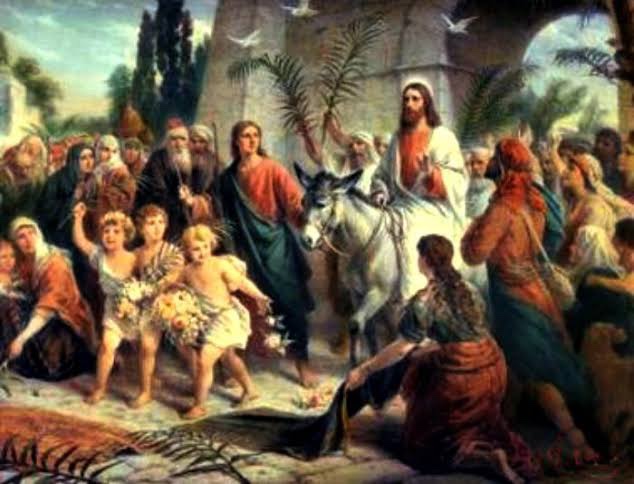
The donkey (colt) perhaps gives us the clue.

In Biblical times, horses were used when a king rode to war, whereas donkeys were used to signal a time of peace.

King Solomon rode on his father, David’s donkey (Cf. 1 Kgs 1:33)

Zechariah prophesies a time of peace as the King rides on a donkey (Cf. Zech 9:9-10)

Jesus, the Prince of Peace, enters Jerusalem, the City of Peace, in humility and lowliness on a donkey, and would soon be mounted on the Cross…
… Cross, the sign of God’s new, true rainbow which connects the heavens and the earth
… Cross, the sign of reconciliation, of forgiveness, a sign of love that is stronger than death.

By making a ‘grand entry’ on the donkey, Jesus shatters every false notion that had been clouding the minds of the people, who thought He would be the political Messiah

He presents Himself as the Lamb of God, Who is to be sacrificed.

It is interesting to note when Jesus asked for the donkey (colt), He made a statement “The Lord has NEED…!” (Mt 21:3)

Did the Lord of the universe NEED something?

No!

But this is the Divine Paradox, wherein the Divine lowers Himself to invite humanity to partake of Divine Life!

And today, this Divine Paradox is inviting all of us and telling us: I need you!

What is our response?

Very often, we give many excuses… and we may feel….
… we are still too young (like Prophet Jeremiah)
… we are already old (like Abraham, the father of Faith)
… we are useless and not talented (like Moses, who would lead the people through the Exodus)
… we are sinful (like Isaiah and Peter who confessed their unworthiness)
… we are not considered favoured in the eyes of God (like Elizabeth and Zechariah)
… we are having a bad past filed with mistakes (like St Paul and St Augustine)

The Lord assures us that if we offer our lives, He will make come into us! (Cf. Rev 3:20)

Many of us are just happy to be part of the “city crowd”…
… remain there and once in a way, shout Hosanna, and be happy!

But the Lord says: Leave the city, and climb Calvary

He who wishes to follow me, must deny, take up the cross daily and follow – Mt 16:24

We must realise… Christianity without the Cross is impossible…
No Cross, no crown!
No wounds, No blessings!
No offering, no happiness!

We have the palms with us now – they are fresh and green.

But in a few days, they will turn dry.

It is easy to sing and shout Hosanna when everything is fresh and green.

But can we keep the same spirit, even when things dry up…
… or will we end up saying, Crucify Him!

Let us try to make this week, a “holy week” indeed…
… by making a confession of our sins
… be taking a decision to read the Bible every day, without fail
… by spending time with Jesus, in personal prayer, every day
… by repairing some relationships from which we keep away

Wish you a Blessed Holy Week!

God Bless! Live Jesus!!


📖 Discovering the beauty of the Catholic Church through the Catechism
THE SACRAMENT OF HOLY ORDERS IN THE ECONOMY OF SALVATION – WHO CAN RECEIVE THIS SACRAMENT?

No one has a right to receive the sacrament of Holy Orders.
Indeed no one claims this office for himself; he is called to it by God.
Anyone who thinks he recognizes the signs of God’s call to the ordained ministry must humbly submit his desire to the authority of the Church, who has the responsibility and right to call someone to receive orders.

Like every grace this sacrament can be received only as an unmerited gift. (CCC # 1578)

✝️ REFLECTION CAPSULE – April 1, 2023: Saturday

“Seeking the Lord wholeheartedly in all situations, knowing that everything in life happens for good, for those who love God!”

(Based on Ezek 37:21-28 and Jn 11:45-56 – Saturday of the 5th Week in Lent)

There is an ancient story, familiar to many of us, in many forms…

A poor farmer in a village, owned a horse, which he used for ploughing and transportation.

One day, this horse escaped into the hills.

The neighbours sympathised with the farmer over his bad luck.

But the farmer replied, “Bad Luck? Good luck? Who knows!”

A couple of days later, the horse returned to the farm, with a herd of wild horses, following its trail. The farmer locked these horses in the stable.
When the neighbours heard of it, they congratulated the farmer on his good luck.

But the farmer said “Good Luck? Bad luck? Who knows!”

The following day, the farmer’s son mounted one of these wild horses, but was thrown off, fracturing his legs.
Once again the neighbours called on the farmer to express their sorrow at his bad luck.

But the farmer replied, “Bad Luck? Good luck? Who knows!”

The following week, army officers arrived at the village to recruit all the able-bodied young men, because of a war that had started. But, they of course, had to leave behind the famer’s young son, because of his fractured leg.
The neighbours once again told the farmer, how much in luck he was.

But the farmer said “Good Luck? Bad luck? Who knows!”

The farmer maintained a position of neutrality and balance in the midst of all pleasant and unpleasant events of life.

However, very often, we are like the neighbours, who rejoice greatly when good things happen and curse immensely when things go wrong.

We fail to see that everything in life has a purpose.

As a result, negative experiences in life often crush us and cause immense disappointments.

When things don’t shape up as we plan, we get greatly frustrated.

When people don’t behave in the way we expect, we get totally devastated.

But through today’s Gospel reading, the Lord invites us…
… to not get shattered or disappointed with life’s bad-turns or evil-leanings…

Rather, to gather strength and courage to fight the evil, arm oneself in faith and hope and seek to live a life of holiness and conviction…
… even in the midst of any setback or failure!

The Gospel of the day, on this eve of the Holy Week, introduces us to culmination of the sharp antagonism and hatred that was building up against Jesus.

Jesus had raised up the dead Lazarus (Jn 11: 1-43)

This event garnered a lot of attention…

Many people began to believe in the person of Jesus, as the Messiah and Lord.

But many others, also began to have a greater bitterness towards this Man who was working wonders!

Many people grew in their following of Jesus and placed a greater trust and confidence in Him

But many others, had their flames of jealousy intensified and began to have greater plotting to finish off the “law-breaker” and “blasphemer”

The good that the Lord had done, was apparently turning out to be an evil for the Lord!

The “life-giving” action of the Lord would immediately result in a “life-taking” act on Him!

The event of blessing to Lazarus would apparently turned out to result in an occasion of curse on Him (since dying on the cross was considered to be a curse (Deut 21: 23)!

In the ensuing planning and plotting by the chief priests and the Pharisees, the High Priest said, “… it is better for you that one man should die instead of the people, so that the whole nation may not perish” (Jn 11: 50)

Jesus had grown to be a big threat for them
Jesus had gathered up much popularity and had become a menace for the leaders.

Therefore, the High Priest suggested a “quick-solution”… to kill Jesus!

But, everything in life has a purpose…
… Because God is the ultimate ruler, preserver and nurturer of this universe!

They plotted death…
… but God planned life
They were selfish…
… but God made Him the Saviour
They sought for political gain…
… but God ensured spiritual gain.
They hoped to spare one nation…
… but God saved the whole world.
They intended the worst evil for Jesus…
… but God turned it into the greatest good.
They wished to scatter all His followers…
… but God brought them together as one holy nation.

Our life also follows this same pattern…

The events we think are bad…
… also have a purpose in God’s mind.
The moments that we consider as cursed…
… also can be turned to a blessing by God.

Sometimes, it’s just too hard to accept this teaching…
… too difficult to understand this concept..

But we have a beautiful answer in this our painful moments: the Cross.

Look to the Cross and find strength from Him…
… who was abused though He was pure
… who suffered immensely, thought He was faultless.
… who underwent tremendous agony, thought He was sinless.

The Cross is the way of God…
… mysterious to us, but life saving for the world.
… baffling for us, but redemptive for the world.

What is most important is not to get discouraged or disheartened; rather…
… to seek the Lord wholeheartedly in all those situations
… to be faithful to the Lord in steadfastness and patience.
.. to be strong and joyful, finding strength in the love of the Lord.

Everything… yes… everything in life, happens for good!

God Bless! Live Jesus!


📖 Discovering the beauty of the Catholic Church through the Catechism
THE SACRAMENT OF HOLY ORDERS IN THE ECONOMY OF SALVATION – WHO CAN RECEIVE THIS SACRAMENT?

“Only a baptized man validly receives sacred ordination.”
The Lord Jesus chose men to form the college of the twelve apostles, and the apostles did the same when they chose collaborators to succeed them in their ministry.
The college of bishops, with whom the priests are united in the priesthood, makes the college of the twelve an ever-present and ever-active reality until Christ’s return. >> The Church recognizes herself to be bound by this choice made by the Lord himself.

For this reason the ordination of women is not possible. (CCC # 1576)

EUREKA 23: Discovering Catholic Treasury – through a Lenten lens!

“FAMILIARIS CONSORTIO”

A. What is it?
“Familiaris Consortio” is a post-synodal apostolic exhortation written by Pope John Paul II and promulgated on 22 November 1981.
“Familiaris Consortio” means ‘The fellowship of the family.’ It is subtitled ‘On the Role of the Christian Family in the Modern World.’

B. What does it speak of?

The document describes the position of the Catholic Church on the meaning and role of marriage and the family, and outlines challenges towards realizing that ideal.
It refers to marriage as “one of the most precious and most urgent tasks of Christian couples in our time”

“Familiaris Consortio” consists of 4 parts:

Part ONE: BRIGHT SPOTS AND SHADOWS FOR THE FAMILY TODAY

The Church is called to be a prudent observer of the challenges and opportunities which face today’s family. The Church must listen to the questions and concerns of married couples.
In responding to the needs of young married couples and families, the Church must offer
the truth of the Gospel as a source of inexhaustible grace rather than follow majority opinion.
This truth is urgently needed today because of the challenges faced by families: divorce, abortion, sterilization, contraception, the decay of parental authority, and a general weakening of the marriage bond between husband and wife.
The spiritual and moral renewal of marital and family life brings about a much-needed elevation of society in general.

PART TWO – THE PLAN OF GOD FOR MARRIAGE AND THE FAMILY

The human person was created by God out of love, and each is called to love within his or her vocation.
Love is the calling of each person.
Marriage and family life are special opportunities to live the vocation of love.
The love between husband and wife mirrors the love between Christ and his Church – that is, this love is sacrificial and life – giving
Married life is enriched and becomes a family, with the gift of children.
Virginity and celibacy do not deny the dignity of married and family life; rather, they highlight the call to love and the need to wait in patient hope for the Bridegroom – Jesus Christ.

PART THREE – THE ROLE OF THE CHRISTIAN FAMILY: BECOME WHAT YOU ARE

The family is part of God’s plan for creation and salvation.
It is within the family that the human person comes to be whom he or she is and comes to know the living God.
Love within the family reveals in a special way the unbounded love of God.
Family love involves four general callings: (1) Forming a community of persons; (2) Sharing a love which serves life; (3) Participating in the development of society; (4) Sharing in the life and mission of the Church.
Being faithful to these four callings to love, the family is a living proclamation of the Gospel and the truth of Jesus Christ.

PART FOUR – PASTORAL CARE OF THE FAMILY

The family is called to grow through a constant conversion to the will of God.
The Church is called to care, in the name of Jesus, for married couples and for families.
The Church must encourage and support those preparing for marriage and those who daily accept the challenges to be faithful to their marital vows.
Those who find themselves in difficult marital and family situations (mixed marriages, trial marriages, divorce, separation, and domestic violence) are in need of special pastoral care by the Church.
Pastoral ministry to those in difficult situations flows from the words and example of Jesus to love and be close to the broken-hearted, rejected, and suffering.

In conclusion, the model of true marriage and family life is the Holy Family: St. Joseph is the upright guardian of the family; Mary is the one entrusted with the Word made flesh; and Jesus is the child who perfectly does the will of the Father.

The Pope prays that each Family will be a holy family to the glory of God.

C. Pointers for Reflections

  1. The family is a community of life and love.

The Holy Father keeps these two words together – life and love.
‘Love and life’ are never to be torn apart; which is very different from “planned parenthood” or “family planning”.

  1. The family is the first living cell of society.

Families produce, nourish and form individuals who will in turn go on to make new families. This is the natural cycle of society.
The Christian family serves the poor, the outcast, the lonely and the weakest ones.

  1. The family must become what it is.

The family must develop its full potential according to God’s plan…
… for its own inner life as a community of persons based on marriage
… for its service of life
… for its wider role in society
… and for its life of faith within the Church

D. What virtues/points can we pick up from “Familiaris Consortio” for this Season of Lent?

  1. Deepening our bonding in the family
  2. As a Christian Family, reach out in service to others

E. Tips to practice these virtues

  1. Introduce practises that help to unite – maybe some have been forgotten or missed (eg. Family Prayer, Family Meals, Sharing together – leaving aside all electronic gadgets)
  2. Choose 3 families to whom we as a family can reach out – either with financial/material/spiritual/emotional assistance

May this Lent and the familiarity with “Familiaris Consortio” help us to grow in our acclamation: “Eureka – I have found the Lord”

CLICK TO READ the Full Text of “Familiaris Consortio” at:
https://www.vatican.va/content/john-paul-ii/en/apost_exhortations/documents/hf_jp-ii_exh_19811122_familiaris-consortio.html

God Bless! Live Jesus!

✝️ REFLECTION CAPSULE – March 31, 2023: Friday

“Not being stone-hearted; rather having tender, loving, understanding and compassionate hearts!

(Based on Jer 20:10-13 and Jn 10:31-42 – Friday of the 5th Week in Lent)

“We are strewn all over the ground.

Some of us are considered useless….
Some of us are just stamped upon…
Some are made use in some hard labour…

Some of us…
… well, some of us, however, are made use for some inhuman practices.

This includes making use of some of us, to hurt others
… to cause pains and wounds to others
… and some even to cause fatal deaths!

Our life is often long…
… but sometimes, such kind of painful moments and incidents, ooze out any bit of feelings we may have (though we are considered not to be having any sentiments!)

Are you wondering who we are?

Well…
… we are the family of stones!

Yep… Stones!

Strewn all over…
Sometimes useless, right?
Sometimes just stamped upon, right?
Sometimes just made use for hard labour, right?

But sometimes, some of us, the stones
… also become objects of injuring and causing pain to others

One such occasion was when, as you read in the Gospel of St John 8
… some of us were picked up by a gang of highly malicious, judgmental and selfish people, to cause death to a woman who was caught in an act of immorality.

We were ready to thrown on that woman.
We were set to become objects of brutality and terror.

However, that day, we encountered the most amazing personality.
He had glorious eyes.
He had a breath-taking voice.
He had a tremendous authority.

His name was JESUS!

And His one sentence, “He who is without sin, let him be the first to stone” dropped the jaws of all those blood-thirsty and cruel people.

We were all released from their hands.

We saw them all turning their backs and going home, in shame.
We also saw, the wonderful triumph of Mercy and Love and Compassion.

However, a few days later, some of us were soon back to find ourselves in the hands of those blood-thirsty men.

This time, the target was none other than that same charismatic person named Jesus.

You read about that in John 10:31, “The Jews took up stones again to stone Jesus”

We were left wondering why this innocent man was being targeted so badly.

He was after all preaching the Kingdom of God.
He was bringing the message of God’s Love and salvation to the world.
By His works, He was also proving Himself to be the Son of God.

But none of these “clear-cut” evidences were able to convince those people.

They still believed that Jesus was a blasphemer.

And so they picked us up – yes, we the stones
… to indulge themselves in a blood-bath of the Blessed Man of claimed Himself to be the Lord and Saviour of the World!

Prophet Jeremiah also had a similar experience of being denounced by the people…
… and centuries ago, recounting his own struggle, had written these prophetic words about the Saviour: “For I hear many whispering. Terror is on every side!
‘Denounce him! Let us denounce him!’ say all my familiar friends, watching for my fall.
‘Perhaps he will be deceived, then we can overcome him, and take our revenge on him!’” (Jer 20:10)

Our thoughts go out to those people who have such ruthless and stony intentions….

God had blessed them with such beautiful hearts.
God had showered them with so much of wisdom to discern and understand.

Yet, they failed to make use of these divine gifts and instead, had hardened their hearts!

What a pity, that those human beings had become like us
… stones!

Yes, just how could they become stone-hearted?

Stone-hearted
… that they failed to be open to the possibility of God’s hand at work.

Stone hearted
… that they were adamant to be closed to any explanation of the Lord.

Stone-hearted
… that they were stubborn to listen to the voice of God’s Spirit in their lives.

We, the stones, now appeal to you, dear readers, to be wary and examine your lives: Are you also sometimes acquiring a nature like us, the stones…
… hard to the feelings of other people and failing to understand them?
… rigid to the inspirations of the Spirit of God and not letting Him work in your lives?
… inflexible to have changes and transformations in life, to attune oneself to God’s Will?

There are already many of us in the world…

On your streets, on your roads
… we are all, indeed strewn all over the place
…we, the stones.

But we sincerely beg you…
… not to let your hearts to become like us
… not to let your lives to be similar to our nature.

Let the world have more of, not stone-hearts…
… but tender, loving, understanding and compassionate hearts!

Let the world have more of, not hardened souls…
… but docile, open, submissive and humble lives!

God Bless! Live Jesus!


📖 Discovering the beauty of the Catholic Church through the Catechism
THE SACRAMENT OF HOLY ORDERS IN THE ECONOMY OF SALVATION – WHO CAN CONFER THIS SACRAMENT?

Since the sacrament of Holy Orders is the sacrament of the apostolic ministry, it is for the bishops as the successors of the apostles to hand on the “gift of the Spirit,” the “apostolic line.”

Validly ordained bishops, i.e., those who are in the line of apostolic succession, validly confer the three degrees of the sacrament of Holy Orders. (CCC # 1576)