
Ray of Hope #236: Fire of Gods Truth
“Striving to be sincere followers of Christ who are ‘willing to be counted’ to stand up for the Kingdom values!”
(Based on Jer 38:4-6, 8-10, Heb 12:1-4 and Lk 12:49-53 – 20th Sunday in Ordinary Time, Cycle C)
An interesting incident is narrated of how some years ago, the prime minister of a certain country, was speaking before several distinguished leaders.
He was severely critical of his predecessor who was known to be a harsh dictator.
While he was speaking, someone from the audience sent up a note:
“How about you? What were you doing when that dictator committed all those atrocities?”
At that, the Prime Minister – filled with fury and rage – shouted: “Who sent up that note?”
Not a single person stirred.
“I’ll give him one minute to stand up!”
The seconds ticked off.
Still no one moved.
“All right, I’ll tell you what I was doing.
I was doing exactly what the writer of this note was doing – exactly nothing!
I was afraid to be counted!”
As a Christian, am I afraid to be counted…
… and thus fail to stand up for Christ and His Values?
Every Christian is expected to set the world on fire…
… by being passionate in their love for the Lord
… and being compassionate to the people of God!
Our Blessed Lord was greatly filled with zeal to “set the earth on fire”…
… and desires all His followers to share in this passion for the Kingdom of God.
The Gospel of the Day begins with Jesus exclaiming:
“I have come to set the earth on fire, and how I wish it were already blazing” (Lk 12: 49)
“Fire” in the Bible is an imagery of many aspects…
God’s judgment (Jdt 16:17; Is 66:16; Am 7:4; 2 Pt 3:7)
God’s protective presence (Ex 13: 21, 2 Kgs 6:17)
Purification (Nm 31:23; Ez 22:19-22, Zec 13: 9),
The Holy Spirit (Mt 3:11, Acts 2:3).
God’s Holiness (Dt 4:24)
God’s glory (Ez 1:4, 13)
Fire also has many characteristics:
It warms… refines… transforms… burns!
The Lord who was greatly zealous to “set the earth on fire” invites us to examine:
Am I filled with zeal, to blaze the world “on fire”…
… the fire of God’s love?
… the fire of God’s purging mercy?
… the fire of God’s judgment with respect to sin and evil?
The following verse of the Gospel passage comes in as a shock…
“Do you think that I have come to establish peace on the earth? No, I tell you, division!” (Lk 12:51)
The Gospel of St. Mathew’s version of the same verse reads:
“Do not think I have come to bring peace. I have to come not to bring peace, but a sword… (Mt 10: 34)
These verses become more surprising in the context of…
The Sermon of the Mount where in Mt 5:9, it says, “Blessed are the peacemakers”
The description of the Messiah where in Isa 9: 6 it says, “He (Messiah) will be called “Prince of Peace”
Why does St Mathew use the words “peace and sword?”
Why does St Luke use the words “peace and division?”
This could be a technique called “Juxtaposing”.
Juxtaposing simply means to place two things side-by-side or next to each other…
… especially to compare or to emphasize on the contrast.
This technique is used extensively in the Bible…
“Unless a grain of wheat dies, it will not give life” (Jn 12: 24)
“A good tree cannot bear bad fruit” (Mt 7:18)
“Light shines in the darkness” ( Jn 1:5)
Thus we see…
… life and death
… good and bad
… light and darkness
This “juxtaposition” we also observe in our daily life.
Any artist or a person with some aesthetic sense will vouch for the fact that, in order a highlight some light-coloured flowers in a bouquet…
… a darker background is preferred.
Even in our style of dressing, we prefer to wear dark-coloured trousers…
… along with light-coloured shirts.
The logic is simple: Juxtaposing two contrasting stuff emphasizes the meaning.
Peace, is generally defined as a situation where there is no violence or war.
Sword, on the other hand, signifies conflict, struggle and death.
Peace, is normally understood as a situation of calm and absence of conflicts
Division, on the other hand, points to disturbances, instability and turmoil.
What is the meaning of this usage of “juxtaposition” in today’s Gospel passage?
The Kingdom of God is righteousness, peace and joy (Rom 14: 17)
To establish this peace or this Kingdom of God…
… sword is an inevitable reality!
… division is an inescapable consequence!
Disturbances, instability, turmoil, conflict, struggle and even death is a real possibility!
That’s why Jesus would go on to say:
“From now on a household of five will be divided… three against two and two against three…” (Lk 12: 52)
These verses are an import from Mic 7:6 which speaks of “division in the household”.
In the Jewish Society…
… the household was one of the strongest units of loyalty and binding.
However, Jesus shatters all these pre-conceived notions and demands:
“Loyalty of a disciple to Jesus is to be much higher than even to his own household!”
All intimate relations, even that within the family, are to be given subordinate status in our Love for Jesus.
It is also interesting to note the order of people mentioned in Lk 12:53…
… Father vs Son, Daughter vs Mother, Daughter-in- law vs Mother in Law.
It is always the young vs the old.
What could be the meaning?
The Kingdom of God will cause a sword of division…
… It will be a division of the Young vs Old!
Young and Old are not to be considered in the physical sense…
… but in the spiritual sense!
Young as being people who are “new”… those by giving up a life of sin, choosing to be part of the Kingdom of God.
Old as being those people who are “unrepentant”… those who cling on to sinful ways and oppose the Kingdom.
The Kingdom of God is always characterized by people who are willing to be “new” in the Spirit…
… young at heart and mind, full of dynamism and full of enthusiasm.
What are the implications of all what we have said today?
The establishment of peace in the Kingdom of God is always accompanied by the sword of division
Are we ready to face the struggles and difficulties that surely will come on our way, as we work for the Kingdom?
In this our mission of establishing the Kingdom, we are demanded to have a loyalty to Jesus that is higher than all other relationships.
Are we ready to sacrifice… perhaps our relationships or our way of thinking or even our lifestyle – all for the sake of loyalty to Christ?
The Kingdom of God demands that we always be young – dynamic, enthusiastic, cheerful and energetic.
Are we ready to always remain Young at heart and in mind, for the sake of the Kingdom of God?
Jesus, Who was greatly filled with zeal to “set the earth on fire”…
… desires all His followers to also share in this passion for the Kingdom of God.
Yes, let us become Christians “who set the world on fire!”…
… and strive to be sincere followers of Christ who are ‘willing to be counted’ to stand up for the Kingdom values!
God Bless! Live Jesus!
📖 Discovering the beauty of the Catholic Church through the Catechism
MAN’S VOCATION LIFE IN THE SPIRIT – GOD’S SALVATION: LAW AND GRACE – The Fifth Commandment – Respect for human life
Discontinuing medical procedures that are burdensome, dangerous, extraordinary, or disproportionate to the expected outcome can be legitimate…
… it is the refusal of “over-zealous” treatment. (CCC # 2278)

“Seeing the world through the eyes of a child – in openness, sincerity, wonder and innocence!”
(Based on Josh 24:14-29 and Mt 19:13-15 – Saturday of the 19th Week in Ordinary Time, Year 1)
Charles Francis Adams was a 19th century American historical editor, politician and diplomat.
His son was Brooks Adams, who became a historian.
A researcher, while making a study on the life of the Adams Family came across their personal diaries.
Both, the father and son, had entered a description of a particular day…
… It was a day when they had gone fishing.
However, interestingly, their descriptions had a world of difference…
The father, wrote in his diary:
“Went fishing with son. Day wasted.”
The son, however wrote in his diary:
“Went fishing with my father. The most wonderful day of my life!”
Why such a huge contrast in the description of the same day?
The son Brooks, was only twelve years at that time.
It was a bad day at fishing as they didn’t catch any fish…
… but they spent a lot of time talking
The boy had asked a number of questions, and the father had creatively answered…
… in the process, explained many important aspects about life.
The father, on the other hand, felt it as a waste of time…
… without even any fish being caught!
Our attitude in life makes a world of difference!
Seeing the world through the eyes of a child – in openness, sincerity, wonder and innocence – can help us to have “a wonderful day,” every day of our life!
Hence, in the context of a family life, there is a popular quote which says:
“A house is built with bricks and beams…
… A home is built with love and dreams!”
The Gospel of the Day presents to us an occasion to dwell on a reflection on our families…
… and some of the basic essentials that needs to be part of every family (religious community included as well)
Family Life is an important component of every society.
The Gospel of St. Matthew, Chapter 19, has an interesting structure or a progression with respect to the topics discussed and the persons involved.
Thus, the Chapter 19 of Matthew is a travel through a FAMILY context…
… starting from MARRIAGE…and the need to avoid DIVORCE…
… to little CHILDREN
… to the problems of a YOUTH
… and finally ending with the choices as an ADULT.
In today’s Gospel, we have the discussion on Little Children (Mt 19: 13-15)
Though it’s a short passage, the Gospel gives us enough food for thought…
… especially in the context of a family or a community life.
We see four different groups or sets of people in today’s Gospel Passage, and we can learn some aspects from each of those sets…
Three of them give us a positive quality which is to be inculcated
One gives a negative quality which is to be avoided in life.
A. Firstly, the Gospel begins with the statement, “Little children were brought to Jesus…” (Mt 19: 13a)
Probably the parents, the elder brothers/sisters or the guardians of the children would have brought them to Jesus.
We see here, the First set of people… Parents, Guardians, Elders etc…. and they teach us the First Positive Quality – the Spirit of Responsibility!
They were Responsible in caring for the good and future of the children.
It was an ancient practice that children would be brought to Rabbis to be blessed and prayed over.
This first set of people teach us to be responsible for the growth of others in our family and in our communities.
B. The Second set of people are obviously the Little Children.
These little ones teach us the Second Positive Quality, needed in a family or a community – the Spirit of Receptivity!
Children display a great sense of receptivity and openness.
They are able to accept the affection, the care, the love and the blessings that are given to them.
They do not close themselves to the good things in life.
We too need to cultivate this Spirit of Receptivity, to be open to the actions, thoughts, views and feelings of others in our family and our community.
C. The Third Set of people display a negative attitude which we need to avoid.
When the children were brought to Jesus, the Disciples refuse to accept them and want to keep them away (Mt 19: 13b)
They show a Spirit of Rejection!
They perhaps felt that these children would be a nuisance to Jesus and His ministry.
They felt it as a waste of time and energy to entertain the children.
Little things in life were considered to be a useless and futile activity.
We need to avoid this Spirit of Rejection…
In our families or communities, we can have this attitude towards those who don’t do any work or fail to contribute anything.
We often fail to understand the importance…
… of little tokens of love
… tiny expressions of care by our family and community members
And we, instead, tend to reject and avoid them.
D. The fourth Set is represented by Jesus Himself…
… and he presents the Spirit of Restoration and Redemption.
He does not reject…
… rather, He accepts and seeks to redeem the little children.
He seeks to restore the little ones who are rejected…
… who are avoided and who are not given the due importance.
In our lives, we too need to be having a Spirit of Redemption and Restoration…
To redeem the ones who are at the periphery and who fail to get any attention
To restore the ones who are broken and abused and are shunned!
Thus, this powerful Gospel passage teaches us…
To avoid the Negative Quality of the Spirit of Rejection…
Rather…
To adopt the positive qualities of…
… The Spirit of Responsibility,
… The Spirit of Receptivity
… The Spirit of Redemption and Restoration!
Let us seek the Intercession of our Blessed Mother that we may avoid the tendency to Reject People…
And instead, we may be…
… Responsible towards others
… Receptive to others
… and Redeem and Restore the lives of others!
And thus build happy and loving homes!
Let us always understand that “our attitude in life makes a world of difference!”
Seeing the world through the eyes of a child – in openness, sincerity, wonder and innocence – can help us to have “a wonderful day,” every day of our life!
God Bless! Live Jesus!
📖 Discovering the beauty of the Catholic Church through the Catechism
MAN’S VOCATION LIFE IN THE SPIRIT – GOD’S SALVATION: LAW AND GRACE – The Fifth Commandment – Respect for human life
The error of judgment into which one can fall in good faith does not change the nature of this murderous act…
… which must always be forbidden and excluded. (CCC # 2277)
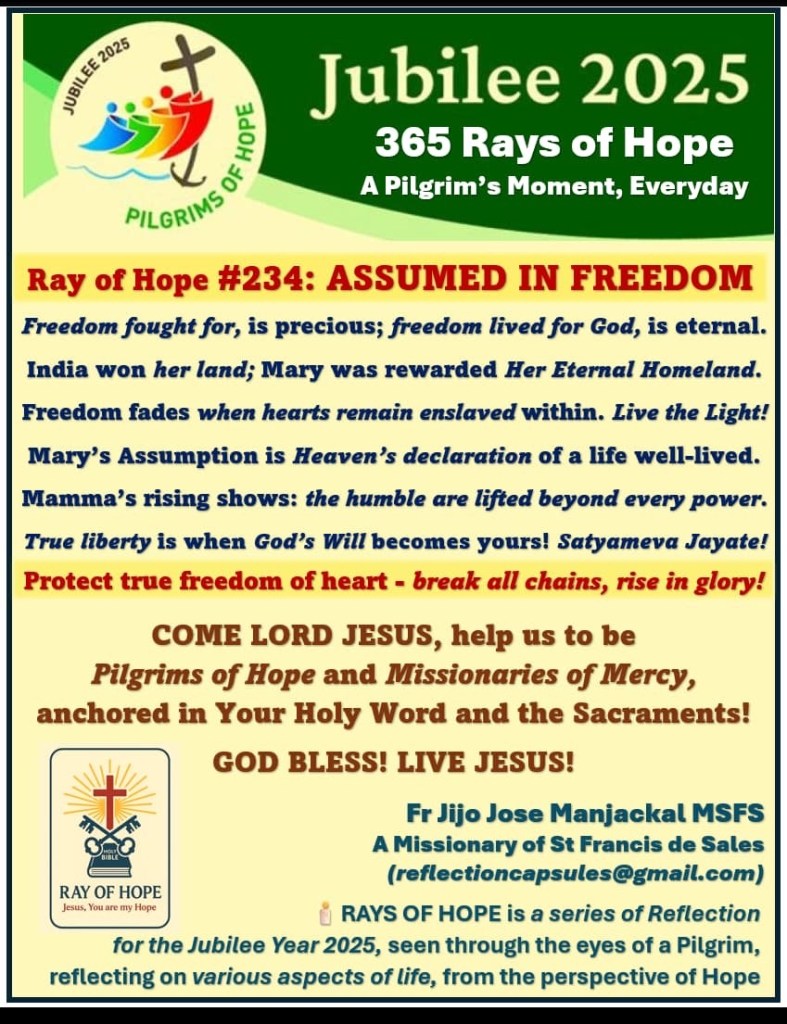
“Like our Blessed Mother Mary, properly channelizing the God-given Freedom towards excellence of life, blossoming of virtues and the Glory of God!”
(Based on the Solemnity of the Assumption of Blessed Mother Mary & the Independence Day of India)
The Feast of the Assumption of our Blessed Mother Mary is celebrated in variety of ways, all over the world.
In some of the small towns of Italy, there is a very symbolic custom.
It is called as “L’Inchinata”- the Bowing Procession.
The people in the village carry a statue of the Blessed Virgin Mary down the main street.
This is symbolic of Mother Mary on Her way to heaven
From the opposite direction comes another procession, carrying the statue of Jesus.
This is symbolic of Her Son Jesus coming to welcome Her
Under an arch that has been prepared with branches and thousands of flowers, the two processions meet.
The statues are then made to bow to each other, three times…
… It is symbolic of Jesus welcoming His Beloved Mother at the gates of heaven.
Then the combined procession continues, with the people carrying the statues side-by-side to the Church….
… Symbolically indicating, Jesus taking along His Mother to Her throne in heaven!
This ‘bowing procession’ so very beautifully and symbolically represents the wonderful event of the Assumption of our Blessed Mother Mary.
It celebrates the Son-King sharing His Glory with His Mother.
Human kingdoms have followed the tradition of the son who is the King of the Land, crowning his mother, as the Queen of the Kingdom.
The Old Testament bears witness to this fact:
King Solomon on assuming charge of the throne, after King David, raised his mother Bathsheba to his side, to be the royal queen (1 Kings 2: 19)
This was also a foretaste of what was to follow…
… Jesus, the King of Kings awarding the throne of glory to His Mother, Mary and raising Her to be the Queen of Heaven and Earth!
The feast of the Day – the Assumption of Mother Mary – is one of the four Marian Dogmas that the Catholic Church pronounces.
A dogma is a doctrine that is solemnly proposed by the Church as formally revealed in Scripture or Tradition.
The four Marian Dogmas are:
The declaration of the Dogma of the Assumption of Mary is as follows:
“By the authority of our Lord Jesus Christ, of the Blessed Apostles Peter and Paul, and by our own authority, we pronounce, declare, and define it to be a divinely revealed dogma: that the Immaculate Mother of God, the ever Virgin Mary, having completed the course of her earthly life, was assumed body and soul into heavenly glory.”
This Dogma of the Assumption was proclaimed on November 1, 1950, by Pope Pius XII in the Apostolic Constitution “Munificentissimus Deus”
The Dogmatic Proclamation of the Assumption was not defining something new in the Church…
… rather it was an official recognition of the centuries-old belief on Christians about the Assumption of their Heavenly Mother.
The celebration of the Feast of the Assumption teaches us one important aspect: The Assumption of Mother Mary is the sure hope for us, for a life of eternal glory!
Our Blessed Lord came to this world to “die” and “win” salvation for human beings.
This act of salvation had its total co-operation in the Person that God had chosen as His Own in the Divine Plan – Mother Mary.
From the moment, She said “yes” to the messenger of the Lord to become the Mother of God’s Child…
… She placed Herself under God’s Will!
Her Yes to God, meant a “No” to many things in Her personal life…
… her own individual desires
… her own undisclosed dreams
She become the epitome of the one who lived the teaching that Jesus would later expound during His ministry:
“No one who puts a hand to the plough and looks back is fit for service in the Kingdom of God” (Lk 9: 62)
Her echo of “Yes” reverberated and resonated all through Her life…
… in times of loneliness
… in times of immense pain
… in times of utter hopelessness
It was this daring faithfulness that made God to bestow on Her the privilege to share in Her Son’s Glory!
This is wonderful story of the Assumption.
This then is one of the great promise and assurance that God gives to each one us through this Dogma of the Assumption of our Blessed Mother Mary.
Does life grind us, with its daily toils and do we undergo immense pain and suffering…
… sometimes even unbearable and agonizing?
Does life grill us, with many incidents of misunderstandings, exposition to calumnious talks…
… and total absence of positive encouragements and unconditional acceptance by people?
Then, the Assumption of our Blessed Mother comes to our rescue, with a hopeful answer to all such miserable questions!
We need to be reminded that Mary had exclaimed, “Behold, I am the Handmaid of the Lord” (Lk 1:38)
Mary was an ordinary human being.
She had Her ordinary and humble beginnings.
But through these “ordinary” circumstances…
God “raised” Her to the Heights
God “assumed” Her into Glory
… because She “found favour with God” and lived in total submission, humble obedience and loyal faithfulness!
This then is our call too…
As Baptized Christians, we too have “found favour” with God.
We dwell in “ordinary” circumstances of life – with hardships and pains.
But if we also…
… seek and live the Will of the Lord at all times
… constantly submit to what He wants
… and dutifully bow to His mercy and grace
Then the glory which Jesus has “won” for us at Resurrection, will be ours!
God’s plans are indeed wonderful…
In the “Story of the Fall,” a mother (Eve) had been involved intimately with a man (Adam) and humanity fell into the sea of sin!
In the “Story of the Rise,” a Mother (Mary) was involved intimately with a Man (Jesus) and humanity is promised to “assume” to the skies of glory!
Are we ready to co-operate with God’s plans in our lives, just as Mother Mary did…
… and thus receive the “Privilege of Assumption into Glory” just as Mother Mary received?
Let us grow in our Love for the Lord and for the Blessed Woman who bore God in Her womb…
… and was borne by God into heaven, and not left in the grave to turn back into dust!
Today, the Great Land of India celebrates her Independence Day.
May all Indians grow to understand the true meaning of freedom…
… respecting each other’s rights and promoting integrity of life
… and like Mother Mary, properly channelize the God-given Freedom towards excellence of life, blossoming of virtues and to the Glory of God!
Happy Feast to Jesus, Our Great King and to Mamma Mary, His Glorious Queen-Mother!
Happy Independence Day to all Indians, all over the world!
God Bless! Live Jesus!
📖 Discovering the beauty of the Catholic Church through the Catechism
MAN’S VOCATION LIFE IN THE SPIRIT – GOD’S SALVATION: LAW AND GRACE – The Fifth Commandment – Respect for human life
An act or omission which, of itself or by intention, causes death…
… in order to eliminate suffering constitutes a murder… gravely contrary to the dignity of the human person and to the respect due to the living God, His Creator. (CCC # 2277)

“Entrusting ourselves to the Lord knowing that God’s Plan of Salvation (GPS) for human beings is His Mercy!”
(Based on Josh 3:7-10a, 11, 13-17 and Mt 18:21-19:1 – Thursday of the 19th Week in Ordinary Time, Year 1)
A tech-savvy young man was once explaining the functioning and usage of a smartphone to an elderly priest.
The use of GPS (Global Positioning System) was among the few things that he taught the senior priest.
Explaining GPS, the man told of how it can be used to quickly locate places, move from one place to another effortlessly…
… and adding, “You know Father, even if you lost your direction, the GPS will safely guide you
It will only give a message, ‘Re-routing’ and then guide you to your location, provided your destination is proper”.
Hearing this, the priest reflected a while and said, “Ah! So this is a beautiful reflection of the way God is, isn’t it?”
… and he continued: “Every time we stray, God safely guides us.
Every time we miss the way, He prompts the right direction.
He gives the message ‘re-routing’ and amazingly shows the way to proceed ahead.
Of course, all we need to ensure is that our destination is Holiness!”
The priest concluded by saying, “I think GPS for me stands for God’s Plan of Salvation…
… and GPS for human beings is His Mercy!”
That’s truly beautiful, isn’t it?
God’s Plan of Salvation (GPS) for human beings is His Mercy!
The Gospel of the Day is the mighty message of the Lord to share in this Divine attitude of reaching out Mercy to everyone in our life.
To be merciful involves the aspect of forgiveness.
. Many of us have our moments of grappling with the aspect of ‘forgiveness’.
For some people, it’s easy…
But for many, to reach out pardon to those who have hurt, is a hard struggle!
Jesus today teaches us this necessary virtue of “forgiveness”.
To the query of Peter, “Lord, how often shall my brother sin against me, and I forgive him” (Mt 18:21), Jesus illustrates His reply with the Parable of the Unforgiving Servant.
One of the principles in this virtue of forgiveness is the avoiding of a “mathematical accounting policy” in granting pardon.
As human beings, there is sometimes an avoidable tendency in us to “keep counts” in our relationships…
We make a count or keep a rough numerical impression…
… of how many times a person has done good to me
… of when was the last time a person behaved badly with me
… of how many times a person has hurt or caused harm to me
… of how often has a person offended me or spoken ill about me
Relationships…
… sometimes get reduced to mere mathematical entities
… sometimes find themselves entangled in the web of calculative units.
It’s in such situations that “forgiving” the one who has erred against us becomes a ‘calculative’ affair.
Thus, we find that Peter in the Gospel asks Jesus, “How often must I forgive the brother who has sinned against me?”
We maintain, sometimes, a sort of an imaginary “fault-account” book.
And our thought-process takes the following pattern:
“This person, on so and so date, committed this mistake
And on so and so date, I had forgiven him”.
“This person, on this particular day, had behaved in a very indifferent manner to me
And a particular number of days later, I had extended my pardon”.
But Jesus today warns us to stop looking at life and relationships from a “mathematical” or “calculative” perspective.
What is the basis for Jesus to say this?
It is simply the fact that all of us – without any exception – are the beneficiaries of the Mercy and Forgiveness of God.
God abandons all mathematical calculations in extending His forgiveness to us
God lets go of every measure of computation in allowing us to receive His mercy
Rom 3:23 says that “all have sinned and are deprived of the glory of God. They are justified freely by His grace through the redemption in Jesus Christ”.
Each of us find ourselves sinking in the “boats of sinfulness and guilt”.
But it is the Mercy of God that still keeps us ashore.
Each of us pass through the “deserts of shame and culpability”
But it is the Forgiveness of God that nourishes us with the oasis of blessings
This “free and underserved” reception of the forgiveness of God places an undeniable responsibility on us to extend His pardon to all.
The prayer “Our Father” is recited so often by us, during the day or in our prayers.
But do we realize that it contains a clause, whose condition, if not fulfilled, does not help us to receive the “unconditional forgiveness of God?”
We pray, “Forgive us our sins… as we forgive those who sin against us”.
Even though the mercy of God is always made available for us, it can be genuinely received…
… only if one is willing, generous and humble enough to “forgive” the faults of others.
Forgiveness is a powerful weapon that, of course, won’t change the past, but will surely transform the future.
So many are the moments we stray away from the path of the Lord.
But every time we stray, God safely guides us.
Every time we miss the way, He prompts the right direction.
He gives the message ‘re-routing’ and amazingly shows the way to proceed ahead.
Of course, all we need to ensure is that our destination is Holiness!
Let us entrust ourselves to the GPS of our lives and imitating the Lord… knowing that
… God’s Plan of Salvation (GPS) for human beings is His Mercy!
Today we celebrate the Feast of St Maximillian Kolbe…
… who was called by Pope St John Paul II as the “Patron Saint of our Difficult Century!”
May the words of this Heroic Saint, who volunteered to die in place of a stranger in the Nazi death camp of Auschwitz…
… be an inspiration for us:
“The most deadly poison of our times is indifference.
And this happens, although the praise of God should know no limits.
Let us strive, therefore, to praise Him…
… to the greatest extent of our powers!”
God Bless! Live Jesus!
📖 Discovering the beauty of the Catholic Church through the Catechism
MAN’S VOCATION LIFE IN THE SPIRIT – GOD’S SALVATION: LAW AND GRACE – The Fifth Commandment – Respect for human life
Whatever its motives and means, direct euthanasia consists in putting an end…
… to the lives of handicapped, sick, or dying persons.It is morally unacceptable. (CCC # 2277)

“Choosing God’s unconditional mercy over grudging unhealed memory!”
(Based on Deut 34:1-12 and Mt 18:15-20 – Wednesday of the 19th Week in Ordinary Time, Year 1)
In 1994, Rwanda bled.
Hatred tore neighbors apart, and in the space of 100 days, over 800,000 lives were lost.
Among them were the parents, two brothers, and a sister of a 14-year-old boy named Marcel Uwineza.
Years passed.
That boy became a Jesuit priest.
One day, before leaving Rwanda for studies abroad…
… he returned to the village where his family lay buried.
And there – standing before him – was the man who had murdered his beloved ones.
The man fell to his knees and said:
“Marcel… do you have space in your heart to forgive me?”
Father Marcel later said, “I was invaded by something greater than myself…
… because on our own, we can’t forgive.”
He helped the man to his feet and embraced him.
At that moment, he recalls, “It was as if the chains were breaking away from my legs…
… I, too, had been in prison.
Now I was set free.”
Forgiveness doesn’t erase the past…
… it redeems it.
It doesn’t change what happened…
… it changes what happens next!
What happened with Fr Marcel Uwineza SJ…
… is what Jesus calls us to in today’s Gospel: not to “unfriend” or cut off, but to seek out
… confront with love, and restore.
Perfection in relationships isn’t measured by how few faults we find…
… but by how much of God’s Mercy we give!
The Gospel of the Day invites us to reflect in depth on this wordly trend to “easily unfriend” people from our lives…
… without even giving them further chances or opportunities to remedy themselves.
Jesus says, “If your brother sins against you, go and tell him his fault, between you and him alone” (Mt 18: 15)
Jesus was a person who had an important principle in all His teachings: the need to strive towards perfection.
In Mt 5: 48, Jesus says, “Be perfect as your Heavenly Father is perfect”
It’s this pursuit of perfection in human relationships that makes Jesus to invite us in being careful and cautious…
… with respect to severing our relationships with one another.
“Friendship”, it is said, “is delicate as a glass – once broken it can be fixed but there will always be cracks”
Jesus, therefore warns us on the need to “handle with care” our relationships.
The “pursuit towards perfection” makes it inevitable for a Christian – a follower of Christ, to go beyond one’s own limitations and situations in maintaining relationships…
… by preserving and perfecting the fine ones
… by mending and restoring the broken ones.
It is easy to say “I don’t like you any more” because of some bad experience
… but it takes Christian Gentleness to respect and accept a person, despite his/her faults or failures
It is easy to show a person the exit-door in our relationship due to some misunderstanding or ego-clash
… but it takes Christian Humility to let go of one’s “proud and adamant mentality” and lower oneself to try to understand better the person in fault and his/her situation and background
It is easy to harbour grudge and to nurture ill-feelings and to spread the contagion of malicious talks regarding a person whom we don’t like
… but it takes Christian Charity to allow the honey of Christ’s love to permeate our hearts and to be able to find goodness even in the midst of a slush of ‘apparent dirt’ in the person
Our lives, families, communities and societies are being plagued by a number of cancers with respect to relationships:
Backbiting and spreading false rumours about people and situations
Cooking up bogus stories and building up on some true incidents to fashion an “interesting and spicy” report regarding particular persons
Actively engaging in forming groups and cliques against someone in order to satiate one’s own pleasures and get through one’s personal agenda for life
Are we ready to be bold to let go of all such tendencies to which we can be prone…
… and instead engage ourselves in radical Christian charity and humility?
Let the ‘chains of guilt and hurt’ drop…
… choose God’s unconditional mercy over grudging unhealed memory!”
God Bless! Live Jesus!
📖 Discovering the beauty of the Catholic Church through the Catechism
MAN’S VOCATION LIFE IN THE SPIRIT – GOD’S SALVATION: LAW AND GRACE – The Fifth Commandment – Respect for human life
Those whose lives are diminished or weakened deserve special respect.
Sick or handicapped persons should be helped to lead lives as normal as possible. (CCC # 2276)
 Reflection Capsules