REFLECTION CAPSULE – Mar 06, 2021: Saturday

“Running into the embrace of the Merciful Father, with a sincere repentance and contrition of heart, and pledging to live for Him, and with Him!”

(Based on Mic 7:14-15, 18-20 and Lk 15:1-3, 11-32 – Saturday of the 2nd Week in Lent)

Charles Dickens – an English writer and a social critic – is known to be one of the greatest novelists of all times.

He has created some of the world’s best-known fictional characters and his works enjoyed unprecedented popularity during his lifetime; by the 20th century, critics and scholars had recognised him as a literary genius.

His novels and short stories are still widely read today.

Someone asked Charles Dickens once, what was the best short story in the English language.

Without any hesitation, came his reply: “The Prodigal Son!”

The Gospel of the Day is the beautiful rendition of this classic: “The Prodigal Son!”

This Parable of the Prodigal Son(s) – is the beautiful exposition of the Unconditionally True Love of the Heavenly Father to each of His beloved children!

The Parable of the Prodigal Son(s) is surely one of the most popular, the most loved and the most touching parables of Jesus.

This parable has three main characters and we could view any of them as playing the main role in the story:

  1. The Prodigal Son – Younger son

He went away from the love of his father

Inheritance was given to children only after the death of the father

In asking the inheritance, therefore, alluded to the fact that the prodigal son considered his father to be dead!

But having spent his life in useless living, he realised the emptiness and vacuum that filled his heart.

And so he decided to turn back… and go to his father

  1. The Prodigal Son – Elder Son
    He remained the faithful “servant” of the house

But when he saw, that his brother – who had wasted away the inheritance, was received with so much warmth, his temper rose!

He couldn’t digest the fact that his brother who lived a “wasted life” was honoured….
… whereas he was never given the chance to “enjoy with his friends”

The context of the parable is Jesus speaking to the “Pharisees and scribes” who were “complaining that Jesus always accepted sinners” (Lk 15: 1-2)

In this context, the character of the Elder Son portrayed the attitude of the Pharisees and Scribes.

  1. The Loving Father
    Beyond these two characters of the two prodigal sons – the younger and the elder – towers high the Image of the Father – the Father who loved and accepted his lost sons!

He suffered a deep pain when his younger son went away

He underwent immense pain waiting for the son to come back
He went through moments of dilemma when his elder son was opposing the welcome of the younger one

Yet through all this, the Character of the Father towers high!

He is the Father of Mercies – Who accepts all, just as they are
He is the Father of Love – Who loves everyone, unconditionally
He is the Father of Compassion – Who receives all to His loving embrace

In our life, often as children – like the Prodigal Son(s) – we go away.

We try to do something good…
… but our life turns into a mess!

Our student life gets messed up with lack of commitment and failures

Our marriage hits the rocks with misunderstandings and lack of acceptance
Our family life gets into a crisis with lack of unity and peace of mind

We feel our life is all in a mess…

We find ourselves lost, frustrated and upset!

But in all such situations, we need to look up…
… and see how the Loving Father is waiting to embrace us… And love us!

As Prophet Micah very beautifully reminds us:
“Who is a God like thee, pardoning iniquity and passing over transgression for the remnant of his inheritance?

He does not retain his anger for ever because he delights in steadfast love.
He will again have compassion upon us, he will tread our iniquities under foot.
… Thou wilt cast all our sins into the depths of the sea!” (Mic 5:18-19)

Yes, the Merciful Father is waiting for each one of us…
… Whatever be the mess, that my life may be in!

Let us run into His embrace of Love…
… with a sincere repentance and contrition of heart
And pledge to live for Him, and with Him!
For you, forever!

God Bless! Live Jesus!


Discovering the beauty of the Catholic Church through the Catechism:
FAITH AND SCIENCE
Though faith is above reason, there can never be any real discrepancy between faith and reason.

Since the same God who reveals mysteries and infuses faith has bestowed the light of reason on the human mind, God cannot deny Himself, nor can Truth ever contradict truth.
Consequently, methodical research in all branches of knowledge – provided it is carried out in a truly scientific manner and does not override moral laws – can never conflict with the faith…
… because the things of the world and the things of faith derive from the same God.
The humble and persevering investigator of the secrets of nature is being led, as it were, by the hand of God in spite of himself, for it is God, the conserver of all things, who made them what they are. (CCC # 159)
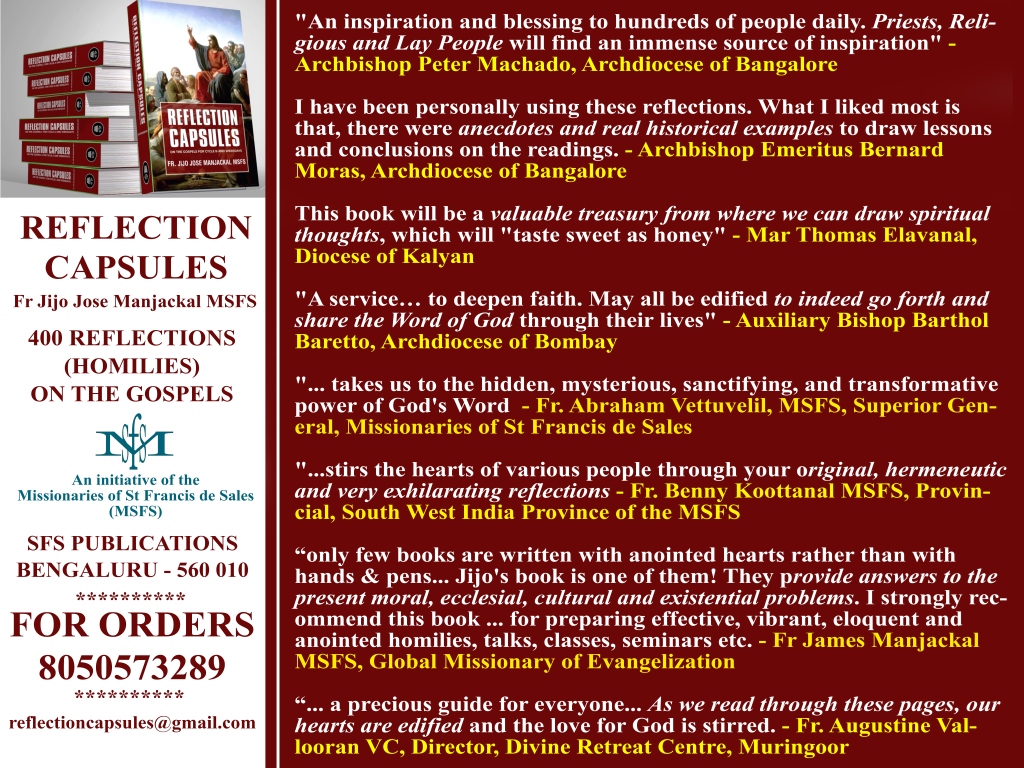

REFLECTION CAPSULES BOOK – Available also on Amazon India

💫 “REFLECTION CAPSULES” – Daily Reflections based on the Gospel is now available as a Book (paperback)
(Fr Jijo Jose Manjackal MSFS – 8050573289)

CLICK TO ORDER REFLECTION CAPSULES FOR PERSONAL/FAMILY/ COMMUNITY/CONGREGATION
https://forms.gle/nByuVrSphLmrSzZn6

• 840 pages with 400 Reflections/Homilies
• Over 225 Themes and nearly 500 anecdotes and stories
• Useful in studying the Gospels, in preparing homilies, recollections, talks, community and family prayers and for motivational sessions

🎁 GIFT THE REFLECTION CAPSULES BOOK AS A GOSPEL STUDY COMPANION!

It is also good for 💫GIFTING SOMEONE – for new priests or on jubilees, for religious at their first or final professions or during an assembly/chapter, for children for their birthdays/confirmation days, for couples at marriages etc.

As an Introductory Offer, REFLECTION CAPSULES is offered to you at a price of Rs 600/- (excluding postage) [$20 – for orders outside of India – excluding postage]

You may also let me know by sending a WhatsApp/Telegram/Signal Message – 8050573289

YouTube Promo Video: https://youtu.be/C0ol4NbIlfo?sub_confirmation=1

AMAZON INDIA ORDER LINK: https://www.amazon.in/REFLECTION-CAPSULES-Daily-Reflections-Gospels/dp/8185812705/ref=sr_1_1?dchild=1&keywords=reflection+capsules&qid=1613919727&sr=8-1

Online Payment can be done online through Bank Account Transfer

Thank you. God bless! Live Jesus!
Fr Jijo Jose Manjackal MSFS 😊😇😊

REFLECTION CAPSULE – Mar 05, 2021: Friday

“Doing away with any ’personal agenda or selfish motives’ and instead, making the Lord as the Centre of our Lives!”

(Based on Gen 37:3-4,12-13,17-28 and Mt 21:33-43, 45-46 – Friday of the 2nd Week in Lent)

An incident is said about a former American astronaut who took over as the President of a major airline.

He determined to make the airline’s service the best in the industry.
He sought ‘commitment to work’, by all the employees in all the departments.

One day, as the new president walked through a particular department, he saw an employee resting…
… with his feet on a desk, while the telephone on the desk rang continuously. .

“What are you doing? Aren’t you going to answer that phone?” the boss demanded.

“This isn’t my department, Am here, just to relax!” answered the employee, with a total indifference!
(He had not recognized his new boss, and so chose to answer with apathy!)
“I work in the maintenance department”, he went on to say.

“Not anymore!” snapped the president, “You no longer will work in my company!”

The President, with his liking for “committed work” and “achieving excellence”…
… made sure there was no room for “people with lack of commitment and zeal!”

As Christians, we are all co-workers of the Project Kingdom!

Do we work with commitment?
… or are we often found to be people of indifference, “lacking commitment and zeal?”

The Gospel of the Day is a strong message to examine one’s level of commitment to the Kingdom of God…
… exhorting to do away with any “personal agenda” or “selfish motives”

The Gospel presents to us the very volatile and conscience-wrenching parable of the Wicked Tenants.

The tenants were entrusted the vineyard by the Master…
… with much hope and expectation.

They were expected to provide the produce in the season.

However, the tenants quite miserably let down the hopes of the Master!

Filled with much pride and arrogance…
… they inflicted harm on all the servants who came on behalf of the Master

They even made an attack on the “own of the Master” – the Master’s Son!

A sense of total rigidity, pride and casualness caused these tenants to abhor the Master!

What about us?
How is our attitude to our Lord – the Master of our lives?

We may feel that we don’t abhor or despise the Will of the Lord in our life – to this extent, as these tenants.

But let us realise…

Every time, we reject the voice of the Lord, and seek to do as our wills lure us…
Every time, remain in stubbornness to pursue our wrong habits and evil tendencies…
Every time, we cause pain to the other by our words of rash judgement and condemnation…
… we are failing to obey the Master and denying His role as a Master in our life!

As Christians, we are indeed co-workers of the Project Kingdom!

The Master has entrusted the vineyard to us
… our homes, our places of work, our neighbourhood, our families and communities…
…. the people we meet daily, the problems we encounter constantly, the situations we are challenged with…

These are “our vineyard!”

Do we work with commitment?

Or are we often found to be people of indifference, “lacking commitment and zeal?”

Let us never have to hear from Our Master, “Not anymore! You no longer will work in my company!”
Instead…
… let us do away with any “personal agenda” or “selfish motives” as the workers of the Vineyard…
And seek to be impressed by the personality of Jesus…
… making Him the Centre of our Lives!

God Bless! Live Jesus!


Discovering the beauty of the Catholic Church through the Catechism:
FAITH IS CERTAIN, AND FAITH SEEKS UNDERSTANDING

Faith is more certain than all human knowledge, because it is founded on the very Word of God, Who cannot lie.
To be sure, revealed truths can seem obscure to human reason and experience…
… but “the certainty that the Divine Light gives, is greater than that which the light of natural reason gives.
It is intrinsic to faith that a believer desires to know better the One in whom he has put his faith, and to understand better what He has revealed.
A more penetrating knowledge will in turn call forth a greater faith, increasingly set afire by love. >> The grace of faith opens “the eyes of your hearts” to a lively understanding of the contents of Revelation…
… of the totality of God’s plan and the mysteries of faith, of their connection with each other and with Christ, the centre of the revealed mystery.
In the words of St. Augustine, “I believe, in order to understand; and I understand, the better to believe. (CCC # 156)


REFLECTION CAPSULE FOR THE DAY – Mar 04, 2021: Thursday

“Seeking to be more other-centred and heaven-oriented!”

(Based on Jer 17:5-10 and Lk 16:19-31 – Thursday of the 2nd Week in Lent)

Schindler’s List is a 1993 American epic historical period drama film, which received 7 Oscar awards.

This movie is based in the true story of a Catholic businessman, Oskar Schindler, who lived in Poland during the 2nd world war.

After a life of initial notoriety, in which he made a lot of money, by betraying his own people…
… Schindler, later realized the horrors of the Nazi rule.

He began to use his wealth and influence…
… in order to save his fellow Jews from the holocaust.

By the end of the war, he was reduced to having very little money

But in the process, had managed to save hundreds of Jews from being killed.

The last scene of the movie depicts, Schindler being thanked by the people whom he had saved.

But suddenly, Schindler began to weep!

Looking around at the people who were rescued, he exclaimed: “I could have done so much more!”

Holding up his gold watch, he moaned, “This could have bought someone’s freedom!”

He wished that he could have started sooner in helping people, so that many more could have been rescued!

His self-centredness had caused failure in saving many more people!

It was an agonizing experience of the negative effects of “indifference in life” and the “sin of omission!”

We need to examine our life and check:

Am I a person who misses out on doing the good we can?
Do I fail to reach out the needy, even though I am able?
Has self-centredness became a way of life for me?

The Gospel of the Day is a powerful message to look deeper into these aspects of our life…
… and seek to be more other-centred and heaven-oriented!

The parable of the rich man… “who was dressed in purple and fine linen and who feasted sumptuously every day”
… and of Lazarus, “a poor man, covered with sores, who longed to satisfy his hunger with what fell from the rich man’s table; even the dogs would come and lick his sores”
… is a remarkable story that challenges us to get out of our “zones of comfort and indifference!”

The ways of the world constantly allure us…
… to be “dressed in purple linen and fine clothes” (Lk 16:19) and to be self-centred: “Just go about with our business and don’t consider other’s needs”
… to be “dining sumptuously” (Lk 16:19) and to look to only one’s own comforts and needs: “Live and let live. I don’t need to care about others, when I have my own cares to be attended to!”

But the Christian way of life is a challenge to this “rich man’s style of living”

There can be no excuse given to us…
… if we miss out on doing the good we can!
… if we fail to reach out the needy, even though we are able!
… if self-centredness has become a way of life for us!

Time is short…
… and our life is limited!

Let us begin today, with no further delay…

To do the good we can…
… in the best way we can!
… to all the people we are able!
… in every situation that is possible!

Let our lives be totally offered to the Lord, Who alone is the source of every goodness and mercy.

In the words of Prophet Jeremiah:
“Blessed is the man who trusts in the LORD, whose trust is the LORD.

He is like a tree planted by water, that sends out its roots by the stream, and does not fear when heat comes, for its leaves remain green…
… and is not anxious in the year of drought, for it does not cease to bear fruit!” (Jer 17:7-8)

Let us seek to be more other-centred and heaven-oriented!

God Bless! Live Jesus!


Discovering the beauty of the Catholic Church through the Catechism:

What moves us to believe is not the fact that revealed truths appear as true and intelligible in the light of our natural reason
We believe “because of the authority of God himself who reveals them, who can neither deceive nor be deceived”.
So that the submission of our faith might nevertheless be in accordance with reason…
… God willed that external proofs of his Revelation should be joined to the internal helps of the Holy Spirit.
Thus the miracles of Christ and the saints, prophecies, the Church’s growth and holiness, and Her fruitfulness and stability “are the most certain signs of divine Revelation…
… adapted to the intelligence of all”; they are “motives of credibility” (motiva credibilitatis), which show that the assent of faith is “by no means a blind impulse of the mind!” (CCC # 156)


REFLECTION CAPSULE – Mar 03, 2021: Wednesday

“Daring to follow the path of humility and making a choice for the Cross!”

(Based on Jer 18:18-20 and Mt 20:17-28 – Wednesday of the 2nd Week in Lent)

A rich businessman had grown greatly in his endeavours.

He became greatly possessed with acquiring more wealth and seeking for greater power.

His sole intention in life was to find ways and means to gain more wealth (by hook or crook; by honest or corrupt ways!) and capture more positions of power.

Though a Christian…
… he cared hardly for his family
… he bothered least about his faith

One day, while sitting in his posh office, pondering on ways to augment his wealth and prestige in the society…
… his eyes went towards the Crucifix that was placed on his table.

Looking from the place where he was sitting, he could see…
… The Crucifix and a Chair that was placed opposite him.

And suddenly a thought came across his mind:
“What is more important for you in life?

Cross or Chair?”

This thought stuck him badly.

Being greatly disturbed… he sought to ward off that idea from his mind.

But it kept disturbing him…. “Cross or Chair… Cross or Chair!”

Well, it’s not known whether that incident changed his life.

But this question is placed before each of us:
“What is more important for you in life?

Cross or Chair?”

The Gospel of the Day is the incident of the mother of the sons of Zebedee aspiring to obtain a place of honour for her children..
… through which, Jesus poses this question of supreme importance to us as well:
“What is more important for you in life?

Cross or Chair?”

This incident is sandwiched between two important instructions by Jesus…

  1. His master plan of establishing the Kingdom: His Passion, Death and Resurrection
  2. His master technique to allow access to the Kingdom: The way of Humility
  3. His master plan of establishing the Kingdom: His Passion, Death and Resurrection
    Jesus predicts about His sufferings to His disciples (Mt 20: 17-19)

It was clearly His way of telling His chosen ones, that His Kingdom is not to be one that accords prime importance to power and position…
… instead it was about obedience and self-giving.

  1. His master technique to allow access to the Kingdom: The way of Humility
    Jesus further teaches His disciples that the key to enter the Kingdom is the way of humility (Mt 20: 26-28)

It was clearly a reminder as well as a warning, that His Kingdom is not reserved for the powerful or the mighty…
… instead it is to be given to those of meek heart and lowly self.

It’s in between these two powerful “Kingdom” teachings, that we have the incident of the mother of the sons of Zebedee seeking for a place of honour for her children (Mt 20: 20-24)

The incident showed that they had quite badly misunderstood Jesus…

They mistook His master plan of establishing the Kingdom as being “through force and power and might!”
They mistook His master technique to allow access to the Kingdom as being “the way of Supremacy!”

But Jesus shatters this misconception by posing a master question: “Can you drink the cup that I am going to drink?” (Mt 20: 22)

“Drinking the Cup” for Jesus meant the Master Plan of His Passion, Death and Resurrection
“Drinking the Cup” for Jesus meant the Master Technique of the way of Humility

This incident is a reminder and warning for each of us as well:

  1. Are we willing to be in accord with the Lord’s master plan of establishing the Kingdom: His Passion, Death and Resurrection?
  2. Are we ready to practise the Lord’s master technique to allow access to the Kingdom: The way of Humility?

Jesus clearly poses this question of supreme importance:
“What is more important for you in life?

Cross or Chair?”

Very often we settle down to sit on the “Chair”…
… the ‘chair’ of comfort and relaxation
… the ‘chair’ of lethargy and indifference
… the ‘chair’ of materialism and individualism

But the Lord challenges us to carry the “Cross”…
… the ‘Cross’ of responsibility and commitment
… the ‘Cross’ of witnessing to the Lord and trusting in Him
… the ‘Cross’ of serving the deprived and being sensitive to the need of the other

The way of the Christian is none but the Way of the Cross.

The path of the Christian can be none but the Path of Humility.

Let us give heed to the words of St Louise de Marillac (the patroness of the parentless and of social workers):
“If humility, simplicity and charity which produce support, are well established in you…
… your community will be made up of as many saints as there are persons!”

Yes, let us dare to follow the path of humility…
… and seek to positively answer to the question that Jesus poses to each of us:
“What is more important for you in life?

Cross or Chair?”

God Bless! Live Jesus!


Discovering the beauty of the Catholic Church through the Catechism:
FAITH IS A GRACE AND A HUMAN ACT
Faith is a gift of God, a supernatural virtue infused by Him.

Before this faith can be exercised, man must have the grace of God to move and assist him; he must have the interior helps of the Holy Spirit, who moves the heart and converts it to God, who opens the eyes of the mind and ‘makes it easy for all to accept and believe the truth.
Believing is possible only by grace and the interior helps of the Holy Spirit…
… but it is no less true that believing is an authentically human act.
Trusting in God and cleaving to the truths He has revealed, is contrary neither to human freedom nor to human reason.
Even in human relations it is not contrary to our dignity to believe what other persons tell us about themselves and their intentions, or to trust their promises (for example, when a man and a woman marry) to share a communion of life with one another. If this is so, still less is it contrary to our dignity to “yield by faith the full submission of… intellect and will to God who reveals”…
… and to share in an interior communion with Him
In faith, the human intellect and will co-operate with divine grace: “Believing is an act of the intellect assenting to the divine truth by command of the will moved by God through grace.” (CCC # 153-155)


REFLECTION CAPSULE – Mar 02, 2021: Tuesday

“Practising the virtue of humility and avoid falling into the dungeon of pride and conceit!”

(Based on Isa 1:10, 16-20 and Mt 23:1-12 – Tuesday of the 2nd Week in Lent)

There is an incident mentioned in the life of St Francis de Sales.

A short time before his death, St Francis was asked by a nun from the Visitation Convent, to mention what virtue he would specially wish the sisters to cultivate.

The saint, being unable to converse, owing to his extreme sickness, asked for a piece of paper to write.

On this piece of paper, the Gentleman Saint wrote one word: “Humility”!

This saint who lived this virtue, considered humility as the most essential virtue for a genuine Christian living.

The saint who preached and practised love, exhorted humility as the primary virtue for growth in holiness.

The one who lacks humility begins to proclaim one’s own glory and draw attention to oneself.

The Gospel of the Day presents Jesus highlighting this lack of humility among the religious leaders of His time…
… and putting forward a warning to be wary of the danger of falling into the dungeon of pride and conceit.

The Lord in all His teachings loves to get to the core of true human living and makes it a point to emphasize on all such inner values.

In the 23rd Chapter of St Matthew, Jesus makes a long condemnation of the “proud” actions and “conceited” devotions of the Pharisees and the Scribes.

Jesus says, “The scribes and the Pharisees have taken their seat on the chair of Moses. Therefore, do and observe all things whatsoever they tell you, but do not follow their example. For they preach, but do not practise” (Mt 23: 2-3)

Jesus lashes out strongly at the self-attention seeking attitude of these religious leaders.

They would tie heavy burdens on others… but would themselves not move a finger to move them
They would widen their phylacteries and even lengthen their tassels.
They would love to be seated on places of honour in the synagogues and banquets.
They would seek to be called with great salutations and titles in the public places.
They would perform many works before others… but all to be seen by other people.

What were Phylacteries?

Phylacteries were small cube-shaped “leather cases” that was worn on foreheads and arms. In these cases, were the Scripture verses (Ex 13: 1-10, 11-16 and Dt 6: 4-9; 11: 13-21)

The Exodus verses were about how God brought His people out of slavery in Egypt, and about the celebration of the Passover.

The Deuteronomy verses were about loving God wholly – with one’s heart, mind, and spirit.

The tassels (fringes) on the robes were to be a constant reminder of God’s commandments (Num 15: 38-41).

Each time the one who wore noticed the tassel, he was to ask himself if he were sincerely living God’s law in the world.

However, by making their phylacteries and tassels extra-long, the Pharisees and the Scribes were putting on a show of great religiosity, of being spiritually more superior than others.

The purpose of these external signs were to be great reminders of the wonders of God Yahweh and their own commitment to the Lord.

But this purpose was lost…
… and it was replaced with a self-show!

The one who lacks humility begins to proclaim one’s own glory and draw attention to oneself.

The Pharisees and Scribes were losing the virtue of humility…
… and instead were drowning in the murky waters of pride!

This danger can be reality for anyone of us too, in our lives…

And so the Lord cautions us…

Am I making my practise of Christianity as a mere tool for a higher social status and some cheap material benefits?

Am I losing out on cultivating true and honest devotion and instead settling for a “showy” and “external” facade of pious practices?

The Lord invites us to grow in the virtue of Humility.

Let the words of St Augustine be a challenge as well as a reminder for us:
“It was pride that changed angels into devils;
It is humility that makes men as angels.”

God Bless! Live Jesus!


Discovering the beauty of the Catholic Church through the Catechism:
FAITH- I KNOW WHOM I HAVE BELIEVED

Faith is first of all a personal adherence of man to God. At the same time, and inseparably, it is a free assent to the whole truth that God has revealed. As personal adherence to God and assent to His truth, Christian faith differs from our faith in any human person.
It is right and just to entrust oneself wholly to God and to believe absolutely what he says…
… it would be futile and false to place such faith in a creature.
For a Christian, believing in God cannot be separated from believing in the One he sent, His “Beloved Son”, in whom the Father is “well pleased”; God tells us to listen to him. The Lord himself said to his disciples: “Believe in God, believe also in me.”
We can believe in Jesus Christ because he is himself God, the Word made flesh.
One cannot believe in Jesus Christ without sharing in his Spirit. It is the Holy Spirit who reveals to men who Jesus is. For “no one can say “Jesus is Lord”, except by the Holy Spirit!”
We believe in the Holy Spirit because he is God.
The Church never ceases to proclaim her faith in one only God: Father, Son and Holy Spirit. (CCC # 150-152)


REFLECTION CAPSULE – Mar 01, 2021: Monday

“Giving ourselves entirely to the Lord, especially at Holy Mass, and through the Mass, at all times of the day, to all persons in our life.

(Based on Dan 9:4-10 and Lk 6:36-38 – Monday of the 2nd Week in Lent)

Barter is a system of exchange by which goods or services are directly exchanged for other goods or services without using a medium of exchange, such as money.

This type of exchange was relied upon by early civilizations.
Goods were exchanged for food, tea, weapons, and spices.

The barter system requires the giving of a good (product), to receive an equivalent good.
It is a system which involves the dimension of providing and obtaining, offering and receiving.

The Gospel of the Day calls for a similar barter system…on a Divine realm though…

Giving to God and obtaining His graces and favours.

The Lord, giving His teachings on a practical Christian life, exhorts,”…give and it will be given to you; good measure, pressed down, shaken together, running over, will be put into your lap. For the measure you give, is the measure you get back” (Lk 6:38)

Jesus brings a very concrete example from the market scene, to drive home his point of generously giving.

The context of Jesus is the market in Israel, the middle-east part of the world.

As in many places today, this area witnessed markets that had buyers and sellers engaged in bargaining and negotiating over prices, quality and the amount of things and goods.

When a price was finally set, the customer would offer his container—usually a large bowl or pot or an open vessel—and the seller would use a scoop (measuring spoon) to fill the container.

There would be some interesting steps in this process of measuring the grain for a customer and which Jesus quotes in His approach to giving:

  1. First, the seller would fill the container to the top.
  2. Secondly, he would press the grain down and fill some more.
  3. Thirdly, he would shake the container so the grain would settle and then fill in some more.
  4. Finally, he would fill the container until it overflowed!

The contents of this overflowing container would then be transferred to a pouch or a bag so that the buyer could bring home the contents from the market.

Well, this process could sound a bit strange and weird to us in the modern world.

We live in times, when contents are sold by the weight, and not the volume..
We live in times, when manipulations are done to give as less as possible…

But this is where, Jesus, bringing in the example of the market, invites generosity in giving…

Our giving ought to be measured not by weight, but by volume…and that refers to a far-greater amount of giving!
Our giving ought to, not be curtailed down by clever manipulations…rather is to be done very generously and lavishly!

St Paul in 2 Cor 9:6 would say, “Whoever sows sparingly, will also reap sparingly; whoever reaps bountifully will also reap bountifully”

Our giving ought not to be a calculated effort…rather should be a overflow from the heart!

When we engage is such a lavish and generous giving, God too will shower His abundance, in a similar and much better fashion!
“For the measure you give, will be the measure you get back” (Lk 6:38)

Of course, that is not to say that we are limiting God’s power of giving…

God’s surely showers His gifts lavishly!
God surely pours His blessings overwhelmingly!

But the Lord invites us to be involved in a Divine Barter System…

Give to God, who deserves all, so that we may be prepared to receive His blessings.
Give to God, who is worthy of all, so that we may be blessed to receive His graces.

In the Divine barter system, the advantage is that, we get much more than what we give… we obtain far greater than what we offer!

God’s giving is not to be seen just from material or physical aspects…

In fact, that would just be a very limited and low level of understanding.

God’s gifts are to be understood more from a spiritual perspective:
… Gift of His mercy to live a life in union with Him.
… Gift of His grace to be faithful and more committed.
… Gift of His love to be better human beings and be more charitable.
… Gift of His salvation to enjoy eternal bliss and happiness with Him .

All these gifts will be surely lavished and given… “good measure, pressed down, shaken together, running over, will be poured out into our laps!”

The greatest exchange…the Divine barter system.. is seen and experienced in the Holy Eucharist.. at every Holy Mass.

Let us give ourselves entirely to the Lord… especially at Holy Mass and through the Mass, at all times of the day… to all persons in our life…
… especially as we enter into a new month,

Then, in the words of Fulton Sheen, we will be graced to hear the words of the Divine Lord telling us…

You give me your humanity, and I will give you my Divinity!
You give me your time, and I will give you My eternity!
You give me your broken heart, and I will give you Love!
You give me your nothingness, and I will give you My all!

God bless! Live Jesus!


Discovering the beauty of the Catholic Church through the Catechism:
MARY – “BLESSED IS SHE WHO BELIEVED”
The Virgin Mary most perfectly embodies the obedience of faith.

By faith, Mary welcomes the tidings and promise brought by the angel Gabriel, believing that “with God nothing will be impossible” and so giving her assent: “Behold I am the handmaid of the Lord; let it be [done] to me according to your word.”
It is for this faith that all generations have called Mary blessed.
Throughout her life and until her last ordeal, when Jesus Her Son died on the Cross, Mary’s faith never wavered.
She never ceased to believe in the fulfilment of God’s Word…
… and so the Church venerates in Mary the purest realization of faith! (CCC # 148-149)


REFLECTION CAPSULE – Mar 01, 2021 – Monday

“Giving ourselves entirely to the Lord, especially at Holy Mass, and through the Mass, at all times of the day, to all persons in our life.

Barter is a system of exchange by which goods or services are directly exchanged for other goods or services without using a medium of exchange, such as money.

This type of exchange was relied upon by early civilizations.
Goods were exchanged for food, tea, weapons, and spices.

The barter system requires the giving of a good (product), to receive an equivalent good.
It is a system which involves the dimension of providing and obtaining, offering and receiving.

The Gospel of the Day calls for a similar barter system…on a Divine realm though…

Giving to God and obtaining His graces and favours.

The Lord, giving His teachings on a practical Christian life, exhorts,”…give and it will be given to you; good measure, pressed down, shaken together, running over, will be put into your lap. For the measure you give, is the measure you get back” (Lk 6:38)

Jesus brings a very concrete example from the market scene, to drive home his point of generously giving.

The context of Jesus is the market in Israel, the middle-east part of the world.

As in many places today, this area witnessed markets that had buyers and sellers engaged in bargaining and negotiating over prices, quality and the amount of things and goods.

When a price was finally set, the customer would offer his container—usually a large bowl or pot or an open vessel—and the seller would use a scoop (measuring spoon) to fill the container.

There would be some interesting steps in this process of measuring the grain for a customer and which Jesus quotes in His approach to giving:

  1. First, the seller would fill the container to the top.
  2. Secondly, he would press the grain down and fill some more.
  3. Thirdly, he would shake the container so the grain would settle and then fill in some more.
  4. Finally, he would fill the container until it overflowed!

The contents of this overflowing container would then be transferred to a pouch or a bag so that the buyer could bring home the contents from the market.

Well, this process could sound a bit strange and weird to us in the modern world.

We live in times, when contents are sold by the weight, and not the volume..
We live in times, when manipulations are done to give as less as possible…

But this is where, Jesus, bringing in the example of the market, invites generosity in giving…

Our giving ought to be measured not by weight, but by volume…and that refers to a far-greater amount of giving!
Our giving ought to, not be curtailed down by clever manipulations…rather is to be done very generously and lavishly!

St Paul in 2 Cor 9:6 would say, “Whoever sows sparingly, will also reap sparingly; whoever reaps bountifully will also reap bountifully”

Our giving ought not to be a calculated effort…rather should be a overflow from the heart!

When we engage is such a lavish and generous giving, God too will shower His abundance, in a similar and much better fashion!
“For the measure you give, will be the measure you get back” (Lk 6:38)

Of course, that is not to say that we are limiting God’s power of giving…

God’s surely showers His gifts lavishly!
God surely pours His blessings overwhelmingly!

But the Lord invites us to be involved in a Divine Barter System…

Give to God, who deserves all, so that we may be prepared to receive His blessings.
Give to God, who is worthy of all, so that we may be blessed to receive His graces.

In the Divine barter system, the advantage is that, we get much more than what we give… we obtain far greater than what we offer!

God’s giving is not to be seen just from material or physical aspects…

In fact, that would just be a very limited and low level of understanding.

God’s gifts are to be understood more from a spiritual perspective:
… Gift of His mercy to live a life in union with Him.
… Gift of His grace to be faithful and more committed.
… Gift of His love to be better human beings and be more charitable.
… Gift of His salvation to enjoy eternal bliss and happiness with Him .

All these gifts will be surely lavished and given… “good measure, pressed down, shaken together, running over, will be poured out into our laps!”

The greatest exchange…the Divine barter system.. is seen and experienced in the Holy Eucharist.. at every Holy Mass.

Let us give ourselves entirely to the Lord… especially at Holy Mass and through the Mass, at all times of the day… to all persons in our life…
… especially as we enter into a new month,

Then, in the words of Fulton Sheen, we will be graced to hear the words of the Divine Lord telling us…

You give me your humanity, and I will give you my Divinity!
You give me your time, and I will give you My eternity!
You give me your broken heart, and I will give you Love!
You give me your nothingness, and I will give you My all!

God bless! Live Jesus!


📖 Discovering the beauty of the Catholic Church through the Catechism:
MARY – “BLESSED IS SHE WHO BELIEVED”
The Virgin Mary most perfectly embodies the obedience of faith.

By faith, Mary welcomes the tidings and promise brought by the angel Gabriel, believing that “with God nothing will be impossible” and so giving her assent: “Behold I am the handmaid of the Lord; let it be [done] to me according to your word.”
It is for this faith that all generations have called Mary blessed.
Throughout her life and until her last ordeal, when Jesus Her Son died on the Cross, Mary’s faith never wavered.
She never ceased to believe in the fulfilment of God’s Word…
… and so the Church venerates in Mary the purest realization of faith! (CCC # 148-149)


REFLECTION CAPSULE – Feb 28, 2021: Sunday

“Experiencing ‘Transfiguration moments’ in order to take us through, strongly, in our moments of darkness!”

(Based on Gen 22:1-2, 9a, 10-13, Rom 8:31b-34 and Mk 9:2-10 – 2nd Sunday of Lent, Year B)

There is a little story told of a person who went abroad on a trip.

Wishing to buy his wife a gift, he purchased a phosphorescent, ‘mother-of-pearl’ match-box container.

(‘Mother-of-pearl’ is the common name for sparkling nacre, a blend of minerals that are secreted by oysters and deposited inside their shells, coating and protecting them from foreign objects; these eventually become pearls)

The beauty of this gift was that in the dark it was said to radiate a wonderful light.

The man packed it in his trunk, took it home and after the family-dinner, asked for the lights to be put out.

In the dark, he took the match-box container from his pocket to present it to his wife.

But, when he looked at it, it was as black as the darkness around.

Frustrated, he said, “That is just the way foreigners are often treated! I have been cheated!”

Next day, however, his wife, a bit curious, discovered on the box, a few words in French.

She took it down to some friends who had a French maid and had it translated.

That night, in the darkness, that box was all aglow, for she had followed the instructions written on the box, which said:
‘If you keep me all day long in the sunlight,
I will shine for you all night long, in the darkness’

Yes…

The greater one is in the light, the greater would be one’s glow in the dark!
… because a glow in the dark is assured for that which has the capacity to infuse light within itself!

Light emerges from the depths of holiness… to shine clearly even in the dark…

This is Transfiguration!

As followers of Jesus Christ, we are invited to have this Transfiguration Experience, in imitation of our Blessed Lord.

On this Second Sunday of Lent, we are presented with the event of the Transfiguration of our Lord, as recounted by St Mark.

The scene of the Transfiguration is a visually powerful and an authoritatively impactful incident.

Jesus takes three disciples – the core team among the Twelve – Peter, James and John – and led them up a high mountain. (Mk 9: 2)
There He was – His appearance changing and seen to be with Great Glory!

One of the easy tendencies in life is to “get used to”…

Get used to doing the same works and dealing with the same people.

A tendency of “monotony” creeps in

A feeling of “boredom” crawls in!

The danger with “monotony” is that…
… it can drain away enthusiasm from the works one does

This danger of “monotony” is a strong possibility even in our spiritual life.

We begin to take our faith for granted
We tend to view our devotions with casualness.

Prayers get boring.

The Holy Eucharist seems meaningless
Pious practices fails to generate any passion

The same danger was true even in the case of the Disciples.

The disciples had been with Jesus for a while now…

They had seen Him…
… performing many wonders
… teaching and addressing the crowds
… being the subject of many oppositions too

But slowly, as human tendency is – a feel of monotony would have begun to creep into their lives.

It is at this stage, that our Blessed Lord chooses three of His “core” disciples – Peter, James and John, and in their presence gets Transfigured! (Mk 9: 2-10)

The Transfiguration experience was something very special and unique for these disciples…

They saw our Blessed Lord glisteningly shining – His clothes being whiter “as no fuller on earth could bleach” (Mk 9:3)
They witnessed Moses and Elijah (Mk 9:4) – the great Lawgiver and the mighty Prophet – along with Jesus, Who was the fulfilment of the Law and the Prophet!
They heard the Divine Voice – “This is My Beloved Son; listen to Him” (Mk 9: 7b) – from the cloud; reminiscent of God Yahweh who would speak to His people of old, from the clouds

The three disciples were being introduced to a new perspective of their Master.

They saw Jesus – not in the usual way – but arrayed in His Divine Glory and Honour!

Jesus had not become something that He was not…

He was always God and was always the Second Person of the Divine Trinity.
All this while, the eyes of the disciples were kept away from seeing the fullness of glory – only sparks of Divinity was revealed to them

But now, here was a moment, though short – the Transfiguration – when the chosen disciples could come face-to-face with Divine Glory!

The moment of Transfiguration had made them see things in a new light…

Jesus was still the same – but they now saw Him, for a short moment, with a Glorious Glow

That is the splendour and glory of the moment of Transfiguration…
… when wounds are refined into beauty
… when sufferings are graced into meaningfulness

Have we had this Transfiguration Experience?

Surely, we have had…

But perhaps, many of us fail to recognise it… or acknowledge it

A moment…
… when our words have touched and sparkled a sad soul
… when we ourselves have been healed in our brokenness by some Divine intervention
… when we experienced the light of God’s healing, restoration, forgiveness etc through the Sacraments of the Church
… when a pulse of joy and satisfaction raced through our veins in having rendered, perhaps, a tiny but significant act of service and care to a needy person
… when, in our brokenness or deep pain or lethargy, an encouraging word revived our bent spirits

Many are such moments of Transfiguration in our life…

But the more we look deeper, the more we find, that God has blessed us immensely with such “Transfiguration” experiences.
And He wishes that through Prayer, we grow in Him to have deeper “Transfiguration Experiences!”

It is these “Transfiguration” moments that will take us through, strongly, in our moments of darkness.

The light of Transfiguration on Mount Tabor helped to shine through during the darkness of Crucifixion on Mount Calvary for Jesus!

The greater one is in the light of the Transfiguration, the greater would be one’s glow in the dark phases of life!

May this Gospel of the Transfiguration help us to be reminded of the promise of the Lord that:
“If you keep yourself, all day long in the sunlight of My Love,
I will shine for you all night long, in the darkness of your life”

God Bless! Live Jesus!


Discovering the beauty of the Catholic Church through the Catechism:
THE OBEDIENCE OF FAITH
To obey (from the Latin ob-audire, to “hear or listen to”) in faith is to submit freely to the word that has been heard, because its truth is guaranteed by God, who is Truth itself.

Abraham is the model of such obedience offered us by Sacred Scripture.
The Virgin Mary is its most perfect embodiment.
Abraham fulfils the definition of faith in Hebrews 11:1: “Faith is the assurance of things hoped for, the conviction of things not seen”
Abraham believed God, and it was reckoned to him as righteousness. Because he was “strong in his faith”, Abraham became the “father of all who believe” (CCC # 144-146)


REFLECTION CAPSULE– Feb 27, 2021: Saturday

“Making a journey of considering people not as a “burden” but as a brother, not as a “stress” but as a sister!”

(Based on Deut 26:16-19 and Mt 5:43-48 – Saturday of the 1st Week in Lent)

The following story is known to us, perhaps in different forms…

A gentleman who was walking down the streets of a city was greatly interested to look at the street children – many of whom were carrying smaller children upon their backs – and managing at the same time to play their games.

“It is too bad,” said the gentleman to one little fellow, “that you have to carry such heavy burdens!”

“He’s no burden, Sir!” came a quick reply; “he’s my brother.”

The child who was carrying his younger sibling, did not count the pain or the difficulty in carrying; instead embraced the situation joyfully.

“He’s no burden, Sir… he’s my brother” – is a phrase that ought to strike a chord in our hearts.

As Christians, we need to make this journey…
… of considering people not as a “burden” but as a brother!
… of considering people not as a “stress” but as a sister!

The Gospel of the Day is a powerful exhortation by Jesus to make this transition from considering people as a “burden” and “stress”…
… and instead look at them as “brothers and sisters”, extending the Christian virtue of unconditional love to all.

Jesus, in the Sermon on the Mount, continues to pull down barriers of “comfort and coziness” by challenging His disciples to rise above the normal standards of the world.

Today He speaks on the aspect of “Love”.

Love is the fundamental and innate vocation of every human person.

The dictionaries define love as being ‘a profoundly tender, passionate affection for another person’ or a ‘feeling of warm personal attachment or deep affection’.

Generally speaking, love is considered only to be a human ’emotion or feeling’.

It is something that is usually understood as being “felt” or “sensed” or “experienced”.

Jesus surely did consider “love” as an emotion and a feeling.

Therefore…

He loved the company of people….
He cherished affection of those who followed Him…
He treasured relationships and fostered friendships with all…

But beyond these “external” dimensions of Love…
… Our Blessed Lord taught and showed a higher aspect of love.

Love, not just being a “feeling” but “love as a “decision”.

Love, not just being a “sensation” but love as a “commitment”

Therefore Jesus would say, “For if you love only those who love you, what recompense will you have?” (Mt 5: 46)

Love, when understood only as a “feeling” or an “emotion” can get reduced to being just an “object” or a “thing”

Just as one exchanges goods with each other… love is also exchanged with one another.
Just as one shares one’s belongings and possessions with one another… love is also shared with one another
Just as one gives and takes things from each other… love is also given and taken from each other

But the Lord presents a higher understanding of love and demands a much supreme expression of love from His followers: “Be perfect as your heavenly Father is perfect” (Mt 5: 48)

Love to be a “virtue” has to surpass the ordinary realms of being “an emotion” and “feeling” and transcend to being a “radical decision” and a “faithful commitment”.

When someone hurts us, we don’t “feel” like loving…

But Jesus says, “Love that person”, because love is a “daring decision”

When someone continues to be lukewarm, we don’t have any “emotions” of love…

But Jesus says, “Love that person”, because love is an “absolute allegiance”

When someone continues to cause pain, we don’t “experience” any love…

But Jesus says, “Love that person” because love is a “challenging commitment”

Now this teaching certainly irks our “normal” understanding.

How can I possibly love someone who has hurt and killed me, mentally?
How can I be expected to show love to someone who still hurts me, even intentionally?
How can I be told to love people who have no regard for me at all and treat me as an object?

It seems to be an impossibility.

It seems to be absurd.

But let us look to the Crucified Lord…
… and we have the perfect example of this Love being lived in actuality!

Jesus on the Cross shows that love is to be a “daring decision”, an “absolute allegiance” and a “challenging commitment”!

Love to be a “virtue” has to surpass the ordinary realms of being “an emotion” and “feeling”…
… and transcend to being a “radical decision” and a “faithful commitment”.

One may not be able to “show” love…
… but can we still, at least pray and wish for the good of the person?

One may not be able to “talk” freely to the one who has hurt…
… but can we still, at least refrain from wanting bad to happen to that person?

One may not be able to “resist” from having bad feelings when encountering one’s enemy…
… but can we still, at least offer the person to the Mercy of God?

This teaching certainly seems to be a big “burden” and a significant “stress”

But this is where, we need to make a journey…
… of considering people not as a “burden” but as a brother!
… of considering people not as a “stress” but as a sister!

The Lord has walked through this journey.

He is still with us, to accompany us.

This journey may be hard
This journey may be hurting
This journey may be painful

But the Lord says, “My grace is sufficient for you!” (2 Cor 12: 9)

Let us trust Him!

Let us be courageous in Him!

God Bless! Live Jesus!


Discovering the beauty of the Catholic Church through the Catechism:

By his Revelation, “the invisible God, from the fullness of His Love, addresses men as His friends…
… and moves among them, in order to invite and receive them into His own company.”
The adequate response to this invitation is faith.
By faith, man completely submits his intellect and his will to God.
With his whole being, man gives his assent to God the revealer. Sacred Scripture calls this human response to God, the author of revelation, “the obedience of faith” (CCC # 142-143)