May 11 (Jn 6:60-69)

“Tom Brown’s School Days” is an 1857 novel by Thomas Hughes.

The story is set in the 1830s at Rugby School, a public school for boys.

>> Much of the novel is based on the author’s experiences in the school.

There is a fine passage in Tom Brown’s School Days which tells of a boy who had the courage to stand up against ridicule.

A new boy – a Christian – had come to the school.

>> On his first night, in a room where there were twelve beds and boys, he knelt down to say his prayers.

But the boy became the object of ridicule and fun…

…others began to make poking comments

…some others began to laugh and giggle, humiliating him and his faith.

Tom Brown had been observing all the while.

>> It was at that time, that Tom also saw a heavy slipper flying through the air toward the head of the kneeling boy.

But the boy remained unperturbed and finished his prayers.

When the lights went out a little later, Tom Brown thought of his own mother, and the prayers that she had taught him to say, but which he had never said since he came to Rugby.

>> Then and there he made a decision that the next time he went to bed, he, too, would say his prayers.

When that next night came, the other boys in the room, ready to laugh and scoff at this newcomer who said his prayers, were amazed to see…

…Tom Brown, whom they all respected and feared, kneel down at the side of his bed and pray.

The courageous prayer of the boy, in spite of the ridicule, won the respect of all his companions!

Yes, Christianity demands…

>> And only the ones who are willing to respond to these demands are worthy of being the Followers of the Lord.

It pays to be a Christian!

>>> It costs much to be a Follower of Christ!

In the Gospel of the Day, the Lord is pretty straight-forward and candid in His challenging requirements and would even ask us, as He asks His disciples, “Do you also wish to go away?” (Jn 6: 67)

We are at the concluding portion of the 6th Chapter of the Gospel of St John – known as the chapter on the Discourse of the Bread of Life.

The hearers of Jesus, from the beginning of this Chapter have been taken through a very intriguing path…

>>> It began with the fragrance of compassion and mercy being radiated by the Lord in the multiplication of the loaves (Jn 6: 1-15)

>>> This fragrance developed into an aura of authority and power that was displayed in the incident of the walking on the water (Jn 6: 16-21)

>>> This aura began to radiate more gloriously through His teachings on He being the Bread of Life (Jn 6: 22-59)

>>> This glorious splendour was further revealed and explained when He declared Himself as the Son of Man who would ascend to where He was (Jn 6: 61-62)

The Chapter, as it’s nears the conclusion, finds many of the hearers abandoning Christ.

Therefore we read, “As a result of this, many of His disciples returned to their former way of life and no longer accompanied Him” (Jn 6:66)

It seemed nice and wonderful to be the followers of Christ, when He provided food to their satisfaction

… But when there was a demand made by Christ, the “goody-goody” feelings disappeared and they began to reject Him!

Is this not the attitude that is prevalent among many of the Christians… including we, perhaps?!

As long as the ground of our lives, receives the continual showers of favours being granted and prayers being instantly heard, we feel nice with the Lord.

… But in the times when the ground has to experience the drought of delays in prayers and absence of the rains of consolation, we feel to do away with the ways of the Lord!

As long as the garden of my life, is blessed with the flowers of prosperity, security and comforts, we remain happy to be with the Lord

… But in the circumstances when the garden goes dry and the weeds of misery begin to crop up, we feel to abandon the presence of the Lord and tread our own wills!

And therefore the Lord asks us, “Do you also wish to go away?” (Jn 6: 67)

Faith in the Lord is no cheap thing!

>> It indeed costs to be faithful!

The History of the Bible is replete with examples for this fact…

>> It cost Abraham in giving up Isaac, his beloved, in order to prove his faith in the Lord

>> It cost Moses to let go off his weaknesses and frailties, in order to become the leader of a vast multitude

>> It cost Daniel to be cast into the den of lions in being a faithful warrior of the Lord

>> It cost Shadrach, Meshach and Abednego to pass through the ordeals of the fiery furnace in proving to be loyal to the Lord

>> It cost Stephen a painful death by being stoned in order to witness his daring courage in the Lord

>> It cost Peter to be nailed upside down to stand firm as the rock of faithfulness and commitment

Yes, Christianity demands…

>> And only the ones who are willing to respond to these demands are worthy of being the Followers of the Lord.

What is it costing us to be faithful to our Lord and King?

Often times, our practice of Christian faith enters, tiptoed and slyly, into the halls of comfort and coziness…

> A Baptism received long ago…

>> Some Sacraments obtained now and then…

>>> A few Church obligations completed once in a way…

>>>> Some occasionally unavoidable practise of piety and devotion…

This is all that sometimes it “costs” us in being a Christian!

But the Lord today powerfully seeks to shake off the dusts of lethargy and casualness and confronts us, “Do you also wish to go away?”

Our remaining with the Lord, ought not to be in mere words, but also in deeds and actions

Being with the Lord demands…

… that we grow in our zeal and love for the Lord

… that we become an extension of Christ to the needy

… that we strive to be passionate proponents of His love and mercy

Yes, let us be fervent in the stipulations of being a Christian…

… and be willing to respond to those demands that make us worthy of being the Followers of the Lord.

May our Christian lives be encompassed by a deep love for the Lord and may we rise up to the challenge to remain loyal and faithful to the demands placed on us by Christ, our Powerful and Mighty King!

God Bless! Live Jesus!

——————————–

Quotable-quote-a-day-with-St Francis de Sales (SFS) – The fire of Holy Love that Moses saw on the mountain flamed up…

… amid thorns.

>> So does the practise of Sacred Love maintain itself more happily…

… amid tribulations!

——————————–
May 10 (Jn 6:52-59)

In the early 1970s, during the Vietnam War, Francis Xavier Nguyen Van Thuan was the Archbishop of Saigon.

The Communists saw him as a threat.

>> On the Feast of the Assumption – 1975 – he was arrested and shipped off to a prison in North Vietnam.

He stayed there for thirteen years, nine of them in solitary confinement.

>> During his imprisonment, he was not allowed celebrate Mass or receive the Eucharist.

However, the Archbishop was allowed one luxury: to write letters to friends outside prison.

When he did, he often asked them to send him what he called “his medicine.”

>> They knew what he meant.

They sent him cough medicine bottles…

… filled with wine and small bits of bread.

>> Sympathetic guards smuggled him some wood and wire, and from that he made a small cross, which he hid in a bar of soap.

He kept all this in a cardboard box.

>> That box became his own private altar.

Every day, at 3:00 p.m. – the Hour of Christ’s death – he would place drops of wine in the palm of his hand, mingled with water, to celebrate Mass.

The greatest ongoing miracle in history was able to take place.

>> That cramped prison cell became as beautiful and as blessed as any cathedral…

… a sanctuary for the glory of God.

He did this for thirteen years…

… till he was finally freed in 1988.

This is a man who understood – with every fiber of his being – how precious Holy Communion is.

What about us?

>> How deep is my understanding, faith and love for the Most Holy Eucharist?

The Holy Eucharist – the Body and Blood of Jesus – is the greatest treasure that the Church offers to Her children…

>> Yet, the Holy Eucharist sometimes, also becomes the great barrier for people to misunderstand and misinterpret the Church.

The same was true even in the time of Jesus.

>> The mention of His Body and Blood caused great division, misunderstanding and led to the misinterpretation of Jesus.

The Gospel of the Day is an account of the Lord declaring the necessity of being partakers of His Body and Blood to be having a share in eternal life.

Jesus continues His discourse on He being the “Bread of Life”.

The Lord surprises His hearers by saying that He is “the bread that came down from heaven” (Jn 6:51a)

He shocks them even further by saying that “the bread that I give is my flesh for the world” (Jn 6:51b)

This caused a dispute among the people, “How can this man give us His flesh to eat?” (Jn 6:52)

The bold declaration of the Lord that He would give His Flesh and His Blood as food and drink, caused a huge scandal among His listeners and it cause deep divisions and disputes.

The same is so much true in our own world, when the Church declares the Holy Eucharist to be the True and Real Body and Blood of the Lord, there is so much dispute and division caused.

>> Not many are able to accept this understanding

>> Not many are convinced of this teaching

>> Not many even believe this to be true

>> Not many are passionate either

The Catechism of the Church declares that “the mode of Christ’s presence under the Eucharistic species is unique”

“In the Most Blessed Sacrament of the Eucharist ‘the body and blood, together with the soul and divinity, of our Lord Jesus Christ and, therefore, the whole Christ is truly, really, and substantially contained.”

The questions now arise before us…

1. How is my belief and understanding of this most Precious and Treasured Gift of the Holy Eucharist – “the source and summit of Christian Life”?

… Do I believe with conviction that Jesus is truly present in the Blessed Eucharist?

… Do I celebrate and participate in the Holy Mass with this Divine Fervour?

2. What is the effect that this Sacrament of Total Self-giving on me?

… Does the reception of Jesus, the Love Incarnate, make me in turn to be more loving towards others and do I make deliberate choices to extend love to all?

… Does the sacrifice of the Holy Eucharist impel me also to make sacrifices – even tiny, insignificant, unnoticed – for the cause and good of others?

3. How is my contribution to spread the Good News of the Holy Eucharist to others?

… Am I being a person who radiates the love of the Eucharist to others, by my conscious efforts to be respectful, reverent and devoted in the Chapel or Church and also become aware of the Lord’s Presence, when passing by Churches or handling Sacred objects?

… Do I tell to other people about this exciting, real presence of God in the Holy Eucharist, to other people, especially the sick, the suffering and those in distress, that they may experience the Real and True healing presence of the Lord?

May we understand that in the Most Holy Eucharist – the greatest ongoing miracle in history – takes place.

>> It is this miracle that can turn even a cramped prison cell to become as beautiful and as blessed as any cathedral…

… a sanctuary for the glory of God.

Let us grow in the Love for the Holy Eucharist and deepen our faith and conviction in Him.

May Jesus in the Most Holy Sacrament of the Holy Eucharist always be praised…

… and may our Blessed Mother Mary, the Mother of the Eucharist, intercede for us!

God Bless! Live Jesus!

——————————–

Quotable-quote-a-day-with-St Francis de Sales (SFS) – “The Holy Eucharist is the ‘the Sun of all spiritual exercises…

… the centre of the Christian religion

… the heart of devotion

… and the soul of piety

>> It is the Ineffable Mystery that comprises within itself the deepest depths of Divine Charity, the Mystery…

… in which God really gives Himself and gloriously communicates His graces and favours to us.”

——————————–

May 9 (Jn 6:44-51)

Saint Mother Teresa was known for her immense devotion to the Blessed Sacrament of the Eucharist.

>> She found her strength for her services of mercy, by being united and spending time with the Eucharistic Lord…

… everyday!

She has spoken very beautifully about the Holy Eucharist:

She says:

“When Jesus came into the world, he loved it so much that he gave His Life for it.

He wanted to satisfy our hunger for God.

And what did He do?

>> He made himself the ‘Bread of Life.’

He became small, fragile and defenseless for us.

>> Bits of bread can be so small that…

… even a small child can chew it!

… even a dying person can eat it!”

Have we discovered our Love for this “Precious Bread of Life”?

The Sixth Chapter of the Gospel of St John can be called as “the great discourse on the Bread of Life”

>> Jesus declares Himself as the “Bread of Life” (Jn 6:35), Who came down from heaven.

On hearing this statement of the Lord, the Jews “murmured” about Him (Jn 6:41)

>> They knew that Jesus was only the son of Joseph.

>> They knew the father and mother of Jesus.

>> They were very familiar with His human origins

Therefore, the statement of Jesus that “He was the bread, Who came down from heaven” caused a great deal of “murmur”.

The Greek word that is used here for murmur is a word, “gogguzo”…

This “gogguzo” means…

… any low, continuous sound as of a brook, the wind, trees etc or low indistinct voices

… a mumbled or private expression of discontent

… to show “smouldering discontent”, droning on in a low, constant murmur

This similar “gogguzo” was also expressed by the Israelites, in their long journey in the desert.

When Moses led the large multitude of the Israelites through the desert, the impatient crowd, raised their voices in complaint against Moses and Aaron, “Would that we had died at the Lord’s hand in the land of Egypt, as we sat by our fleshpots and ate our fill of bread” (Ex 16:3)

The Israelites also “murmured”!

In response to this “murmuring” of the people, God Yahweh provides them with the “flesh of the quail” and the “bread of the Manna” (Ex 16: 4-15)

>> In the Gospel, when the Jews “murmured”, Jesus provides them with a reply of the “flesh of His body” and the “bread of His Life”

Jesus told them, “Stop murmuring among yourselves… I am the Living Bread that came down from heaven… the bread that I give is my flesh for the world ” (Jn 6: 43, 51)

The Israelites were given perishable flesh of the quails and they who ate the Manna, died.

>> But Jesus, now gives His imperishable flesh of His Own Body and offers the Eternal Manna as the Bread of our life!

It is in the Holy Eucharist, that the Lord offers this imperishable food and salvation to each of us.

What is our perception and passion towards this True Life that Jesus offers in the Holy Eucharist?

The Israelites in the Old Testament as well as the Jews in Jesus’ time, “murmured”…

>> Do I also “murmur” and remain indifferent to believing in the Real Presence of Jesus in the Holy Eucharist?

>> Do I also “murmur” and fail to prepare myself well to receive Jesus, in the Holy Sacrifice of the Mass?

>> Do I also “murmur” and become unmindful or even disrespectful to the Presence of the Lord in the Blessed Sacrament, in the Chapels and in the Churches?

May this lengthened meditation on John 6 – the “the great discourse on the Bread of Life” – help us to deepen our faith and zeal for Jesus, in the Most Holy Eucharist.

It is this devotion and union with the Lord, alone, that can make us also, in turn, a Eucharistic people – breaking and giving ourselves – for the welfare and salvation of the world!

Let us seek to satisfy our hunger for God…

… by growing in our love for Jesus in the Most Holy Eucharist – the Bread of Life!”

God Bless! Live Jesus!

——————————–

Quotable-quote-a-day-with-St Francis de Sales (SFS) –”When the bee has gathered the dew of heaven and the earth’s sweetest nectar from the flowers, it turns it into honey, then hastens to its hive.

>> In the same way, the priest, having taken from the Altar, the Son of God (who is as the dew from heaven, and true son of Mary, flower of our humanity)…

… gives him to you as Delicious Food!”

——————————–

May 7 (Jn 6:30-35)

Our generation is a much trendier and health-conscious one….

Right?

People, especially, in the urban areas, do spend a great deal of time and energy in seeking to be more fashionable, better-looking and being healthier.

As part of this inclination, the modern trend is being highly conscious of the “diet” that one takes…

· One is keen to know which food will help one’s body to remain fit and healthy

· One is conscious to supplement foods that will keep one stronger and also appeal to the taste buds, at the same time.

· One is also eager to plan out one’s meals and food-eating habits that suits one’s lifestyle, in order to promote good health, shape and wellbeing.

But it would be nice and good to also check what is the condition and state of our “spiritual diet”.

We do tend to give a lot of importance to our “physical diet” in terms of the food to be eaten and that which are to be avoided.

>> But what is the importance that we accord to our “spiritual diet”?

· Is my “spiritual diet” nourishing – my soul, my spiritual wellbeing?

· Is my “spiritual diet” leading me to good health – of holy thoughts and purity of heart?

The Gospel of the Day presents Jesus, the Spiritual Dietician, exhorting the most important element that is to be part of the “spiritual diet” of everyone who follows Him – the Holy Eucharist – through the “Bread of Life” discourses.

After the feeding of the large multitude of people by the multiplication of the loaves, the people sought Jesus.

· Jesus, knew their hearts longed not for Him, but for the bread-giver!

· Jesus knew they were following not Him, but the food-provider!

So Jesus sought to put the matters in the right perspective and teaches them about the real food that they should be longing.

It is in this context that Jesus declares, “I am the bread of life; He who comes to me shall not hunger and He who believes in me, shall never thirst” (Jn 6: 35)

Jesus declares Himself as the Bread of Life.

>> The Greek word that is used here for “bread” is “artos”.

This “artos”….

… refers to food composed of flour mixed with water, and baked.

… also refers to food of any kind or food in general.

As “bread” or “food” is essential for the physical life

… Jesus as “the bread of life” is required for the spiritual life!

Without bread, physical life would perish….

… Without Jesus, the bread, spiritual life would perish!

In the Holy Eucharist, Jesus offers this “Bread of Life” for us…

… to be our nourishment and strength

… to be our sustenance and energy

… to be our life and forte

What is our disposition and attitude towards Jesus, the “Bread of Life” in the Holy Eucharist?

History is a witness, that through centuries, there have been many saints, both men and women, who have lived for major chunks of their lives, just on the Holy Eucharist.

>> They would take no food or drink, but ONLY received the Holy Communion, everyday.

A few notable among these saints are…

…. St Catherine of Siena (in the 1350’s….. prior to her death, for seven years, she took no food into her body, except the Holy Eucharist)

… St Nicholas of Flue (lived in Switzerland as a hermit, in the 1400’s… for nearly 19 years, lived without any food, except the Holy Eucharist)

… Blessed Alexandrina da Costa of Portugal (of the 20th century… for the last thirteen years of her life, lived on the Holy Eucharist alone)

Our Lord himself explained to Blessed Alexandrina why He gives this grace to his some of His saints:

“You are to live by the Eucharist alone,” Jesus told her, “because I want to prove to the world the power of the Eucharist and the power of my life in souls.”

This greatest Treasure of Lives – the Holy Eucharist – the Bread of Life…

… eagerly longs for our reception

… keenly awaits for our adoration

As Pope Benedict XVI says,

“In the Sacrament of the Altar, the Lord meets us, men and women created in God’s image and likeness, and becomes our companion along the way.

>> In this Sacrament, the Lord truly becomes food for us, to satisfy our hunger for truth and freedom.

Since only the truth can make us free, Christ becomes for us the food of truth.”

Shall we not renew our love and commitment to receiving the “Bread of Life” more frequently, more devoutly, more passionately and with greater preparedness?

>> Shall we not revive our affection and dedication to spend more time with the “Bread of Life” in the Blessed Sacrament, to gain strength, to atone for sins and to offer the world for its sanctification and healing?

Let the Holy Eucharist – the Bread of life – become the essential, the integral and the most fundamental constituent of our “Spiritual Diet”

God Bless! Live Jesus!

——————————–

Quotable-quote-a-day-with-St Francis de Sales (SFS) – “I often speak with my Teacher – Jesus in the Blessed Sacrament – because I can learn from Him.

>> Jesus is the Teacher of the Science of Holiness.

I go to Him because I would like to learn from Him, how to become a saint!”

——————————–

May 6 (Jn 6:22-29)

There is an old legend of a swan and a crane.

A beautiful swan alighted by the banks of the water, in which a crane was wading about, seeking snails.

For a few moments the crane viewed the swan in incredulous wonder and then inquired: “Where do you come from?”

“I come from heaven!” replied the swan.

“And where is heaven?” asked the curious crane.

“Heaven!” said the swan, “Heaven! Have you never heard of heaven?”

And the beautiful bird went on to describe the grandeur of the Eternal City…

She told of streets of gold, and the gates and walls made of precious stones; of the river of life, pure as crystal, upon whose banks is the tree whose leaves shall be for the healing of the nations.

With eloquence, the swan described the beauty of the other world…

… but none of it, strangely, seemed to arouse the slightest interest of the crane.

Finally the crane asked: “Are there any snails there?”

“Snails??” repeated the swan; “No! Of course there are not!”

“Then,” said the crane, as it continued its search along the slimy banks of the pool, “you can have your heaven. I only want snails!”

The crane was satisfied with the lowly earthly “snails” and failed to have any interest for the divine “heavens”

How often we are also like this crane….

… interested only in earthly affairs, and least attracted to the heavenly realms

… busy only with gathering earthly pleasures but rejecting offers for heavenly happiness

The Gospel of the Day presents Jesus chiding the people for following Him, just for the sake of earthly desires, and instead, invites and exhorts them to seek for higher and heavenly longings in life…

“Do not work for food that perishes but for the food that endures for eternal life, which the Son of Man will give you” (Jn 6: 27)

The people had witnessed Jesus’ great miracle of the multiplication of loaves.

· Their hunger had been satisfied.

· Their appetites had been gratified.

· In Jesus, they found a person who was able to answer the bodily needs.

· In Jesus, they found a person who was able to satisfy their material desires.

The people desired to crown Him as their King!

Is this not a trend in our society as well?

How often are the bread-givers and money-makers held in high esteem, even in our days…

… at the expense of people who are unable contribute much or do much work.

Think of the aged, the sick, the invalids in our own houses, communities and societies, who are unable to work or contribute anything materially…

· How often do we neglect them!

· How often do we put them down!

· How often do we call them as useless!

We sometimes glorify people based only their work, their position and their activities…

· The “being” of a person is often neglected… only the “doing” of a person is exalted!

· The “essence” of a person is often not given value… only the “work” of a person is given credit!

But Jesus refrains from being a victim to this mentality of the society.

· He refuses to be their “Bread-Boss”!

· He rejects to being their “Materialistic-Messiah”!

And so when people, come to Him, Jesus recognizes their motive in seeking Him…

… and He chides them saying:

“Amen, Amen, I say to you, you are looking for me, not because you saw signs but you ate the loaves and were filled.

>> Do not work for food that perishes but for the food that endures for eternal life, which the Son of Man will give you” (Jn 6: 26-27)

The Lord seeks to lead the people to desire and long for the higher realities of life.

And this is the wish of the Lord for each one of us too, that we…

… be interested not only in worldly affairs; rather, we be more attracted to the heavenly realms

… be busy not only with gathering earthly satisfactions; but, we accept and embrace more of heavenly happiness

· It is true that “to the hungry one, food and other material wants demand higher urgency”

· It is not denied that “to the one whose basic needs are not met, material satisfaction is important”

But having said this… one must also be willing to accept, that beyond these material aspects, the human person has greater needs – on a spiritual sense, that of the soul, towards the transcendental realities!

What is needed therefore, is a proper prioritizing…

· Does God and the Heavenly realities mean more to me, than earthly desires?

· Does Jesus and His Virtues occupy primal position in my life, than the worldly values?

A true prioritizing and firm conviction alone can help us to be the true witnesses of Jesus, the Messiah.

>> Jesus is our model and example, Who, in His life, accorded the first and primal place to God and His Will.

The lives of the saints and the martyrs are also proof for this fact.

In the Acts of the Apostles, 6:8-15, we read of how St Stephen, the first Martyr of the Church, “was filled with grace and power, and could withstand any persecution”, because he had a made a choice for Jesus and His Kingdom, above all!

He rejected all worldly promises and desires that blocked his view of the Kingdom!

Are we going to be a people, merely fixed in searching, through the slimy banks, for ‘snails’ of earthly pleasures?

>> Or we going to be a people, who can transcend and rise up higher, to live our lives in the grandeur of Jesus and His Everlasting Kingdom?

God Bless! Live Jesus!

——————————–

Quotable-quote-a-day-with-St Francis de Sales (SFS) – “He who is able to procure pearls, does not burden himself with shells.

>> Similarly, those who are intent on virtue…

… are not eager for honours!

——————————–

May 5 (Jn 21:1-19)

An American reporter once visited the office of the great Nobel-prize-winning physicist, Niels Bohr, in Copenhagen.

(Niels Bohr is famous for his contribution in the field of quantum physics especially by his understanding of the atomic structure)

The reporter was amazed to find that over Bohr’s desk was a “horseshoe”.

(A horseshoe, by superstition, was considered to be bringing good luck and good fortune.

>> Horseshoe charms and amulets have been used, down through centuries and civilizations, to ward off the evil and bring in good fate!)

This horseshoe was securely nailed to the wall, with the open end up, in the approved manner (so it would catch the good luck and not let it spill out!)

The reporter said with a nervous laugh, “Surely you don’t believe the horseshoe will bring you good luck, do you, Professor Bohr? After all, you are a scientist!

The genius scientist, Bohr, chuckled and said,

“I believe no such thing, my good friend.

No… not at all!

>> I am scarcely likely to believe in such foolish nonsense.

However, I am told that a horseshoe will bring you good luck, whether you believe in it or not!”

The scientist, with his reasonable mind, did not have faith in the horseshoe bringing in any luck…

>> However, at the back of his mind, he still continued to possess the horseshoe, wanting to have any favours or luck, if it all it brought any!

The mind, with its reasons, said no, to an act which required faith…

>> The heart, however, still chose to seek and enjoy any benefits that it could bring!

Our faith in the Resurrection of the Lord, is perhaps similar….

Our minds sometimes, do not really have faith or trust in this mysterious miracle of the Resurrection..

>> Yet, we continue to hold on this mystery, expecting favours and benefits!

Isn’t it so?

Like the scientist, we refuse to be active acknowledgers of the object of faith and yet want to enjoy the benefits of the same…

>> We fail the live the life and fruits of the Resurrection…

… and yet, we wish to have spiritual gains…

>> We fail to actively profess and live our faith…

… and yet, we wish to enjoy many providential graces..

>> Is our Faith in the Resurrection of mere theoretical and pragmatic value or have we embraced it as our life-giving and life-motivating truth?

>> Is our Belief in the Resurrection, only a springboard to grab many blessings and favours or has it become the foundation stone for a passionate and vibrant faith?

The Gospel of the Day presents the Risen Lord encountering His Disciples and strengthening their belief and faith in His Resurrection.

The Disciples after the death of their Master, had been a frightened lot.

> They were even unable to believe some of the appearance stories of Jesus, to people who were associated with them.

But the Lord today appears to them, and casts away their fears and apprehensions.

>> He invites His disciples to have breakfast with Him (Jn 21:10, 12)

Jesus invites the disciples to throw away their doubts, and instead to believe that He is truly Risen, in human flesh and blood

>> He invites the disciples to open their eyes, and dispel the shadows of suspicions, and instead be convinced of His Resurrection

This experience of the Risen Lord would find its empowerment, for the Disciples, on the Pentecost Day, when the Holy Spirit would fill them with power and strength.

>> It is this exhibition of power and force that we see in St Peter, when he boldly proclaimed Jesus as the Lord and Saviour (Acts 3: 13-15, 17-19)

The Risen Lord, became for the Apostles, the source, strength and summit for their expression of faith and trust.

Today, we are invited to have this similar faith – bold, passionate and zealous- in the Risen Lord.

However, sometimes, the Resurrection of the Lord remains only a mere “theoretical” dogma and fails to get converted to a “practical” and experiential reality in our life.

>> Our lives are still lived in “fear”…. Our activities are still conducted with “apprehension”

>> We live our lives without much “joy”… We spend our days without much “hope”

Our minds sometimes, do not really have faith or trust in this mysterious miracle of the Resurrection…

>> Yet, we continue to hold on this mystery, expecting favours and benefits!

The Risen Lord today invites us… to believe in Him more deeply and witness His life more radically in our lives.

>> He offers His Holy Eucharist as His Risen and Living Presence in our midst.

>> He gives His Holy Word as His Dynamic and Transforming Reality in our lives.

Let us grow more and more, in our conviction and love for Jesus, the Life and the Resurrection.

>> With St Peter, let us also proclaim and profess: “Lord, You know everything! You know that I love You!” ( Jn 21: 17b)

May our faith in Him, not be a “pragmatic” approach, just to receive favours and benefits… rather, may it grow, transform and bring renovations in our life!

God Bless! Live Jesus!

——————————–

Quotable-quote-a-day-with-St Francis de Sales (SFS) – “Faith is like a bright ray of sunlight.

>> It enables us to see God in all things as well as all things in God!”

——————————–

May 4 (Jn 6:16-21)

A compass is an instrument used for navigation and orientation that shows direction.

It is used to find the right direction to get one to where one wants to go.

·      A compass helps to guide through unknown terrains.

·      A compass helps to direct well, without being lost.

·      A compass helps to keep right the focus.

A compass in life is a requirement in order to be constantly having the right target and aim.

The Gospel of the Day presents Jesus, as a person, in perfect control of His life; as a result of being in union with His Father – the Compass of His life..

… and He, becomes the Compass in the life of His disciples – to guide and direct them to safety!

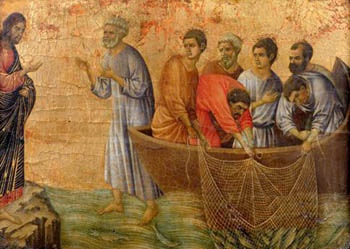
The Gospel is the incident of Jesus walking on the waters, as the disciples travel in the boat, caught up in the midst of a strong sea wind.

This incident follows the “miraculous” event of the multiplication of five loaves and two fish, to feed a “massive” number of people. ( Jn 6: 1-15)

The people were greatly amazed and excited about this “super-miracle”.

This is evident in their words, “This is truly the Prophet, the One Who is to come into the world” (Jn 6: 14)

·      The people had seen an astonishing miracle.

·      The people had witnessed Someone who was able to provide them food.

·      The people had experienced Someone who could provide them security and strength.

But Jesus realized that all such excitement and exhilaration, would lead the people to make Him a King…

He knew that they would….

… be stuck to only material satisfaction and physical contentment

… not understand the heavenly and transcendental meaning of the miracle

And so Jesus withdrew to the mountain (Jn 6:15) to be with His Heavenly Father, alone.

His Beloved Father was the “Compass” of His life – the One who led Him….

… to guide through unknown terrains

… to direct well, without being lost

… to keep right the focus.

United with His Father, Jesus reaches out as a “Compass” to His struggling disciples…

They were being tossed up by the mighty waves and their boats were lashed by the mighty winds. (Jn 6:18)

But Jesus enters this “chaotic” scene….and ensures His peace and calm.

·      The disciples were lost…

·      They had missed sight of their direction…

·      They were disoriented in their focus and sight…

·      Fear had seized them

·      Anxiety was drowning them.

But the Lord, the “Compass” of Life restores back their calm and focus and direction.

·      Nothing is lost, when we have the Lord as the compass of our lives.

·      Nothing will be drowned, if we hold on to Jesus, as the compass of our lives.

The disciples realized this… and they experienced the calming effect in their lives.

Are we also ready to have God as the “Compass” of our lives?

In prayer… In faithfulness.. In trust…

… let us be ready and open to be led by the True Guide of our lives!

God bless! Live Jesus!

——————————–

Quotable-quote-a-day-with-St Francis de Sales (SFS) – “Amongst all loves, God’s is so to be preferred, that we must always stand prepared in mind…

… to forsake them all, for that alone!”

——————————–

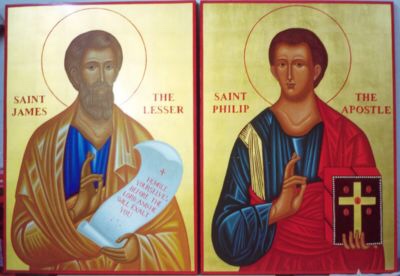
May 3 (Feast of the Apostles – St Philip and St James, Jn 14:6-14)

A story is told of a lady who was very much zealous in telling about Jesus Christ to the world.

This lady was blind and illiterate…

… and yet found different ways to spread the Gospel.

One day, she went to a Missionary Priest and asked for a copy of the Bible in French.

When she got it, she asked the missionary to underline John 3:16, in red, and mark the page, so that she could find it.

(Jn 3:16 = “For God so loved the world, that He gave His Only Son…that whoever believes in Him should not perish, but have Eternal Life!”)

The missionary wanted to see what she would do with this Bible that was marked with red…

… and so he followed her.

The lady went in the late afternoon to a school…

… and made her way to the entrance.

As the school children came out, she would stop one of them and ask if he knew how to read French.

If the boy would say “Yes” she would ask him to read the verse that was marked in red.

Then she would ask, “Do you know what this means?”…

… and then go on to tell him more about Jesus Christ and living a Life in the Lord!

The missionary priest would later testify that this lady led nearly a couple of dozen boys to become missionaries of the Lord!

As followers of Christ, each of us are bound to tell the world about the Precious Life of “Living in God!”

How well are we doing our Duty of Proclaiming God to the world?

>> Am I a Faithful Apostle?

Today Holy Mother the Church celebrates the Feast of two Apostles St Philip and St James…

>> They lived a faithful and courageous life as followers of Jesus…

… and made Jesus more known to the world by their faithful life!

The Apostle St Philip was a native of Bethsaida, on Lake Gennesaret. 

>> He was among the first disciples of Jesus (Jn 1:43)

(a) At the miraculous feeding of the multitude, it was to Philip that Jesus asked, “Where shall we buy bread that these may eat?” to which Philip replied, “Two hundred denarii worth food will not be enough for them to have a little” (Jn 6:5)

(b)  When through Greeks came to meet Jesus, it was Philip whom they met and it was he who reported to Andrew and they both went to Jesus (Jn 12: 21-22)

(c) It was Philip who told Jesus, in the Upper Room, “Lord, show us the Father and it is enough for us” (Jn 14: 8)

The Apostle St James is called as the Younger or the Less, because he was the second of that name who was an apostle of Jesus – distinguishing him from James the Greater, the son of Zebedee

>> St James the Less was also called as James the Just and is sometimes also called as the “Brother of the Lord”

(a) He is the author of one of the Epistles in the New Testament

(b) He was also ordained as the Bishop of Jerusalem.

The Gospel of the Day (Jn 14: 6-14) presents Jesus declaring Himself as “The Way, the Truth and The Life” (Jn 14: 6)

>> These two Apostles, St Philip and St James by their life, gave a faithful witness to Jesus – “The Way, The Truth and The Life!”

We are called and challenged, by these Apostles to do the same as well…

Being ready…

>> to embrace Jesus as The Way…

… seeking to follow only His paths and doing His Will

… being bold to stand firm in the face of hardships, while walking on the Way

Being ready…

>> to embrace Jesus as The Truth…

… wanting to let go a life of dishonesty and hypocrisy in our actions of life

… determined in the conviction to live for Christ and His virtues in day-to-day life

Being ready…

>> to embrace Jesus as The Life…

… willing to utilize all our talents, gifts, resources in life for the glory of God and His Kingdom

… being brave to let go off anything which prevents us from living a life for the Lord

The Apostles St Philip and St James…

… were greatly purified in their following of the Lord, through various persecutions and hardships

>> And finally, gave their life in martyrdom to the Lord and His Kingdom!

When there is determination and passion for God, we look for ways and means, to preach about God and His Love to the world!

>> No blindness can prevent us from showing people “the vision of Divine Life”

>> No illiteracy can stop us from declaring to people “the Word of Life!”

Let us wait at the “entrances of people’s life” and…

… point the “the red and passionate Love of the Lord” to the world!

Wish you a Happy Feast of the Apostles – St Philip and St James!

>> May we too, seek and work to be His True Apostles and thus live to be a Saint!

God Bless! Live Jesus!

——————————–

Quotable-quote-a-day-with-St Francis de Sales (SFS) – “The test of a preacher is that his congregation goes away saying not, “What a lovely sermon,” but…

… “I will do something!”

——————————–

May 2 (Jn 3:31-36)

A few days back we celebrated the Easter Vigil.

The Easter Vigil is called as the mother of all vigils.

>> In the liturgy of the Easter Vigil, a Paschal Candle is prepared.

The priest marks the candle, in the shape of the Cross, Alpha and Omega – the first and the last Greek letters and the present Year, 2019

He uses the following words:

… Christ yesterday and today (on the vertical arm of the cross)

… the Beginning and the End (horizontal arm of the cross)

… the Alpha (alpha above the cross)

… and the Omega (omega below the cross)

… All time belongs to him (numeral 2 in upper left corner of cross)

… and all the ages (numeral 0 in upper right corner of cross)

… To him be glory and power (numeral 1 in lower left corner)

… through every age and for ever. Amen (numeral 9 in lower right corner)

These words declare the Supreme authority and Heavenly glory of Jesus, the Son of God.

However, it can happen so, that at times, in our life…

… such fundamental factors of faith are taken for granted…

… such basic truths of our spiritual life are presumed as known…

Therefore,  it is sometimes good take a pause in our spiritual life, and ask ourselves, this fundamental question,

•      ” Am I really trusting and believing in Jesus, as the True Son of God, the One who is all-powerful and Holy”?

•      “Is my faith and spirituality truly built on the great foundation, that the Lord is the ultimate beginning (Alpha) and the end (Omega) of everything?”

The Gospel of the day is an invitation to make this examination of the basics of our faith and spirituality and to renew our belief and trust in the Lord.

The Gospel passage begins with the verse, “The One who comes from heaven is above all” (Jn 3: 31)

This verse refers to the Divine origin of the Lord.

At the Annunciation, Angel Gabriel had announced to Mother Mary that Her child “will be great and will be called the Son of the Most High” (Lk 1: 32)

This Divinity of the Lord was affirmed by Him through the various works of wonders and great deeds…

… of healing many in afflictions and sicknesses

… of accepting many of the rejected and unwanted

… of strengthening many of the oppressed and the abused

… of preaching many on the need for repentance and striving to enter the Kingdom

•      His personality shone with Divinity….

•      His character radiated with Holiness…

He sought to become the Way-revealer, the Truth-instiller and the Life-giver.

He is the One “Whom the Father loves” and “to Whom the Father has given everything” (Jn 3:35)

•      Have we given our lives entirely to Him, who is above all things?

•      Have we entrusted ourselves entirely to Him, who has been entrusted everything by the Father?

At the Holy Mass, one of the most beautiful prayers is called as the “Doxology”.

In this, we render all the praise to the Father, through the Son, in the Holy Spirit.

>> “Through Him, With Him, In Him…. O God Almighty Father, in the unity of the Holy Spirit, all glory and honour is Yours, forever and ever, Amen!”

It would be good, to make this prayer of the Doxology, our own, in our works and activities.

•      This could be a conscious way of acknowledging the Divinity of the Lord in all our activities.

•      This could be a meaningful way of saying that the Lord reigns in all our works and deeds.

Let us revive our hearts to firmly install the Lord as the True Alpha(the beginning) and the True Omega (the end) of all our activities… and our life itself!

God Bless! Live Jesus!

——————————–

Quotable-quote-a-day-with-St Francis de Sales (SFS) – “Walk always near to God, for the gentleness of His Shadow…

… is more healthy than the brightness of the sun!”

——————————–