Jan 12 (Mk 2:1-12)

A wealthy man was once seen driving his Lamborghini car through the streets of a busy city.

As he stopped in a particular place for parking, a curious passer-by, remarked at the driver:

“Hey, it’s surprising! You’re driving such an expensive car… but didn’t you notice that your rear window glasses are broken!”

“There’s a reason for pursuing with the broken glasses…”, the man in the car replied, “the broken windows remind me of God’s Providential Love!”

“Huh?”, enquired the passer-by with greater curiosity, “How do ‘broken windows’ remind you of God’s Providential Love?”

“Well.. then, listen to my story,” said the man as he continued, ” I was once passing through the streets, zipping across in my luxurious car…

… when suddenly, a crashing sound was heard from the back!

>> I saw that a stone had been thrown at my car!

In great anger, I noticed that it was a rag-picker boy, who had thrown the stone!

My blood boiled, in rage, as I stopped my vehicle and moved closer to him.

But then I saw him, joining his hands, as he pleaded to me in tears: “Sir, look at my younger brother…

>> I noticed to see, that a young boy who legs were paralyzed was lying down, with a heavy scars and bruises on his legs.

The boy continued: ‘I was crossing the road, helping my lame brother, when a fast-moving bike ran over him, to leave with a bleeding leg.

I called out to many people for help…but none cared!

Finally, out of my helplessness, I decided to throw a stone at the vehicle which would come next, in order to seek help!

The boy continued: ‘Sir, I am extremely sorry that your expensive car is damaged. But, trust me, this was the only way I could seek help for my injured brother!”

Tears filled my eyes, as I told the boy: “My car windows are surely broken! But they are also a reminder, that sometimes, we have to allow God to break certain things, to remind…

… that we need to stop and help!

… that we need to depend on God in all aspects of life!

>> Surely, these broken windows are a sign of God’s Providential Love!”

Are there “broken windows” in our life?

>> Broken windows…

… when tragedies and calamities have hit our life?

… when untimely incidents and unexpected twists have taken place in life?

>> Though difficult to comprehend, perhaps, a deeper reflection, will help us to realize that such “Broken Windows are a sign of God’s Providential Love!”

The Gospel of the Day is a story of how a “broken roof becomes a sign of God’s Providential Love!”

We are travelling very quickly with St Mark’s journey of the ministry of Jesus.

>> We were with Jesus by the Sea of Galilee, where He called the first disciples (Mk 1: 16-20)

Then…

… we came to the synagogue, where Jesus cures a man with an unclean spirit (Mk: 1: 21-28)

… we reached Simon’s house, where Jesus heals Simon’s mother-in-law (Mk 1:29-31)

… we went to the mountains to pray with Jesus, who always remained focused (Mk 1: 35)

… we met a leper, unacceptable in the society, who was made clean by Jesus (Mk 1: 40-45)

The journey moves fast and immediately…

At Capernaum, a great crowd has gathered in a house, where Jesus is preaching (Mk 2:1-2)

>> The house is fully packed with people cramming to hear the Lord and seek His Healing..

Then comes a group of thick friends who have brought their paralytic friend to Jesus.

>> They came with much expectation to get their friend whole and well again.

But as they approached the house…

… their hopes went down!

The massive gathering at the door thinned their anticipations!

But when the chips are down…

… one is given a chance to find strength one never knew one had & put it toward the greater good.

They came seeking for blessings…

… but it seemed, that the firmament was closed to shower down blessings!

But then they had a hope: They realized that “Even a broken roof can be a sign of God’s Providential Love!”

>> And so they decided to plead God to shower His blessings: “by tear opening the roof!”

“Unable to get near Jesus, because of the crowd, they opened up the roof above Him” (Mk 1:4)

“Opened up the roof” has other translations:

>> “Dug a hole through the roof”

>> “Removed part of the roof”

>> “Uncovered the roof”

We would perhaps think the roof was some primitive, thatched roof.

>> But most likely, that was not the case…

As per the architecture then, this roof was more than likely a mud clay roof with tiles

>> To lower their paralyzed friend through the roof, they literally had to do a major demolition of the roof.

Well… picture this:

You’re in this packed house…trying to listen to Jesus.

>> All of a sudden you start to hear some banging on the roof.

These friends would have literally tore the tiles off the roof, made a hole & lowered the paralyzed man by a rope into the house.

>> Then the roof materials begins to fall in on you!

Well… picture the people’s responses:

>> They would have been astonished, amazed and some even angered!

They were there to listen to Jesus….they had come early…they had won their spot…

>> They were perhaps hearing their life-transforming sermon!

It’s at this point, that the “roof starts tearing down!”

>> But Jesus, the God of blessings, is immensely pleased and edified by their faith and trust!

Their “tearing of the roof”…

… is blessed by “pouring down of blessings” and a “cleansing of sins”.

Many of the times, we too face similar barriers and blockages in our experience for the Lord.

>> We need to plead to God to shower His blessings: “by tear opening the roof!”

>> When we have…

… ‘end-of-the-road’ feelings and hopeless situations

… problems which seem impossible and unsolvable

>> Are we willing to have our “roofs broken”…

… and thus realize God’s Providential Love?!

Difficulties and barriers will always be many in life…

Hardships and challenges will often stare on our face…

>> But let us have the grit and the guts to be ready to “have our roof broken” of all such adversities!

Yes, let us understand that even a “broken roof is a sign of God’s Providential Love!”

God Bless! Live Jesus!
Jan 11 (Mk 1:40-45)

One of the common experiences in many of our daily lives is the aspect of “delay”…

> Go to get a certificate in a university….and we are told: “Come next week”

>> Go to an office to get a document signed…and we are told: “Today it’s not possible”

>>> Go to a department to meet an official…and we are told: ” Sir is busy today”

Our works are not done in time… Much of our time gets wasted.

>> We experience a lot of “delays”

>> Delays could suggest lack of availability.

>> Delays could suggest a lack of interest.

>> Delays could suggest a lack of sincere efforts.

But the Gospel of the Day is in stark contrast to this “delay” syndrome!

>> Get set to meet the “fast-paced” and “accelerated” Jesus in the Gospel of St Mark!

The Gospel of St Mark is the shortest of the four Gospels and probably the earliest.

>> This Gospel was primarily intended to the group of persecuted Christians.

It was most likely intended to be read aloud in the Christian assembly, rather than a private reading.

>> A Gospel for the ear more than the eye!

And so we would have in the Gospel of Mark, the use of constant repetitions, summaries, recapitulations and variations on a theme.

One of such word that is an oft-repeated one…

… is the word “Immediately”

The Greek usage of this word is Eutheos,” which is variously translated “straight away, immediately, at once, soon” etc.

>> St Mark would use this word “Eutheos” an astounding 40+ times in his Gospel which is only 16 chapters long!

Here are some examples:

>> Immediately, the Spirit drove Him to the desert (Mk 1: 12)

>> And they immediately left their nets and followed Him (Mk 1: 18)

>> Jesus immediately knew in His mind what they were thinking (Mk 2: 8)

>> The Pharisees went out and immediately took counsel against Him (Mk 3:6)

>> The seed sprang up immediately because the soil was not deep (Mk 4: 5)

Even the Gospel of the Day uses this word “immediately”…

>> The leprosy left him immediately and he was made clean (Mk 1:42)

>> Then warning him sternly, he dismissed him immediately (Mk 1:43)

No other Gospel or New Testament writer uses this word “immediately” to the extent that Mark does in his Gospel.

What’s happening?

>> Why is St Mark so gripped with this word “immediately”?

Perhaps the foremost word to describe the Gospel of Mark is ACTION.

> No effort is wasted.

>> No time is spent on the frivolous.

>>> The pace is fast.

>>> The language vivid.

Mark’s purpose was to immediately confront readers with the need to respond to the Lord.

What does this “immediacy” mean for us – you and me?

>> This sense of immediacy is still relevant to us today.

When we take a stand for the Gospel…

… we are immediately tempted.

When we are called by the Lord…

… we are invited to follow Him immediately.

When we are touched by the Lord…

… we are made to respond immediately.

>> There is to be no “delay”, but a need to “immediately” perform.

>> There is to be a promptitude in His service and the urgency for His mission.

>> There is to be no holding back, no reluctance, no slackness, but a blessed “immediateness”.

As Christians, we have perhaps allowed ourselves to get into a “delay” syndrome…

>> We no longer feel the pinch to react when there is immense injustice and corruption around

>> We take it so lightly when we hear reports of tragic deaths and heart breaking calamities.

>> We are not much moved when people around us suffer and undergo deep pain.

We have many who “talk” in defence and importance of faith…

>> But very few who really live and profess this faith.

We have many who raise protests when false accusations and persecutions of faith are made

>> But very few who actually live a life of prayer and holiness.

We are often no longer on the cutting edge of relevancy…

>> We seem to be more comfortable!

>> Are we “delaying”…

… to help the suffering people?

… to reinvigorate our Christian lives?

… to take our faith and spiritual life seriously?

… to stand up in defence of Christ and His Church?

… to mould and shape our lives according to God’s Will?

In all these “delay” syndromes, the Gospel of Immediacy is challenging and confronting us!

Come, let us be ready to act…

Come, let us be ready to respond…

…Yes…. immediately!!

God Bless! Live Jesus!

Jan 10 (Mk 1:29-39)

It was the 19th century British essayist Mr. Charles Lamb and his wife Mary who moved the 17th century playwright William Shakespeare from his undeserved obscurity to the limelight of fame.

The two selected 20 of Shakespeare’s best-known plays and set out to make them accessible to children and to pay enthusiastic homage to the original works.

Together the Lambs distilled the powerful themes and unforgettable characterizations of Shakespeare’s plays into elegant narratives–classic tales in their own right.

>> All of the Lambs’ stories–with their clear, supple, and rhythmic prose–reward any reader, whether encountering Shakespeare for the first time or revisiting his work.

This Charles Lamb was once involved in a discussion of the question, “Who is the greatest literary genius of all time?”

Two names finally emerged: William Shakespeare and Jesus of Nazareth.

Charles Lamb put an end to the debate when he said: “I’ll tell you the difference between these two men.

If Shakespeare walked into this room right now, we would all rise to greet him…

>> But if Jesus Christ came in, we would all fall down and worship Him!”

The greatness of men may make us rise in respect…

>> The greatness of Jesus would compel us to kneel in worship and adoration!

“Let’s talk about Jesus” is a popular English hymn.

>> Today, for our reflection, let us talk about Jesus…

… the most influential person ever, in history!

H. G. Wells, a prolific English writer, summed up this difference…

“Christ,” he wrote, “is the most unique person of history.

>> No man can write a history of the human race without giving first and foremost place to the penniless teacher of Nazareth.

From poverty and obscurity to teacher to death on the cross, to ascended Lord – Jesus Christ is the growing figure of history.

>> He is unique – for while all others decrease, he increases!”

The Gospel of the day reveals the immensely charismatic personality of Jesus.

He heals the mother-in-law of Simon Peter.

>> He healed many others who were with various sicknesses and diseases.

>> He cast out demons from many who were possessed and under bondages.

He became a sought-after person!

>> He became an attraction for many many people!

Jesus’ tremendous passion for the missions is admiring…

>> Jesus’ spectacular urge to preach the Kingdom of God is amazing…

>> Jesus’ unfazed commitment to the mission entrusted to Him is astounding…

We have said “Yes” to follow ‘this’ Jesus…

… Jesus who wants us to follow Him in healing the world

… Jesus who wishes us to become agents of casting out demons and unclean spirits

… Jesus who waits on us to preach and teach the Kingdom of God to all people anywhere

To be like Jesus, we need to imitate Him, not just in works… but above all in His Being!

… Totally committed to a life of prayer and union with God (Mk 1:35)

… Passionately zealous for the salvation of people (Mk 1: 32-33)

… Absolutely focused on the needs of the Kingdom of God (Mk 1:38)

>> Do I have my prayer life and communion with the Lord as the greatest thrust and push in all my activities, undertakings and ministries?

>> Do I have a deep desire and commitment to bring God’s love to all people and be passionate to share Him to all others?

>> Do I remain undistracted in the midst of all worldly attractions and forego personal pleasures by remaining focused on His Kingdom alone?

The world certainly faces a lot of darkness, pain and sufferings. (Job 7:1-4)

Our own world may be filled with shattered hopes, unfulfilled dreams, meaningless miseries etc

>> The world outside may be filled with terrible injustices, lacuna of peace, horrifying terrors etc

But the Lord assures that “He is the One who heals the broken-hearted”. (Ps 146:1)

Let us be filled with the power and spirit of Jesus, “the One whom we ought to preach by our lives” (1 Cor 9:16)

May we discover and be convinced of Jesus, to be the greatest in our lives.

>> Shall we therefore, fall in deep adoration, ardent worship and fervent submission to Him…

… so that we can become agents of Him, who transforms the world continually?

Let us not have the woe of not preaching the Gospel! (1 Cor 9:16)

>> Let us share the blessings of the Gospel! (1 Cor 9:23)

>> Let us become all things to all! (1 Cor 9:22)

God Bless! Live Jesus!

Jan 9 (Mk 1:21-28)

One of the very beautiful descriptions of a “Prophet” goes thus:

>> A prophet is someone…

… who comforts the disturbed

… and disturbs the comforted!

This description finds its expression in the lives of Prophets in the Bible

They were people…

… who offered great comfort and consolation to those in difficulty and distress

… who reached out to the ones who needed a word of hope and happiness

At the same time, they were people…

… who out rightly condemned those who led a comfortable life – away from God and His Commandments

… who vehemently opposed the ways of those who oppressed the poor and constantly disrupted the lethargic lives of people.

Jesus is the “Prophet of all prophets!”

>> The perfection and the fullness of all prophets!

And so, undoubtedly, Jesus, by His Prophetic Ministry also greatly upheld the principle of being the one…

… who comforts the disturbed

… and disturbs the comforted!

The Gospel of the Day presents such an action of encounter…

… where on side a group of people, who are listening to Jesus, are comforted

… while on the other side, some are extremely disturbed by the Prophetic Presence of Jesus!

… between the Kingdom of Satan and the Kingdom of God

… between the shackles of captivity and bondage and the power of release and liberation

Jesus is in the synagogue on the Sabbath Day and addressing the people. (Mk 1:21)

His prophetic teaching is full of power and conviction…

>> His prophetic teaching is filled with passion and fervour…

When one is deeply convinced of one’s beliefs, it overflows into one’s words and actions

>> When one is highly passionate about one’s faith, it overwhelms one’s deeds and life.

As He taught the people, Jesus encounters a man with an unclean spirit, who cried out,” What have you to do with us, Jesus of Nazareth?” (Mk 1: 24)

Where there is light, darkness cannot stand too long…

>> Where there is immense holiness, filth cannot remain for long…

>> When there is the Word of God being proclaimed, the powers of Satan begin to tremble…

Imagine this situation…

Jesus had been preaching for a while in the synagogue.

>> All people were in rapt attention & awe, listening to His gracious words.

But in the midst of them.. was this man, with an unclean spirit.

He also was patiently hearing…

>> But as the bold words flowed from Jesus, the spirit within this man began to disturb.

The Lord’s Voice…

… began to reverberate his heart and mind…

… began to pierce into the depths of his soul…

He began to get agitated.

>> He began to get restless.

>> He began to get frantic.

And finally, he could no longer tolerate and with a massive and shrieking voice, he cried, “What have you got to do with us, Jesus of Nazareth?!”

The cry of the man is not something in isolation….

>> The cry of the man is not something which is unique….

This cry is often repeated by all of us too…

>> “What have you got to do with us, Jesus of Nazareth?”

When we are living a life of coziness and comforts…

>> And we are encountered with situations of misery and helpless of other people..

We hear the words of the Lord to reach out to them in compassion and love.

>> But, often we cry out, “What have you got to do with us, Jesus of Nazareth?”

When we are living a life in sin, bad habits and without even a sense of guilt…

>> And we are encountered by caring people who remind us of our need to give up such things…

We hear the words of the Lord to renew and mend our lives in purity and holiness.

>> But, often we cry out, “What have you got to do with us, Jesus of Nazareth?”

When we are going through our life without proper sacraments and religious practices…

>> And we are encountered by constant exhortations to deepen our spiritual life…

We hear the words of the Lord to return to Him in humility and repentance.

>> But, often we cry out, “What have you got to do with us, Jesus of Nazareth?”

Often, we are happy to remain with the spirit of luxury, the spirit of casualness, the spirit of indifference, the spirit of lukewarmness, the spirit of pleasures etc…

We don’t like being disturbed.

>> We don’t like being questioned.

>> We don’t like being shaken up.

If we are, we get agitated and irritated… we resist and we get wild.

>> We even shout out: “What have you got to do with us, Jesus of Nazareth?”

But, in all such situations, the Lord wants to empower us with His powerful & bold words, “QUIET! Come out of him” (Mk 1: 25)

Yes, Jesus the Prophet, mightily challenges all of us!

He is the Great Prophet

… who comforts the disturbed

… and disturbs the comforted!

Our life is a constant warfare with the forces of the evil and the spirit of darkness.

It’s a battle that rages strongly…

>> It’s a combat that is highly engrossing.

But let us not be afraid…

The Powerful and Awe-Inspiring Lord is on our side!

>> Let us hold on to Him… and victory will be ours!

God Bless! Live Jesus!

Jan 8 (Feast of Baptism of Jesus)

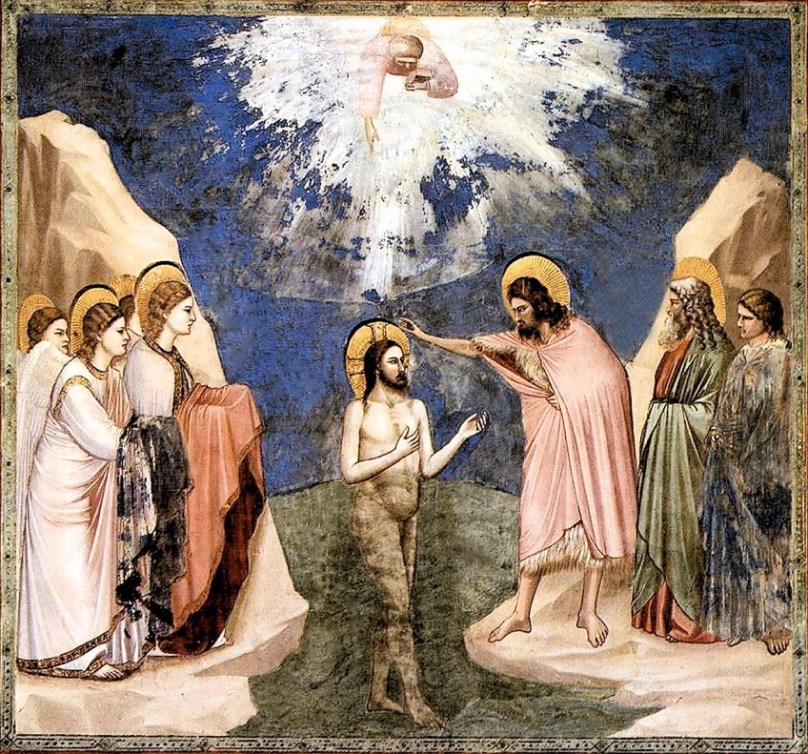
The Baptism of our Lord Jesus, Giotto di Bondone, 1305, Capella Scrovegni, PaduaAn incident is told about St Katherine of Alexandria.

Katherine was a noble and learned young woman in this cultural hub of the ancient world of the 4th century. She had attained a lot of popularity in the town of Alexandria.

>> She was a Christian.

This was the time of the persecution of Christians by Emperor Maxentius.

Christians were given only two options:

>> Worshipping the emperor (which would violate the First Commandment)…

… or being put to death

In this context, the Governor of Alexandria also came up with another plan to humiliate and discourage the Christians.

He invited the famous Katherine to debate a group of fifteen (some say 50) of the best pagan philosophers and orators…

… Hoping that this dispute would refute all her pro-Christian arguments and thus morally discourage other Christians as well!

Katherine accepted the challenge.

>> They gathered in the governor’s palace and the discussion began.

But the plan backfired.

Instead of Katherine being converted, several members of the panel (some sources say all members) were actually converted!

>> They asked for baptism immediately, so as to receive God’s grace into their souls.

But the governor was furious and condemned them all to immediate death.

To that, Katherine with concern and care assured all the new-converts that since they so sincerely desired to receive the sacrament…

… their own blood would take the place of water, and their own martyrdoms would take the place of baptism.

Those men were willing to give up everything else, only in order to receive the friendship and grace and Jesus Christ.

That’s the power of God’s Love!

>> And that’s the Power of Witnessing to God’s Love!

The fire of God’s Love that was kindled in St Katherine of Alexandria, at Baptism…

… continued to blaze in her, setting many other souls on fire for love of God!

Does the Fire of Love, that had been kindled in us, at our Baptism…

… continue to blaze powerfully in us?

>> Or has the fire been diminished and lessened?

Today, Holy Mother the Church celebrates the Feast of the Baptism of Jesus…

… and with an invitation: To “fan into flames” ( 2 Tim 1:6) the fire of God’s Love that has been kindled in us, at our Baptism!

The liturgical season of Christmas, celebrating the self-revelation of God through Jesus, comes to an end with the feast of the Baptism of Our Lord.

This incident of the Baptism of Jesus is greatly significant and important….

>> It is one of the few passages that appears in all the four Gospels.

>> It was the first public revelation of the Three Persons of the Trinity

>> It was the first official declaration of Jesus as the Son of God to the world

For Jesus, it was…

… a moment of identification with us sinners.

… a moment of decision to begin His public ministry.

…a moment of approval when His Father called Him as His “beloved Son”.

Each one us, as Christians have been baptized in the Lord!

What does Baptism mean to us?

>> What has Baptism meant to us?

Baptism is a time when we call ourselves to have “put on” Christ…

… a time of conversion…from the old to the new!

For a moment, lets borrow the idea of how the Jewish conversion would be effected…

… so that we could have a better and a deeper understanding of our Christian Baptism

For a Gentile man to become a full-fledged Jew there was a basic three-step process:

1. The first was to offer a sacrifice

A heifer or a pair of turtledoves was brought to the priest and given as a burnt offering to God. This meant some expense involved.

It required hardship, forfeiting and sacrifice oneself to become a new person!

2. The second was circumcision – the cutting away of a piece of flesh from a man’s body.

For a Jewish boy, this was done when he was 8 days old, thus the pain wasn’t remembered.

>> But an adult male, who wanted to become a Jewish proselyte, had to undergo this procedure, regardless of his age.

It required deep pain, immense agony and even shedding of blood to become a new person!

3. The third was baptism.

The person stripped off all of his clothes.

>> He then went into the water naked before the Rabbis…

… dipped himself under water making sure to fully immerse his entire body!

It required a lot of humility and self-sacrifice to become a new person!

Christian Baptism doesn’t have these external signs and actions as that of the Jews.

>> But the internal aspects are much more strongly present…

… and even more valid!

To be a Baptized Person in Jesus – a passage from the Old to the New, requires….

1. Sacrifice of oneself

…. Willingness to sacrifice one’s life for the Lord, in the form of money, talents, time, energy etc…

>> He who wishes to follow me, must deny himself, take up his cross and follow me (Mt 16:24)

2. Undergoing pain and suffering

… Openness to share the agony and grief of life through various life situations and being patient and faithful in all trials …

>> “The Lord your God will circumcise your heart… to love the LORD your God with all your heart and with all your soul…” (Dt 30: 6)

3. Embracing a life of humility and dependence on God

… Readiness to overcome our pride, our selfish desires and interests and allow God’s grace and mercy to flow through us…

>> “Humble yourselves, therefore, under God’s mighty hand, that he may lift you up in due time” (1Pet 5:6)

Most of us have been Baptized when we were too little…

We were not aware….

>> But those who loved us and cared for us, were aware.

Today very often, the Ceremony of Baptism gets reduced to a mere ritual with only celebrations and get-togethers

>> We need to instead, revive the primary aspect of Baptism: As a life-transforming process, with its intrinsic elements of pain and sacrifices!

Baptism was a beginning… an initiation…into a life of grace…

… a journey with the Lord!

The Spirit of the Lord is within us…

And the call from Deep within us is strong:

“Rise up from slumber, if you are sleeping…

As a Baptized Christian, you have a very noble vocation and an immense responsibility…

Christian Life is no joke

… it does not tolerate passivity

… it does not allow lethargy!

Look up..

Mother Church is waiting to embrace you in deep love with Her Sacraments…

>> Mother Mary and all the Saints and Angels are encouraging you to become a Saint…

Yes, You are a Baptized Child of God

… Consecrated to the Lord

… Holy to Him!

Be true…

>> Be Faithful…

>> Be Enthusiastic…

>> Be Proud… to be a Christian”

Yes, the fire of God’s Love that has been kindled in us at Baptism…

… ought to continue to blaze in us, setting many other souls on fire for love of God!

Let us re-kindle the fire and love of being a Christian….

>> Let’s renew our Baptismal vows!

>> Let’s live our Baptism!

Happy Feast to all of us, baptized with our Dearest Lord!

God Bless! Live Jesus!

Jan 7 (Feast of the Epiphany of the Lord)

A Parish priest was taking a group of his catechism children to a church, which was known to be a pilgrimage centre.

The children were very much excited seeing the new church, which was particularly famous for its glass paintings.

As they kids moved around the church, little Peter – all of 6 years and the smallest one of the group – suddenly gazed at a large glass painting and shouted:

“Wow! There is the Cross of Christ!

>> Do you see what I see?”

Seeing his excitement, the others also gathered to see the Glass Painting.

>> But they could see nothing of the Cross!

To them, the glass painting resembled only a jumbled mass of confusion

>> It was a modernistic glass picture composed of a maze of colors and shapes – sophisticated and abstract

But little Peter kept shouting: “Do you see what I see?”

The others kept nodding their heads in negation.

But Peter went on: “Can’t you see him? It’s Jesus hanging on the cross.”

The priest finally said: “Little Peter.. maybe we are all blind.

>> But could you please… help us to see what you see?”

With all excitement, with his little finger, through the maze of shapes and colors…

… Peter outlined the Cross as he kept saying: “Do you see what I see?”

And then… like an Epiphany, they all saw JESUS…

… His Face

… His Arms outstretched on the Cross

>> As the image began to appear more clear!

And then with astonishment, the priest looking at little Peter and then the Cross of Christ, exclaimed: “This… is… Epiphany!”

When one longs with a great desire and looks with a clear intent, then we have the Epiphany of God!

>> Yes, the Lord makes Himself known to the one who desires and longs – sincerely, honestly and faithfully!

It is this deep desire and the wonderful manifestation of the Lord that we celebrate today, in the Feast of the Epiphany of the Lord.

The word “Epiphany”, means…

… appearance or manifestation or showing forth.

>> It is from the Greek word “Epiphaneia”

It refers to the first appearance of Jesus to the Gentiles.

This Feast of the Epiphany drives home a powerful message…

… and gives pointers to experience true joy and happiness in life.

The Magi teach us some vital clues towards finding the “Joy in Life”…

1. WHAT do we seek?

The Magi from the East had just one purpose in their long journey: to meet the New Born King and pay Him homage and worship. (Mt 2:2)

This single focus and dedication…

… Impelled them to move forward with determination

… Inspired them to overcome all hurdles

… Infused them with a hope that would taken them through their deep desire.

What about us?

>> What do we seek in life?

Is it for the Lord and His glory… ?

… Or do we engage ourselves in activities for our own glory and pride?

Is the Lord the end and purpose of all our actions… ?

… Or do worldly desires dilute our works and actions?

2. WHERE do we seek?

The purposeful determination of the Magi made them to be focused on the Star – a sign to lead them to their destination ( Mt 2:2b)

>> As long as they followed the Star, they remained on the right track.

Of course, for a moment, seeing King Herod’s palace, they got a bit deviated as they reasoned out that the New Born King would be born in a palace!

>> But Divine Providence soon brought them back on track.

The star once again led them and they reached the Great King enthroned on the Wooden Throne of the Manger!

>> (pre-figuring the enthronement of the Lord, later, on the Wooden Throne of the Cross!)

What about us?

>> Where do we seek the Lord?

>> Do I faithfully follow the Star of inspiration, that the Lord constantly sends…

… Through His Commandments, Teachings of the Church, many people in our life and the situations of life

>> Do I seek His Love in the wonderful sacraments that the Church offers, encounter Him in the poor and the needy and experience His Providence in the situations of our life?

… Or do I get lost, in our search for the Divine, in the pleasures of this world, engage too much only in our works and material engagements or dip ourselves into the murky waters of sinful addictions, sly attachments and silly attractions.

3. WHAT GIFTS do we offer Him?

The Gospel says that the Magi offered Baby Jesus, their precious gifts – fit and appropriate.. ( Mt 2:11b)

> Gold for Jesus, the King

> Frankincense for Jesus, the Priest

> Myrrh for Jesus, the Prophet.

These gifts would have cost them a fortune…

… They also bore the marks of their sacrifice and pain

>> But they were gifts that were worthy and befitting the King!

What about us?

>> What gifts do we offer to the Lord?

In the Holy Mass…

>> Do we really offer Him our pains, struggles, our little sacrifices, our honest longings?

… or, has the Holy Mass become just a customary ritual, without we offering anything to Him and thus failing to derive any joy or consolation for this Precious Sacrament?

In our life…

>> Do we try to make some personal sacrifices…?

>> Take some radical decisions to live worthier Christian lives, and be more dedicated to pursue a life of holiness and sanctity…?

The Lord wishes, desires and deserves the best gifts from us.

>> He tells us to, above all, “offer our lives as a living sacrifice” ( Rom 12: 1) – sinful, broken, wounded; just as we are…

… So that He can transform us, and make us a new creation (“Behold I make all things new – Rev 21:5)

The Feast of the Epiphany is a powerful invitation for us:

>. To examine, purify and strengthen…

… the focusses and priorities of our life.

Yes, like the Magi…

>> Let us seek the Lord deeper

>> Let us long for the Lord intensely in the right place

>> Let us desire for the Lord passionately, offering Him the best gifts of our life

Our life may sometimes resemble a jumbled mass of confusion

>> Like the modernistic glass pictures, we may often get lost in the maze of colors of uncertainty and shapes of difficulties – sophisticated and abstract!

But if we maintain the desire of God in our hearts, He will, through the little things of life…

… outline His Plan to us

>> And then…

… like an Epiphany, we will be able to see the Presence of God in our Lives!

>> May we all, thus, with astonishment and gratitude exclaim: “This is Epiphany!”

Happy Feast of the Epiphany!

God bless! Live Jesus!

Jan 6 (Mk 1:6-11)

The Rosary is a beautiful prayer that takes us through the life of Jesus…

… holding the hands of Blessed Mother Mary.

It was on October 16, 2002 that Pope St. John Paul II in his Apostolic Letter “Rosarium Virginis Mariae” proposed and recommended a new set of mysteries to be meditated on when praying the Rosary – The Mysteries of Light.

One reason for this addition of the “Luminous Mysteries” to the ancient prayer of the Rosary…

… was to encourage all Catholics to contemplate Jesus in the daily life of his public ministry.

Jesus was a not a person away from the people…

… rather He was very close to the daily struggles and the everyday happenings of the people!

Therefore, the “Luminous Mysteries” remind that God is always “with His people and identifies with them”…

… starting with the Lord’s Baptism

… then the Wedding at Cana

… followed by His proclamation of the Kingdom of God, with his call to conversion

… moving on to the Transfiguration Experience

… concludes with the Institution of the Holy Eucharist – His beautiful way of “being with His people” always!

Yes, God loves to “be with His people and identify with them”

The Gospel of the Day presents this beautiful incident of God Who identifies Himself with the sinful humanity through the event of the Baptism of Jesus (Mk 1: 6-11)

The passage begins with an introduction to the person of John the Baptist.

>> Being clothed in camel’s hair, with a leather belt around his waist and feeding on locusts and wild honey (Mk 1: 6)…

… John the Baptist resembled Elijah (2 Kings 1:8)

He was the messenger, who would prepare the way for Christ, the King…

… just as “a messenger was sent by every king” in order to prepare the people for his reception!

A man filled with humility, John the Baptist declares of the coming of the Messiah and of His Greatness:

“I am not worthy to stoop down and loosen the thongs of His Sandals…

… He will baptize you with the Holy Spirit” (Mk 1:8)

These are two dimensions we can greatly learn from John the Baptist:

1. Being a messenger of Christ

>> Do we also, in our own places of work and acquaintance, be a “Messenger for Christ” by radiating the Gospel Values – in conviction and without any compromise?

2. Growing in the virtue of humility

>> Do we also, practise acts of humility, so that all our words and actions, may render glory to God and His Kingdom?

As John the Baptist goes about baptizing people…

… he is encountered by Jesus Himself. (Mk 1: 9)

What follows is a beautiful act: The Son of God humbles Himself, before His messenger, “who himself had humbled before Him!”

This act of John the Baptist baptizing Jesus was the Lord’s way of showing forth His Mission: Identifying with the people and taking their place!

All His actions on the earth would show forth this aspect: Identifying with the people and taking their place!

… His Incarnation: Being born as a human – and dwelling among people

… His Preaching the Kingdom of God: Moving from one place to another – in touch with the realities of life

… His Passion and Death: Experiencing the pains and sufferings of life, especially death – the consequence of sin

Why was the Lord so insistent in “identifying with the people?”

It was His beautiful reminder to all of us: That He is always with us – loving us and being intimate to us!

He is not a God away from the people…

… rather He is very close to the daily struggles and the everyday happenings of people!

This is the beautiful truth that all of us need to be convinced of, and live it in our day-to-day life: That God is always with us.

Even when we go through the struggles of life…

… financial crisis crashing our life

… relationships hitting rock bottom

… memories of the past scarring us

… uncertainties of the future haunting us

>> May we realize: That God identifies with us, and He is with us!

It is the conviction in this Truth that will help us to always be “joyful in life”!

Externally, things may not really go the way we want or wish…

… but the conviction that “God identifies with my situation” ought to be a huge boost for us to be firm in life!

Apparently, situations may be really harsh and we may feel really worried..

… but the fact that “God is with me at this present moment” should become the positive stroke for us to remain steadfast and hopeful!

Yes, the Lord “Who is the Light and in Whom there is no darkness at all” (1 Jn 1:5)…

… constantly calls us live our “life in light” under His “Luminous Mysteries!”

May this Gospel Reflection on the “Baptism of Jesus” – wherein God shows that “He is with His people and identifies with them”…

… help us to constantly live our lives in hope and joy!

God Bless! Live Jesus!

Jan 5 (Jn 1:43-51)

An incident is told about a famous agnostic ( = a person who believes that nothing is known/can be known of the existence or nature of God)…

… who was staying as a guest in the house of a Catholic Family.

When Sunday came around, all the members of the family got ready to go to Church.

But this agnostic was not willing to.

>> In fact, he approached the owner of the house and asked him to stay back, without going to Church.

“Why not avoid going to Church today,” he told the owner, “and instead stay back and tell me what does your Catholic Faith mean to you!”

The owner- a devout and staunch, yet simple Catholic – got perplexed: “You have the capability to destroy any argument and any opponent.

>> I am just an simple Catholic. I am not clever enough to argue with you.”

But the agnostic continued gently: “I don’t want to argue with you. I just want you

to tell me simply what this Christ means to you.”

The man stayed at home and simply told him of his faith.

The incident goes on to say that, when he had finished…

… there were tears in the agnostic’s eyes.

Yes, it was not clever argument that touched the agnostic’s heart…

… but the simple story of a man’s faith!

>> Where arguments, prejudices and rhetoric fail…

… there faith and love always win!

>> Where bombastic words and complicated talks fail to touch…

… an experience of God’s Power and Grace can work wonders!

The Gospel of the Day presents such a beautiful experience…

… of a person who was made to go beyond the “influence of prejudice and rhetoric” and thus could “experience God’s Power and Grace”!

The Gospel narrates the incident of Philip, who has already had a “Come and See” Experience (Jn 1: 39).

After “experiencing” the Lord, Philip goes to his town Bethsaida, where he meets Nathanael. (Jn 1: 44-45)

Nathanael – a name which means, “God has given” is an interesting character.

When Philip who had met Jesus, went and told Nathaneal that “We have found Him of whom Moses in the law and also the prophets wrote, Jesus of Nazareth…” (Jn 1: 45)…

… Nathanael put forward a blunt question, “Can anything good come out of Nazareth?” (Jn 1: 46)

Nathanael showed forth a cynical and doubtful mind…

… probably due to his prejudice and bias.

But…

>> Where arguments, prejudices and rhetoric fail…

… there faith and love always win!

>> Where bombastic words and complicated talks fail to touch…

… an experience of God’s Power and Grace can work wonders!

And so, Philip invites Nathanael to have a first-hand experience of the Lord, by telling Him, “Come and See” (Jn 1: 46b)

Nathanael was relying more on the “the power of rhetoric” and the “strength of logical argument”

>> He depended more on his past experience and his ability to “put forth ideas”

But Philip is willing to show how the power of rhetoric” and the “strength of logical argument” can be easily won over by the Experience of God’s Love and Faith in Him!

Philip himself was told by Jesus, “Come and See” (Jn 1: 39)

>> He went and saw… and with an experience, had his life transformed!

He now invites Nathanael to do the same: “Come and See” (Jn 1: 46b)

>> So that he too can go and see… and have an experience, to have his life transformed!

Here’s a big lesson to all of us:

>> Unless we have a first-hand experience of God’s Love and Providence…

… we will only remain in the level of “rhetoric and argument”

>> Unless we thirst to be filled with God’s Presence and Comfort…

… we will only be stuck with our “past experiences and prejudices”

Nathanael would “dare” to have the “Come and See” Experience…

… and that would result in his public confession: “Rabbi, You are the Son of God! You are the King of Israel” (Jn 1: 49)

Are we willing to have the “Come and See” experience…

… like Philip?

… like Nathanael?

Let us realize that it is not arguments or rhetoric that would help us to grow in our faith…

… rather an “experience” of the Lord and His Love!

Many of us perhaps “know a lot about God”

>> But how many of us “know God a lot?”?

Many of us perhaps can regularly give “talks on God”

>> But how many of us, regularly, “talk to God?”

Let the “Come and See” Experience of Nathanael be an inspiration for all of us…

… to grow in our thirst for the Lord

Through…

… Regular prayer

… Reception of the Sacraments

… Reading of the Bible

… Recognizing the guidance of God in all what we do

… Recounting the many blessings of God

>> May we constantly grow in this “Come and See” Experience of the Lord!

On this First Friday of the Month and of the New Year 2018…

… may we re-consecrate our hearts to the Sacred Heart of the Lord

>> And renew our commitment and love for the Lord!

God Bless! Live Jesus!

Jan 4 (Jn 1:35-42)

A simple and commonly known story goes such…

A generous and a noble King once made a grand announcement to his subjects.

He declared that on a particular day, all the people could come into the King’s palace, and take for themselves from the palace hall, whatever they wished for!

An amazing and once-in-a-lifetime opportunity indeed!

And so the day came… hundreds and thousands had gathered in the palace.

The people waited for the King’s signal to start picking up whatever they wanted in that hall.

The moment arrived…the King waved his royal hand to begin…

>> It was time to lay hands on whatever they wished to make their own possession.

The rush was maddening…

>> People ran helter-skelter, seeking for the most precious things…

… Golden vessels, silver goblets, jeweled showpieces, antique fancy items etc…

But in that crazy rush, there was one particular girl, a teenager, who thought differently.

She took this chance, to go and hug the Prince!

Bingo!!

>> That was the prized catch!

She now became not just the possessor of the love of her life…

… but also on the heir of the land!

She sought what was the most prized possession!

>> She went after, that which was the most treasured of them all!

What are we – you and I – seeking in life?

The Gospel of the Day has Jesus posing this fundamental question of our lives: “What do you seek” (Jn 1: 38)

The first chapter of St John has an account of two disciples of John the Baptist who are sent to follow Jesus by the words, “Behold, the Lamb of God” (Jn 1: 29)

John the Baptist is indeed an amazing person.

His life offers us immense qualities to imitate and follow.

1. He called people to a renewed way of life by turning to God in repentance

He teaches: The need to have a constant examination of our conscience…

2. He lived a life of intense asceticism and self-mortification

He reminds: Of the vanity of earthly glory and what things instead are of utmost importance…

3. He pointed out to Jesus as the Lamb of God and directs people towards Him

He teaches: The importance of focusing on Jesus in life and not on other people or things

4. He doesn’t feel jealous that all are following Jesus and confesses also of his unworthiness

He reminds: The power of humility and the joy of giving everything for God’s Kingdom

When Jesus sees them following, He turns…. (Jn 1: 38)

He turns around to see ‘a part of the humanity that is seeking Him’.

>> He turns around to look at a tiny generation of human beings in quest of Him

>> He turns around to witness a representative of people that is wanting to know Him

And then Jesus poses this soul-probing question…”What do you seek?”

We too have been following Jesus for quite some time…

>> Maybe we’ve heard from others & so we follow Him…

>> Maybe we’ve experienced His caring presence & so we follow Him.

But the Lord once again turns….and asks us, who are following Him : “What do you seek?”

It’s not an interrogation to just obtain some information…

>> It’s not an enquiry to just gather some data.

It is rather a question that is posed to determine what is the real focus and centre of our life.

Jesus probably knew why many people were beginning to follow Him:

>> There would be many seeking Him…

… for bread alone.

… for getting healings alone.

… out of mere curiosity alone.

… for theoretical arguments alone.

… for their own personal desires alone.

And so Jesus poses this heart-penetrating question…”What do you seek?”

The Lord, with His deeply penetrating eyes gazes into the depths of our soul…

… with His soul-arresting charm fixes His eyes into the castle of our heart asks:

>> “My Child, what do you seek?”

Are you seeking just to have some of your earthly desires fulfilled…

>> Or do you seek Me in order to treasure me completely and possess eternity?

Are you seeking spirituality just for namesake and out of a societal and religious obligation…

>> Or do you seek Me because you are convinced of finding in Me, the real Truth and Joy?

Are you seeking transcendence in order to just have a relief in your pains and difficulties…

>> Or do you seek Me to also have a share in my agony and anguish of the Cross?

The Psalmist would say: “God looks down from heaven upon the children of men, to see if there are any who understand, who seek God” (Ps 53:2)…

Can I be a real Seeker of God and of His Kingdom??

Embracing Jesus, the Prince of Life, would ensure the inheritance of eternity.

>> Possessing Jesus, the Prince of Joy, would ensure the inheritance of Divine Life.

Let us become a true seeker of the Lord with the right motives and the proper intentions.

God Bless! Live Jesus!

Jan 3 (Jn 1:35-42)

The five fingers of the hand have their own functions and roles.

However, one finger among these five, is often engaged in a pretty notorious activity…

That Finger is …

… the Forefinger or the Index Finger.

And the activity that it is often used for, is…

… Blaming!

The Index finger or also called as the Pointer Finger is often used

… to point to others and accuse them

… to point towards others and blame them

… to point towards others and lay a charge on them

This action is also called as ‘Finger-Pointing’ – the act of casting the blame or assigning the blame for something, to someone else.

We have somehow, consciously or unconsciously, got into a habit of using our Index or the Forefinger to always blame and accuse others and pass on the fault to other people.

The Gospel of the Day, is however, a welcome change to this “sickening” trend of finger-pointing!

We have St John the Baptist who utilizes this action of pointing, not for blaming or accusing… … but rather to point out the Saviour of the World!

He points out, in a majestic style, to Jesus…

… and declares emphatically, ” Behold, the Lamb of God, who takes away the sin of the world!” (Jn 1: 29)

He points towards Jesus…

… to make known the One who is the long-awaited Messiah!

… and reveals to the world, the One who is to redeem humanity!

… to proclaim the One, who by His greatness, would grant salvation!

John the Baptist, becomes a witness and a testimony to the world, to reveal Jesus as the Redeemer!

This pointing to the Saviour reveals many inner qualities of St John the Baptist…

a. He displays great humility in acknowledging the greatness of Jesus!

b. He shows forth immense goodness in choosing to play the secondary role!

c. He exhibits nobility by gently shifting the focus and limelight to Jesus, the Saviour!

d. He demonstrates faithfulness to his mission of being the forerunner to the True Messiah!

Our life is sometimes plagued by the “bad tendency” to point to others, only in a negative sense…

We point to others…

… to pass on judgment and condemnation

… to cast feelings of guilt and culpability

… to make public the faults of other people

It’s not that we should refrain from constructive criticism… or correcting others gently… or making the other person aware of their shortcomings.

But can we learn from St John the Baptist, the attitude to point out to others, in order to….

… Instill a sense of encouragement and affirmation

… Acknowledge their valuable and precious presence

… Allow people to notice the good and noble deeds of others

Pointing to others, ought not to be a tool of painful criticism and discouragement…

… rather it must be an action of encouragement and acknowledgement.

Pointing to others, ought not to be a medium of accusation and denunciation…

… rather it must be a means of appreciation and admiration.

We celebrate today the Feast of St Chavara Elias Kuriakose, the Saint from India (Kerala).

He became a symbol of great Encouragement, Acknowledgement & Appreciation of others.

In his own words, “Make it clear that your home is not a place for indulging in profane conversation or for speaking ill of others or slandering”

May we tread the path and example shown by St John the Baptist and St Chavara Kuriokose.

Let us become a people of true acknowledgement… and not wasteful blaming.

>> Let us become a people of honest encouragement…and not critical judgment.

>> Let us become a people of credible appreciation… and not distasteful denouncing.

God Bless! Live Jesus!